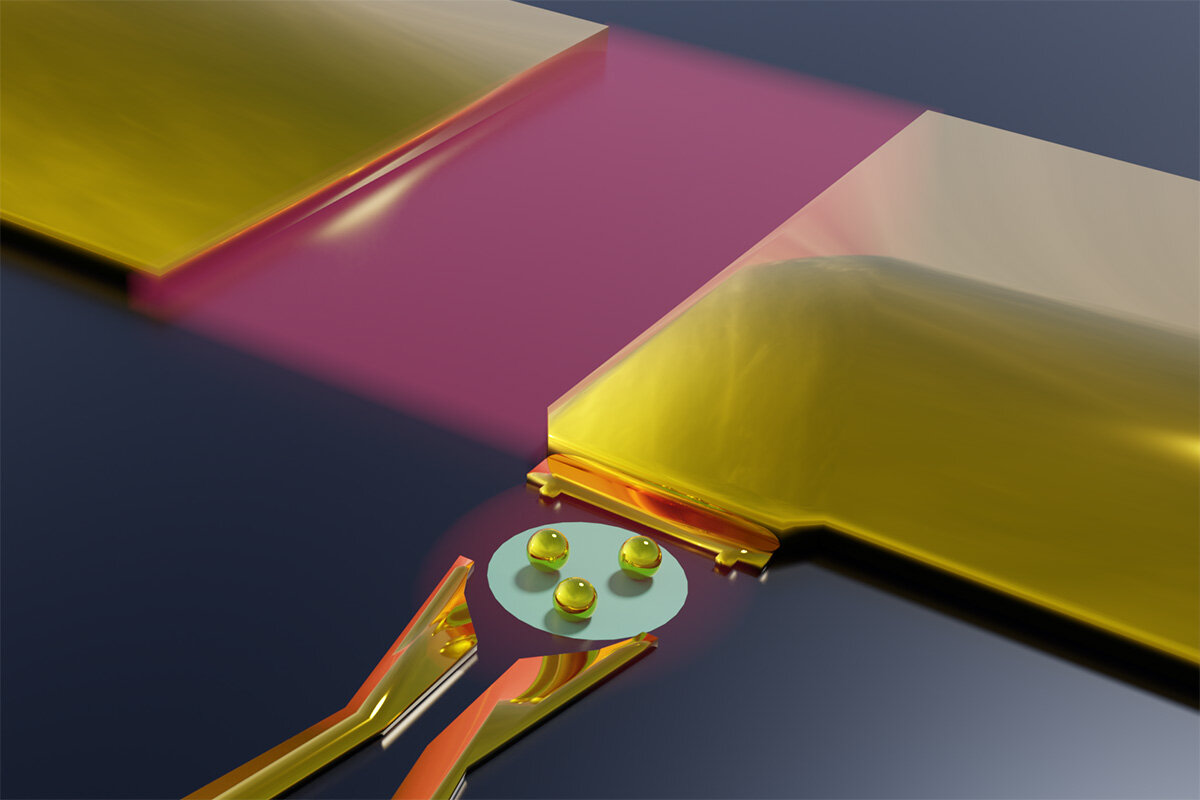
Quantum electronics will substantially differ from conventional electronics. Whereas memory in the latter is stored as binary digits, the former is stored as qubits - which can take many forms, such as entrapped electrons in nanostructures known as quantum dots. However, challenges in transmitting this information to anything further than the adjacent quantum dot have limited qubit design.
Now, in a study recently published in Physical Review Letters, researchers from the Institute of Industrial Science, The University of Tokyo are solving this problem: they developed a new technology for transmitting quantum information over perhaps tens to a hundred micrometers. This advance could improve the functionality of upcoming quantum electronics.
How can researchers transmit quantum information, from one quantum dot to another, on the same quantum computer chip? One way might be to convert electron (matter) information into light (electromagnetic wave) information: by generating light-matter hybrid states. Previous work has been incompatible with the one-electron needs of quantum information processing. Improving on high-speed quantum information transmission in a way that is more flexible in design and is compatible with the semiconductor fabrication tools that are currently available was the goal of the research team's study.
"In our work, we couple a few electrons in the quantum dot to an electrical circuit known as a terahertz split-ring resonator," explains Kazuyuki Kuroyama, lead author of the study. "The design is simple and suitable for large-scale integration."
Previous work has been based on coupling the resonator with an ensemble of thousands to tens of thousands of electrons. In fact, the coupling strength is based on the large size of this ensemble. In contrast, the present system confines only a few electrons, which is suitable for quantum information processing. Nevertheless, both electrons and terahertz electromagnetic waves are confined to an ultra-small area. Therefore, the coupling strength is comparable in strength to that of many-electron systems.
"We're excited because we use structures that are widespread in advanced nanotechnology - and are commonly integrated into semiconductor manufacturing - to help solve a practical quantum information transmission problem," says Kazuhiko Hirakawa, senior author. "We also look forward to applying our findings to understanding the fundamental physics of light-electron coupled states."
This work is an important step forward in solving a previously vexing problem in transmitting quantum information that has limited applications of laboratory findings. In addition, such light-matter interconversion is regarded as one of the essential architectures for large-scale quantum computers based on semiconductor quantum dots. Because the researchers' results are based on materials and procedures that are common in semiconductor manufacturing, practical implementation should be straightforward.
Reference
Coherent Interaction of a Few-Electron Quantum Dot with a Terahertz Optical Resonator
Kazuyuki Kuroyama, Jinkwan Kwoen, Yasuhiko Arakawa, and Kazuhiko Hirakawa
https://journals.aps.org/prl/abstract/10.1103/PhysRevLett.132.066901
Quantinuum reported third quarter 2026 financial results and raised its 2026 revenue outlook after landing its largest cloud agreement. The company also unveiled a roadmap for its Nexus developer platform.
IonQ reported record third quarter revenue of $173.8 million, up 336 percent year over year, and raised full year 2026 guidance to $505 to $515 million on 110 percent quantum computing growth. Backlog more than doubled to $1.2 billion, with demand led by Superion 256 system deployments, including NVIDIA's first on-premise quantum computer. The company also advanced to Stage C of DARPA's Quantum Benchmarking Initiative and acquired Elisity to extend quantum security.
IonQ announced a partnership with QuantumCT, Connecticut's statewide quantum initiative, which will purchase access to IonQ's trapped-ion quantum computers for state organizations. The contract includes more than 150 hours of cloud runtime.
This week in nanotech
$10.2M raised
1 funding round · 13 deals tracked
New products
 Nion-compatible In Situ STEM Holders for Electrical BiasingHummingbird Scientific Featured
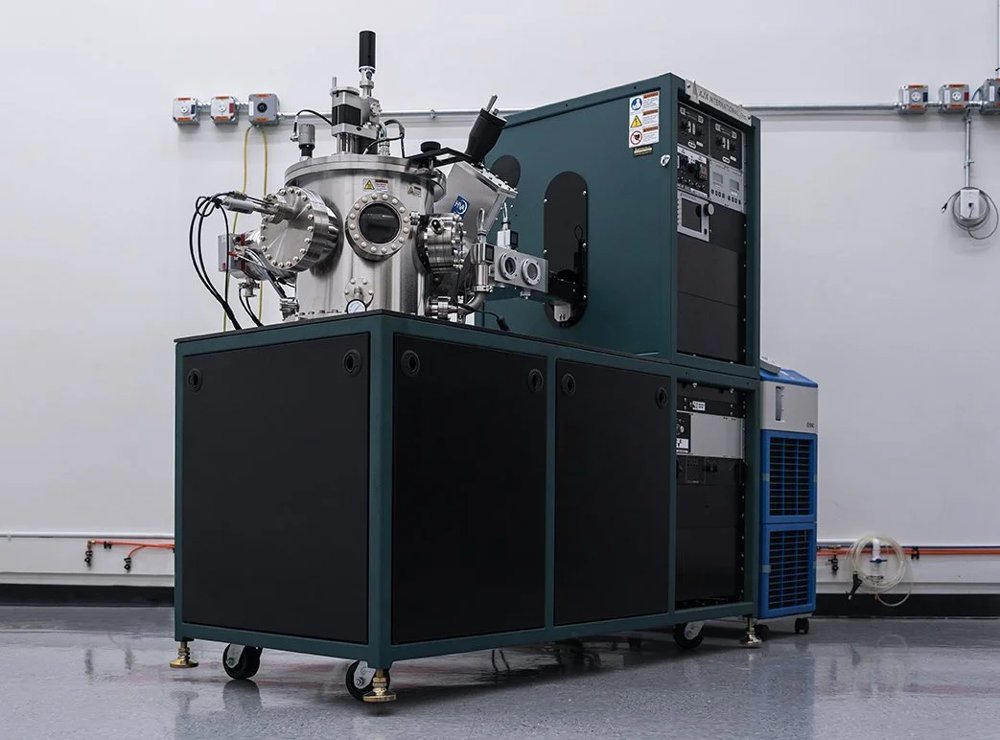 Orion Sputtering Deposition SystemsAJA International Featured
 Talphene™ Graphene AdditivesTalga Group
Market insights
Last 30 days: Quantum Technologies was the busiest vertical: 52 of 174 events (30%).
Money raised per month
Behind the deal
Who led Sandia National Laboratories’s $3.4M Grant?
See the investors with Insights Pro →