City College of New York (CCNY)

In two breakthroughs in the realm of photonics, City College of New York graduate researchers are reporting the successful demonstration of an LED (light-emitting diode) based on half-light half-matter quasiparticles in atomically thin materials. This is also the first successful test of an electrically driven light emitter using atomically thin semiconductors embedded in a light trapping structure (optical cavity).
The research is led by graduate physics student Jie Gu and post-doctoral fellow Biswanath Chakraborty, in collaboration with another graduate student, Mandeep Khatoniyar.
According to Vinod Menon, chair of physics in City College's Division of Science and the research team's mentor, their double feat, reported in the journal "Nature Nanotechnology," marks an important milestone in the field of 2D materials and, more broadly, LEDs.
While such LEDs have been realized in other materials at low temperatures, this device operates at room temperature and is fabricated using the now well known "scotch tape" based technique.
"The fact that this device is fabricated using stacks of atomically thin materials and operates at room temperature makes it an important first step towards a technologically relevant device demonstration," noted Menon, adding: "One potential application of such hybrid LEDs is the speed of operation - which can translate to using them for LED based communication systems including LiFi."
LiFi is a wireless optical networking technology that uses LEDs for data transmission. Benefits of LiFi include higher speeds than Wi-Fi.
The device was fabricated at the CCNY-based CUNY Advanced Science Research Center's nanofabrication facility and tested in Menon's lab. In follow- up research, the CCNY team is attempting to realize quantum emitters (single photon emitters) using similar architecture.
A room-temperature polariton light-emitting diode based on monolayer WS2
Jie Gu, Biswanath Chakraborty, Mandeep Khatoniar & Vinod M. Menon
Nature Nanotechnology (2019)
DOI: 10.1038/s41565-019-0543-6
Contact information:
Vinod Menon
Chair of physics in City College's Division of Science
vmenon@ccny.cuny.edu
Phone: 212-650-7443
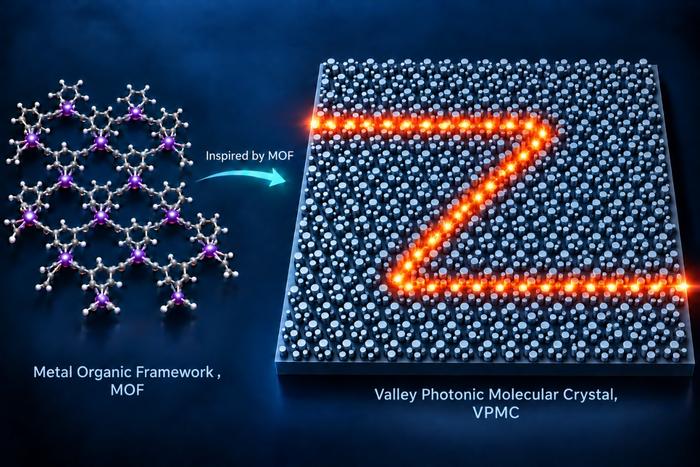
Inspired by Metal-Organic Framework based topological insulators, researchers at Tsinghua University proposed valley photonic molecular crystal (VPMC) and investigated the impact of molecular rotation on the valley-topological properties of VPMC. Credit: Tsinghua University/Xue Feng A research team led by Yidong Huang at Tsinghua University, including Xue Feng and Yongzhuo Li, has developed valley photonic molecular crystals (VPMCs) on a silicon platform. Combining theoretical modeling,...
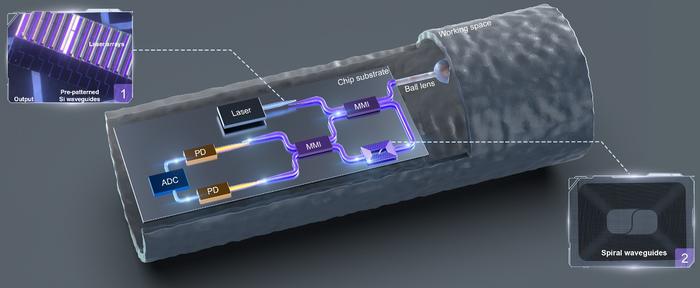
The system integrates a III-V semiconductor light source, SiN-based interferometers, Si-Ge photodetectors (PDs), and an integrated ball-lens microprobe, thereby combining the distinct advantages of multiple photonic integration platforms. The insets illustrate complementary technologies that can be incorporated to realize a miniaturized, fully integrated OCT system. Abbreviations: ADC, analog-to-digital converter. Inset 1: Foundry-scalable embedded III-V lasers on silicon-on-insulator (SOI)...

From left to right: Three photons with different quantum states enter an interferometer with three beam splitters. At each beam splitter, they can take different paths at the same time in superposition. The researchers then measured how often the three photons ended up together at the same output. Counterintuitively, it is possible to make the photons more similar to each other and at the same make them less likely to “bunch” together. AI-generated illustration, by Leonardo Novo. We usually...