Japan Advanced Institute of Science and Technology (JAIST)
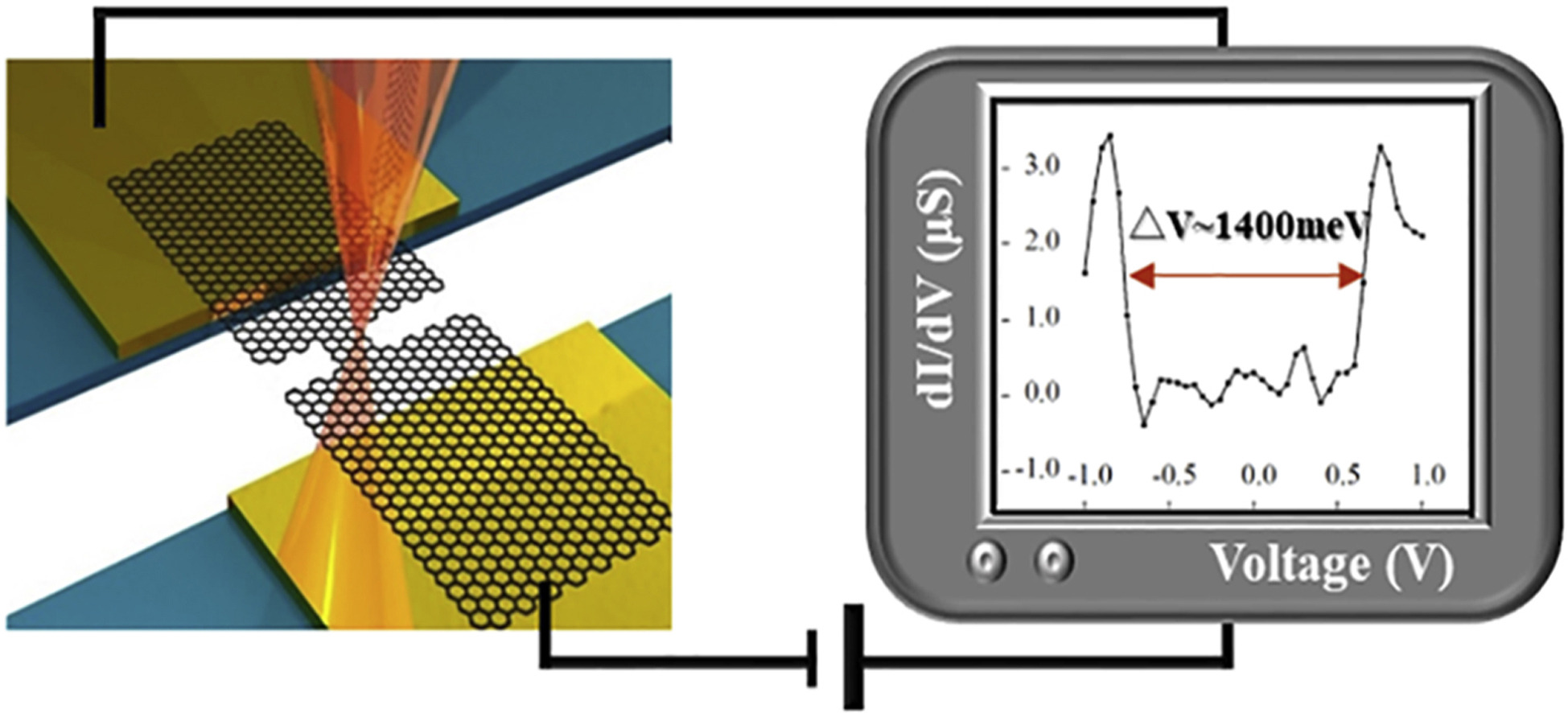
Researchers at Japan Advanced Institute of Science and Technology (JAIST) have successfully measured the current-voltage curve of graphene nanoribbons (GNRs) that were suspended between two electrodes. Measurements were performed using transmission electron microscopy (TEM) observation. Results revealed that, in contrast to the findings of previous reports, the electrical conductance of GNRs with a zigzag edge structure (zigzag GNRs) abruptly increased above the critical bias voltage. This finding is worth noting because the abrupt change in these GNRs can be applied to switching devices, which are the smallest devices in the world.
The electrical structure of GNRs have been systematically investigated through theoretical calculations. Studies have reported that both zigzag and armchair GNRs exhibit semiconducting behavior below several nm in width, although the origin of the energy gap is different. On the other hand, the electrical transport properties have rarely been calculated owing to the non-equiribrium calculations required. In 2009, Nikolic et al. predicted that sharp increments in electrical conductance would occur for extremely thin and short zigzag GNRs as the magnetic-insulator-nonmagnetic-metal phase transition occurs above a certain bias voltage [Phys. Rev.B 79, 205430 (2009)]. The obtained experimental results correspond closely to the results of this non-equilibrium calculation.
A research team led by Ms. Chumeng LIU, Professor Yoshifumi OSHIMA and Associate Professor Xiaobin ZHANG (now of Shibaura Institute of Technology) has developed a special in situ TEM holder and a GNR device for TEM observation. This combination is aimed at clarifying the relationship between the edge structure of GNRs and electrical transport properties. Ms. Liu, the doctoral student of JAIST, said, "The fabrication process of our GNR device is much more difficult than the conventional one because we need to make very narrow GNR which should be stably suspended between both electrodes." She reviewed the literature focused on the fabrication process of GNR devices and verified their process en route to establishing her original fabrication method. Assoc. Prof. ZHANG said, "We were really happy to see that the I-V curve obviously changed when changing the edge structure to zigzag. I suppose we have encountered new possibilities for graphene nanoribbons." The team has successfully performed the in situ TEM observation of extremely narrow GNRs, and they plan to continue identifying electrical transport properties that are sensitive to the edge structure of these GNRs.
Origin of nonlinear current-voltage curves for suspended zigzag edge graphene nanoribbon
Carbon Volume 165, Pages 476-483 (2020)
Chunmeng Liu, Jiaqi Zhang, Manoharan Muruganathan, Hiroshi Mizuta, Yoshifumi Oshima, Xiaobin Zhang
DOI: 10.1016/j.carbon.2020.05.010
Contact information:
Prof. Oshima Yoshifumi
oshima@jaist.ac.jp
Phone: (0761) 51 1500
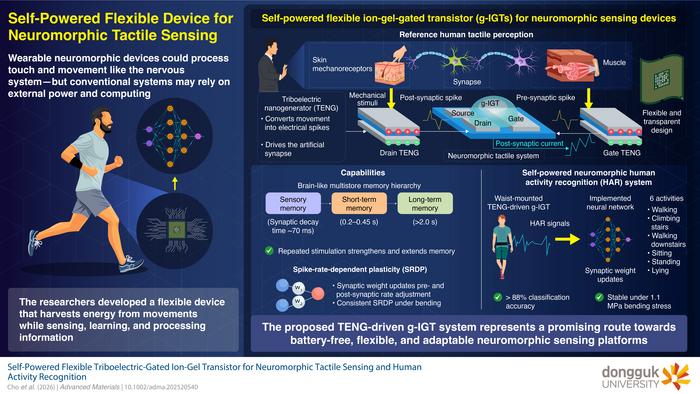
The proposed TENG-driven g-IGT is a flexible, self-powered neuromorphic device capable of reproducing multiple memory states and spike-rate-dependent learning Neuromorphic devices, which are designed to emulate aspects of biological neural networks, are promising candidates for developing low-power and intelligent sensing technologies, including wearable applications. Among the device architectures explored for neuromorphic computing, graphene-channel ion-gel-gated transistors (g-IGTs) are...

Rice University researchers have shown that sub-nanometer wrinkles in graphene generate flexoelectric charge separation, reshaping local electrical behavior through curvature alone. Extreme bending produces polarization far stronger than in larger systems and may enable geometry-controlled electronics without chemical doping. Published in Advanced Materials.
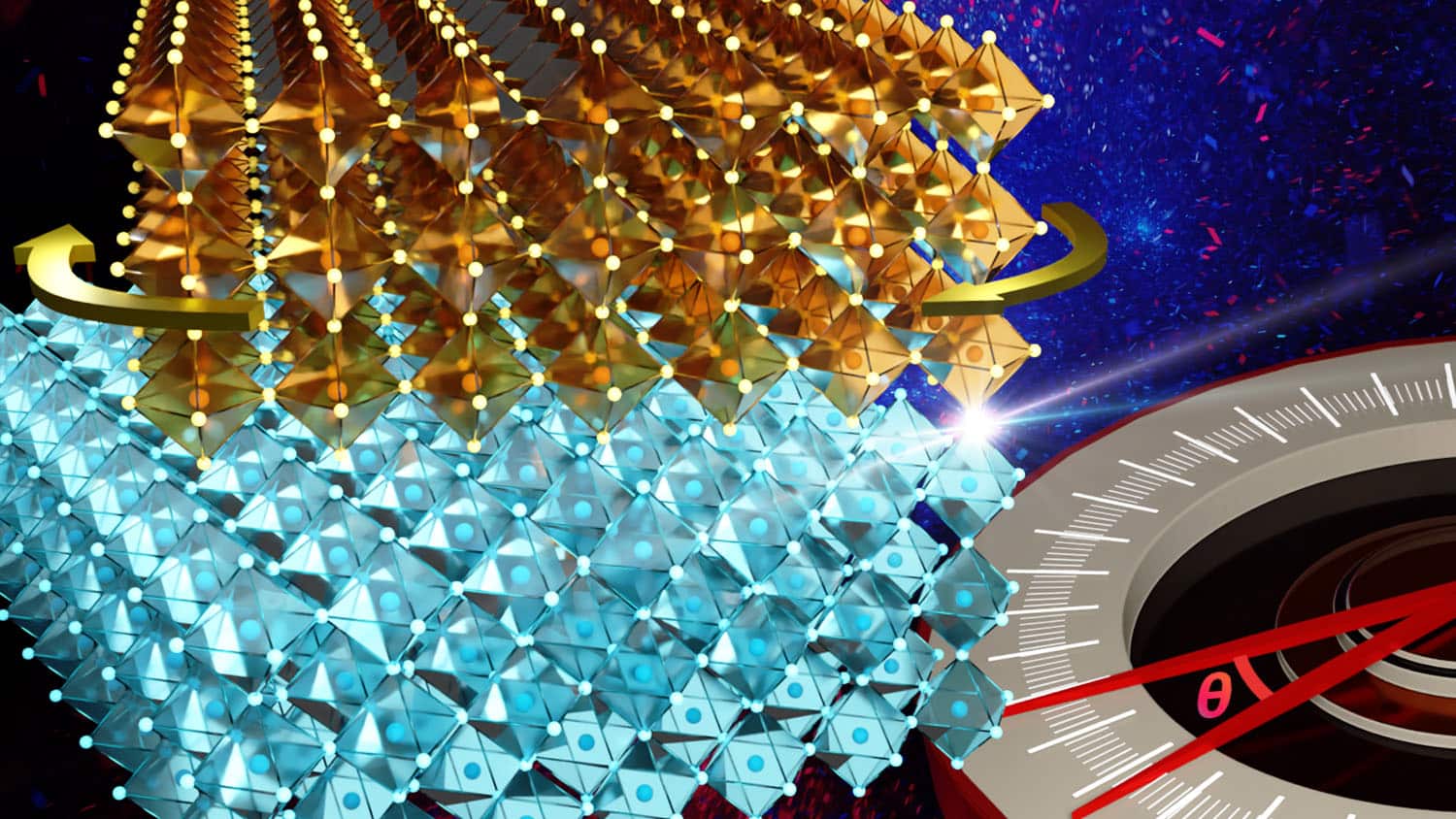
Researchers at NC State have extended twistronics beyond van der Waals materials into strongly bonded crystalline oxides. By stacking sodium niobate membranes with twist angles controlled down to 0.1 degrees, and confirming results via synchrotron X-ray diffraction, the team found interlayer bonds distort the atomic lattice, shifting phase structure and domain configuration. The technique works at near-millimeter scale, far larger than typical twistronic devices, marking a real step toward pract
