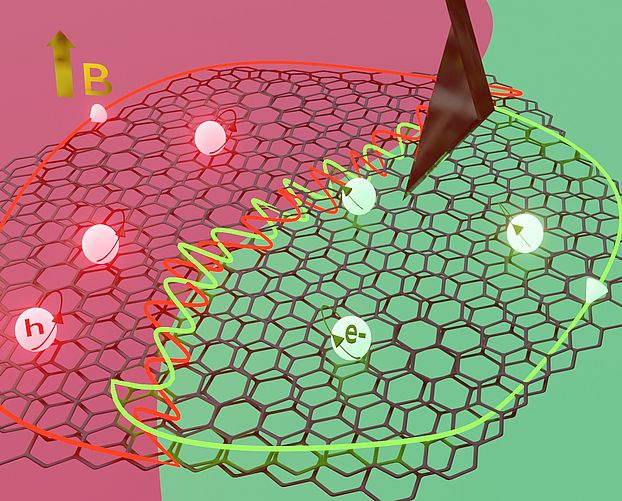
Researchers from the SNI network have used an atomic force microscope in pendulum mode to study a two-layer graphene device. In this bilayer graphene, the two layers of pure carbon were rotated by the “magic angle” of approximately 1.1° relative to one another. The results provide empirical proof that the method can be used to fine-tune not only current flow but also magnetization in the device. The results formed part of a doctoral thesis funded by the SNI and were recently published in the journal Communications Physics.
Recent advances in the development of devices made of 2D materials are paving the way for new technological capabilities, especially in the field of quantum technology. So far, however, little research has been carried out into energy losses in strongly interacting systems.
With this in mind, the team led by Professor Ernst Meyer from the Department of Physics at the University of Basel used an atomic force microscope in pendulum mode to investigate a graphene device in greater detail. For this, the researchers utilized a two-layer graphene, fabricated by colleagues at LMU Munich, in which the two layers were twisted by 1.08° .
When stacked and twisted relative to one another, the two layers of graphene produce “moiré” superstructures, and the material acquires new properties. For example, when the two layers are twisted by the so-called magic angle of 1.08°, graphene becomes a superconductor at very low temperatures, conducting electricity with almost no energy dissipation.
Fine-tuning the properties
Using atomic force microscopy (AFM) measurements, Dr. Alexina Ollier has now been able to prove that the twist angle of the atomic graphene layers was uniform across the entire layer, at about 1.06°. She was also able to measure how the current-conducting properties of the graphene layer can be changed and adjusted as a function of the charge applied to the device.
Depending on the “charging” of the individual graphene cells with electrons, the material behaved as an insulator or a semiconductor. The relatively high temperature of 5 kelvins (-268.15°C) during the measurements meant that the researchers did not achieve superconductivity in the graphene, as this phenomenon — current conduction with no energy dissipation — only occurs at a much lower temperature of 1.7 kelvins.
“We were able, however, not only to modify and measure the current-conducting properties of the device,” explains Ollier, first author of the study, “but also to impart magnetic properties to the graphene — which, of course, consists of nothing but carbon atoms.”
“It is an achievement that we’re able to image tiny graphene flakes in electrical components, change their electrical and magnetic properties, and measure them precisely,” says Meyer regarding the work, which formed part of a doctoral thesis at the SNI PhD School. “In the future, this method will also help us to determine the energy loss of various two-dimensional components in the event of strong interactions.”
Reference
Energy dissipation on magic angle twisted bilayer graphene
Alexina Ollier, Marcin Kisiel, Xiaobo Lu, Urs Gysin, Martino Poggio, Dmitri K. Efetov & Ernst Meyer
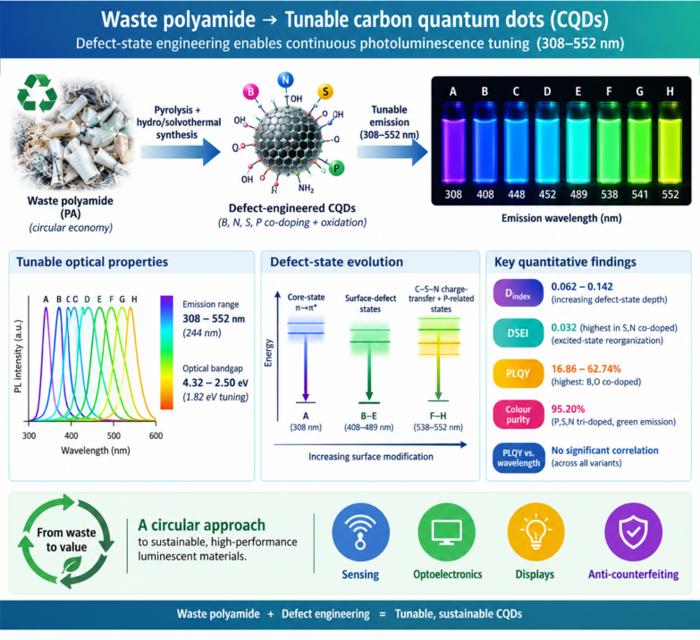
Waste polyamide-derived CQDs show continuous photoluminescence tuning from 308 to 552 nm through sequential defect-state engineering, with optical transition energies decreasing from 4.32 to 2.50 eV. @Christian Ebere Enyoh from Saitama University Carbon quantum dots (CQDs) are fluorescent carbon nanomaterials with potential applications in sensing, optoelectronics, displays, anti-counterfeiting, and environmental technologies. Their optical properties can be adjusted by modifying the carbon...
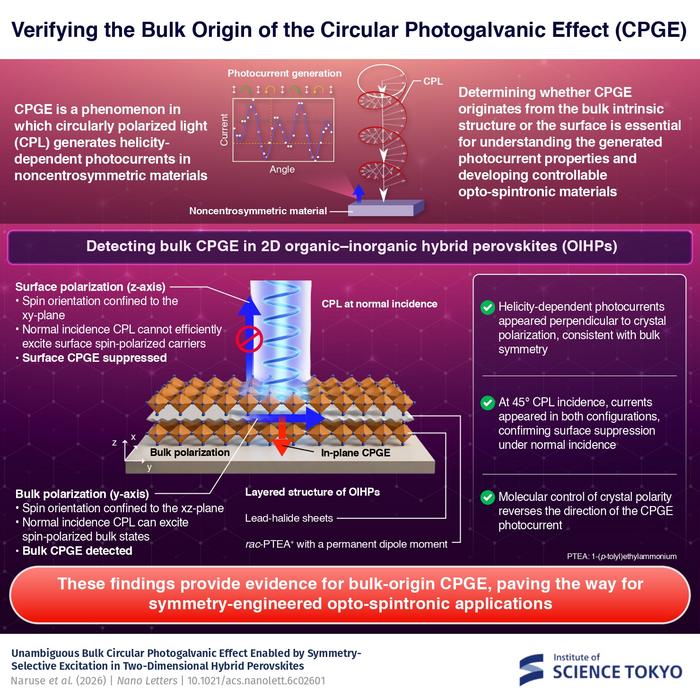
The researchers used circularly polarized light at normal incidence and found that helicity-dependent photocurrents appeared perpendicular to the crystal’s polarization but vanished when measured parallel to it, supporting a bulk origin of CPGE. @Institute of Science Tokyo The circular photogalvanic effect (CPGE), a phenomenon that generates helicity-dependent photocurrents in noncentrosymmetric materials, can originate purely from a crystal's internal structure without contribution from the...
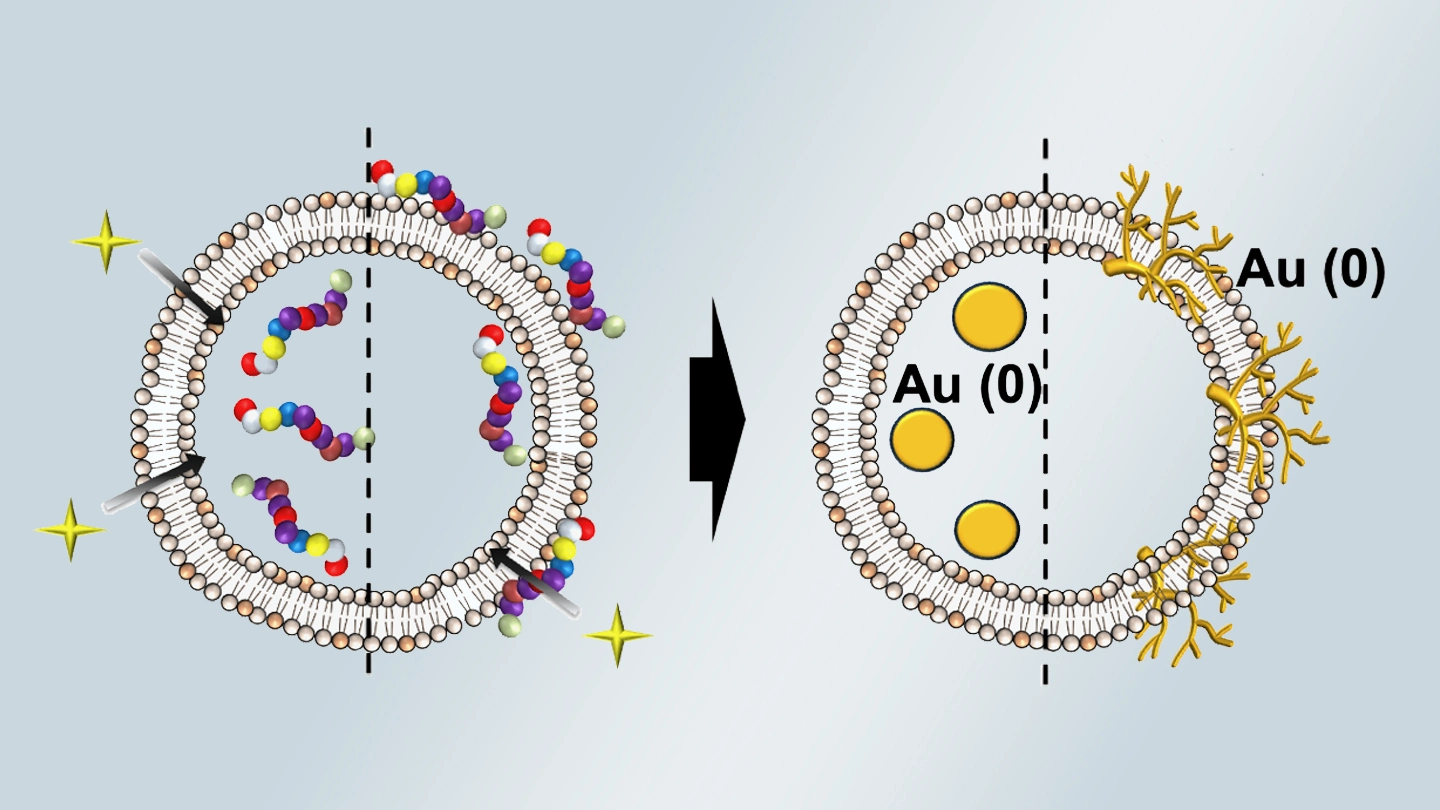
Summary of gold nanoparticle growth programming in liposome based on localization of biomineralization peptide The position of biomineralization peptides within liposomes can influence how gold nanoparticles grow, reports a research team from Institute of Science Tokyo. Peptides localized at the membrane interface promote branched structures, while those confined to the liposome interior favor spherical nanoparticles. The findings offer a new strategy for controlling nanoscale reaction...
