University of Houston (UH)

Researchers have reported a new material, pliable enough to be woven into fabric but imbued with sensing capabilities that can serve as an early warning system for injury or illness.
The material, described in a paper published by ACS Applied Nano Materials, involves the use of carbon nanotubes and is capable of sensing slight changes in body temperature while maintaining a pliable disordered structure - as opposed to a rigid crystalline structure - making it a good candidate for reusable or disposable wearable human body temperature sensors. Changes in body heat change the electrical resistance, alerting someone monitoring that change to the potential need for intervention.
"Your body can tell you something is wrong before it becomes obvious," said Seamus Curran, a physics professor at the University of Houston and co-author on the paper. Possible applications range from detecting dehydration in an ultra-marathoner to the beginnings of a pressure sore in a nursing home patient.
The researchers said it is also cost-effective because the raw materials required are used in relatively low concentrations.
The discovery builds on work Curran and fellow researchers Kang-Shyang Liao and Alexander J. Wang began nearly a decade ago, when they developed a hydrophobic nanocoating for cloth, which they envisioned as a protective coating for clothing, carpeting and other fiber-based materials.
Wang is now a Ph.D. student at Technological University Dublin, currently working with Curran at UH, and is corresponding author for the paper. In addition to Curran and Liao, other researchers involved include Surendra Maharjan, Brian P. McElhenny, Ram Neupane, Zhuan Zhu, Shuo Chen, Oomman K. Varghese and Jiming Bao, all of UH; Kourtney D. Wright and Andrew R. Barron of Rice University, and Eoghan P. Dillon of Analysis Instruments in Santa Barbara.
The material, created using poly(octadecyl acrylate)-grafted multiwalled carbon nanotubes, is technically known as a nanocarbon-based disordered, conductive, polymeric nanocomposite, or DCPN, a class of materials increasingly used in materials science. But most DCPN materials are poor electroconductors, making them unsuitable for use in wearable technologies that require the material to detect slight changes in temperature.
The new material was produced using a technique called RAFT-polymerization, Wang said, a critical step that allows the attached polymer to be electronically and phononically coupled with the multiwalled carbon nanotube through covalent bonding.
As such, subtle structural arrangements associated with the glass transition temperature of the system are electronically amplified to produce the exceptionally large electronic responses reported in the paper, without the negatives associated with solid-liquid phase transitions. The subtle structural changes associated with glass transition processes are ordinarily too small to produce large enough electronic responses.
Poly(octadecyl acrylate)-Grafted Multiwalled Carbon Nanotube Composites for Wearable Temperature Sensors
Alexander J. Wang, Surendra Maharjan, Kang-Shyang Liao, Brian P. McElhenny, Kourtney D. Wright, Eoghan P. Dillon, Ram Neupane, Zhuan Zhu, Shuo Chen, Andrew R. Barron, Oomman K. Varghese, Jiming Bao, Seamus A. Curran
ACS Applied Nano Materials (2020)
Contact information:
UH physics professor
sacurran@uh.edu
Phone: (832) 671-6647
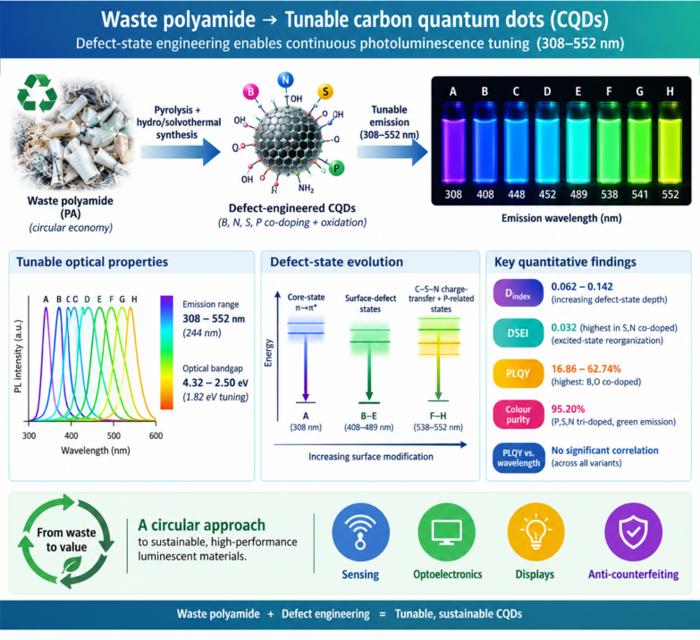
Waste polyamide-derived CQDs show continuous photoluminescence tuning from 308 to 552 nm through sequential defect-state engineering, with optical transition energies decreasing from 4.32 to 2.50 eV. @Christian Ebere Enyoh from Saitama University Carbon quantum dots (CQDs) are fluorescent carbon nanomaterials with potential applications in sensing, optoelectronics, displays, anti-counterfeiting, and environmental technologies. Their optical properties can be adjusted by modifying the carbon...

The researchers used circularly polarized light at normal incidence and found that helicity-dependent photocurrents appeared perpendicular to the crystal’s polarization but vanished when measured parallel to it, supporting a bulk origin of CPGE. @Institute of Science Tokyo The circular photogalvanic effect (CPGE), a phenomenon that generates helicity-dependent photocurrents in noncentrosymmetric materials, can originate purely from a crystal's internal structure without contribution from the...
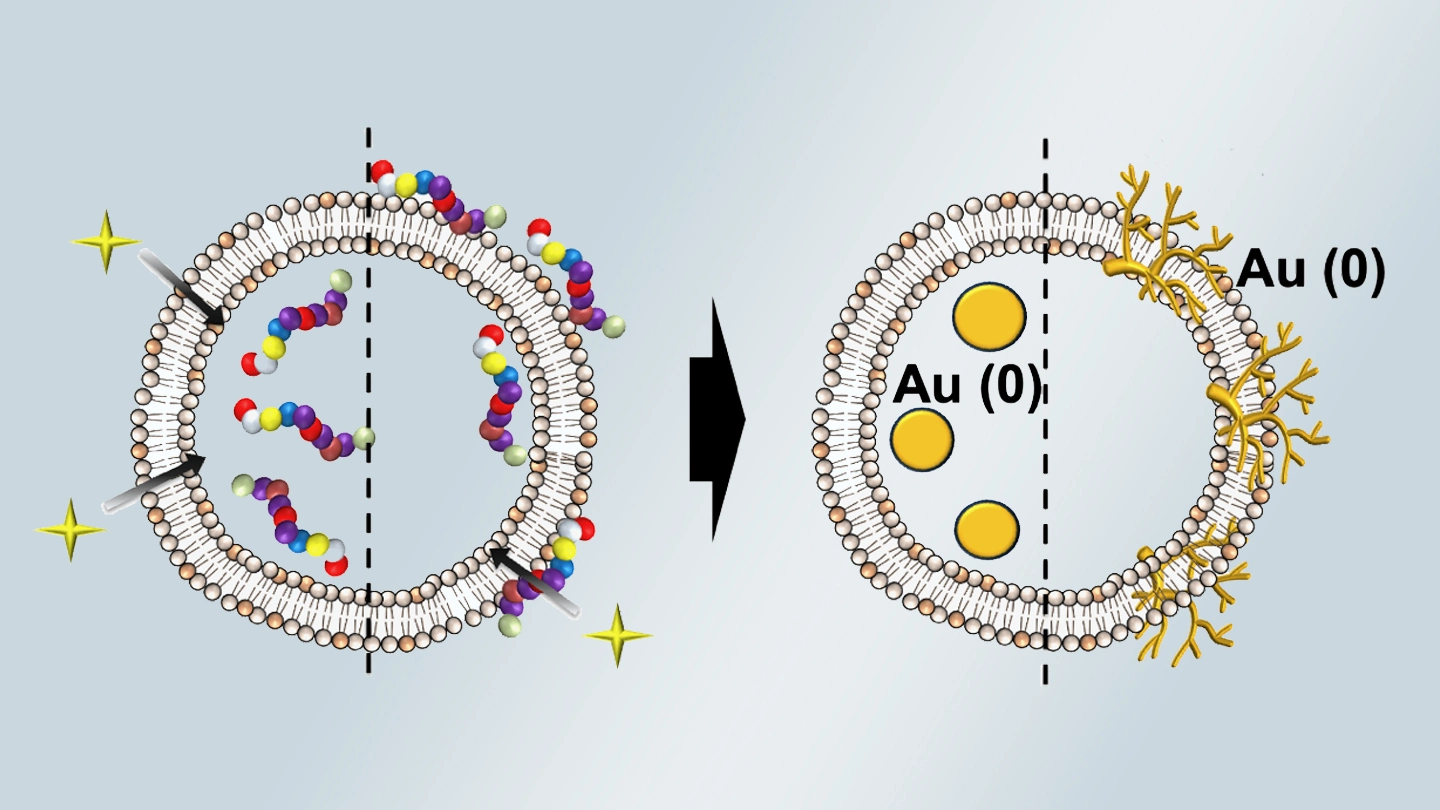
Summary of gold nanoparticle growth programming in liposome based on localization of biomineralization peptide The position of biomineralization peptides within liposomes can influence how gold nanoparticles grow, reports a research team from Institute of Science Tokyo. Peptides localized at the membrane interface promote branched structures, while those confined to the liposome interior favor spherical nanoparticles. The findings offer a new strategy for controlling nanoscale reaction...
