Researchers at The University of Manchester may have cleared a significant hurdle on the path to quantum computing, demonstrating step-change improvements in the spin transport characteristics of nanoscale graphene-based electronic devices.
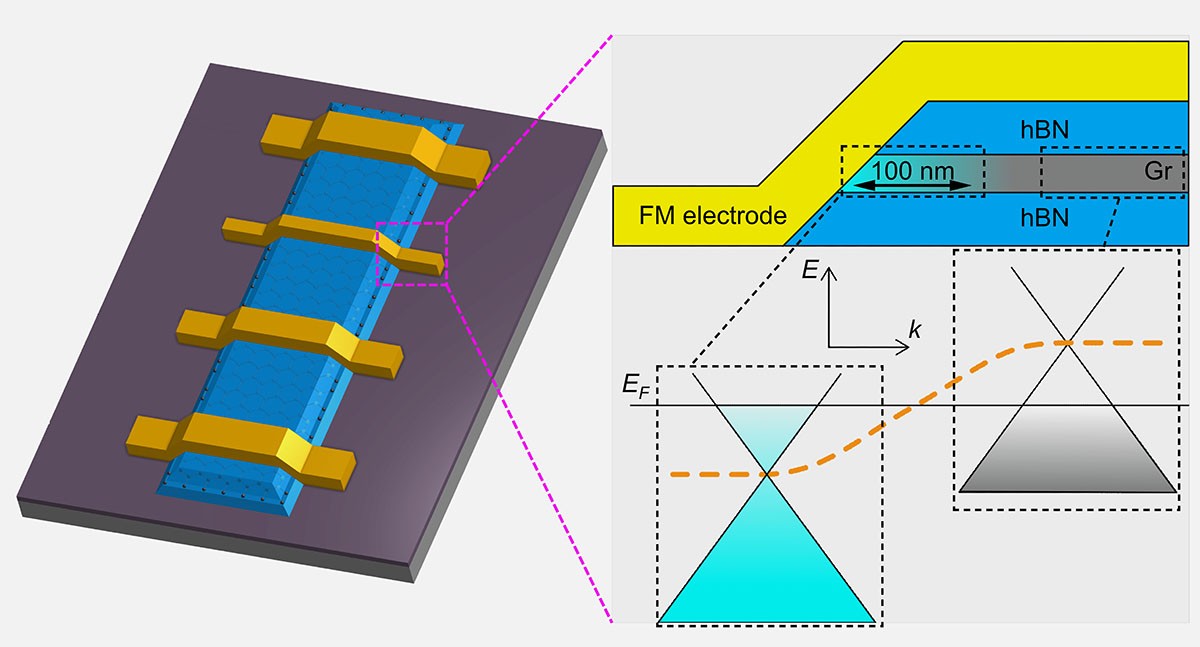
The team - comprising researchers from the National Graphene Institute (NGI) led by Dr Ivan Vera Marun, alongside collaborators from Japan and including students internationally funded by Ecuador and Mexico - used monolayer graphene encapsulated by another 2D material (hexagonal boron nitride) in a so-called van der Waals heterostructure with one-dimensional contacts (main picture, above). This architecture was observed to deliver an extremely high-quality graphene channel, reducing the interference or electronic ‘doping’ by traditional 2D tunnel contacts.
‘Spintronic’ devices, as they are known, may offer higher energy efficiency and lower dissipation compared to conventional electronics, which rely on charge currents. In principle, phones and tablets operating with spin-based transistors and memories could be greatly improved in speed and storage capacity, exceeding Moore’s Law.
As published in Nano Letters, the Manchester team measured electron mobility up to 130,000cm2/Vs at low temperatures (20K or -253oC). For purposes of comparison, the only previously published efforts to fabricate a device with 1D contacts achieved mobility below 30,000cm2/Vs, and the 130k figure measured at the NGI is higher than recorded for any other previous graphene channel where spin transport was demonstrated.
The researchers also recorded spin diffusion lengths approaching 20μm. Where longer is better, most typical conducting materials (metals and semiconductors) have spin diffusion lengths <1μm. The value of spin diffusion length observed here is comparable to the best graphene spintronic devices demonstrated to date.
Lead author of the study Victor Guarochico said: “Our work is a contribution to the field of graphene spintronics. We have achieved the largest carrier mobility yet regarding spintronic devices based on graphene. Moreover, the spin information is conserved over distances comparable with the best reported in the literature. These aspects open up the possibility to explore logic architectures using lateral spintronic elements where long-distance spin transport is needed.”
Co-author Chris Anderson added: “This research work has provided exciting evidence for a significant and novel approach to controlling spin transport in graphene channels, thereby paving the way towards devices possessing comparable features to advanced contemporary charge-based devices. Building on this work, bilayer graphene devices boasting 1D contacts are now being characterised, where the presence of an electrostatically tuneable bandgap enables an additional dimension to spin transport control.”
Reference
Tunable Spin Injection in High-Quality Graphene with One-Dimensional Contacts
Victor H. Guarochico-Moreira, Jose L. Sambricio, Khalid Omari, Christopher R. Anderson, Denis A. Bandurin, Jesus C. Toscano-Figueroa, Noel Natera-Cordero, Kenji Watanabe, Takashi Taniguchi, Irina V. Grigorieva, and Ivan J. Vera-Marun
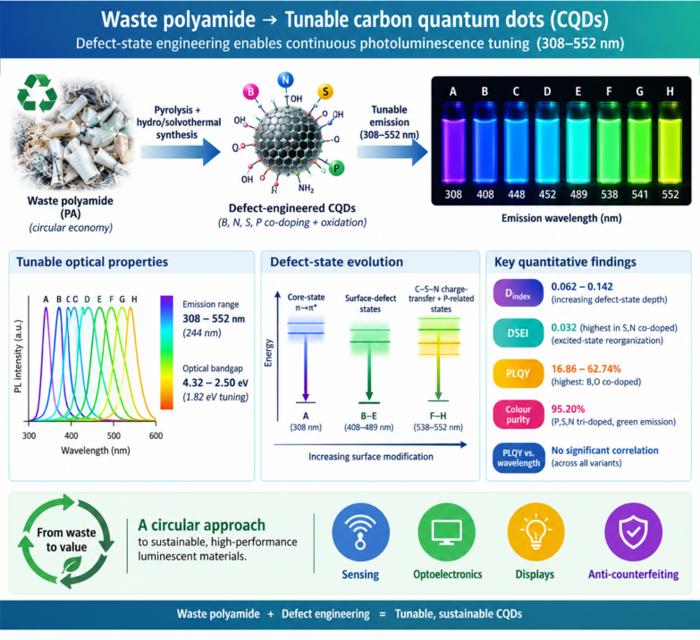
Waste polyamide-derived CQDs show continuous photoluminescence tuning from 308 to 552 nm through sequential defect-state engineering, with optical transition energies decreasing from 4.32 to 2.50 eV. @Christian Ebere Enyoh from Saitama University Carbon quantum dots (CQDs) are fluorescent carbon nanomaterials with potential applications in sensing, optoelectronics, displays, anti-counterfeiting, and environmental technologies. Their optical properties can be adjusted by modifying the carbon...
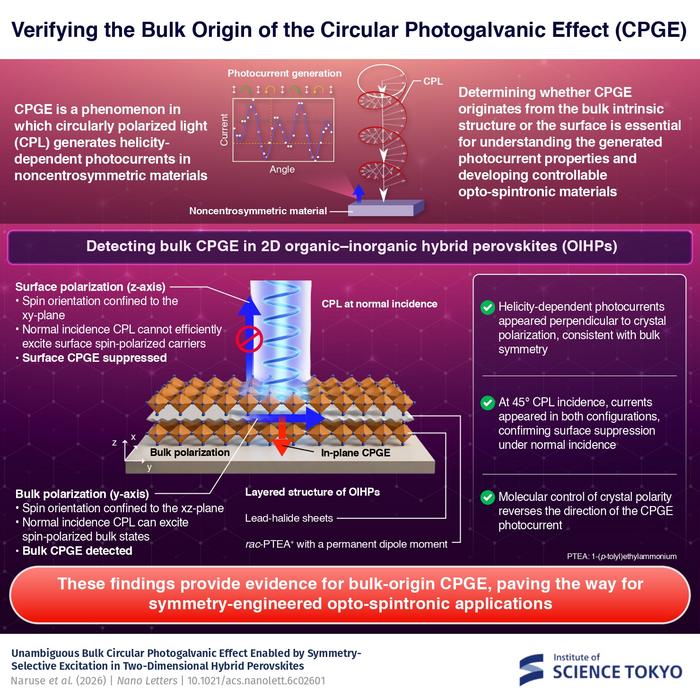
The researchers used circularly polarized light at normal incidence and found that helicity-dependent photocurrents appeared perpendicular to the crystal’s polarization but vanished when measured parallel to it, supporting a bulk origin of CPGE. @Institute of Science Tokyo The circular photogalvanic effect (CPGE), a phenomenon that generates helicity-dependent photocurrents in noncentrosymmetric materials, can originate purely from a crystal's internal structure without contribution from the...
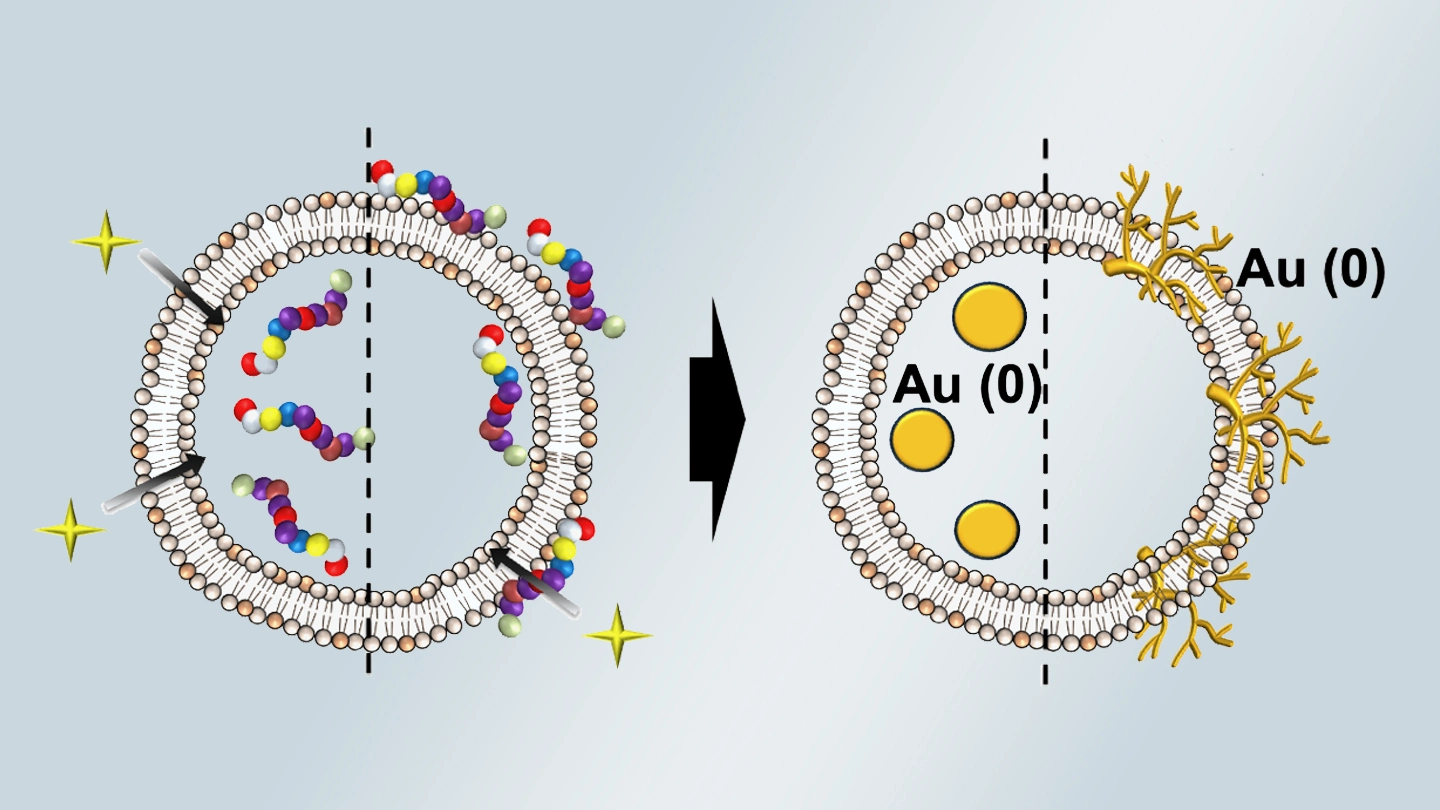
Summary of gold nanoparticle growth programming in liposome based on localization of biomineralization peptide The position of biomineralization peptides within liposomes can influence how gold nanoparticles grow, reports a research team from Institute of Science Tokyo. Peptides localized at the membrane interface promote branched structures, while those confined to the liposome interior favor spherical nanoparticles. The findings offer a new strategy for controlling nanoscale reaction...
