
Researchers at the Institute of Industrial Science, part of The University of Tokyo, and Yokohama City University have introduced novel color-changing organic crystals that spontaneously return to their original shape and hue after being stressed, a property they call superelastochromism. These materials can be used to make sensors for shear forces to monitor locations susceptible to damage.
The ability to visualize forces can be very useful in many industries, particularly heavy manufacturing and shipping. For example, a color-changing material that shows where beams are being stressed would be great for construction companies. However, such devices often work once and have to be replaced after being stretched. Materials that bounce back after being stretched or squeezed, like a rubber ball, are called elastic. But even these objects can suffer a permanent change of shape when stressed too much, in a process called plastic deformation.
Now, a team has introduced a new organic material that changes the color of its emitted fluorescence from green to red under mechanical stress, and bounces right back to its original configuration when this stress is removed.
"We called this property 'superelastochromism' because the color changes are due to completely reversible--that is, elastic--changes to the arrangements of molecules in the material," says first author Toshiki Mutai.
Based on 7-chloro-2-(2?-hydroxyphenyl)imidazo[1,2-a]pyridine (7Cl), the crystals consist of molecules that can exist in two distinct configurations. In both states, a hydrogen atom is covalently bonded to an oxygen atom, and only weakly attracted to a nearby nitrogen atom.
When the material is squeezed or bent, the molecular arrangement switches to the other configuration. This mechanically controlled phase transition alters the wavelengths of light the molecule will emit as fluorescence when excited by an external UV light source. The change is clearly apparent to the unaided eye as a shift in color from neon green to reddish orange.
"Chromatic changes in sensors are highly desirable, because they are easily seen and interpreted by people," says senior author Satoshi Takamizawa. "If more precise measurements are needed, spectroscopy can be used to quantify the amount of stress."
This work can help led to a wide range of "smart" material sensors. For example, one could be used to determine the time when mechanical stress is applied or removed.
A superelastochromic crystal
Toshiki Mutai, Toshiyuki Sasaki, Shunichi Sakamoto, Isao Yoshikawa, Hirohiko Houjou & Satoshi Takamizawa
Nature Communications volume 11, Article number: 1824 (2020)
DOI: 10.1038/s41467-020-15663-5
Contact information:
Toshiki Mutai
Research Associate at Institute of Industrial Science, the University of Tokyo
mutai@iis.u-tokyo.ac.jp
Phone: +81-80-4475-2458
Satoshi Takamizawa
Professor at Yokohama City University
stak@yokohama-cu.ac.jp
Phone: +81-45-787-2187
Takamizawa Lab
Institute of Industrial Science (IIS), the University of Tokyo
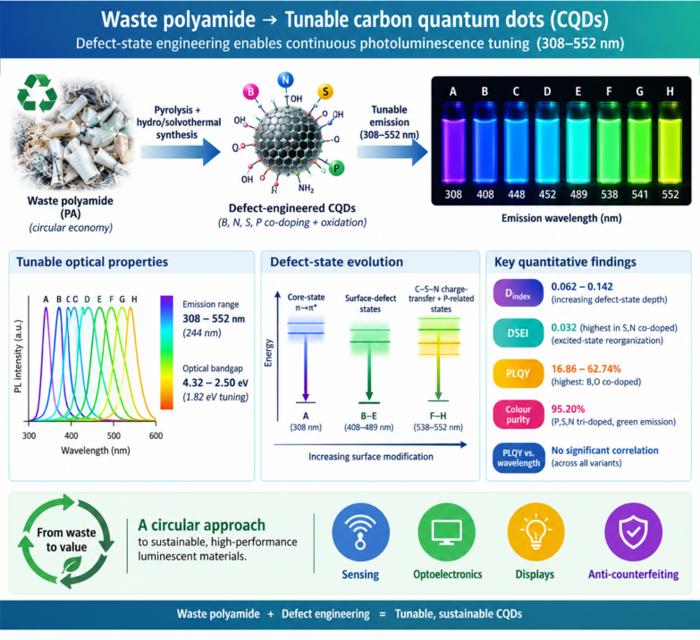
Waste polyamide-derived CQDs show continuous photoluminescence tuning from 308 to 552 nm through sequential defect-state engineering, with optical transition energies decreasing from 4.32 to 2.50 eV. @Christian Ebere Enyoh from Saitama University Carbon quantum dots (CQDs) are fluorescent carbon nanomaterials with potential applications in sensing, optoelectronics, displays, anti-counterfeiting, and environmental technologies. Their optical properties can be adjusted by modifying the carbon...

The researchers used circularly polarized light at normal incidence and found that helicity-dependent photocurrents appeared perpendicular to the crystal’s polarization but vanished when measured parallel to it, supporting a bulk origin of CPGE. @Institute of Science Tokyo The circular photogalvanic effect (CPGE), a phenomenon that generates helicity-dependent photocurrents in noncentrosymmetric materials, can originate purely from a crystal's internal structure without contribution from the...
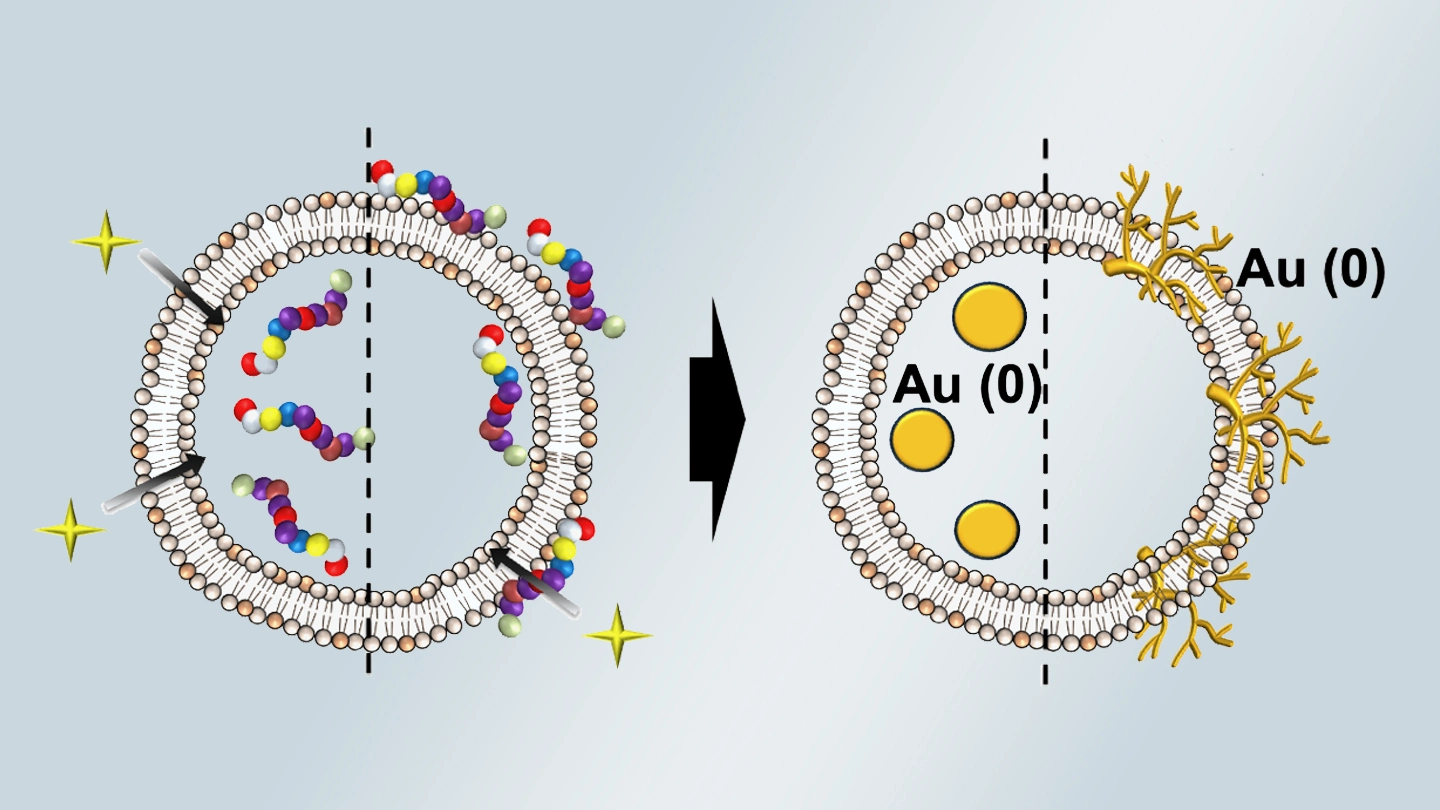
Summary of gold nanoparticle growth programming in liposome based on localization of biomineralization peptide The position of biomineralization peptides within liposomes can influence how gold nanoparticles grow, reports a research team from Institute of Science Tokyo. Peptides localized at the membrane interface promote branched structures, while those confined to the liposome interior favor spherical nanoparticles. The findings offer a new strategy for controlling nanoscale reaction...






