Chinese Academy of Sciences
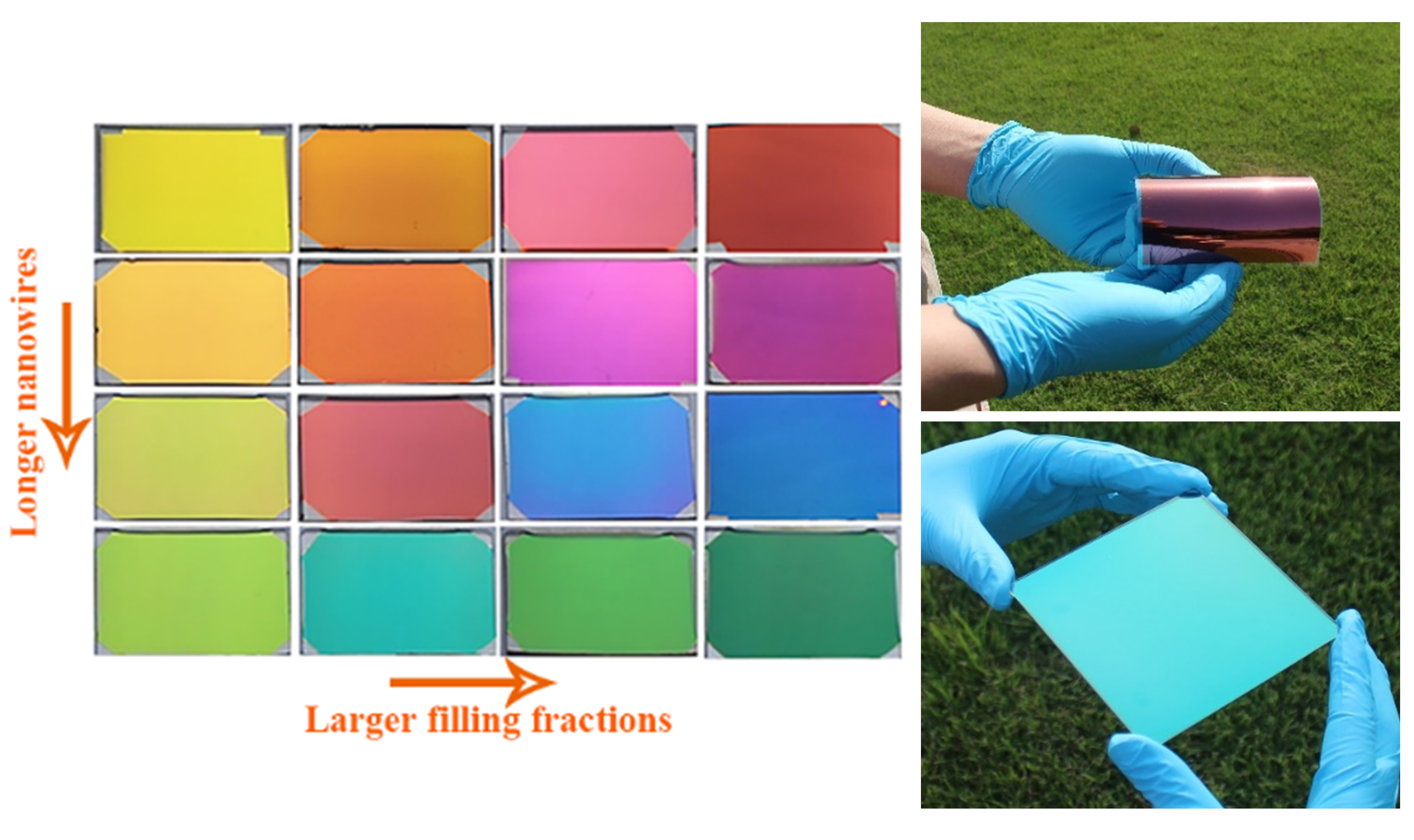
A research group led by Prof. CAO Hongtao at the Ningbo Institute of Materials Technology and Engineering (NIMTE) of the Chinese Academy of Sciences (CAS), has developed a novel direct growth method of vertically orientated nanocavity arrays to generate plasmonic structural colors, which feature wide gamut, improved color saturation, excellent stability in ambient condition and mass-production scalability. The study was published in Advanced Functional Materials.
As an eco-friendly alternative to the traditional pigments and dyes, plasmonic colors boast high efficiency, long-term stability, and nonphotobleaching nature. Therefore, they play a vital role in emerging applications, like backlight-free displays, solar conversion, etc.
However, the facile fabrication technique of large-scale plasmonic structural colors with high coloring quality and steerable control freedom still need to be improved.
Researchers at NIMTE proposed the direct growth method of vertically orientated nanocavity arrays to create plasmonic structural colors. The improved stacked structure is comprised of an Ag nanowire array embedded-SiO2 metamaterial building block layer, a nanoscale-thick SiO2 gap, and a metal mirror. In addition, the whole stacked structure can be prepared via magnetron sputtering, which is an easy scale-up deposition technique. In particular, the nanoscale tuning on the structure feature size of the nanowire arrays was well coupled with the deposition parameters in a controllable and reproducible way.
By virtue of the additional introduction of Ag NP cermet layer, more resonance absorption was triggered. Thus the color gamut was further extended, even including the black color, along with the improved color saturation. In this way, the full-color palette was realized in red, green, blue (RGB) as well as cyan, magenta, yellow, black (CMYK) color space.
Moreover, whether on rigid or flexible substrates, large-area and uniform structural colors showed angle-insensitivity and coloration stability in air ambient.
The study may shed some light on generation technique, theory exploration, material fabrication evolution, and large-area applications of plasmonic colors.
Direct growth of vertically orientated nanocavity arrays for plasmonic color generation
Haibo Hu, Wenjie Gao, Rui Zang, Junhua Gao, Shiwei Tang, Xiaoyun Li, Lingyan Liang, Hongliang Zhang, Hongtao Cao
Advanced Functional Materials (2020)
Contact information:
Cao Hongtao
Professor, Ningbo Institute of Materials Technology and Engineering, Chinese Academy of Sciences
h_cao@nimte.ac.cn
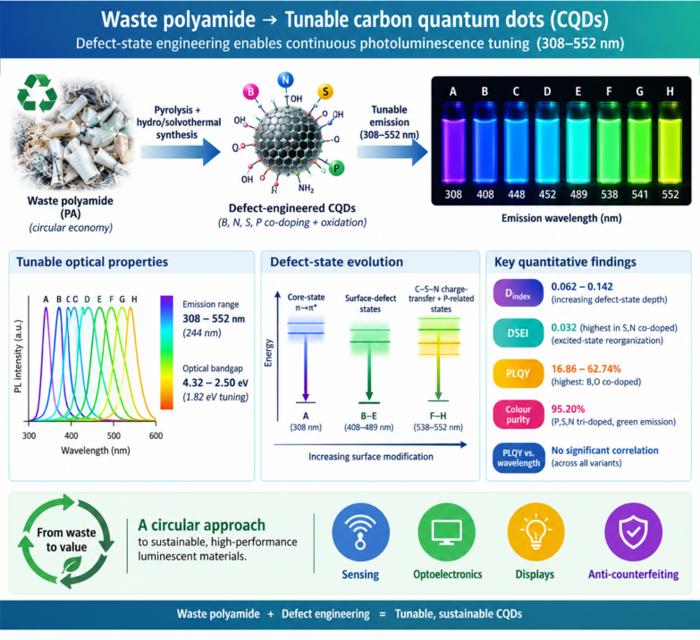
Waste polyamide-derived CQDs show continuous photoluminescence tuning from 308 to 552 nm through sequential defect-state engineering, with optical transition energies decreasing from 4.32 to 2.50 eV. @Christian Ebere Enyoh from Saitama University Carbon quantum dots (CQDs) are fluorescent carbon nanomaterials with potential applications in sensing, optoelectronics, displays, anti-counterfeiting, and environmental technologies. Their optical properties can be adjusted by modifying the carbon...
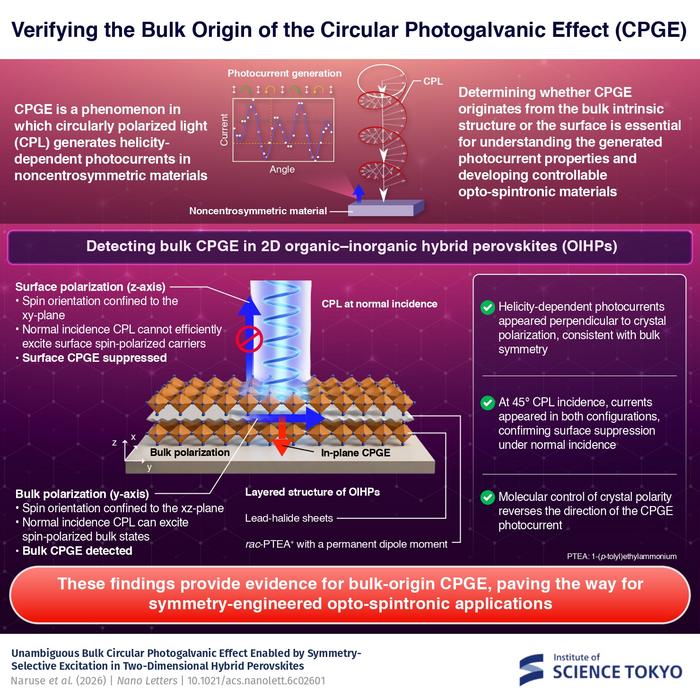
The researchers used circularly polarized light at normal incidence and found that helicity-dependent photocurrents appeared perpendicular to the crystal’s polarization but vanished when measured parallel to it, supporting a bulk origin of CPGE. @Institute of Science Tokyo The circular photogalvanic effect (CPGE), a phenomenon that generates helicity-dependent photocurrents in noncentrosymmetric materials, can originate purely from a crystal's internal structure without contribution from the...
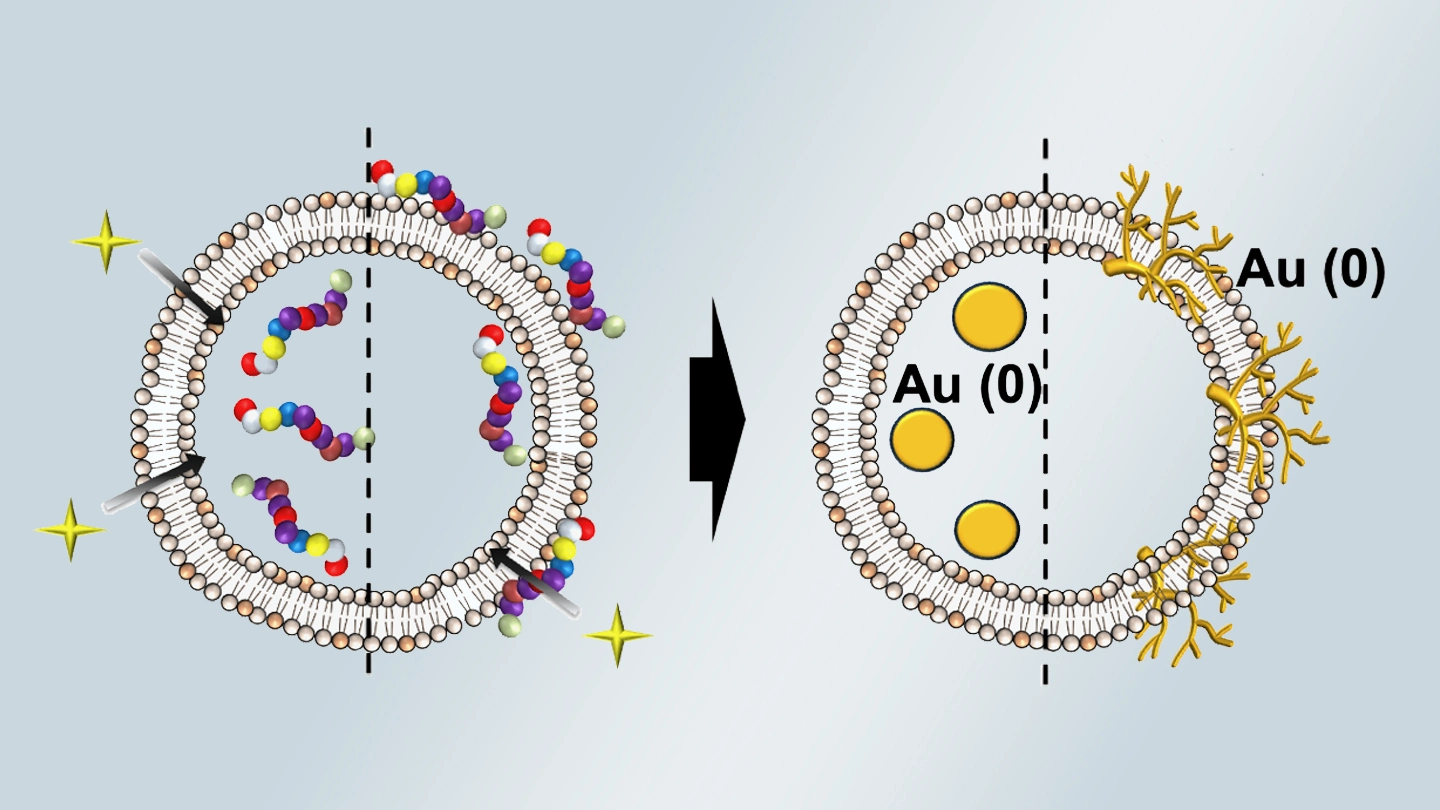
Summary of gold nanoparticle growth programming in liposome based on localization of biomineralization peptide The position of biomineralization peptides within liposomes can influence how gold nanoparticles grow, reports a research team from Institute of Science Tokyo. Peptides localized at the membrane interface promote branched structures, while those confined to the liposome interior favor spherical nanoparticles. The findings offer a new strategy for controlling nanoscale reaction...
