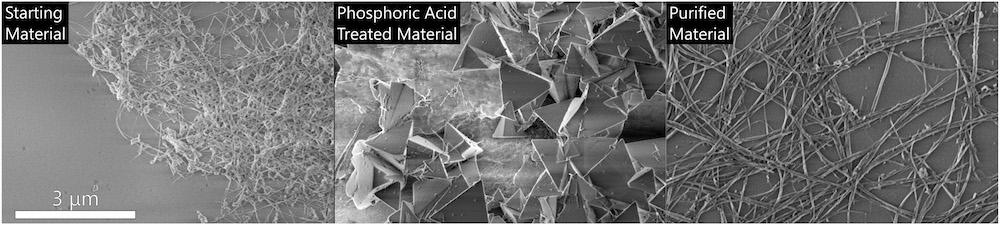
Very strong, light materials that can withstand extremely high temperatures could usher in next-generation spacecraft, enhance current devices or enable the development of new biomedical imaging or hydrogen storage applications, among others. To this end, Rice University scientists in the lab of Angel Martí have uncovered a new way to make high-purity boron nitride nanotubes, hollow cylindrical structures that can withstand temperatures of up to 900 degrees Celsius (~1652 Fahrenheit) while also being stronger than steel by weight.
According to a study published in Chemistry of Materials, Rice researchers figured out how to get rid of hard-to-remove impurities in boron nitride nanotubes using phosphoric acid and fine-tuning the reaction.
“The challenge is that during the synthesis of the material, in addition to tubes, we end up with a lot of extra stuff,” said Kevin Shumard, a chemistry doctoral student and lead author on the study. “As scientists, we want to work with the purest material we can so that we limit variables as we experiment. This work gets us one step closer to making materials with a potential to revamp whole industries when used as additives to metals or ceramic composites to make those even stronger.”
The “extra stuff” that usually mars the quality and usefulness of the nanotubes are boron nitride cages ⎯ hollow sphere-shaped structures that encapsulate boron particles. A paper that showed phosphoric acid acted as a boron nitride wetting agent inspired the researchers to explore whether they could use the acid to remove the cages.
“We didn’t expect a reaction,” said Martí, professor of chemistry, bioengineering and materials science and nanoengineering, chair of chemistry and faculty director of the Rice Emerging Scholars Program.
And, indeed, at room temperature, nothing happened. But when they heated things up, the researchers got a surprise.
“When we looked through the microscope, we saw no tubes and no cages,” Martí said. “Instead, there were pyramids.”
The researchers learned that the high temperatures and acid concentrations were destructive for the boron nitride, so they revised their hypothesis and instead aimed to tune the reaction to destroy only unwanted structures in the material.
“Through a lot of experimentation, we developed a completely new direction for purification of nanotubes,” Shumard said. “I have spent a lot of time in front of an electron microscope and have read a lot of papers with images of boron nitride nanotubes. The material that we can make is by far the purest tubes that I have seen when compared to others.”
The researchers plan to continue their efforts to improve reaction yields so as to produce enough nanotubes to make fibers, which could be a suitable and more sustainable alternative to steel.
“Nitrogen makes up 70% of our atmosphere, and boron is highly abundant in rocks,” Shumard said. “This work could be a stepping stone to much better building materials both in terms of strength and in terms of sustainability.”
The structure of boron nitride nanotubes is very similar to that of carbon nanotubes, and so are some of their properties such as tensile strength and thermal conductivity. However, boron nitride nanotubes are more resilient, and some of their properties are complementary to their carbon counterparts.
“For example, carbon nanotubes can be electrical conductors or semiconductors, while boron nitride nanotubes are insulators,” Martí said. “The science on boron nitride nanotubes is not as well developed as the science on carbon nanotubes ⎯ a gap we were hoping to address in our research because we think the ability to produce pure boron nitride nanotubes efficiently and reliably could be important for a wide range of industries.”
Reference
Reactivity of Boron Nitride Nanomaterials with Phosphoric Acid and Its Application in the Purification of Boron Nitride Nanotubes
Kevin R. Shumard, Jesus A. I. Acapulco Jr., Matteo Pasquali, and Angel A. Martí
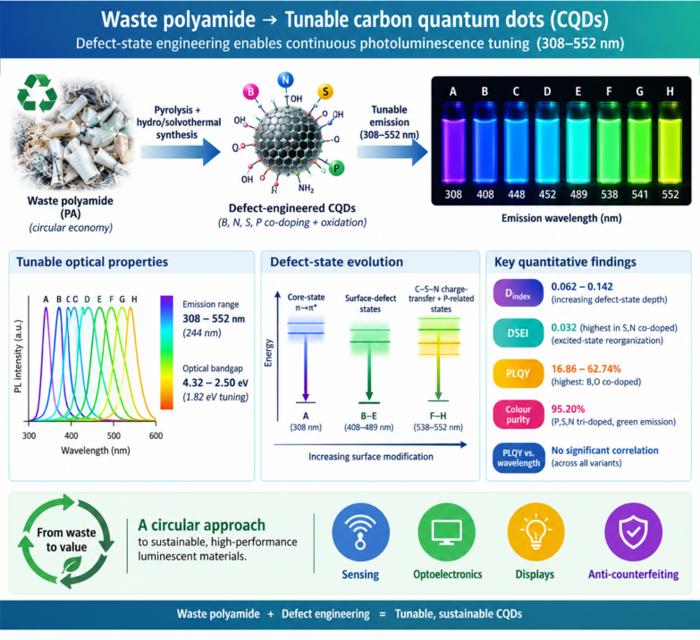
Waste polyamide-derived CQDs show continuous photoluminescence tuning from 308 to 552 nm through sequential defect-state engineering, with optical transition energies decreasing from 4.32 to 2.50 eV. @Christian Ebere Enyoh from Saitama University Carbon quantum dots (CQDs) are fluorescent carbon nanomaterials with potential applications in sensing, optoelectronics, displays, anti-counterfeiting, and environmental technologies. Their optical properties can be adjusted by modifying the carbon...
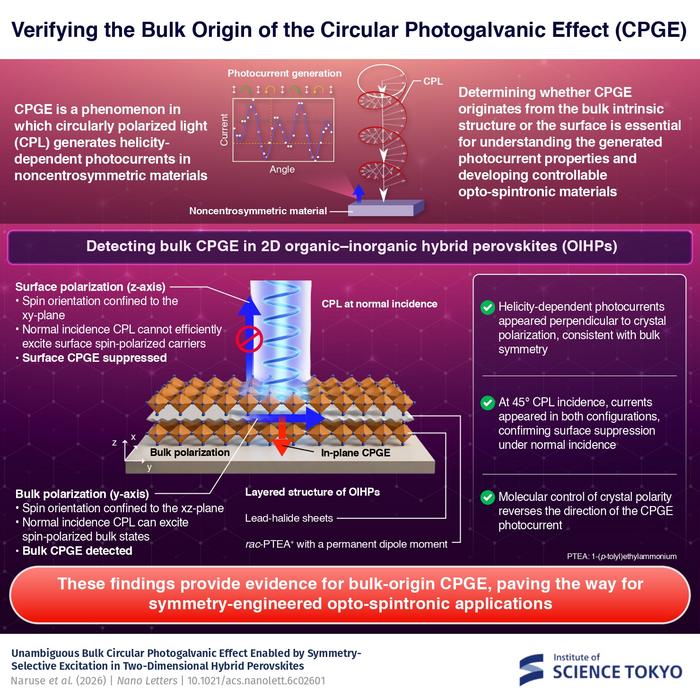
The researchers used circularly polarized light at normal incidence and found that helicity-dependent photocurrents appeared perpendicular to the crystal’s polarization but vanished when measured parallel to it, supporting a bulk origin of CPGE. @Institute of Science Tokyo The circular photogalvanic effect (CPGE), a phenomenon that generates helicity-dependent photocurrents in noncentrosymmetric materials, can originate purely from a crystal's internal structure without contribution from the...
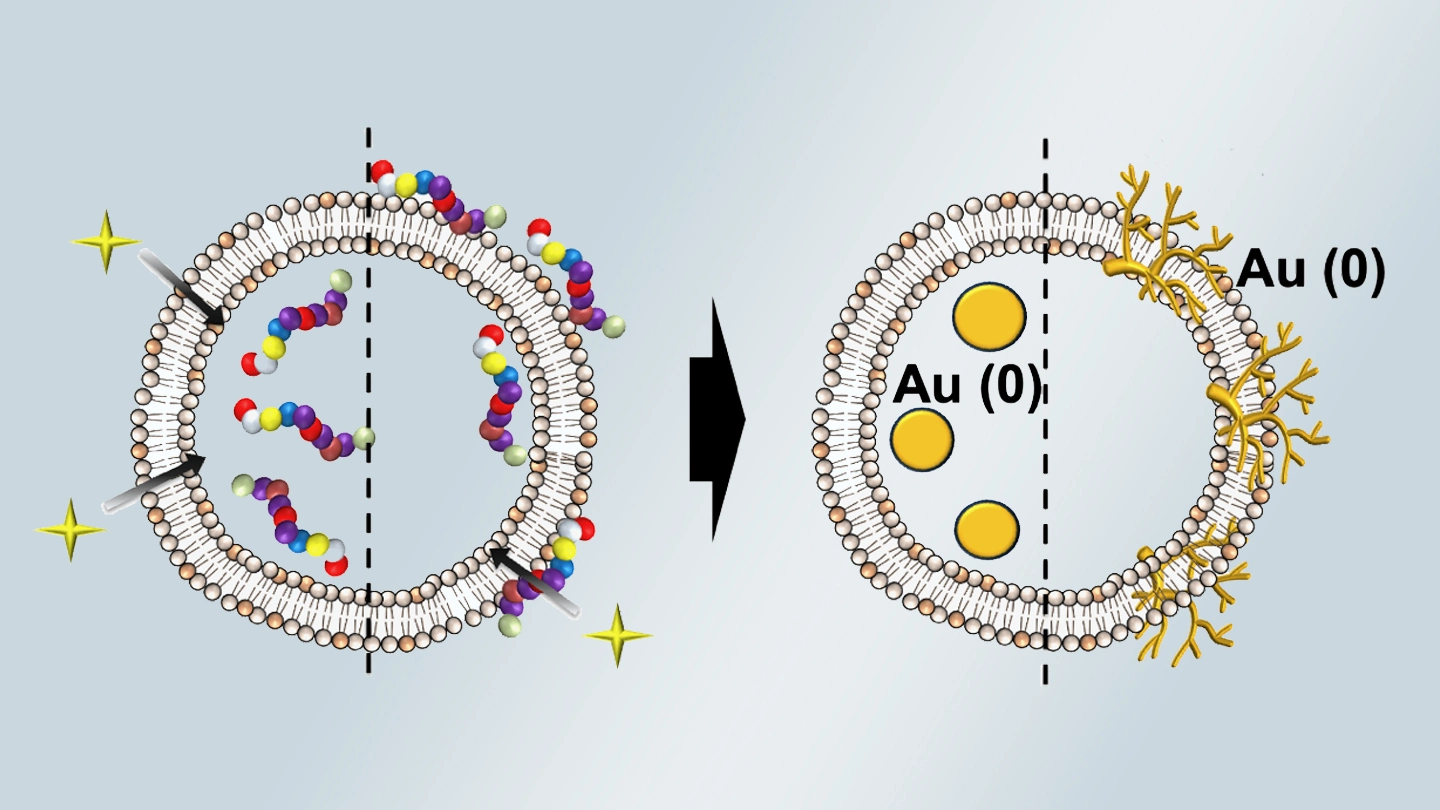
Summary of gold nanoparticle growth programming in liposome based on localization of biomineralization peptide The position of biomineralization peptides within liposomes can influence how gold nanoparticles grow, reports a research team from Institute of Science Tokyo. Peptides localized at the membrane interface promote branched structures, while those confined to the liposome interior favor spherical nanoparticles. The findings offer a new strategy for controlling nanoscale reaction...
