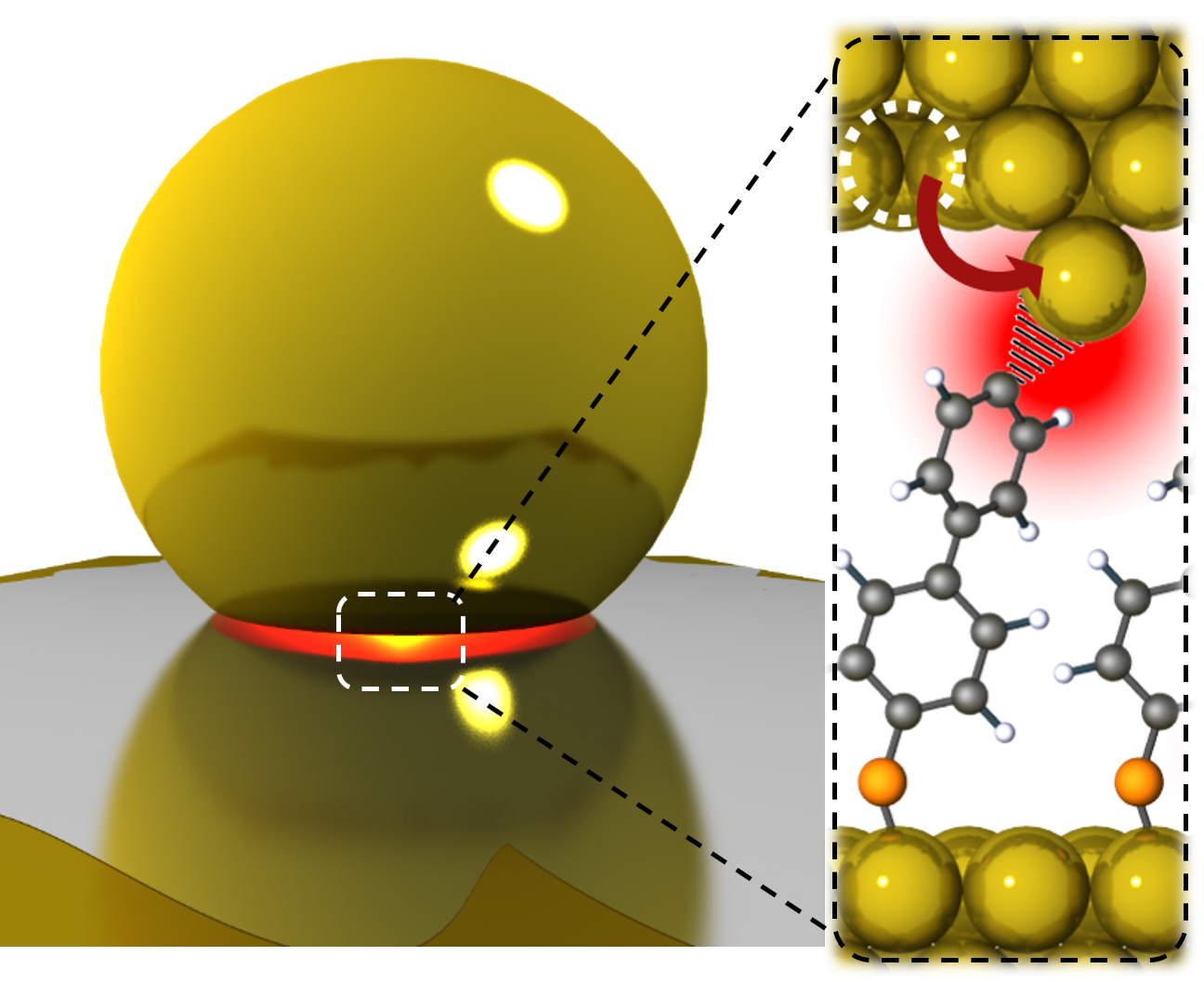
By trapping light into tiny gaps only a few atoms wide, a team from the NanoPhotonics Centre has magnified optical forces a thousand-fold, strong enough to force atoms into positions that drive chemical reactions more efficiently.
“We found a new way to beef up the forces from light, enough to now move metal atoms, and that’s key to reduce the energy barrier for making catalysis work more easily” co-lead researcher Shu Hu explains.
Weak tractor beams are used to make optical tweezers that can probe biological processes with beams of tightly-focussed light that trap transparent micro-objects of glass or polymer. But to use light to pluck single atoms from solids requires much stronger forces. Now a team from the NanoPhotonics Centre in the Cavendish Laboratory has shown a way to build tiny crevices that magnify the optical forces of visible light. They use these to pull single gold atoms from a crystal, approach them close to a molecular bond, and watch the effects directly on their flopping and vibration. Published in Science Advances, they show new ways to make light act powerfully, and suggest new approaches for driving chemical transformations.
Watching one bond at a time in their experiments avoids averaging over a crowd of different effects. “Single metal atoms are the anvil where catalysis forges new chemical bonds” promises Prof Jeremy Baumberg, “and we can start to watch this process happening and control it”. Catalysis is instrumental for all manmade chemicals and polymers.
“It’s like watching the beautiful dance of an atom and a molecule in real time” notes Hu.
Reference
Optical suppression of energy barriers in single molecule-metal binding
Qianqi Lin, Shu Hu, Tamás Földes, Junyang Huang, Demelza Wright, Jack Griffiths, Eoin Elliott, Bart de Nijs, Edina Rosta, Jeremy J. Baumberg
https://www.science.org/doi/10.1126/sciadv.abp9285
University of Cambridge
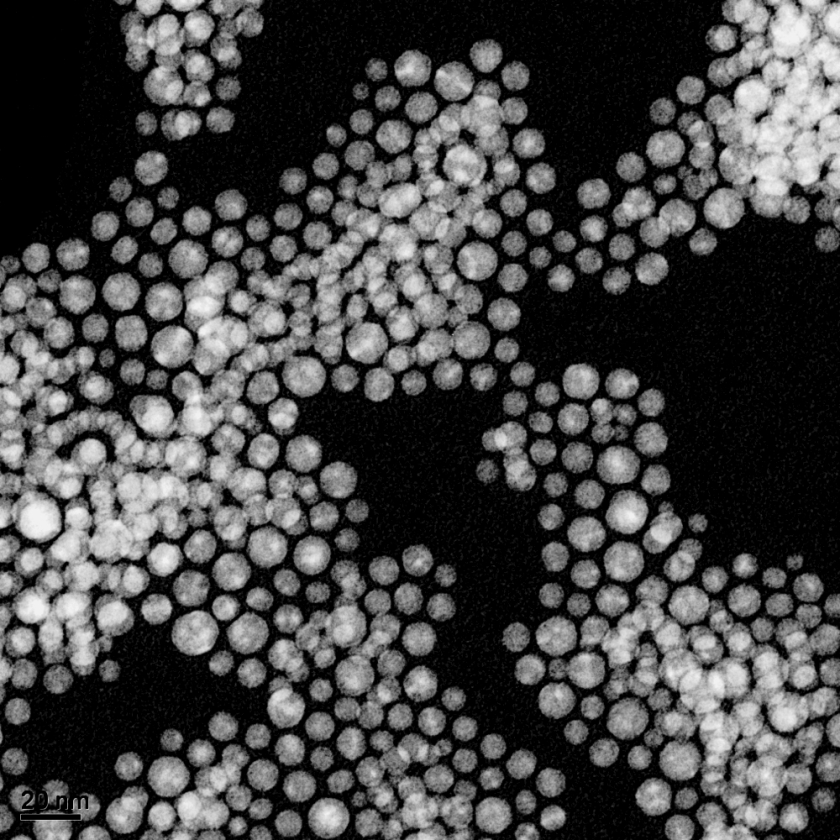
Silver nanoparticles with diameters of ~10 nm deliver the best performance as electrocatalysts. The silver particles are sprayed onto the electrode together with a conductive carbon powder. The ideal mixture consists of 20 per cent by mass silver and 80 per cent by mass carbon powder. This image was taken using a transmission electron microscope (TEM). © HZB Via electrolysis, CO₂ can be reduced to CO, a raw material for further chemical products such as fuels. Within the GreenQuest Project,...
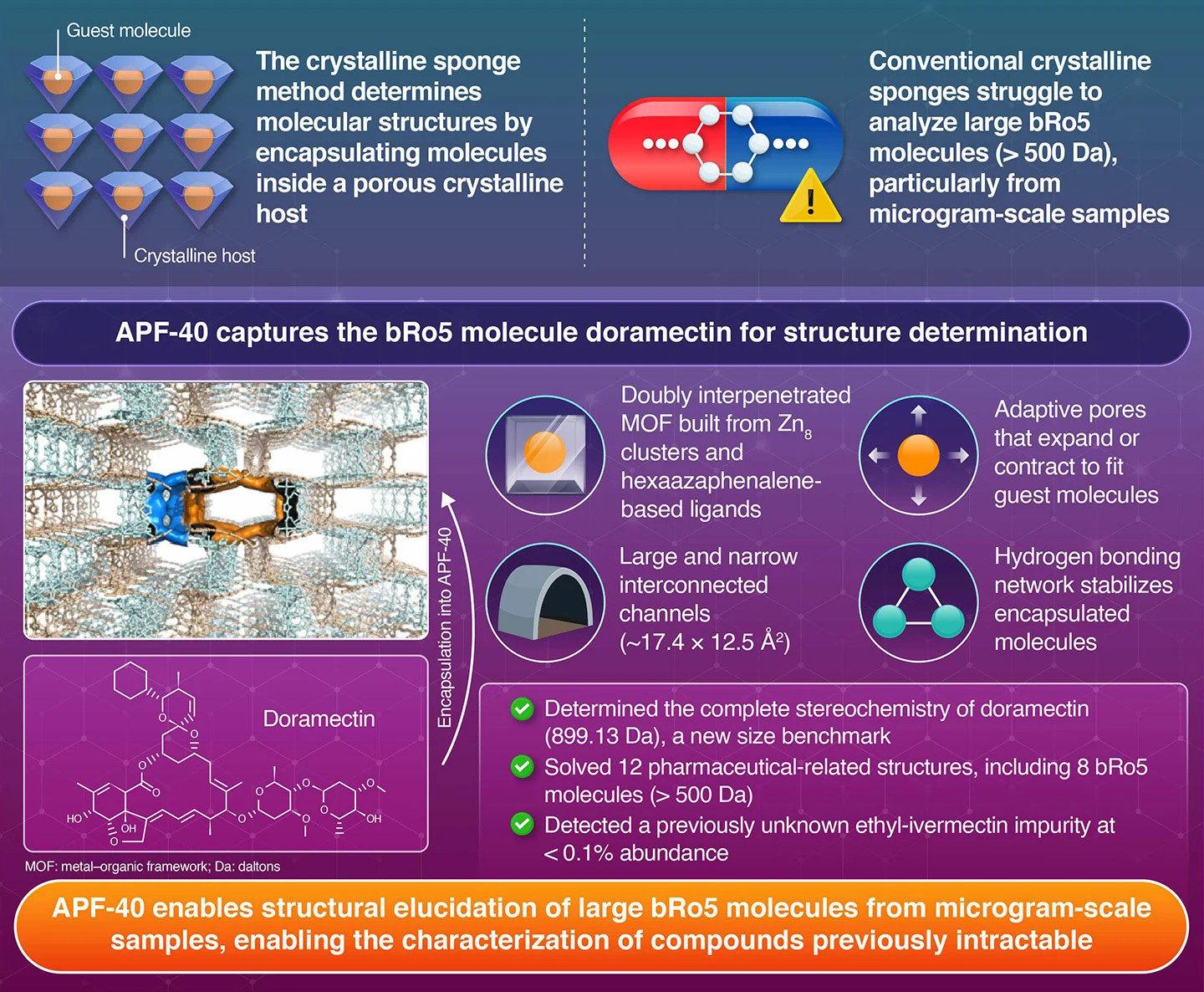
A flexible metal–organic framework developed by researchers from Institute of Science Tokyo enables the structural determination of large "beyond rule of 5" molecules from microgram-scale samples. Using APF-40 as a crystalline sponge, the researchers determined the structures of 12 pharmaceutical-related molecules, including the 899 Da drug molecule doramectin and trace ivermectin derivatives. The method could aid drug discovery, natural products research, and the characterization of rare...
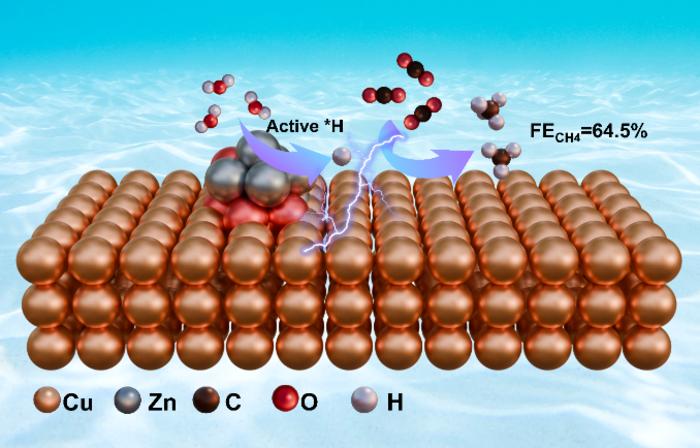
image: CuZn800@C was constructed via solvothermal method and utilizes the high-temperature volatility of zinc to prepare through calcination at different temperatures, which displays a high methane Faradaic efficiency of 64.5% and a remarkable partial current density of -551.3 mA/cm2 at -1.7 V vs. RHE, along with excellent stability. Zn and Cu form a tandem reaction system. Zn sites promote water splitting to provide protons, while Cu sites reduce the energy barrier for *CO hydrogenation....