Massachusetts Institute of Technology

New findings from a team of researchers at MIT and elsewhere could help pave the way for new kinds of devices that efficiently bridge the gap between matter and light. These might include computer chips that eliminate inefficiencies inherent in today’s versions, and qubits, the basic building blocks for quantum computers, that could operate at room temperature instead of the ultracold conditions needed by most such devices.
The new work, based on sandwiching tiny flakes of a material called perovskite in between two precisely spaced reflective surfaces, is detailed in the journal Nature Communications, in a paper by MIT recent graduate Madeleine Laitz PhD ’22, postdoc Dane deQuilettes, MIT professors Vladimir Bulovic, Moungi Bawendi and Keith Nelson, and seven others.
By creating these perovskite sandwiches and stimulating them with laser beams, the researchers were able to directly control the momentum of certain “quasiparticles” within the system. Known as exciton-polariton pairs, these quasiparticles are hybrids of light and matter. Being able to control this property could ultimately make it possible to read and write data to devices based on this phenomenon.
“What’s particularly fascinating about exciton-polaritons,” Laitz says, is that they lie “on a spectrum between purely electronic and photonic systems.” These quasiparticles “have the characteristics of both, and thus you can leverage exciton-polaritons to utilize the best properties of each.”
For example, purely electronic transistors, she explains, have inherent losses to capacitance effects at each interface between devices, whereas “purely photonic systems have challenges in engineering, in that it’s very hard to get photons to interact, and you have to rely on complex interferometric schemes.” By contrast, the quasiparticles used by this team can be easily controlled through multiple variables.
The quasiparticle is “a combined state of light and neutral charge,” Bulovic says. “As a result, you can perturb that combined state either with light or charge, and hence, if you need to modulate that state, you have extra levers you can utilize. These extra levers can now allow one to manipulate this combined state of matter in a more energy-efficient manner.”
What’s more, the materials involved are easily manufactured using room-temperature, solution-based processing methods, and thus could be relatively easy to produce at scale once practical systems are designed. So far, the work is at a very early stage, as researchers are still studying newly discovered effects; practical applications could be five to 10 years away, Laitz says.
Perovskites have attracted much attention in recent years as materials for new lightweight, flexible solar photovoltaic panels, so there has been a great deal of research on their properties and fabrication methods. The team settled on a particular version of perovskite called phenethylammonium lead iodide.
“Halide perovskites harvest light really well, and turn photons into electrons or excitons, depending on the dimensionality and material properties of the perovskite,” she says, which is why the researchers chose this particular version of this large class of materials for their research.
Then, to create what is known as an optical cavity that can trap photons of light, the researchers placed tiny flakes of the material between mirrored surfaces. Two of these ultrathin layers, just tens of nanometers thick, were spaced a precise distance apart using spacer layers, so that the mirrors were separated by half the wavelength of light that this perovskite material both absorbs and emits.
Using perovskite tuned to a wavelength of green light, the emitted green light then bounces back and forth between the mirrors. “It’s reabsorbed by the material, re-emitted, reabsorbed, re-emitted, reabsorbed over and over again so quickly that you’re interconverting between the photon and the exciton, such that you generate a superposition of both,” Laitz says.
This can lead to the state of matter known as a Bose-Einstein Condensate, in which all the particles have identical energy states and behave much like one large particle. Laitz says that such condensates carry a property known as spin, and this can be modified by light or electrical stimulation; the resulting changes can be measured by observing photoluminescence from the material using a spectroscopic imaging system. And unlike purely photonic systems, where there is little interaction between photons, these materials have strong interactions with both light and electrons.
Arrays of such condensates have been produced, but typically only at ultralow, cryogenic temperatures so far. “Perovskites offer the opportunity for realizing this phenomenon at elevated temperatures,” but it’s hard to form the condensates in perovskites. This new research shows fundamental characteristics of the process that leads to condensation, Laitz says. In their paper, “we propose several strategies from a material perspective and a device architecture perspective to enable this.” And that could be a key step toward eventual room-temperature qubits, she says.
While such devices may take several years to develop, a more near-term application of the new findings could be in producing new kinds of light-emitting devices, deQuilettes says, including ones that could provide a steerable light source with directional output that can be controlled electronically.
Reference
Uncovering temperature-dependent exciton-polariton relaxation mechanisms in hybrid organic-inorganic perovskites
Madeleine Laitz, Alexander E. K. Kaplan, Jude Deschamps, Ulugbek Barotov, Andrew H. Proppe, Inés García-Benito, Anna Osherov, Giulia Grancini, Dane W. deQuilettes, Keith A. Nelson, Moungi G. Bawendi & Vladimir Bulović
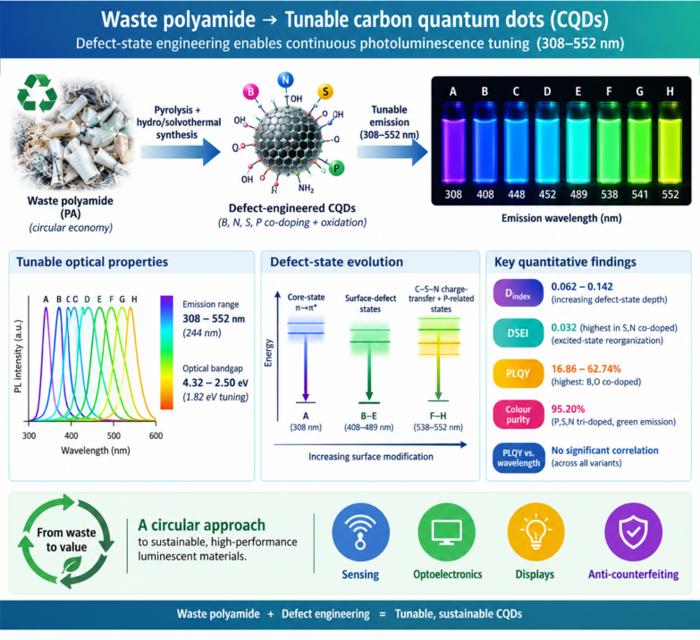
Waste polyamide-derived CQDs show continuous photoluminescence tuning from 308 to 552 nm through sequential defect-state engineering, with optical transition energies decreasing from 4.32 to 2.50 eV. @Christian Ebere Enyoh from Saitama University Carbon quantum dots (CQDs) are fluorescent carbon nanomaterials with potential applications in sensing, optoelectronics, displays, anti-counterfeiting, and environmental technologies. Their optical properties can be adjusted by modifying the carbon...
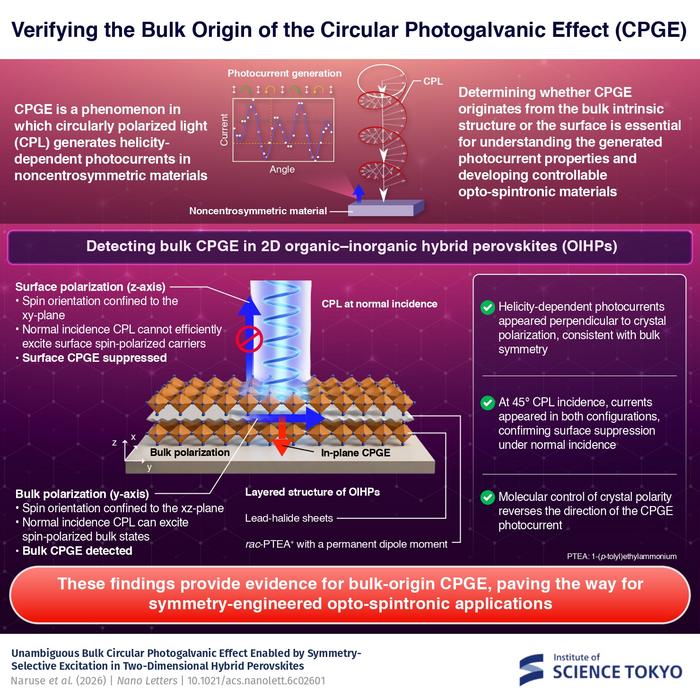
The researchers used circularly polarized light at normal incidence and found that helicity-dependent photocurrents appeared perpendicular to the crystal’s polarization but vanished when measured parallel to it, supporting a bulk origin of CPGE. @Institute of Science Tokyo The circular photogalvanic effect (CPGE), a phenomenon that generates helicity-dependent photocurrents in noncentrosymmetric materials, can originate purely from a crystal's internal structure without contribution from the...
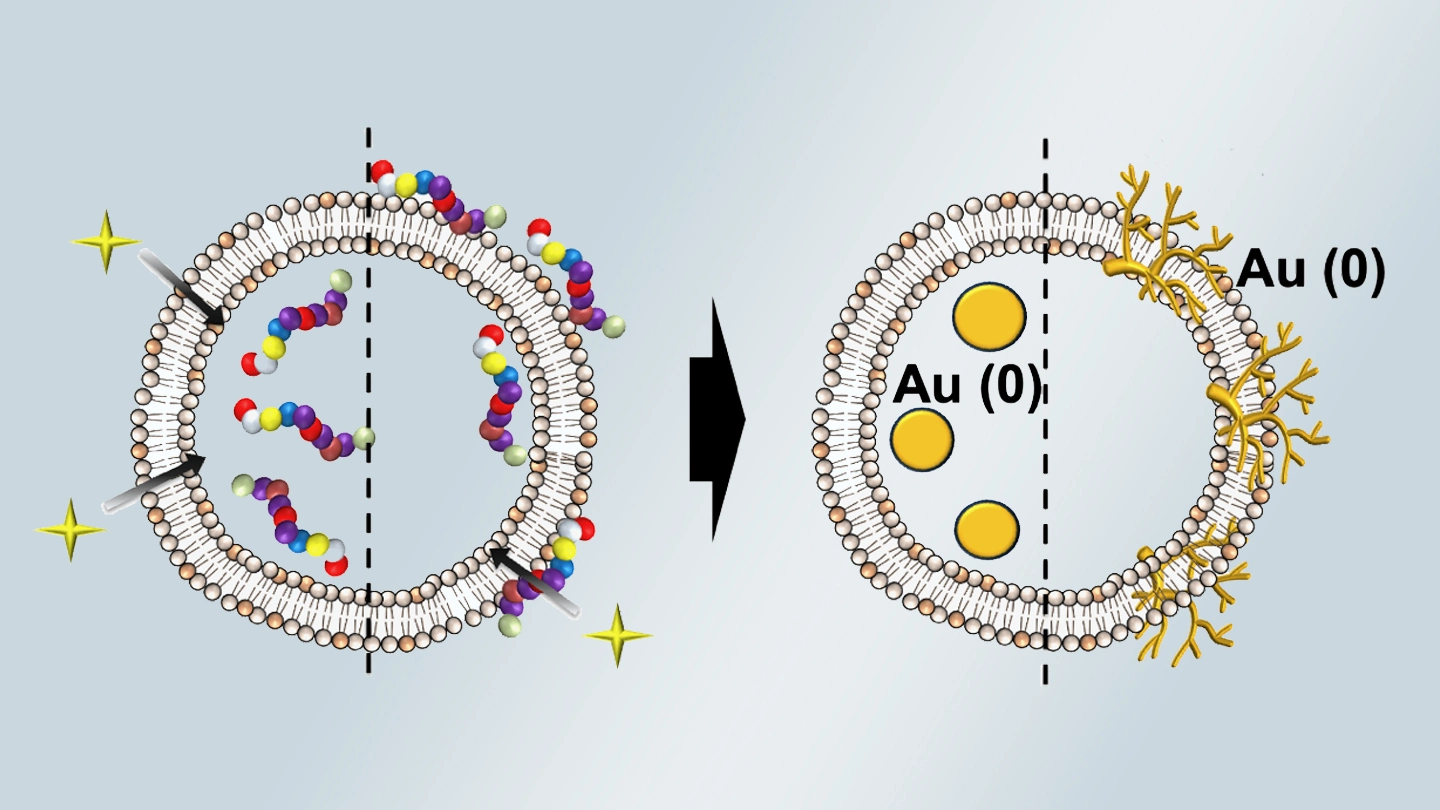
Summary of gold nanoparticle growth programming in liposome based on localization of biomineralization peptide The position of biomineralization peptides within liposomes can influence how gold nanoparticles grow, reports a research team from Institute of Science Tokyo. Peptides localized at the membrane interface promote branched structures, while those confined to the liposome interior favor spherical nanoparticles. The findings offer a new strategy for controlling nanoscale reaction...
