Rensselaer Polytechnic Institute (RPI)
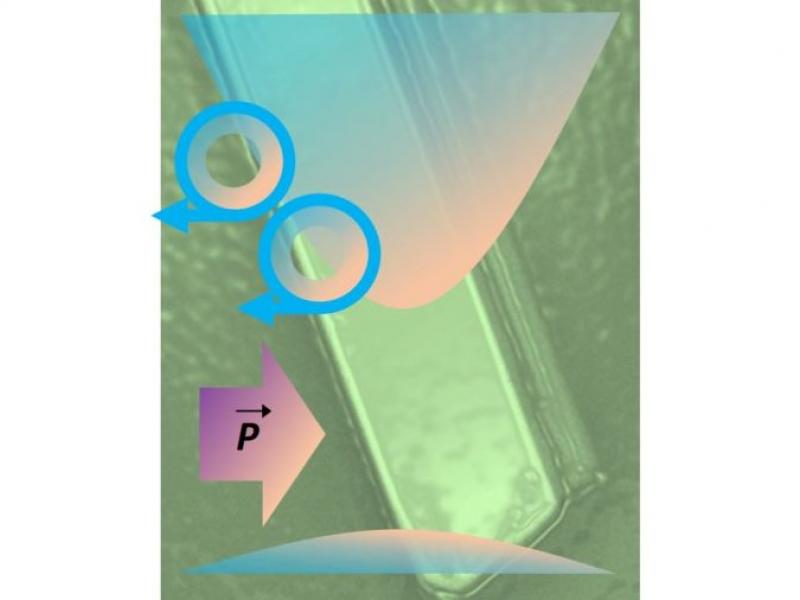
If new and promising semiconductor materials are to make it into our phones, computers, and other increasingly capable electronics, researchers must obtain greater control over how those materials function.
In an article published today in Science Advances, Rensselaer Polytechnic Institute researchers detailed how they designed and synthesized a unique material with controllable capabilities that make it very promising for future electronics.
The researchers synthesized the material -- an organic-inorganic hybrid crystal made up of carbon, iodine, and lead -- and then demonstrated that it was capable of two material properties previously unseen in a single material. It exhibited spontaneous electric polarization that can be reversed when exposed to an electric field, a property known as ferroelectricity. It simultaneously displayed a type of asymmetry known as chirality -- a property that makes two distinct objects, like right and left hands, mirror images of one another but not able to be superimposed.
According to Jian Shi, an associate professor of materials science and engineering at Rensselaer, this unique combination of ferroelectricity and chirality is advantageous. When combined with the material's conductivity, both of these characteristics can enable other electrical, magnetic, or optical properties.
"What we have done here is equip a ferroelectric material with extra functionality, allowing it to be manipulated in previously impossible ways," Shi said.
The experimental discovery of this material was inspired by theoretical predictions by Ravishankar Sundararaman, an assistant professor of materials science and engineering at Rensselaer. A ferroelectric material with chirality, Sundararaman said, can be manipulated to respond differently to left- and right-handed light so that it produces specific electric and magnetic properties. This type of light-matter interaction is particularly promising for future communication and computing technologies.
A chiral switchable photovoltaic ferroelectric 1D perovskite
Yang Hu, Fred Florio, Zhizhong Chen, W. Adam Phelan, Maxime A. Siegler, Zhe Zhou, Yuwei Guo, Ryan Hawks, Jie Jiang, Jing Feng, Lifu Zhang, Baiwei Wang, Yiping Wang, Daniel Gall, Edmund F. Palermo, Zonghuan Lu, Xin Sun, Toh-Ming Lu, Hua Zhou, Yang Ren, Esther Wertz, Ravishankar Sundararaman and Jian Shi
Science Advances 28 Feb 2020: Vol. 6, no. 9, eaay4213
Contact information:
RPI Associate professor of materials science and engineering
shij4@rpi.edu
Phone: 573-239-8872
RPI Assistant professor of materials science and engineering
sundar@rpi.edu
Phone: 518-276-6757
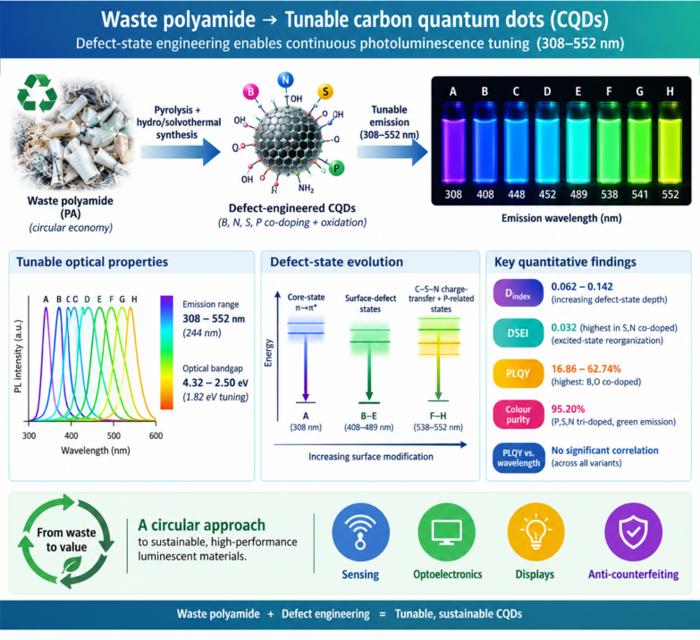
Waste polyamide-derived CQDs show continuous photoluminescence tuning from 308 to 552 nm through sequential defect-state engineering, with optical transition energies decreasing from 4.32 to 2.50 eV. @Christian Ebere Enyoh from Saitama University Carbon quantum dots (CQDs) are fluorescent carbon nanomaterials with potential applications in sensing, optoelectronics, displays, anti-counterfeiting, and environmental technologies. Their optical properties can be adjusted by modifying the carbon...
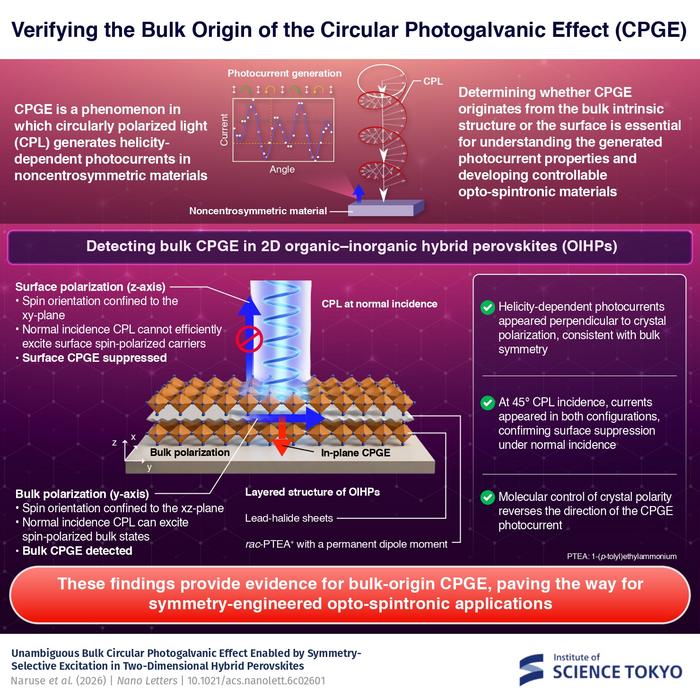
The researchers used circularly polarized light at normal incidence and found that helicity-dependent photocurrents appeared perpendicular to the crystal’s polarization but vanished when measured parallel to it, supporting a bulk origin of CPGE. @Institute of Science Tokyo The circular photogalvanic effect (CPGE), a phenomenon that generates helicity-dependent photocurrents in noncentrosymmetric materials, can originate purely from a crystal's internal structure without contribution from the...
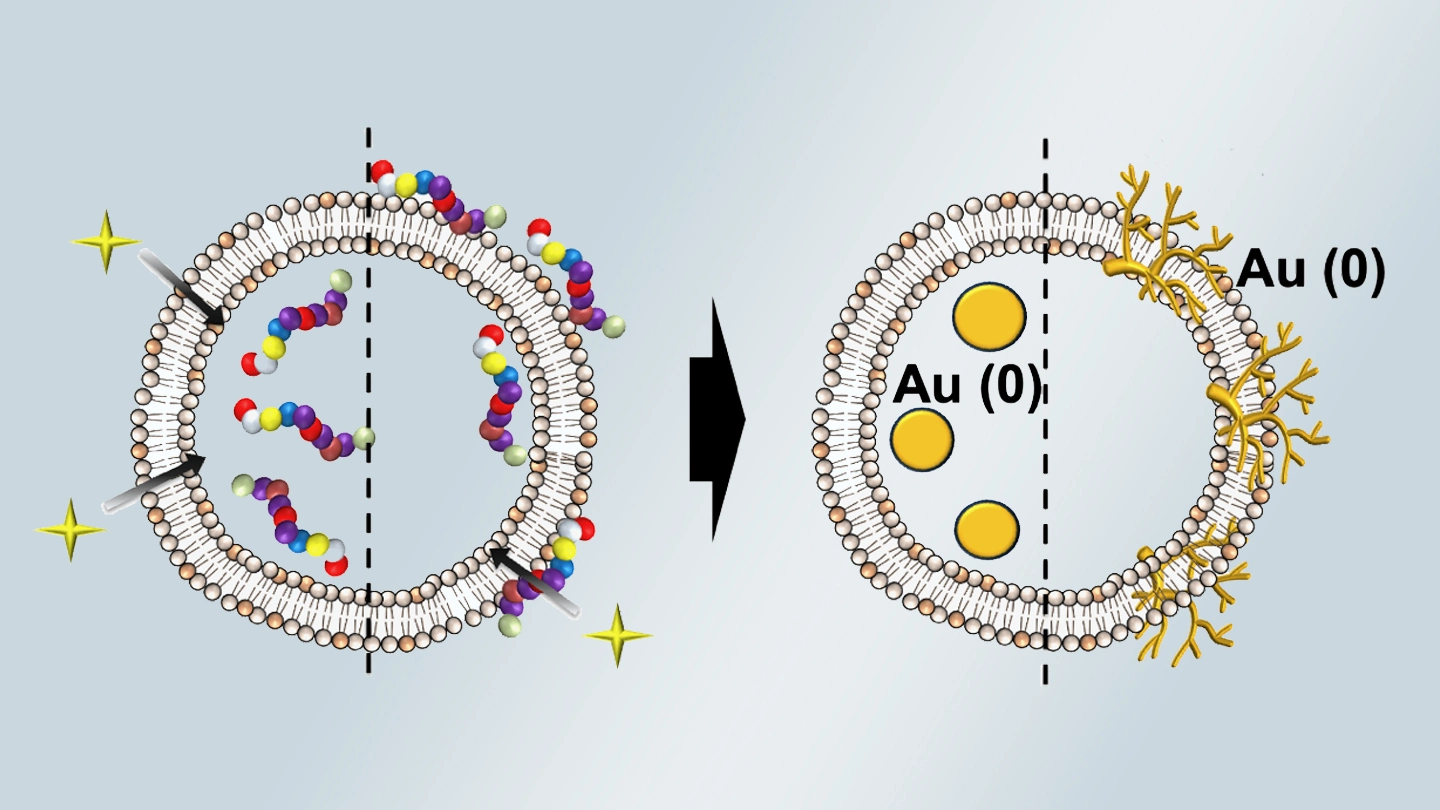
Summary of gold nanoparticle growth programming in liposome based on localization of biomineralization peptide The position of biomineralization peptides within liposomes can influence how gold nanoparticles grow, reports a research team from Institute of Science Tokyo. Peptides localized at the membrane interface promote branched structures, while those confined to the liposome interior favor spherical nanoparticles. The findings offer a new strategy for controlling nanoscale reaction...
