
Materials scientists at Rice University are shedding light on the intricate growth processes of 2D crystals, paving the way for controlled synthesis of these materials with unprecedented precision.
Two-dimensional materials such as graphene and molybdenum disulfide (MoS2) exhibit unique properties that hold immense promise for applications in electronics, sensors, energy storage, biomedicine and more. However, their complex growth mechanisms — inconsistent correlations exist between how the conditions for growth affect the shapes of crystals — have posed a significant challenge for researchers.
A research team at Rice’s George R. Brown School of Engineering tackled this challenge by developing a custom-built miniaturized chemical vapor deposition (CVD) system capable of observing and recording the growth of 2D MoS2 crystals in real time. The work is published online in the journal Nano Letters.
Through the use of advanced image processing and machine learning algorithms, the researchers were able to extract valuable insights from the real-time footage, including the ability to predict the conditions needed to grow very large, single-layer MoS2 crystals.
Study co-author Jun Lou, professor and associate chair of the Department of Materials Science and Nanoengineering at Rice, said this interdisciplinary approach represents a significant step forward in the field of scalable synthesis of 2D materials.
“By combining real-time experimental observations with cutting-edge machine learning techniques, we have demonstrated the potential to predict and control the growth of 2D crystals with excellent accuracy,” Lou said.
The research team’s findings have far-reaching implications for the future of 2D materials. Driven by their success with MoS2, the researchers believe that their approach can be extended to other 2D materials and heterostructures, offering a powerful platform for designing and engineering next-generation 2D materials with tailored properties.
“For example, in electronics, being able to robustly synthesize 2D crystals like MoS2 at scale could lead to faster and more efficient devices,” Lou said. “In sensors, it could lead to more sensitive and selective devices.”
“This research is an important step toward realizing the full potential of 2D materials and paves the way for the development of innovative technologies that could revolutionize a wide range of industries,” said Ming Tang, associate professor of materials science and nanoengineering and study co-author.
Reference
Toward Controlled Synthesis of 2D Crystals by CVD: Learning from the Real-Time Crystal Morphology Evolutions
Jing Zhang, Tianshu Zhai, Faizal Arifurrahman, Yuguo Wang, Andrew Hitt, Zelai He, Qing Ai, Yifeng Liu, Chen-Yang Lin, Yifan Zhu, Ming Tang, and Jun Lou
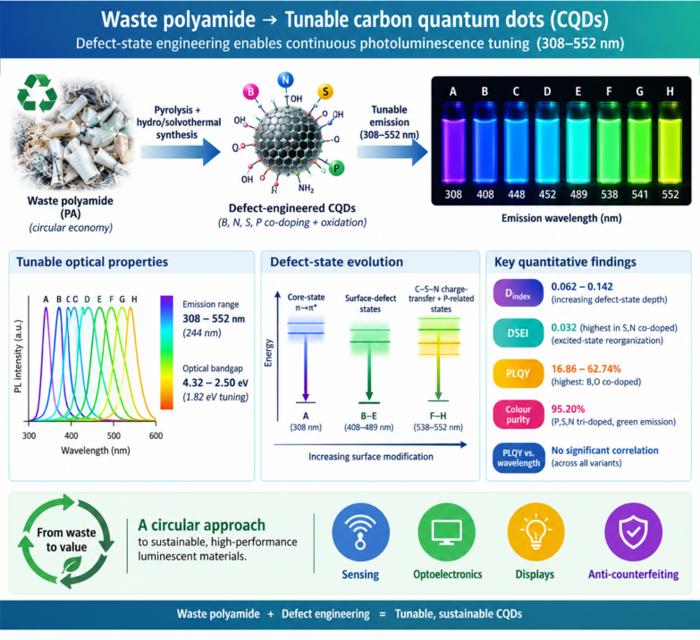
Waste polyamide-derived CQDs show continuous photoluminescence tuning from 308 to 552 nm through sequential defect-state engineering, with optical transition energies decreasing from 4.32 to 2.50 eV. @Christian Ebere Enyoh from Saitama University Carbon quantum dots (CQDs) are fluorescent carbon nanomaterials with potential applications in sensing, optoelectronics, displays, anti-counterfeiting, and environmental technologies. Their optical properties can be adjusted by modifying the carbon...
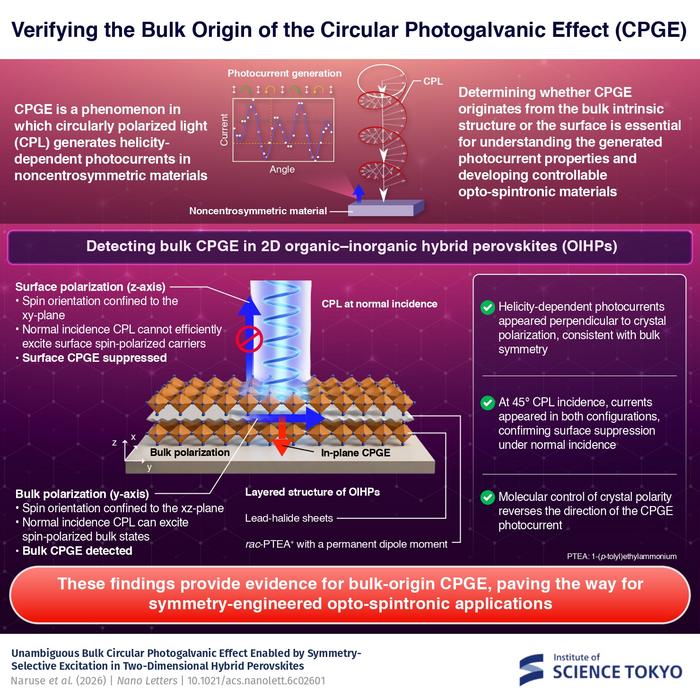
The researchers used circularly polarized light at normal incidence and found that helicity-dependent photocurrents appeared perpendicular to the crystal’s polarization but vanished when measured parallel to it, supporting a bulk origin of CPGE. @Institute of Science Tokyo The circular photogalvanic effect (CPGE), a phenomenon that generates helicity-dependent photocurrents in noncentrosymmetric materials, can originate purely from a crystal's internal structure without contribution from the...
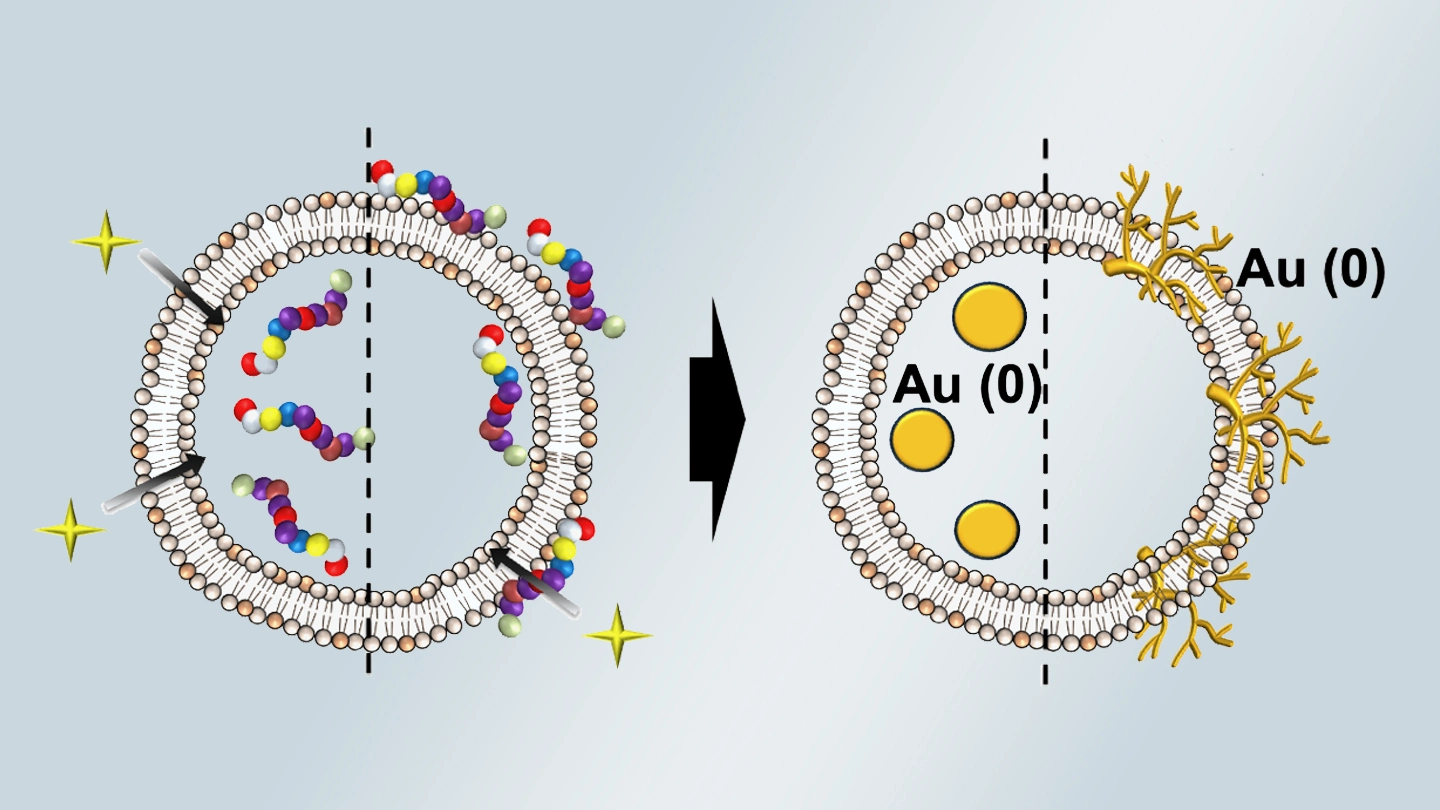
Summary of gold nanoparticle growth programming in liposome based on localization of biomineralization peptide The position of biomineralization peptides within liposomes can influence how gold nanoparticles grow, reports a research team from Institute of Science Tokyo. Peptides localized at the membrane interface promote branched structures, while those confined to the liposome interior favor spherical nanoparticles. The findings offer a new strategy for controlling nanoscale reaction...
