
Researchers from the Tata Institute of Fundamental Research, Mumbai, have demonstrated the ability to manipulate the vibrations of a drum of nanometre scale thickness – realizing the world’s smallest and most versatile drum. This work has implications in improving the sensitivity of small detectors of mass – very important in detecting the mass of small molecules like viruses. This also opens the doors to probing exciting new aspects of fundamental physics.
The work, recently published in the journal Nature Nanotechnology, made use of graphene, a one-atom thick wonder material, to fabricate drums that have highly tunable mechanical frequencies and coupling between various modes. Coupling between the modes was shown to be controllable which led to the creation of new, hybrid modes and, further, allowed amplification of the vibrations.
The experiment consisted of studying the mechanical vibrational modes, or ‘notes’, similar to a musical drum. The small size of the drum ( diameter 0.003 mm, or 30 times smaller than the diameter of human hair) gave rise to high vibrational frequencies in the range of 100 Mega Hertz – implying that this drum vibrates 100 million times in one second. The work done by lead author, Ph.D. student John Mathew, in the nanoelectronics group led by Prof. Mandar Deshmukh, showed that the notes of these drums could be controlled by making use of an electrical force that bends, or strains, the drum. The bending of the drum also caused different modes of the drum to interact with each other. This leads to a sloshing of energy between two notes.
“Using this interaction we now show that energy can be transferred between the modes leading to the creation of new ‘notes’ in the drum”, says Prof. Deshmukh. The rate of energy transfer could be precisely controlled by electrical signals that modulate the coupling. The work, in addition, made use of the mechanical mode coupling to manipulate the energy lost to the environment and demonstrated amplification of the vibrational motion, equivalent to an increase in sound from the drum.
At low temperatures, the high mechanical frequencies would allow studies of energy transfer of a quantum mechanical nature between the notes. The coupling between various notes of the drum could also be engineered to work as mechanical logic circuits and lead to improvements in quantum information processing. The ability to amplify the mechanical motion will also help improve the sensitivity of sensors based on nanoscale drums.
Reference:
Dynamical strong coupling and parametric amplification of mechanical modes of graphene drums
Mathew et al, Nature Nanotechnology, Online 13 June 2016
Tata Institute of Fundamental Research
#Graphene #Physics
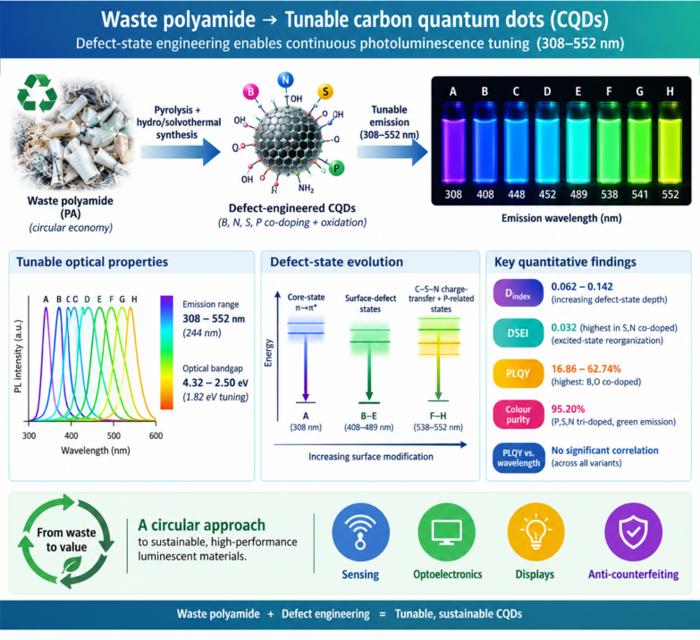
Waste polyamide-derived CQDs show continuous photoluminescence tuning from 308 to 552 nm through sequential defect-state engineering, with optical transition energies decreasing from 4.32 to 2.50 eV. @Christian Ebere Enyoh from Saitama University Carbon quantum dots (CQDs) are fluorescent carbon nanomaterials with potential applications in sensing, optoelectronics, displays, anti-counterfeiting, and environmental technologies. Their optical properties can be adjusted by modifying the carbon...
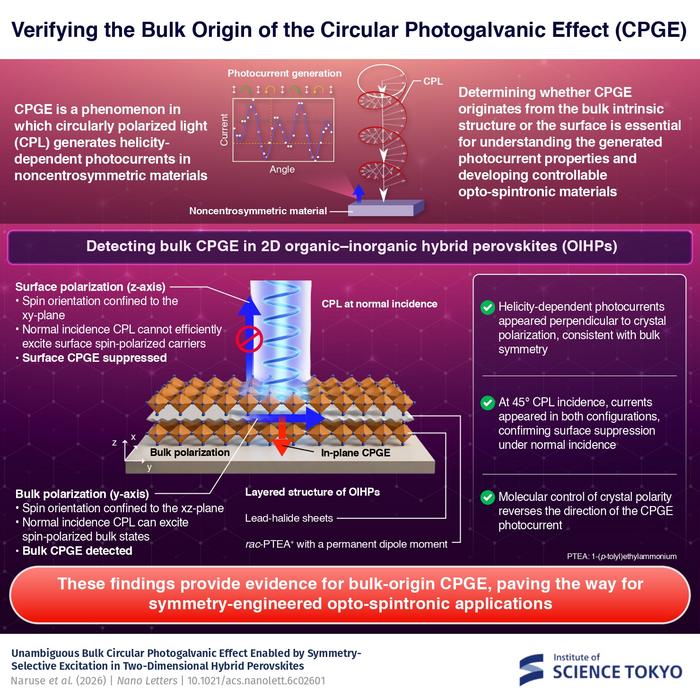
The researchers used circularly polarized light at normal incidence and found that helicity-dependent photocurrents appeared perpendicular to the crystal’s polarization but vanished when measured parallel to it, supporting a bulk origin of CPGE. @Institute of Science Tokyo The circular photogalvanic effect (CPGE), a phenomenon that generates helicity-dependent photocurrents in noncentrosymmetric materials, can originate purely from a crystal's internal structure without contribution from the...
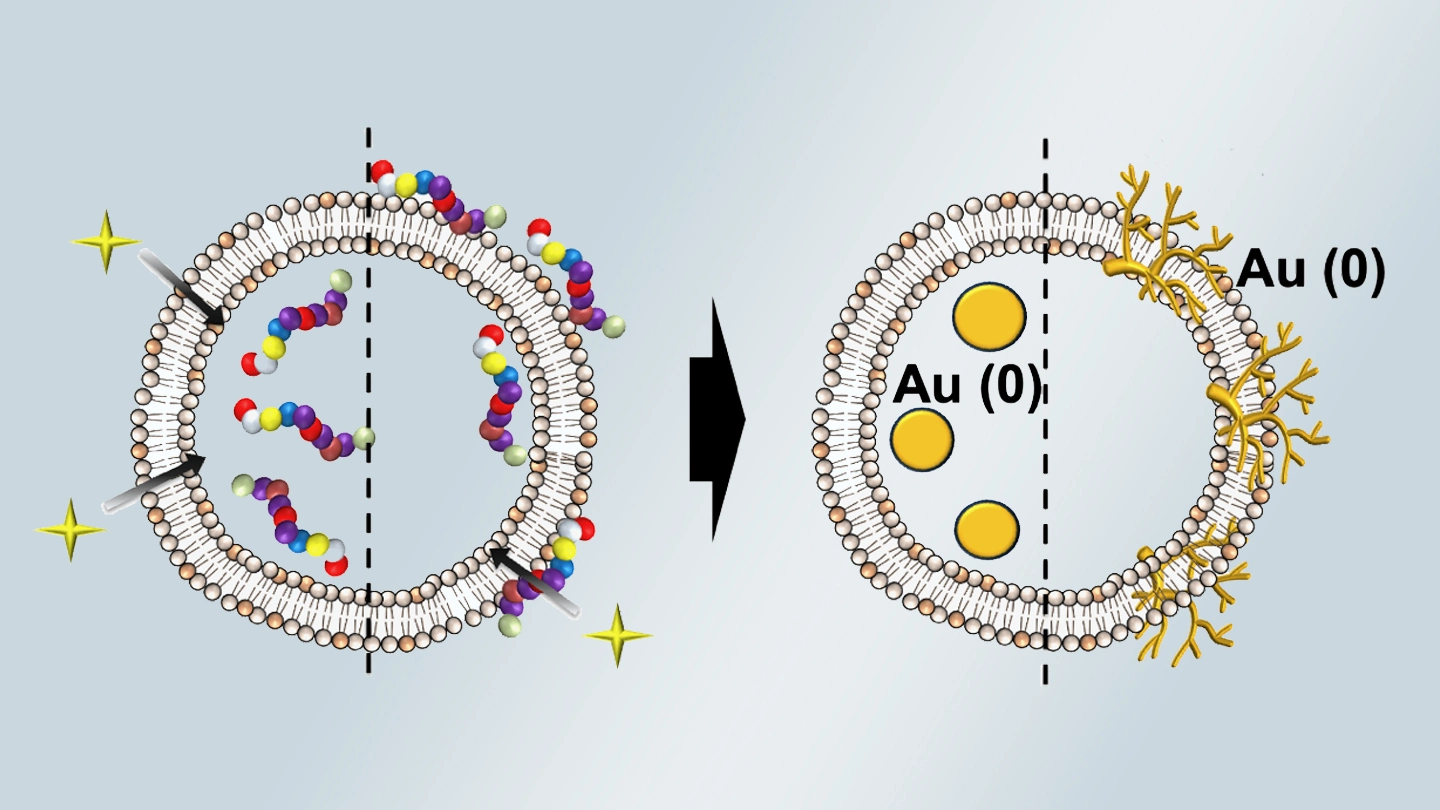
Summary of gold nanoparticle growth programming in liposome based on localization of biomineralization peptide The position of biomineralization peptides within liposomes can influence how gold nanoparticles grow, reports a research team from Institute of Science Tokyo. Peptides localized at the membrane interface promote branched structures, while those confined to the liposome interior favor spherical nanoparticles. The findings offer a new strategy for controlling nanoscale reaction...






