Researchers at Aalto University and Lawrence Berkeley National Laboratory have demonstrated that polaron formation also occurs in a system of magnetic charges, and not just in a system of electric charges. Being able to control the transport properties of such charges could enable new devices based on magnetic rather than electric charges, for example computer memories.
Polarons are an example of emergent phenomena known to occur in condensed matter physics. For instance, an electron moving across a crystal lattice displaces the surrounding ions, together creating an effective quasi-particle, a polaron, which has an energy and mass that differs from that of a bare electron. Polarons have a profound effect on electronic transport in materials.
Artificial spin ice systems are metamaterials that consist of lithographically patterned nanomagnets in an ordered two-dimensional geometry. The individual magnetic building blocks of a spin ice lattice interact with each other via dipolar magnetic fields.
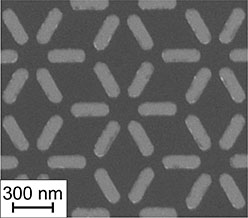
Electron microscopy image of a small fraction of the dipolar dice lattice. The spin ice structure consists of interacting ferromagnetic nanoislands. The experimental lattice consists of several thousand nanoislands and is fabricated by electron-beam lithography.
Researchers used material design as a tool to create a new artificial spin ice, the dipolar dice lattice.
‘Designing the correct two-dimensional lattice geometry made it possible to create and observe the decay of magnetic polarons in real-time,’ says postdoctoral researcher Alan Farhan from Lawrence Berkeley National Laboratory (USA).
‘We introduced the dipolar dice lattice because it offers a high degree of frustration, meaning that competing magnetic interactions cannot be satisfied simultaneously. Like all systems in nature, the dipolar dice lattice aims to relax and settle into a low-energy state. As a result, whenever magnetic charge excitations emerge over time, they tend to get screened by opposite magnetic charges from the environment,’ explains Dr. Farhan.
The researchers at Berkeley used photoemission electron microscopy, or PEEM, to make the observations. This technique images the direction of magnetization in individual nanomagnets.
With the magnetic moments thermally fluctuating, the creation and decay of magnetic polarons could be imaged in real space and time. Postdoctoral researcher Charlotte Peterson and Professor Mikko Alava at Aalto University (Finland) performed simulations, which confirmed the rich thermodynamic behavior of the spin ice system.
‘The experiments also demonstrate that magnetic excitations can be engineered at will by a clever choice of lattice geometry and the size and shape of individual nanomagnets. Thus, artificial spin ice is a prime example of a designer material. Instead of accepting what nature offers, it is now possible to assemble new materials from known building blocks with purposefully designed functionalities,’ says Professor Sebastiaan van Dijken from Aalto University.
‘This concept, which goes well beyond magnetic metamaterials, is only just emerging and will dramatically shape the frontier of materials research in the next decade,’ adds Professor van Dijken.
Thermodynamics of emergent magnetic charge screening in artificial spin ice.
Alan Farhan, Andreas Scholl, Charlotte F. Petersen, Luca Anghinolfi, Clemens Wuth, Scott Dhuey, Rajesh V. Chopdekar, Paula Mellado, Mikko J. Alava & Sebastiaan van Dijken.
Nature Communications 7 (2016). http://dx.doi.org/10.1038/ncomms12635
Aalto
#Physics