Jena scientists generate supercontinuum light source using liquid core optical fibers and reveal a new type of soliton dynamics
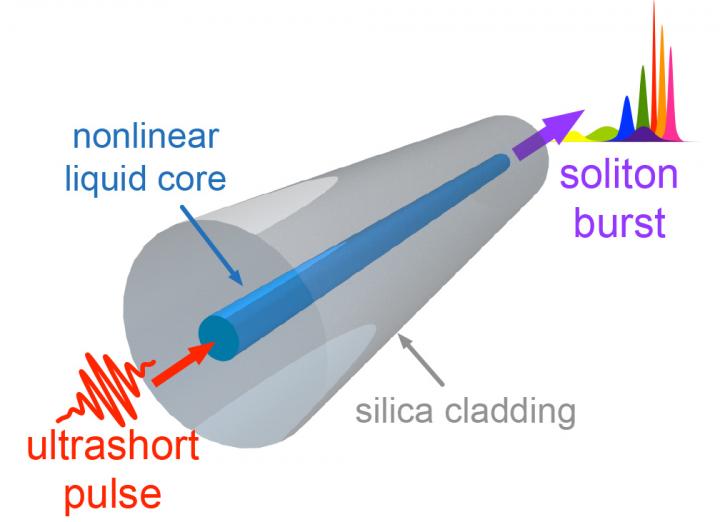
The researchers pumped a hybrid waveguide with an ultrafast, intense laser pulse and produced a very broad light spectrum in the near and mid-infrared range (1.1 μm to 2.7 μm) not visible to the human eye. Due to the unique characteristics of the liquid fiber core, the light pulse is broken up into solitons -- a multitude of light waves with different wavelengths. The solitons form the extremely broadband laser light that is indispensable as a supercontinuum light source for applications in medical imaging, measurement technology, and spectroscopy. The team of research scientists from the Leibniz Institute of Photonic Technology (Leibniz IPHT) in Jena, the Fraunhofer Institute of Applied Optics and Precision Mechanics, the Friedrich Schiller University of Jena, and the Helmholtz Institute Jena published the results of their work in the renowned journal Nature Communications.
Carbondisulfide shows non-linear optical effects and high transmission
The coupled, ultrafast light pulse breaks up into solitons only due to non-linear interactions with matter in the optical fiber. In case of liquid core fibers, this means that the optical density of the liquid inside the core changes significantly with the intensity of the incident light. However, not many materials show nonlinear optical effects and, at the same time, exhibit sufficient light transmission in the infrared spectral range. Mario Chemnitz, scientist at Leibniz IPHT and first author of the publication, explains the unusual effect as follows: "The fiber core is filled with carbon disulfide, a liquid chemical compound with a very high refractive index. If we now couple polarized light into the core, the carbon disulfide molecules orient themselves along the electromagnetic field of the light. Due to this molecular orientation, the optical density -- and thus the light propagation in the fiber -- depends on the intensity of the laser light."
Optical memory effect
One unique feature of carbon disulfide is that the molecules orient themselves with a certain time delay. If the incident laser light pulse is much shorter than the time that the molecules require for orientation in the optical field, the research scientists can observe a special, delayed dynamic of the resulting solitons. This was predicted back in 2010, but it was only now, the Jena scientists were able to provide experimental proof and an exact theoretical description of the processes. Mario Chemnitz describes this phenomenon as an optical "memory effect" of the liquid. This unique characteristic of the liquid fiber cores reduces fluctuations in the spectral bandwidth of the supercontinuum light source and makes liquid core fibers a more stable alternative to the known broadband light sources based on optical fibers made from special glasses.
Leibniz Institute of Photonic Technology
#Photonics #Laser #Physics