From everyday experience we know that metals are good conductors for both electricity and heat -- think inductive cooking or electronic devices warming up upon intense use. That intimate link of heat and electrical transport is no coincidence. In typical metals both sorts of conductivity arise from the flow of 'free' electrons, which move like a gas of independent particles through the material. But when fermionic carriers such as electrons interact with one another, then unexpected phenomena can arise, as Dominik Husmann, Laura Corman and colleagues in the group of Tilman Esslinger in the Department of Physics at ETH Zurich -- in collaboration with Jean-Philippe Brantut at the École Polytechnique Fédérale de Lausanne (EPFL) -- report in a paper in the journal Proceedings of the National Academy of Sciences. Studying heat and particle conduction in a systems of strongly interacting fermionic atoms they found a range of puzzling behaviours that set this system apart from known systems in which the two forms of transport are coupled.
In metals, the connection of thermal and electrical conductivity is described by the Wiedemann-Franz law, which has first been formulated in 1853. In its modern form the law states that at a fixed temperature, the ratio between the two types of conductivity is constant. The value of that ratio is quite universal, being the same for a remarkably wide range of metals and conditions. That universality breaks down, however, when the carriers interact with one another. This has been observed in a handful of exotic metals hosting strongly correlated electrons. But Husmann, Corman and their co-workers have now explored the phenomenon in a system in which they had exquisite control over all relevant parameters, enabling them to monitor particle and heat transport in unprecedented detail.
Clean transport
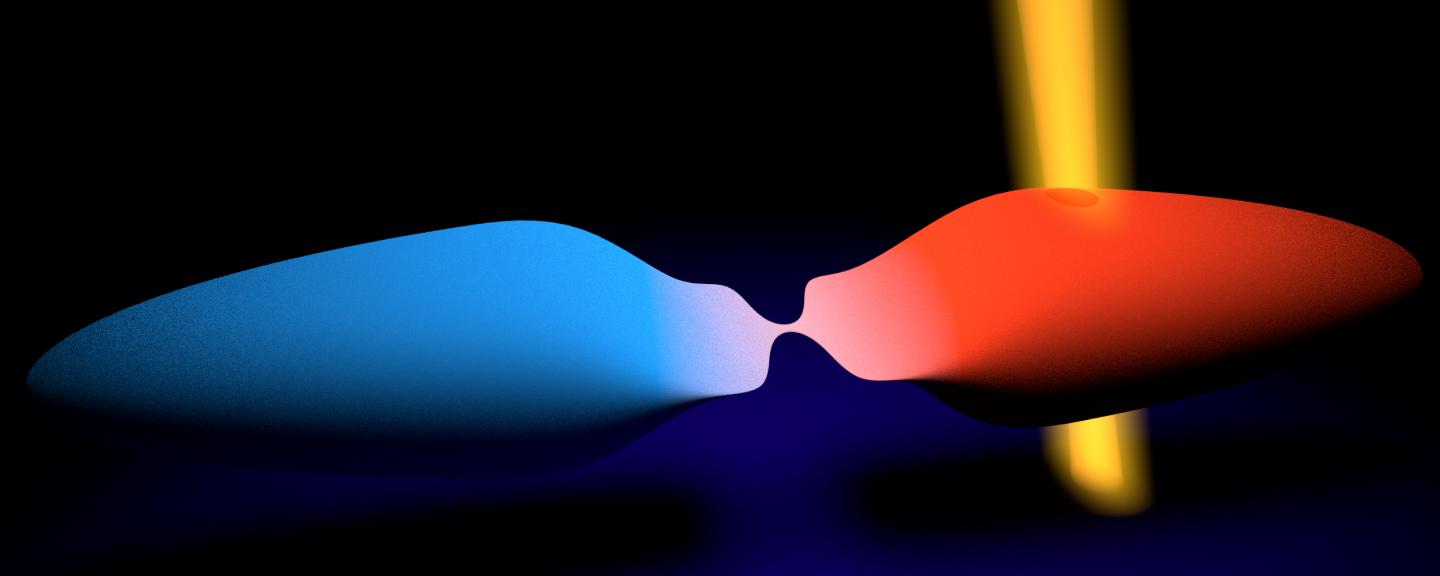
The carriers in their experiments are fermionic lithium atoms, which they cooled to sub-microkelvin temperatures and trapped using laser beams. Initially, they confined a few hundred thousand of these atoms to two independent reservoirs that can be heated individually. Once a temperature difference between the two reservoirs had been established, they opened a tiny restriction between them -- a so-called quantum point contact -- thus initiating transport of particles and heat (see the figure). The transport channel is defined and controlled using laser light as well. The experiment therefore provides an extraordinarily clean platform for studying fermionic transport. For example, in real materials, the lattice through which the electrons flow starts to melt at high temperatures. In contrast, in the cold-atom setup, with the structures defined by light, no such 'lattice heating' occurs, making it possible to focus on the carriers themselves.
Puzzling behaviour
When Husmann et al. determined the ratio between thermal and particle conductivity in their system, they found it to be an order of magnitude below the predictions of the Wiedemann-Franz law. This deviation indicates a separation of the mechanisms responsible for particle and heat currents, in contrast to the situation so universally observed for free carriers. As a result, their system evolved into a state in which heat and particle currents vanished long before an equilibrium between the two reservoirs in terms of temperature and particle number has been reached.
Moreover, another measure for thermoelectric behaviour, the Seebeck coefficient, was found to have a value close to that expected for a non-interacting Fermi gas. This is puzzling, because in some regions of the channel the strongly interacting atoms were in the superfluid regime (in which a gas or liquid flows without viscosity) and in the prototypical superfluid, helium-4, the Seebeck coefficient is zero. This discrepancy signals a different thermoelectric character for the fermionic gas studied by the ETH team.
These findings therefore pose new challenges for microscopic modelling of strongly interacting fermion systems. At the same time, the platform established with these experiments could help to explore novel concepts for thermoelectric devices, such as coolers and engines that are based on interconverting temperature differences into particle flow, and vice versa.
Breakdown of the Wiedemann–Franz law in a unitary Fermi gas
Dominik Husmann, Martin Lebrat, Samuel Häusler, Jean-Philippe Brantut, Laura Corman, and Tilman Esslinger
PNAS August 9, 2018. 201803336;
DOI: https://doi.org/10.1073/pnas.1803336115
ETH Zurich
#Physics