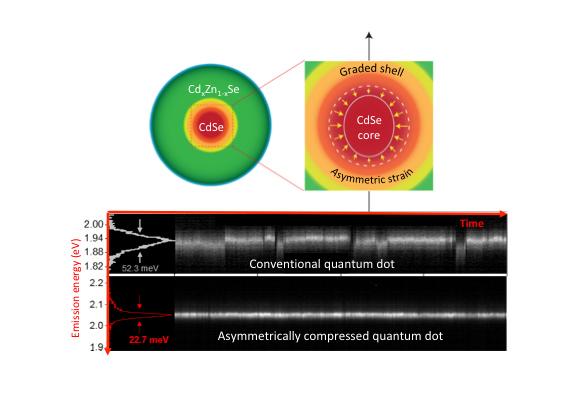
Intentionally "squashing" colloidal quantum dots during chemical synthesis creates dots capable of stable, "blink-free" light emission that is fully comparable with the light produced by dots made with more complex processes. The squashed dots emit spectrally narrow light with a highly stable intensity and a non-fluctuating emission energy. New research at Los Alamos National Laboratory suggests that the strained colloidal quantum dots represent a viable alternative to presently employed nanoscale light sources, and they deserve exploration as single-particle, nanoscale light sources for optical "quantum" circuits, ultrasensitive sensors, and medical diagnostics.
"In addition to exhibiting greatly improved performance over traditional produced quantum dots, these new strained dots could offer unprecedented flexibility in manipulating their emission color, in combination with the unusually narrow, 'subthermal' linewidth," said Victor Klimov, lead Los Alamos researcher on the project. "The squashed dots also show compatibility with virtually any substrate or embedding medium as well as various chemical and biological environments."
The new colloidal processing techniques allow for preparation of virtually ideal quantum-dot emitters with nearly 100 percent emission quantum yields shown for a wide range of visible, infrared and ultraviolet wavelengths. These advances have been exploited in a variety of light-emission technologies, resulting in successful commercialization of quantum-dot displays and TV sets.
The next frontier is exploration of colloidal quantum dots as single-particle, nanoscale light sources. Such future "single-dot" technologies would require particles with highly stable, nonfluctuating spectral characteristics. Recently, there has been considerable progress in eliminating random variations in emission intensity by protecting a small emitting core with an especially thick outer layer. However, these thick-shell structures still exhibit strong fluctuations in emission spectra.
In a new publication in the journal Nature Materials, Los Alamos researchers demonstrated that spectral fluctuations in single-dot emission can be nearly completely suppressed by applying a new method of "strain engineering." The key in this approach is to combine in a core/shell motif two semiconductors with directionally asymmetric lattice mismatch, which results in anisotropic compression of the emitting core.
This modifies the structures of electronic states of a quantum dot and thereby its light emitting properties. One implication of these changes is the realization of the regime of local charge neutrality of the emitting "exciton" state, which greatly reduces its coupling to lattice vibrations and fluctuating electrostatic environment, key to suppressing fluctuations in the emitted spectrum. An additional benefit of the modified electronic structures is dramatic narrowing of the emission linewidth, which becomes smaller than the room-temperature thermal energy.
Asymmetrically strained quantum dots with non-fluctuating single-dot emission spectra and subthermal room-temperature linewidths
Young-Shin Park, Jaehoon Lim & Victor I. Klimov
DOI: 10.1038/s41563-018-0254-7
Los Alamos National Laboratory
#QuantumDots #Nanoelectronics
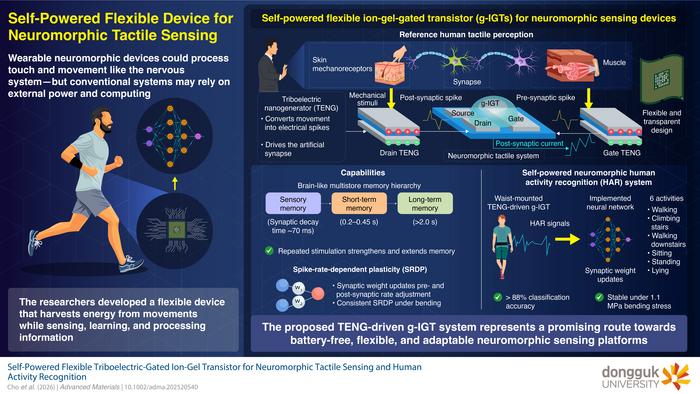
The proposed TENG-driven g-IGT is a flexible, self-powered neuromorphic device capable of reproducing multiple memory states and spike-rate-dependent learning Neuromorphic devices, which are designed to emulate aspects of biological neural networks, are promising candidates for developing low-power and intelligent sensing technologies, including wearable applications. Among the device architectures explored for neuromorphic computing, graphene-channel ion-gel-gated transistors (g-IGTs) are...

Rice University researchers have shown that sub-nanometer wrinkles in graphene generate flexoelectric charge separation, reshaping local electrical behavior through curvature alone. Extreme bending produces polarization far stronger than in larger systems and may enable geometry-controlled electronics without chemical doping. Published in Advanced Materials.
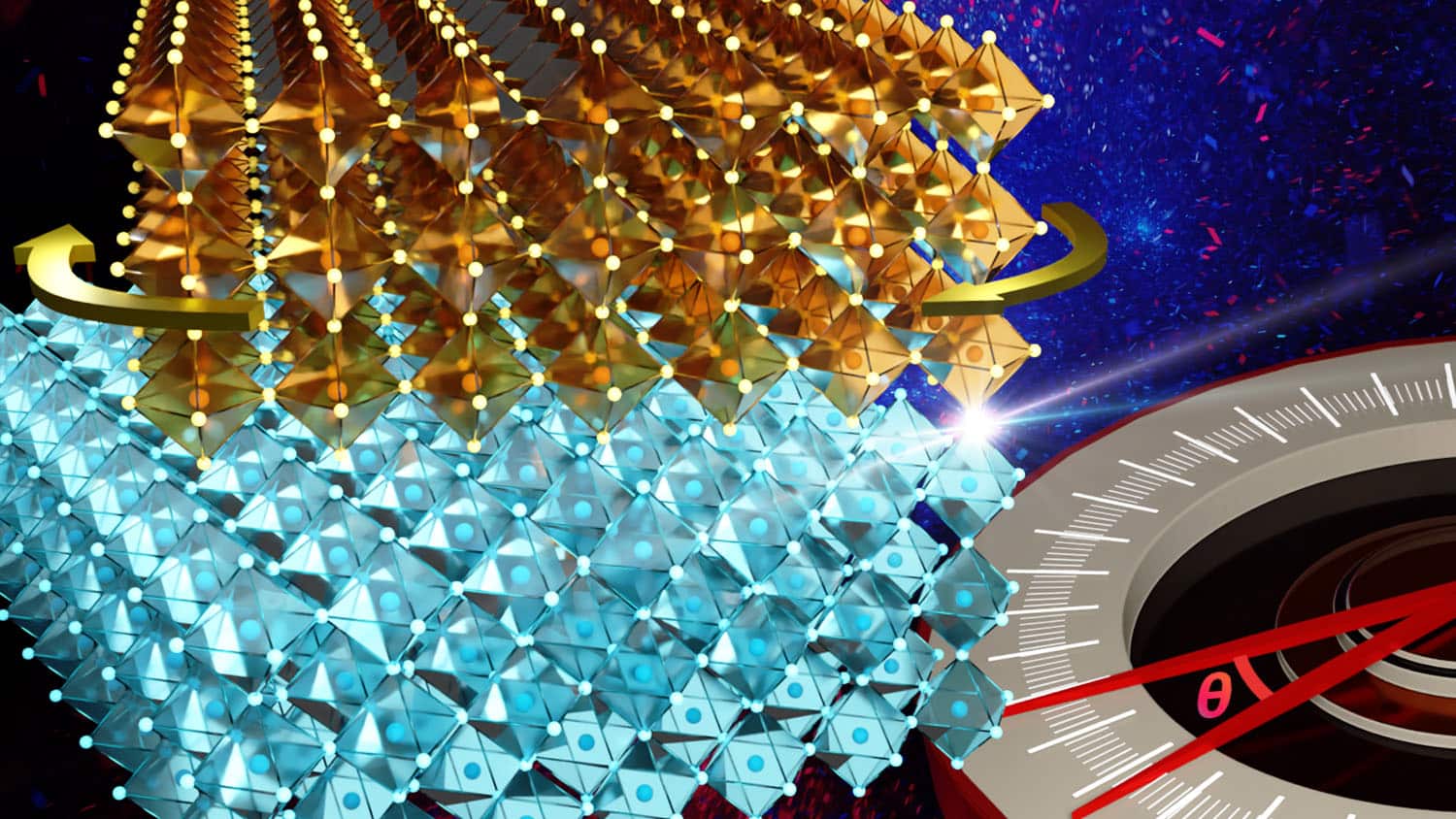
Researchers at NC State have extended twistronics beyond van der Waals materials into strongly bonded crystalline oxides. By stacking sodium niobate membranes with twist angles controlled down to 0.1 degrees, and confirming results via synchrotron X-ray diffraction, the team found interlayer bonds distort the atomic lattice, shifting phase structure and domain configuration. The technique works at near-millimeter scale, far larger than typical twistronic devices, marking a real step toward pract






