Hokkaido University
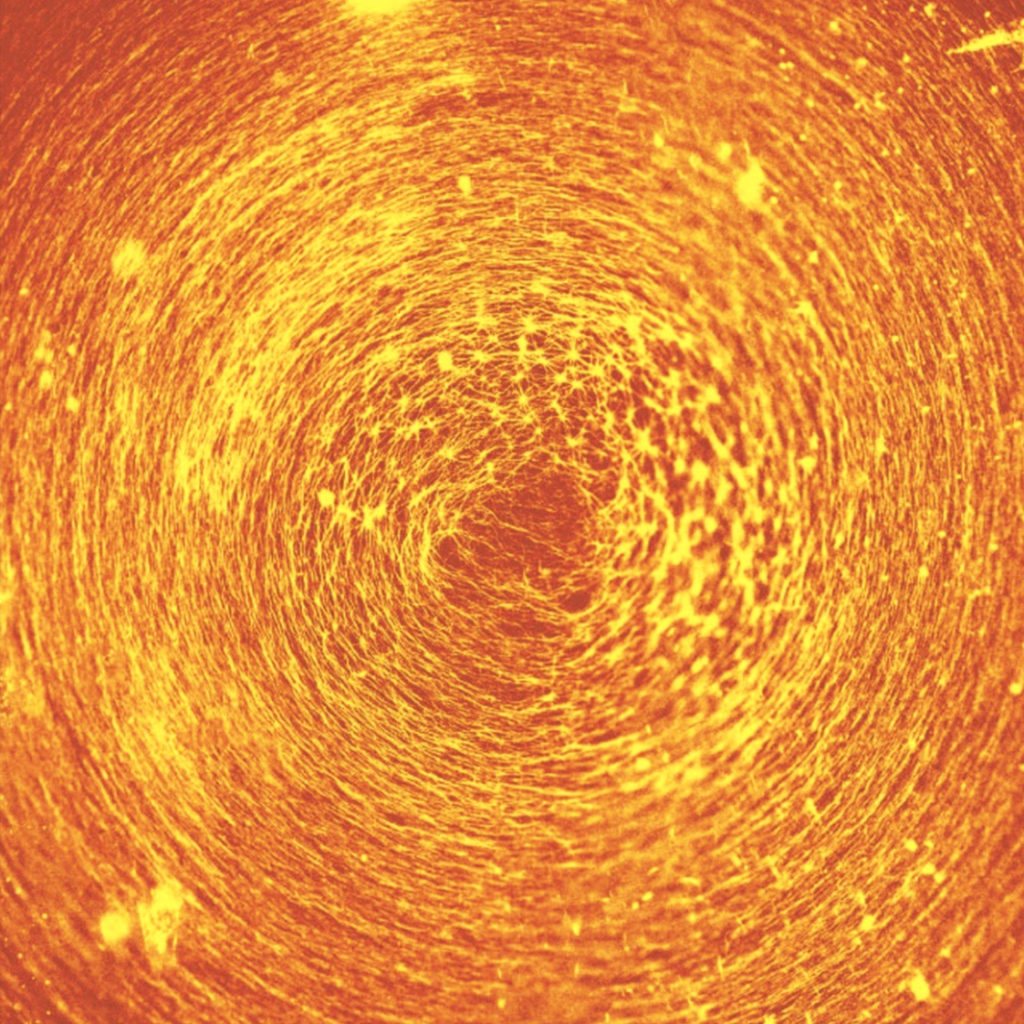
The swarming behavior of about 100 million molecular machines can be controlled by applying simple mechanical stimuli such as extension and contraction. This method could lead to the development of new swarming molecular machines and small energy-saving devices.
The swarming molecules in motion aligned in one direction, exhibited zigzag patterns, or formed a vortex responding to varying mechanical stimuli. They could even self-repair the moving pattern after a disruption, according to a study led by Hokkaido University scientists.
In recent years, many scientists have made efforts to miniaturize machines found in the macroscopic world. The 2016 Nobel laureates in chemistry were awarded for their outstanding research on molecular machines and design and synthesis of nanomachines.
In previous studies, the research team led by Associate Professor Akira Kakugo of Hokkaido University developed molecular machines consisting of motor proteins called kinesins and microtubules, which showed various swarming behaviors. "Swarming is a key concept in modern robotics. It gives molecular machines new properties such as robustness and flexibility that an individual machine cannot have," says Akira Kakugo. "However, establishing a methodology for controlling swarming behaviors has been a challenge."
In the current study published in ACS Nano, the team used the same system comprising motor protein kinesins and microtubules, both bioengineered. The kinesins are fixed on an elastomer substrate surface, and the microtubules are self-propelled on the kinesins, powered by the hydrolysis of adenosine triphosphate (ATP).
"Since we know that applying mechanical stress can play a key role in pattern formation for active matters, we investigated how deformation of the elastomer substrate influences the swarming patterns of molecular machines," says Akira Kakugo.
By extending and contracting the elastomer substrate, mechanical stimulation is applied to about 100 million microtubules that run on the substrate surface. The researchers first found that microtubules form wave patterns when no stress is applied. When the substrate is expanded and contracted 1.3 times or more one time, almost all of the 100 million microtubules perpendicularly aligned to the expansion and contraction axis, and when the substrate is expanded and contracted 1.3 times or less repeatably, it created zigzag patterns placed in diagonal directions.
Their computer simulation suggested that the orientation angles of microtubules correspond to the direction to attain smooth movement without buckling, which is further amplified by the collective migration of the microtubules.
Another important finding was that the moving pattern of microtubules can be modulated by applying new mechanical stimuli and it can be self-repaired even if the microtubule arrangement is disturbed by scratching a part of it.
"Our findings may contribute to the development of new molecular machines that perform collective motion and could also help advance technologies for energy-saving small devices," Akira Kakugo commented.
Adaptation of Patterns of Motile Filaments under Dynamic Boundary Conditions
Daisuke Inoue, Greg Gutmann, Takahiro Nitta, Arif Md. Rashedul Kabir, Akihiko Konagaya, Kiyotaka Tokuraku, Kazuki Sada, Henry Hess, Akira Kakugo
ACS Nano October 4, 2019
Contact information:
Akira Kakugo
Associate Professor at Department of Chemistry, Hokkaido University
kakugo@sci.hokudai.ac.jp
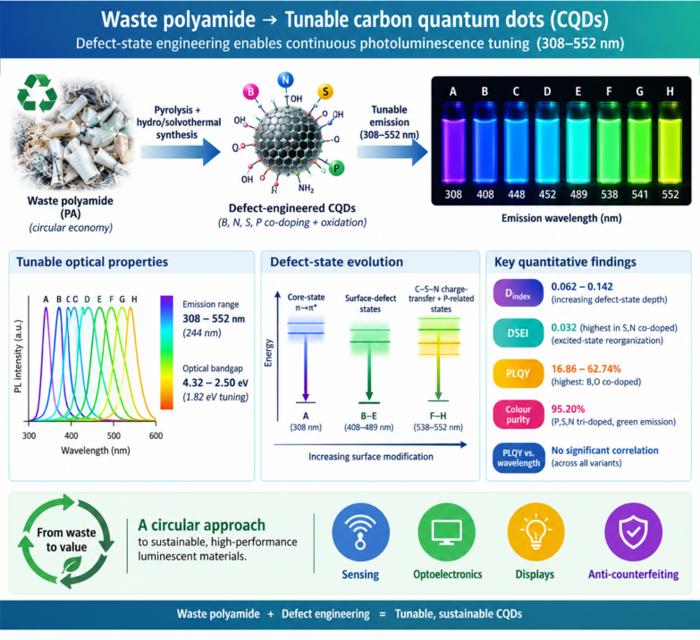
Waste polyamide-derived CQDs show continuous photoluminescence tuning from 308 to 552 nm through sequential defect-state engineering, with optical transition energies decreasing from 4.32 to 2.50 eV. @Christian Ebere Enyoh from Saitama University Carbon quantum dots (CQDs) are fluorescent carbon nanomaterials with potential applications in sensing, optoelectronics, displays, anti-counterfeiting, and environmental technologies. Their optical properties can be adjusted by modifying the carbon...
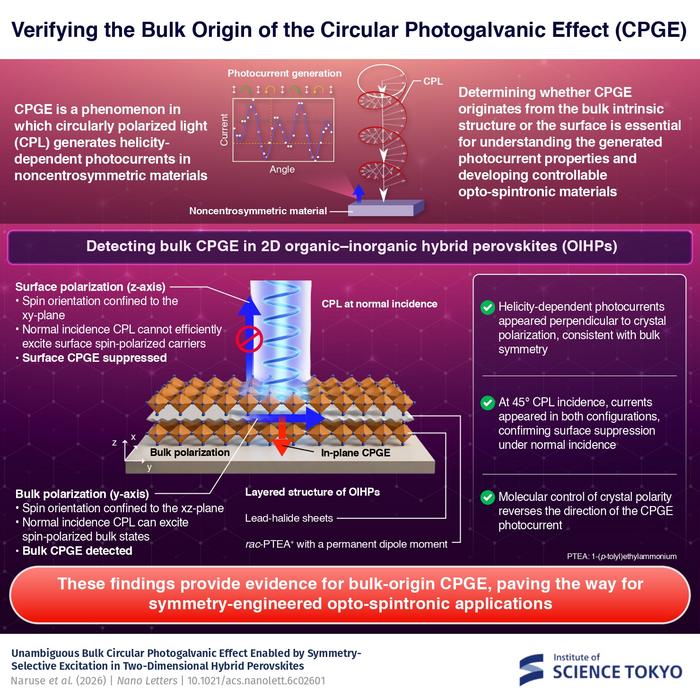
The researchers used circularly polarized light at normal incidence and found that helicity-dependent photocurrents appeared perpendicular to the crystal’s polarization but vanished when measured parallel to it, supporting a bulk origin of CPGE. @Institute of Science Tokyo The circular photogalvanic effect (CPGE), a phenomenon that generates helicity-dependent photocurrents in noncentrosymmetric materials, can originate purely from a crystal's internal structure without contribution from the...
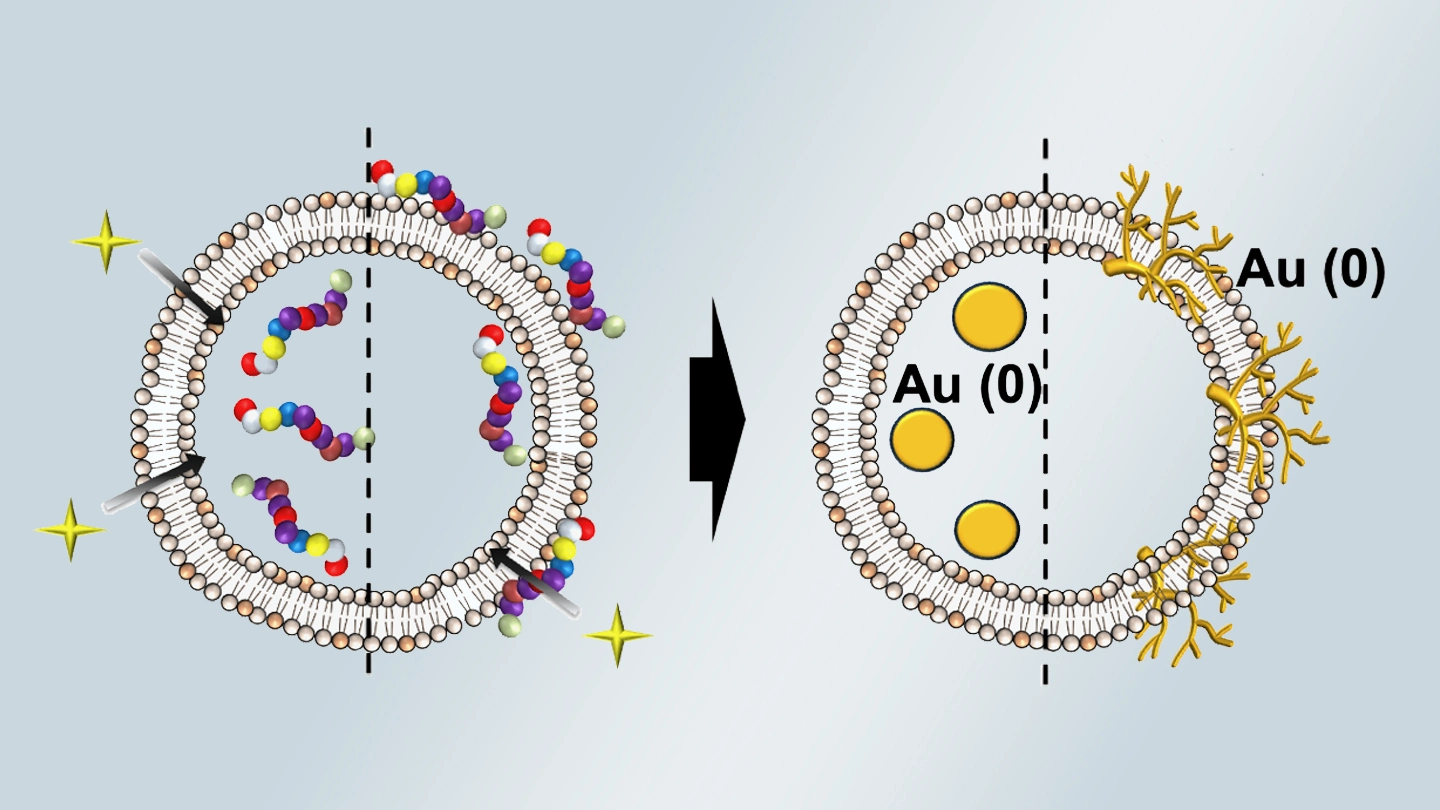
Summary of gold nanoparticle growth programming in liposome based on localization of biomineralization peptide The position of biomineralization peptides within liposomes can influence how gold nanoparticles grow, reports a research team from Institute of Science Tokyo. Peptides localized at the membrane interface promote branched structures, while those confined to the liposome interior favor spherical nanoparticles. The findings offer a new strategy for controlling nanoscale reaction...
