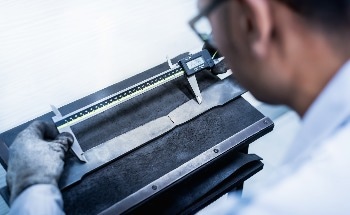
9 October 2026. Alemnis has enabled controlled, constant indentation strain rates of up to 100,000 s-1 (10^5 s-1) in high-strain-rate micromechanical testing, while maintaining quantitative load-displacement measurement. The company said the capability relies on true displacement control, in which the platform actively controls displacement throughout the experiment.
The platform maintains a defined, constant strain rate under dynamic conditions. According to the company, reaching very high strain rates requires displacement to be applied extremely rapidly while keeping precise control over the deformation process. With Alemnis ultra-high-strain-rate technology and high-performance electronics, true displacement control can be maintained at strain rates up to 10^5 s-1.
Conventional nanoindentation typically operates at much lower strain rates, while impact-based methods can reach higher rates but often with less control over the deformation history. Alemnis said it bridges this gap by combining ultra-high-speed actuation, fast data acquisition and true displacement control. The same technology can also be applied to microcompression and microtensile testing.
The capability was demonstrated on molybdenum, nanocrystalline nickel and fused silica across five orders of magnitude in strain rate. A clear hardness increase was observed at high strain rates in all three materials. For molybdenum, the results showed the hardness increase was primarily associated with changes in the dislocation structure and increasing dislocation density.
The capability was demonstrated in the study “Filling a Gap in Materials Mechanics: Nanoindentation at High Constant Strain Rates up to 10^5 s-1,” published in Small and available at https://doi.org/10.1002/smll.73215.
Source: Alemnis
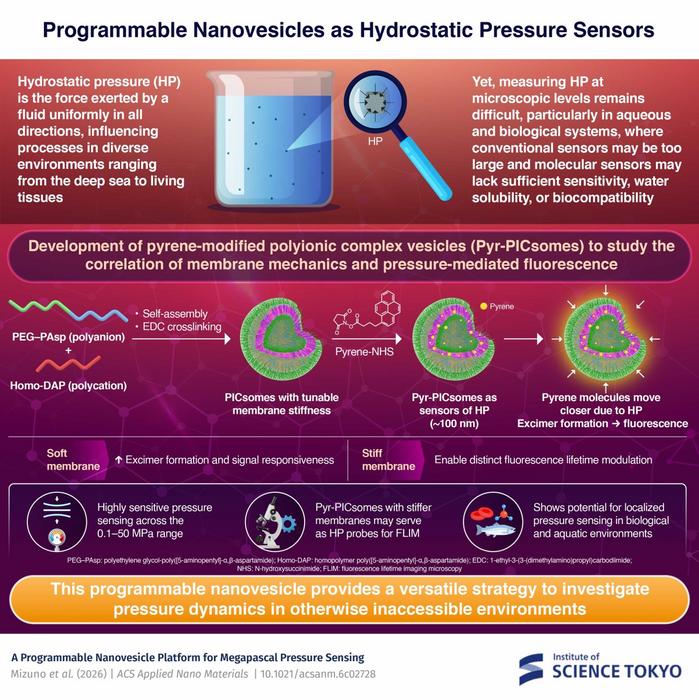
Pyrene-modified polyionic complex vesicles, or Pyr-PICsomes, convert hydrostatic pressure into measurable fluorescence. Crosslinking density tunes membrane stiffness, which governs sensing behavior: soft vesicles give strong excimer-to-monomer ratio changes from 0.1 to 50 MPa, while stiff membranes respond through fluorescence lifetime, suiting lifetime imaging.
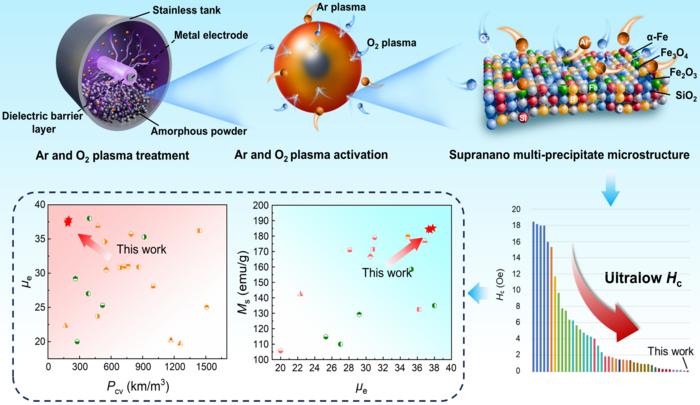
Ar/O₂ plasma treatment generates supranano α-Fe, Fe₃O₄, SiO₂ and Fe₂O₃ precipitates just 0.8–2.5 nm across amorphous powder surfaces, creating nucleation sites that ease magnetic-moment reversal. The resulting soft magnetic composite combines 0.13 Oe coercivity, 37.3 permeability, 185 emu g⁻¹ saturation magnetization and 191.18 kW m⁻³ core loss at 1 MHz and 20 mT. The surface route avoids bulk composition changes, aiding scale-up for high-frequency inductors and power chokes.
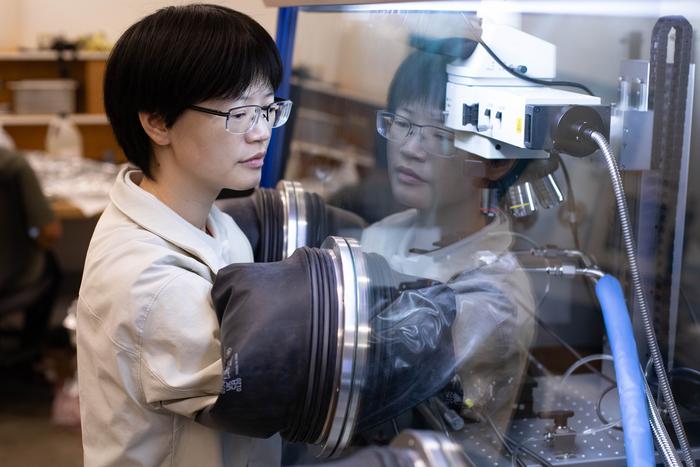
Microscopy of uranium oxytelluride has revealed a chiral superlattice, a twisted atomic pattern that was previously unrecognized in a compound known since the 1960s. Electrons moving through the spiral structure behave unexpectedly because the material combines ferromagnetic and antiferromagnetic order, an unusual pairing that could support faster, more robust magnetic memory.






