University of Tokyo
A team of researchers at The University of Tokyo and Fudan University studied the process of crystallization when more than one structural arrangement is possible. By reducing the noise from random fluctuations, they found that transient precursors of the various crystalline orderings coexist and compete with each other. This work may help lead to more efficient crystal engineering methods.
One of most popular exhibits of any geology museum must be the crystal section. Large flat rectangular or tetrahedral faces of an elegant crystal reflect underlying molecular patterns. On closer inspection, some specimens turn out to be mosaics of different shapes, showing that the same atoms can arrange themselves in multiple ways, called polymorphism. In fact, all crystals are just repeating arrangements of atoms or larger particles that typically grow from smaller "seeds." These seeds serve as initial templates that allow new particles to attach in the proper locations. However, when multiple structures exhibit similar stabilities, the crystallization process can become extremely complex.
To better understand this, researchers at The University of Tokyo and Fudan University studied an experimental system consisting of uniform poly(methyl methacrylate) colloidal spheres. Using confocal microscopy, which allows the 3D-positions of many particles to be tracked simultaneously, along with powerful computer algorithms, the team observed a seething mixture of competing structures constantly breaking and reforming. Each type of crystalline ordering precursor was in competition to seed the growth of that type of structure. The scientists discovered that the intermediate structures before crystallization was complete turned out to be mixtures of local orders that were short-lived and frequently transformed into each other. "Competition between different crystal orderings takes place locally and can be masked by large positional fluctuations," says senior author Peng Tan.
To overcome this noise, the team had to use computational methods to correctly classify the various structures. The spatial coexistence of phases, together with newly found temporal fluctuations of competing orders, shows that disorder is an intrinsic feature of crystal precursors.
"Our method provides the clearest picture yet of the competition that can exist between the various crystalline forms in a single sample," says senior author Hajime Tanaka. "This research may pave the way for new approaches for the industrial production of crystalline materials."
Revealing roles of competing local structural orderings in crystallization of polymorphic systems
Minhuan Li, Yanshuang Chen, Hajime Tanaka and Peng Tan
Science Advances Vol. 6, no. 27, eaaw8938 (01 Jul 2020)
Contact information:
Hajime Tanaka
Senior Collaborators, Institute of Industrial Science, the University of Tokyo
tanaka@iis.u-tokyo.ac.jp
Phone: +81-3-5452-6125
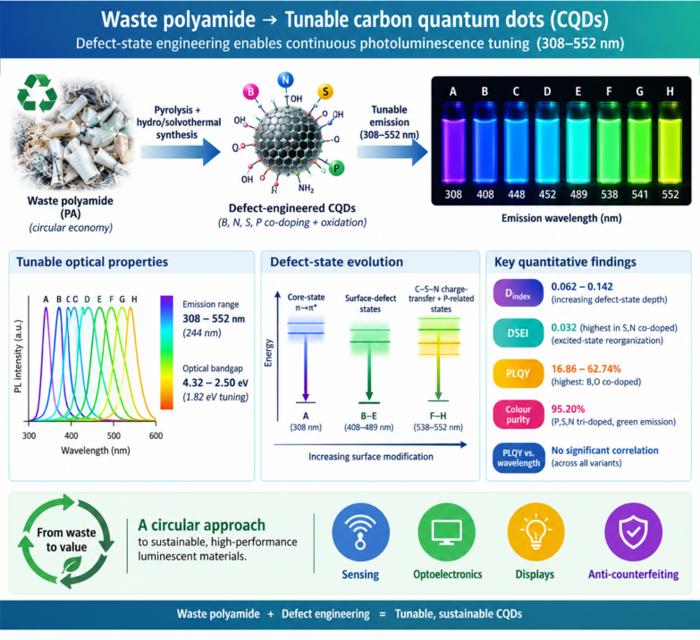
Waste polyamide-derived CQDs show continuous photoluminescence tuning from 308 to 552 nm through sequential defect-state engineering, with optical transition energies decreasing from 4.32 to 2.50 eV. @Christian Ebere Enyoh from Saitama University Carbon quantum dots (CQDs) are fluorescent carbon nanomaterials with potential applications in sensing, optoelectronics, displays, anti-counterfeiting, and environmental technologies. Their optical properties can be adjusted by modifying the carbon...
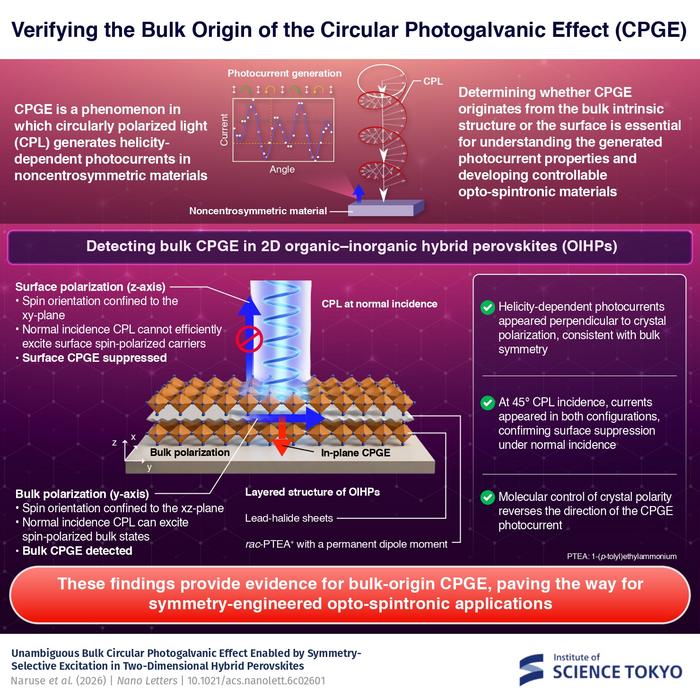
The researchers used circularly polarized light at normal incidence and found that helicity-dependent photocurrents appeared perpendicular to the crystal’s polarization but vanished when measured parallel to it, supporting a bulk origin of CPGE. @Institute of Science Tokyo The circular photogalvanic effect (CPGE), a phenomenon that generates helicity-dependent photocurrents in noncentrosymmetric materials, can originate purely from a crystal's internal structure without contribution from the...
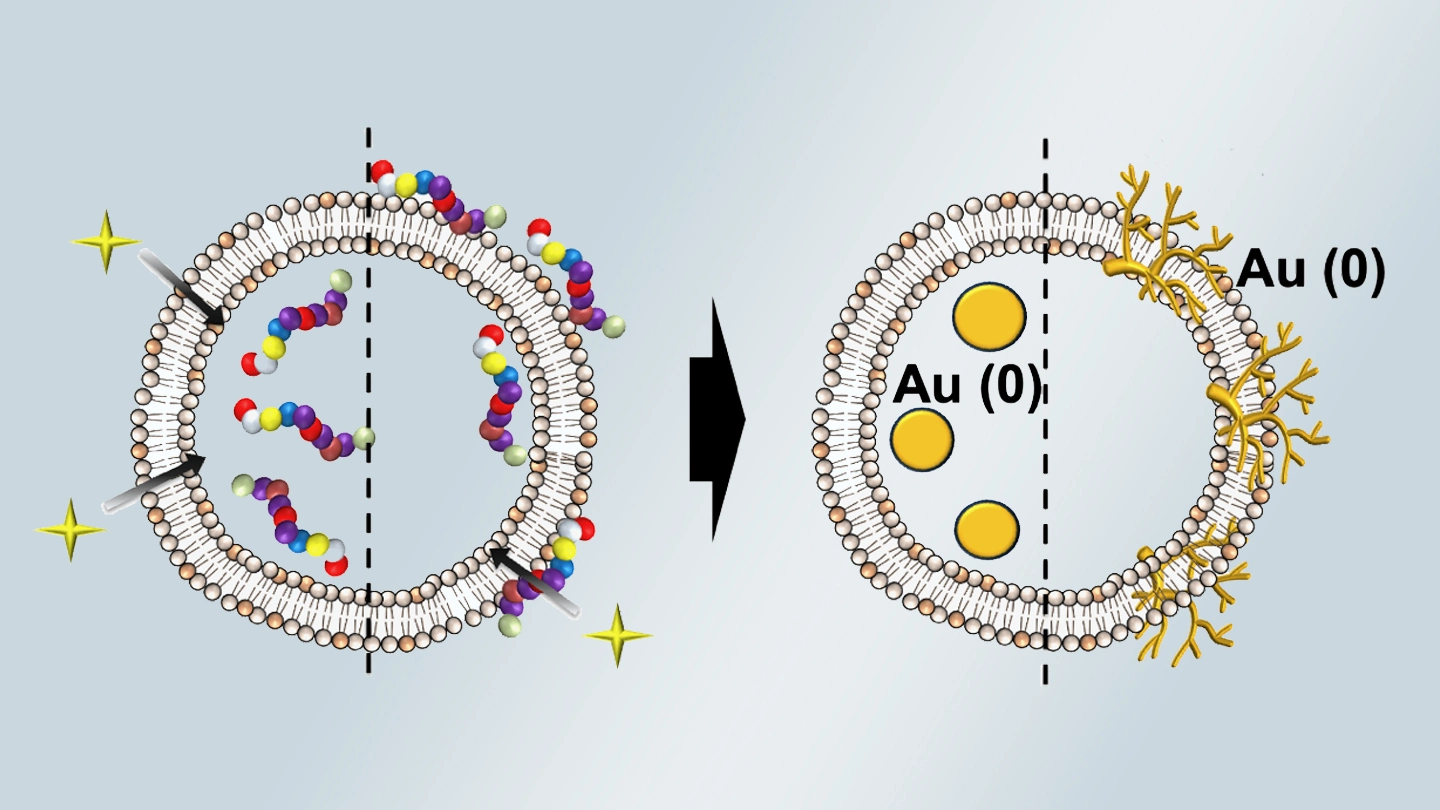
Summary of gold nanoparticle growth programming in liposome based on localization of biomineralization peptide The position of biomineralization peptides within liposomes can influence how gold nanoparticles grow, reports a research team from Institute of Science Tokyo. Peptides localized at the membrane interface promote branched structures, while those confined to the liposome interior favor spherical nanoparticles. The findings offer a new strategy for controlling nanoscale reaction...