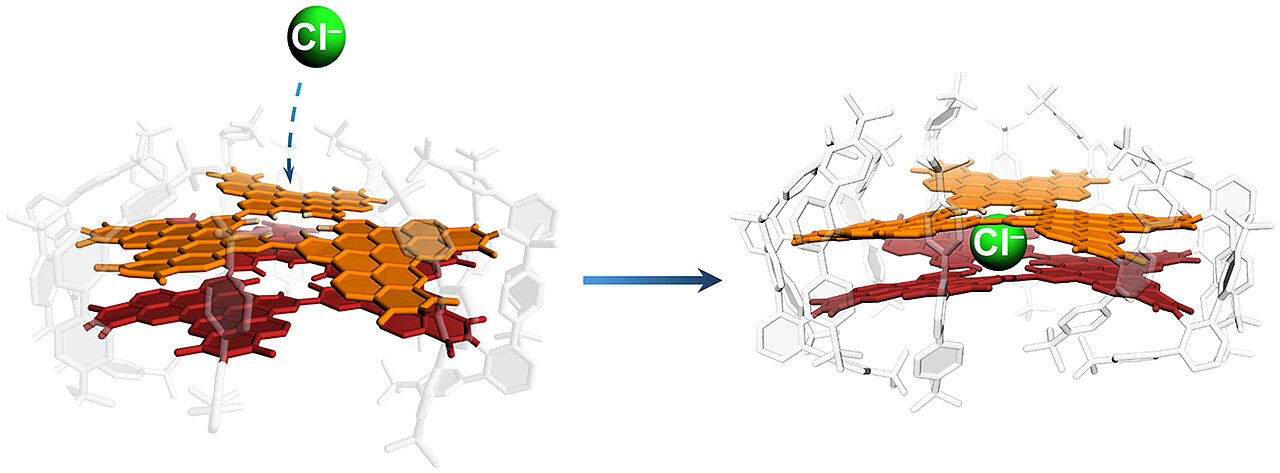
Graphene is an extremely thin, flexible and resistant material made of pure carbon. It forms layers that consist of virtually a single layer of carbon atoms. To make graphene as thick as a human hair, thousands of such layers would have to be stacked on top of each other.
Many researchers are working intensively on graphene. There is a good reason for this, as the special properties of the material promise new applications, for example in electronics or energy technology.
Making Graphene Permeable to Other Molecules
It is particularly interesting for scientists to be able to control the permeability of graphene for different substances: ‘So-called defects can be created in the carbon lattice of graphene. These can be thought of as small holes that make the lattice permeable to gases,’ says chemistry professor Frank Würthner from Julius-Maximilians-Universität (JMU) Würzburg in Bavaria, Germany.
Permeability to other substances, such as ions like fluoride, chloride or bromide, has not yet been observed. ‘However, this would be of fundamental scientific interest for applications such as the desalination of water, the detection or purification of mixtures of substances,’ explains the Würzburg professor.
Defect Allows Ions to Pass Through: Publication in Nature
For the first time, a team led by Frank Würthner has now created a model system with a defect that allows the halides fluoride, chloride and bromide to pass through, but not iodide. This was achieved in a stable double layer consisting of two nanographenes that encloses a cavity. The penetrated halide ions are bound in this cavity so that the time required for entry could be measured. The results have been published in the journal Nature.
Chloride is a component of common salt, is found in seawater and plays an important role in life processes in all organisms. ‘The proof of a high permeability for chloride by single-layer nanographene and a selective binding of halides in a double-layer nanographene brings some applications closer,’ says Dr Kazutaka Shoyama, who initiated and led the project together with Frank Würthner. Such applications include water filtration membranes, artificial receptors and chloride channels.
Larger Stacks of Nanographenes are the Next Goal
In the next step, the Würzburg chemists want to build larger stacks of their nanographenes. They want to use them to investigate the flow of ions – and thus a process that also takes place in a similar form in biological ion channels.
Reference
Bilayer nanographene reveals halide permeation through a benzene hole
M. A. Niyas, Kazutaka Shoyama, Matthias Grüne & Frank Würthner
https://www.nature.com/articles/s41586-024-08299-8
University of Würzburg
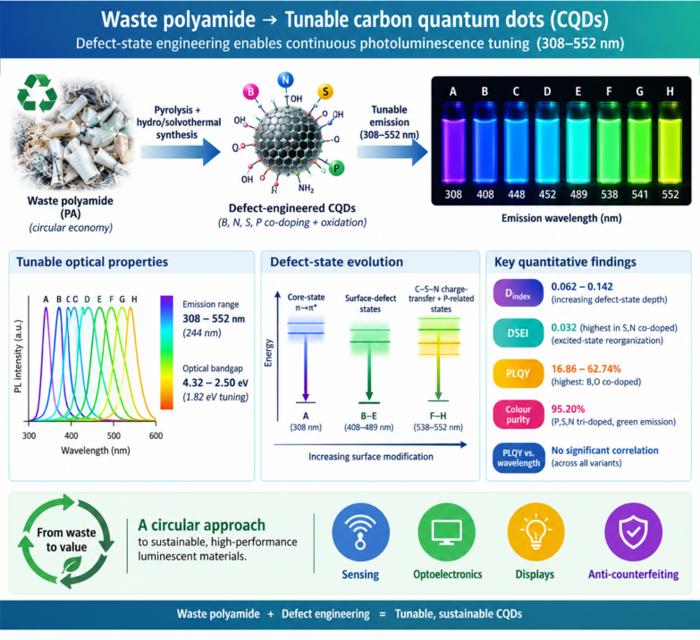
Waste polyamide-derived CQDs show continuous photoluminescence tuning from 308 to 552 nm through sequential defect-state engineering, with optical transition energies decreasing from 4.32 to 2.50 eV. @Christian Ebere Enyoh from Saitama University Carbon quantum dots (CQDs) are fluorescent carbon nanomaterials with potential applications in sensing, optoelectronics, displays, anti-counterfeiting, and environmental technologies. Their optical properties can be adjusted by modifying the carbon...
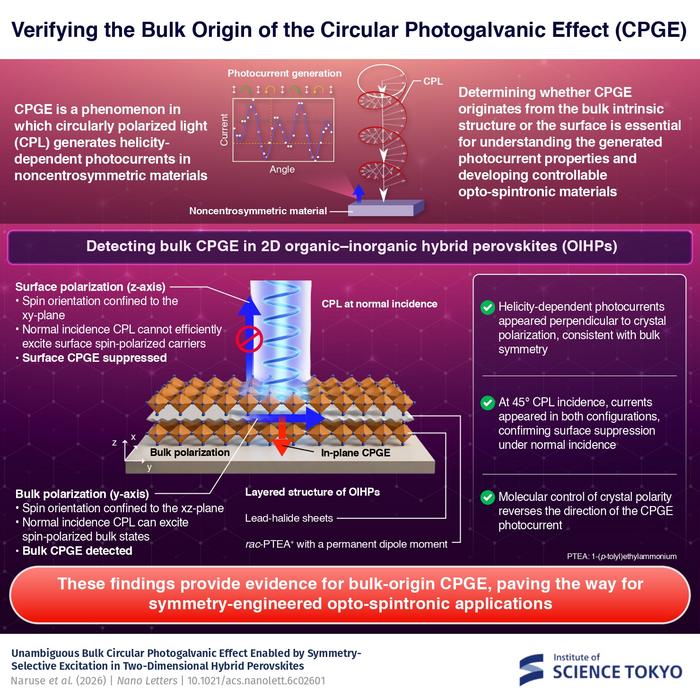
The researchers used circularly polarized light at normal incidence and found that helicity-dependent photocurrents appeared perpendicular to the crystal’s polarization but vanished when measured parallel to it, supporting a bulk origin of CPGE. @Institute of Science Tokyo The circular photogalvanic effect (CPGE), a phenomenon that generates helicity-dependent photocurrents in noncentrosymmetric materials, can originate purely from a crystal's internal structure without contribution from the...
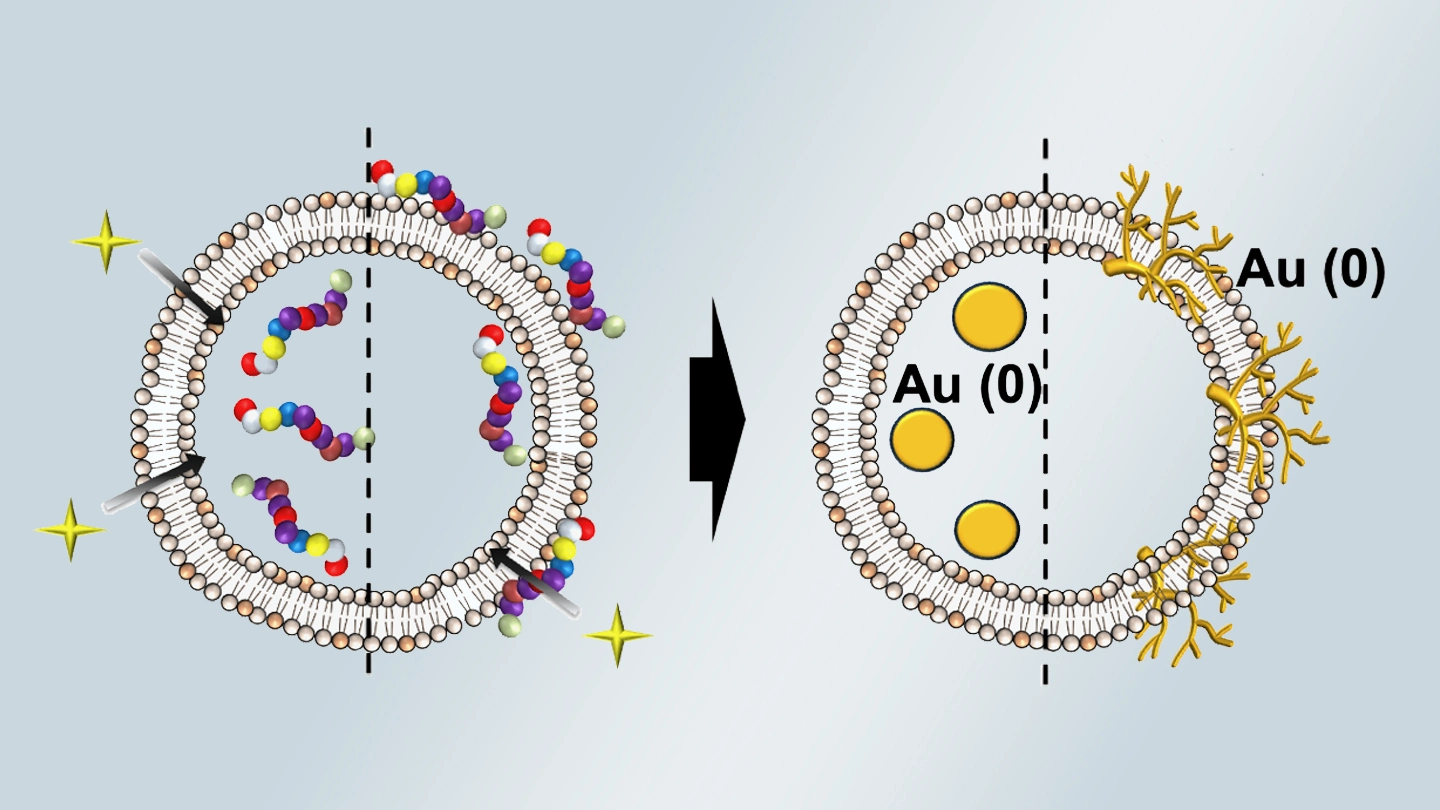
Summary of gold nanoparticle growth programming in liposome based on localization of biomineralization peptide The position of biomineralization peptides within liposomes can influence how gold nanoparticles grow, reports a research team from Institute of Science Tokyo. Peptides localized at the membrane interface promote branched structures, while those confined to the liposome interior favor spherical nanoparticles. The findings offer a new strategy for controlling nanoscale reaction...






