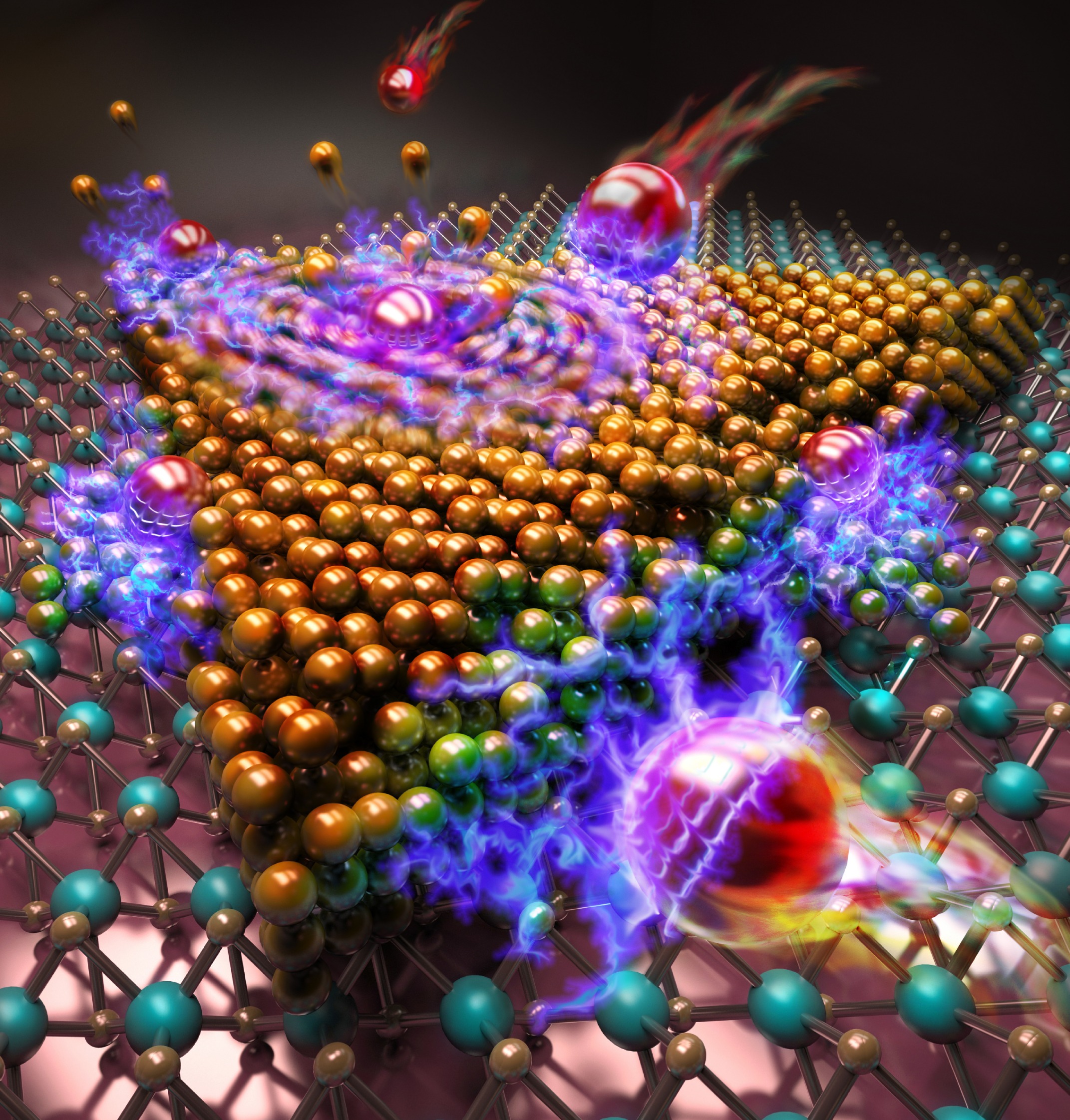
Normally, we have to make a choice in physics: Either we deal with big things – such as a metal plate and its material properties, or with tiny things – such as individual atoms. But there is also a world in between: The world of small but not yet tiny things, in which both effects of the macroscopic world and effects of the microscopic world play a role.
The experiments conducted at TU Wien are located in this complicated in-between world: Extremely small pieces of gold, consisting of a few thousand atoms and with a diameter in the order of ten nanometres, are bombarded with highly charged ions. This makes it possible to change the shape and size of these gold pieces in a targeted manner. The results show: What happens in the process cannot simply be pictured like the impact of a golf ball in a sand bunker - the interaction of ion and gold piece is much more subtle.
Energy transferred by ion bombardment
"We work with multiply-ionized xenon atoms. Up to 40 electrons are removed from these atoms, so they are highly electrically charged," says Prof. Richard Wilhelm from the Institute of Applied Physics at TU Wien. These highly charged ions then hit small gold islands placed on an insulating substrate – and then different things can happen: The gold islands may become flatter, they can melt, they can even evaporate. "Depending on how highly our ions are electrically charged, we can trigger different effects," says Gabriel Szabo, first author of the current study, who is currently working on his dissertation in Richard Wilhelm's team.
The highly charged ions hit the tiny gold nuggets at elevated speed - at around 500 kilometres per second. Nevertheless, it is remarkably not the force of the impact that changes the gold islands. The process is completely different from the impact of a golf ball in a pile of sand, or the accidental impact of a tennis ball in a nicely decorated birthday cake.
"If you shoot uncharged xenon atoms at the gold islands with the same kinetic energy, the gold islands remain practically unchanged," says Gabriel Szabo. "So the decisive factor is not the kinetic energy, but the electrical charge of the ions. This charge also carries energy, and it is deposited exactly at the point of impact."
Changes in the electronic structure
As soon as the extremely strongly positively charged ions hit the nano gold piece, they snatch electrons away from the gold. In a large piece of gold, this would have no significant effect: Gold is an excellent conductor, the electrons can move freely, and more electrons would be supplied from other areas of the gold nugget. But the nano-gold structures are so small that they can no longer be regarded as an inexhaustible reservoir of electrons. It is precisely here that one enters the intermediate world between macroscopic metal and tiny atomic clusters and their nanoscale properties.
"The charge energy of the impacting ion is transferred to the gold, thus the electronic structure of the entire nano-gold object is thrown completely out of balance, the atoms start to move and the crystal structure of the gold is destroyed," explains Richard Wilhelm. "Depending on how much energy you deposit, it may even happen that the entire nano-gold piece melts or is vaporised."
The effects of the ion bombardment can then be studied in an atomic force microscope: Depending on the charge of the ions, the height of the gold pieces is reduced to a lesser or greater extent, Gabriel Szabo reports: "Just as our models had also predicted, we can control the impact of the ions on the gold - and not by the speed we give our projectiles, but rather by their charge."
Improved control and deeper understanding of such processes is important for making a wide variety of nanostructures. "It's a technique that allows you to selectively edit the geometry of particularly small structures. That's just as interesting for the creation of microelectronic components as it is for so-called quantum dots - tiny structures that allow very specific tailor-made electronic or optical effects due to their quantum physical properties," says Richard Wilhelm.
And it is another insight into the world of small but not yet tiny things - into the multifaceted intermediate world between quantum physics and solid-state physics, which can only be understood by keeping quantum and many-particle phenomena in mind at the same time.
Reference
Charge-State-Enhanced Ion Sputtering of Metallic Gold Nanoislands
Gabriel L. Szabo, Benedykt R. Jany, Helmut Muckenhuber, Anna Niggas, Markus Lehner, Arkadiusz Janas, Paul S. Szabo, Ziyang Gan, Antony George, Andrey Turchanin, Franciszek Krok, Richard A. Wilhelm
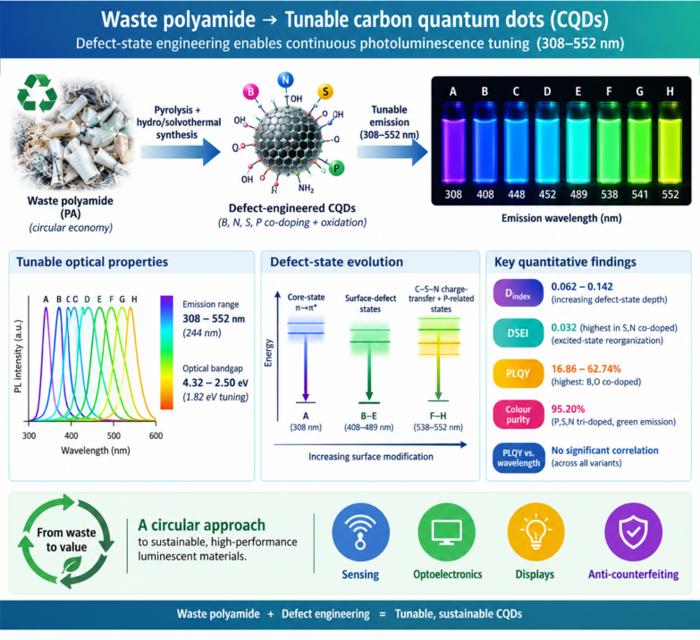
Waste polyamide-derived CQDs show continuous photoluminescence tuning from 308 to 552 nm through sequential defect-state engineering, with optical transition energies decreasing from 4.32 to 2.50 eV. @Christian Ebere Enyoh from Saitama University Carbon quantum dots (CQDs) are fluorescent carbon nanomaterials with potential applications in sensing, optoelectronics, displays, anti-counterfeiting, and environmental technologies. Their optical properties can be adjusted by modifying the carbon...
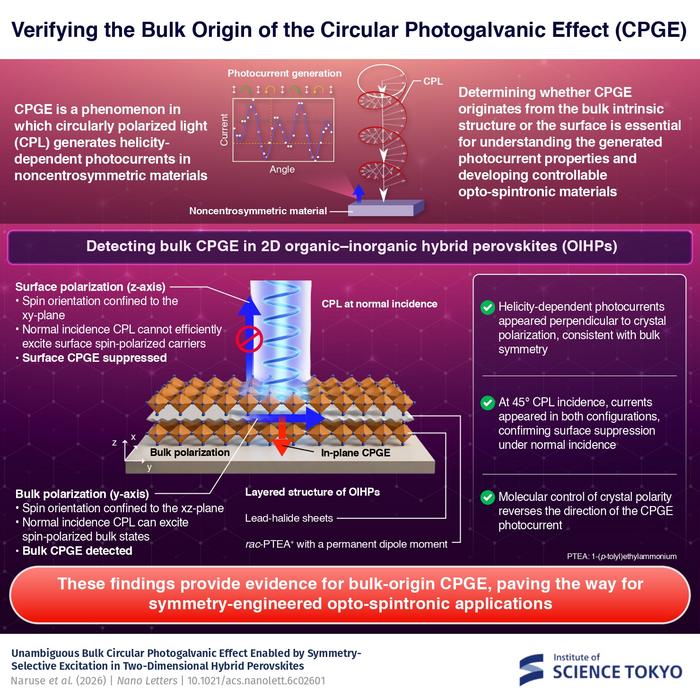
The researchers used circularly polarized light at normal incidence and found that helicity-dependent photocurrents appeared perpendicular to the crystal’s polarization but vanished when measured parallel to it, supporting a bulk origin of CPGE. @Institute of Science Tokyo The circular photogalvanic effect (CPGE), a phenomenon that generates helicity-dependent photocurrents in noncentrosymmetric materials, can originate purely from a crystal's internal structure without contribution from the...
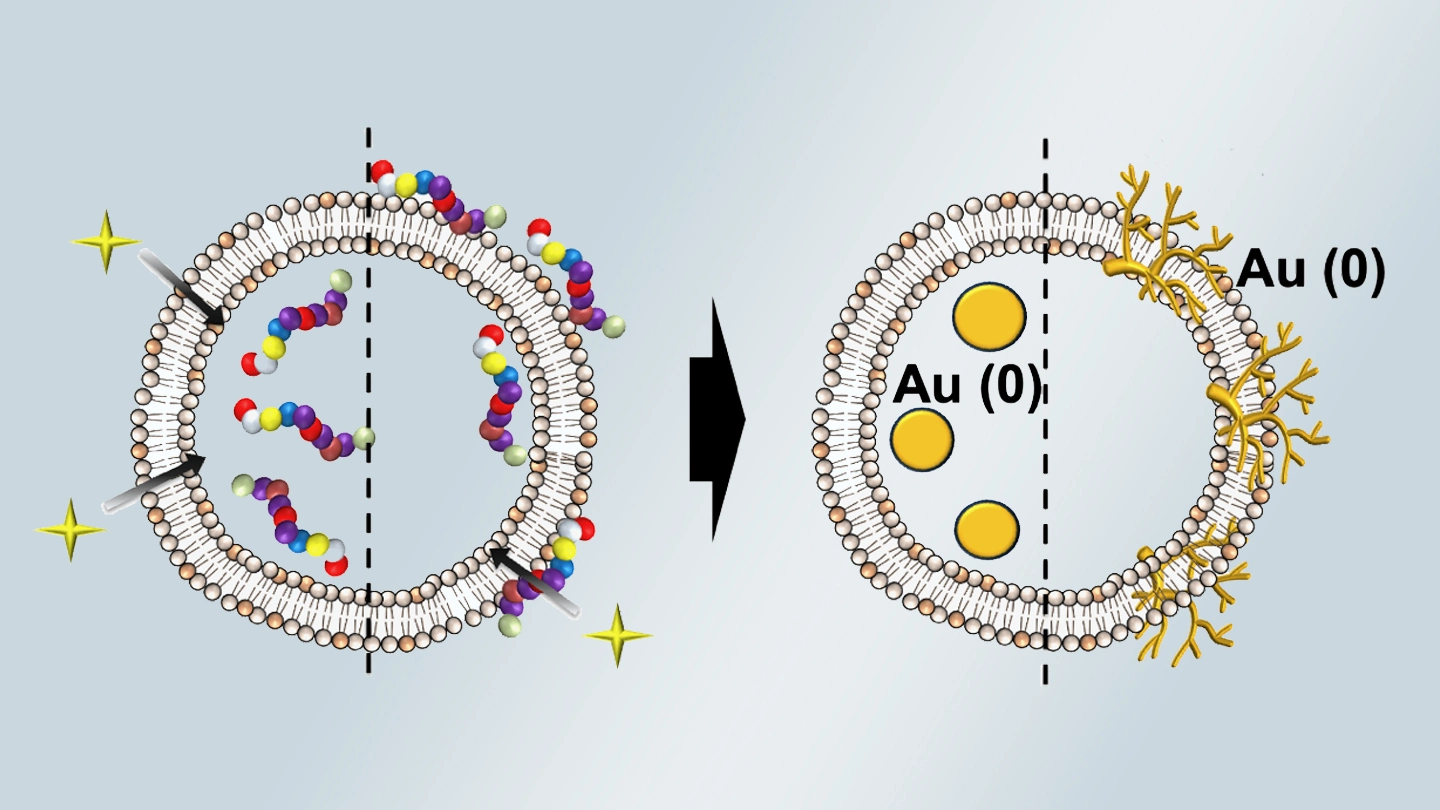
Summary of gold nanoparticle growth programming in liposome based on localization of biomineralization peptide The position of biomineralization peptides within liposomes can influence how gold nanoparticles grow, reports a research team from Institute of Science Tokyo. Peptides localized at the membrane interface promote branched structures, while those confined to the liposome interior favor spherical nanoparticles. The findings offer a new strategy for controlling nanoscale reaction...
