University of British Columbia
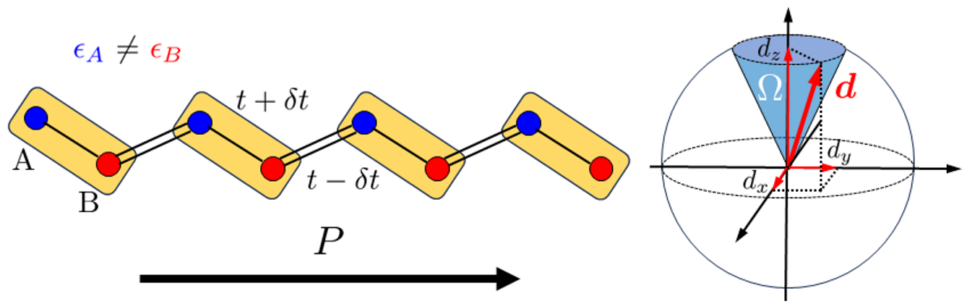
Quantum theorists at UBC’s Blusson Quantum Matter Institute have proposed a new approach to studying stacking ferroelectricity—spontaneous electric polarization—in layered, two-dimensional lab-grown materials.
Ferroelectric materials are unique in their ability to “remember” their new state after the electric field is removed, which makes them useful in applications including solar cell technology and compact memory devices.
“We’ve been learning in recent years that quantum geometry underlies a surprising range of the observable properties of materials,” said Dr. Marcel Franz, deputy scientific director at UBC Blusson QMI and a professor with the Department of Physics & Astronomy. “This work adds an important new entry to the growing list of phenomena that can be elucidated using this fascinating geometric approach.”
Ferroelectricity is a property that allows materials to have a built-in electric polarization. Ferroelectric materials have switchable polarization that can be controlled by an electric field, while stacking ferroelectrics are formed by assembling two atomically thin non-polar layers that create polarization through their special way of stacking.
“The most exciting part of our discovery is that the underlying physics behind stacking ferroelectricity can, in fact, be understood as a geometric property,” said UBC Blusson QMI postdoctoral fellow Dr. Benjamin Zhou, lead author of the study published in the journal Physical Review Letters.
“To establish the meaningful connection between stacking ferroelectricity and geometry, we had to go through detailed model analysis and rigorous numerical calculations for different types of ferroelectric materials such as honeycomb bilayers, rhombohedral bilayer molybdenum disulfide (3R-MoS2) and bilayer tungsten ditelluride (WTe2),” Dr. Zhou said. “The results confirm that our geometric approach works well for all these materials.”
Until now, scientists have studied stacking ferroelectric materials in two ways: symmetry analysis, which determines if the material can be polar, and computational approaches that provide the magnitude of the polarization. However, these methods are limited in describing the robustness of the polarization.
The new quantum-geometric approach allows the researchers to look at the polarization properties as a geometric feature of the model, which they describe using a visual representation of a vector moving over a sphere.
“For each stacking ferroelectric material, the trajectory of its corresponding unit vector across the sphere is unique, allowing us to easily identify how robust the polarization can be and predict what types of materials can exhibit strong polarity,” said Dr. Zhou. “This discovery provides us with a new powerful lens to look into the underlying physics of ferroelectrics.”
The study was inspired by the previous experimental work led by Blusson QMI investigator Dr. Ziliang Ye, published in nature photonics, where Zhou and Franz contributed to the theoretical explanation. The results demonstrated by Ye’s group in 2022 were among the first experiments in the world to achieve ferroelectric spontaneous polarization via a designed stacking order between atomic layers.
“The modern theory of polarization explains bulk ferroelectrics using the Berry phase concept which becomes tricky to deal with for stacking ferroelectrics in the 2D limit. Our geometric approach reconnects the origin of polarization in 2D ferroelectrics with the Berry phase concept,” said Vedangi Pathak, a PhD student in Franz’s group who co-authored the study. “Our work provides a very simple framework that anyone with a physics background can use in their research.”
Reference
Quantum-Geometric Origin of Out-of-Plane Stacking Ferroelectricity
Benjamin T. Zhou, Vedangi Pathak, and Marcel Franz
https://journals.aps.org/prl/abstract/10.1103/PhysRevLett.132.196801
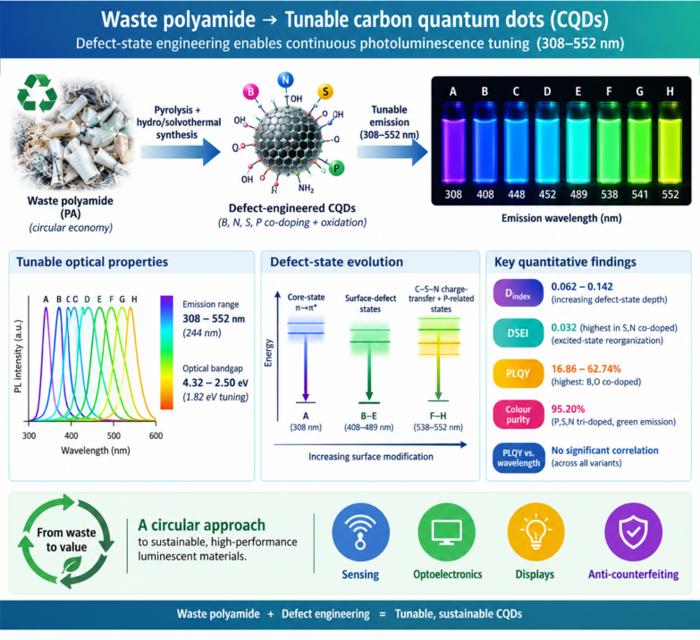
Waste polyamide-derived CQDs show continuous photoluminescence tuning from 308 to 552 nm through sequential defect-state engineering, with optical transition energies decreasing from 4.32 to 2.50 eV. @Christian Ebere Enyoh from Saitama University Carbon quantum dots (CQDs) are fluorescent carbon nanomaterials with potential applications in sensing, optoelectronics, displays, anti-counterfeiting, and environmental technologies. Their optical properties can be adjusted by modifying the carbon...
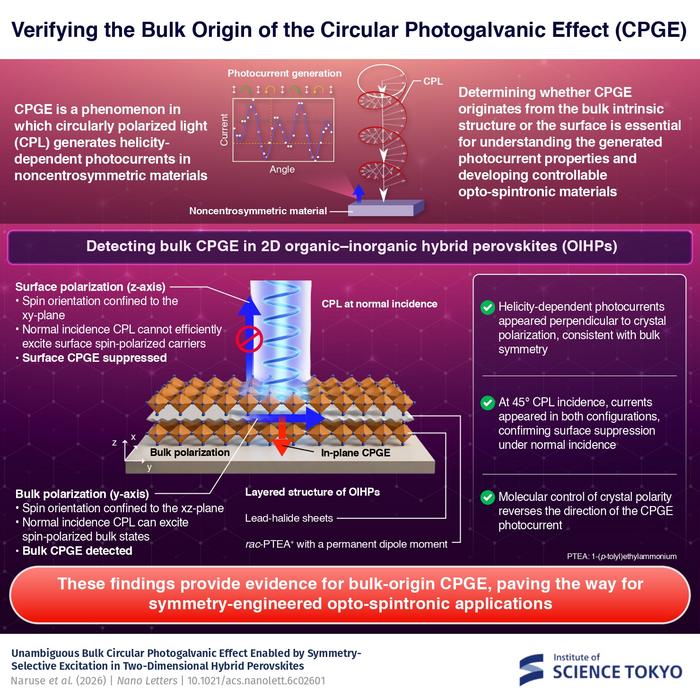
The researchers used circularly polarized light at normal incidence and found that helicity-dependent photocurrents appeared perpendicular to the crystal’s polarization but vanished when measured parallel to it, supporting a bulk origin of CPGE. @Institute of Science Tokyo The circular photogalvanic effect (CPGE), a phenomenon that generates helicity-dependent photocurrents in noncentrosymmetric materials, can originate purely from a crystal's internal structure without contribution from the...
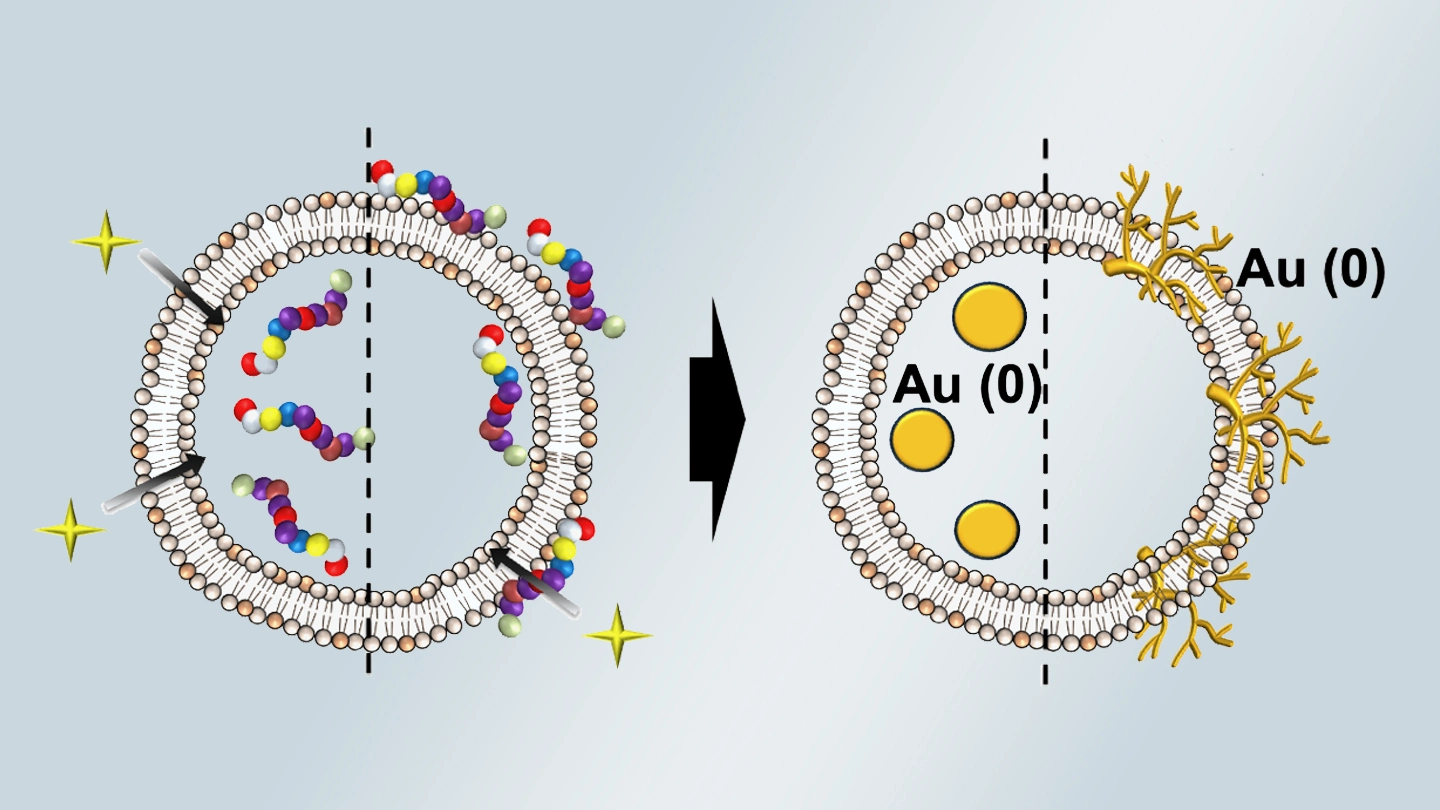
Summary of gold nanoparticle growth programming in liposome based on localization of biomineralization peptide The position of biomineralization peptides within liposomes can influence how gold nanoparticles grow, reports a research team from Institute of Science Tokyo. Peptides localized at the membrane interface promote branched structures, while those confined to the liposome interior favor spherical nanoparticles. The findings offer a new strategy for controlling nanoscale reaction...
