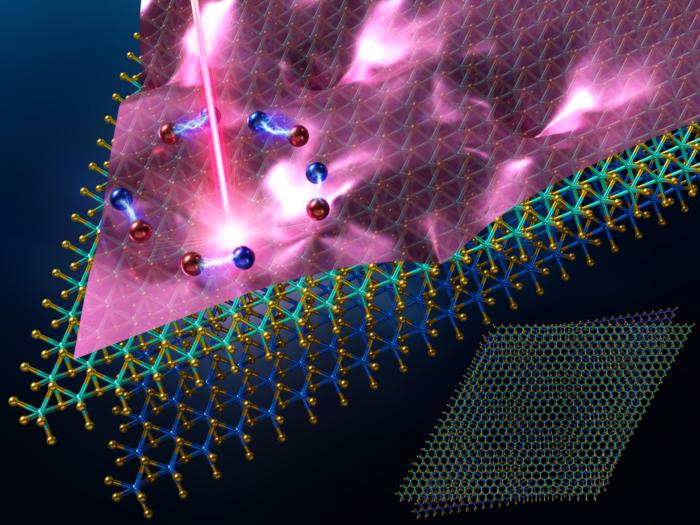
A study from the Research Center for Materials Nanoarchitectonics (MANA), one of the centers under the National Institute for Materials Science (NIMS), presents a new method to decode hidden material disorder contained in complex photoluminescence spectra, paving the way for new optical diagnostics of material disorder in two-dimensional semiconductors and related light-emitting materials.
When two ultra-thin semiconductor layers, such as molybdenum diselenide and tungsten diselenide (MoSe2/WSe2), are stacked with a slight twist, they form a repeating pattern called a moiré heterostructure. These structures have unusual light-emitting properties, featuring a complex landscape of photoluminescence spectra across their surface. While scientists often analyze materials by looking at the individual peaks of their emission spectra, moiré heterostructures produce spectra with many overlapping peaks whose origins are difficult to explain individually.
To address this challenge, Katsunori Wakabayashi from MANA has developed a theoretical framework to explain this complexity. Rather than decomposing spectra peak by peak, his approach examines how simple descriptors, such as peak energy and average energy, change spatially across a sample.
By applying this theoretical framework to descriptor correlations reported for a MoSe2/WSe2 heterostructure, Wakabayashi found that different features respond to different layers of hidden disorder in the material, hinting at a hierarchy of disorder. The first level corresponds to a smooth ‘background’ that varies over larger distances of a few micrometers. In contrast, the second one is finer and much more localized, arising from small defects or exciton-trapping sites in the heterostructure. By comparing how these spectral features vary in space according to a detailed theoretical analysis, the underlying landscape of disorder in the bilayer material can be inferred mathematically without relying on spectral peak decomposition.
Tiny structural imperfections and hidden disorder can strongly affect how materials emit and interact with light. Thus, this new framework hints at a practical way to diagnose material quality issues directly from optical data, without relying on uncertain peak-by-peak spectral assignment. “This work could help researchers make better and more reproducible materials for light-emitting devices, optical sensors, and quantum technologies,” remarks Wakabayashi.
Reference
Hierarchical disorder in moiré exciton photoluminescence probed by spectral-descriptor correlations
Katsunori Wakabayashi

Pyrene-modified polyionic complex vesicles, or Pyr-PICsomes, convert hydrostatic pressure into measurable fluorescence. Crosslinking density tunes membrane stiffness, which governs sensing behavior: soft vesicles give strong excimer-to-monomer ratio changes from 0.1 to 50 MPa, while stiff membranes respond through fluorescence lifetime, suiting lifetime imaging.
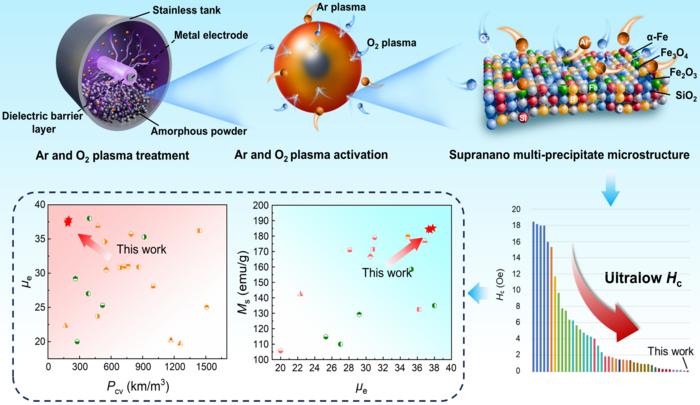
Ar/O₂ plasma treatment generates supranano α-Fe, Fe₃O₄, SiO₂ and Fe₂O₃ precipitates just 0.8–2.5 nm across amorphous powder surfaces, creating nucleation sites that ease magnetic-moment reversal. The resulting soft magnetic composite combines 0.13 Oe coercivity, 37.3 permeability, 185 emu g⁻¹ saturation magnetization and 191.18 kW m⁻³ core loss at 1 MHz and 20 mT. The surface route avoids bulk composition changes, aiding scale-up for high-frequency inductors and power chokes.
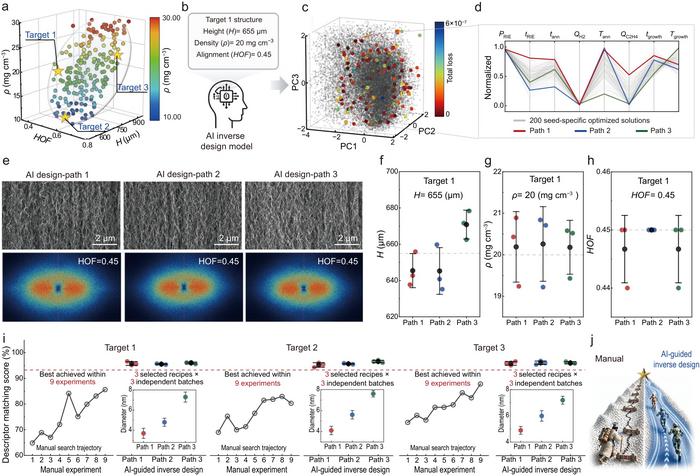
An AI-assisted inverse-design framework has identified multiple distinct growth recipes that reach the same prescribed height, density and alignment in carbon nanotube forests. Trained on 200 water-assisted chemical vapour deposition experiments, the model searched backward from structural targets; 26 of 27 validation batches scored above 95% descriptor matching, yet nanotube diameters and wall structures differed.






