
Chirality is a fundamental property of matter that determines many biological, chemical and physical phenomena. Chiral solids, for example, offer exciting opportunities for catalysis, sensing and optical devices by enabling unique interactions with chiral molecules and polarized light. These properties are however established when the material is grown, that is, the left- and right-handed enantiomers cannot be converted into one another without melting and recrystallization. Researchers at the Max Planck Institute for the Structure and Dynamics of Matter (MPSD) and the University of Oxford have shown that terahertz light can induce chirality in a non-chiral crystal, allowing either left- or right-handed enantiomers to emerge on demand. The finding, reported in Science, opens up exciting possibilities for exploring novel non-equilibrium phenomena in complex materials.
Chirality refers to objects that cannot be superimposed to their mirror images through any combination of rotations or translations, much like the distinct left and right hands of a human. In chiral crystals, the spatial arrangement of atoms confers a specific "handedness", which, for example, influences their optical and electrical properties.
The Hamburg-Oxford team focused on so-called antiferro-chirals, a type of non-chiral crystals reminiscent of antiferro-magnetic materials, in which magnetic moments anti-align in a staggered pattern leading to a vanishing net magnetization. An antiferro-chiral crystal is composed of equivalent amounts of left- and right-handed substructures in a unit cell, rendering it overall non-chiral.
The research team, led by Andrea Cavalleri, used terahertz light to lift this balance in the non-chiral material boron phosphate (BPO4), in this way inducing finite chirality on an ultrafast time scale. “We exploit a mechanism termed nonlinear phononics," says Zhiyang Zeng, lead author of this work. “By exciting a specific terahertz frequency vibrational mode, which displaces the crystal lattice along the coordinates of other modes in the material, we created a chiral state that survives for several picoseconds,” he added. “Notably, by rotating the polarization of the terahertz light by 90 degrees, we could selectively induce either a left- or right-handed chiral structure,” continues fellow author Michael Först.
"This discovery opens up new possibilities for the dynamical control of matter at the atomic level," says Andrea Cavalleri, group leader at the MPSD. "We are excited to see potential applications of this technology and how it can be used to create unique functionalities. The ability to induce chirality in non-chiral materials could lead to new applications in ultrafast memory devices or even more sophisticated optoelectronic platforms"
Reference
Photo-induced chirality in a nonchiral crystal
Z. Zeng, M. Först, M. Fechner, M. Buzzi, E. B. Amuah, C. Putzke, P. J. W. Moll, D. Prabhakaran, P. G. Radaelli, A. Cavalleri
https://www.science.org/doi/10.1126/science.adr4713
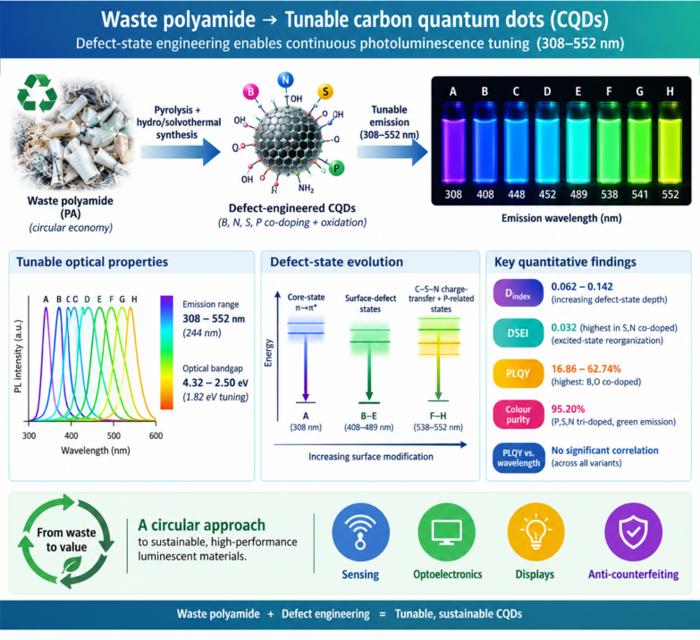
Waste polyamide-derived CQDs show continuous photoluminescence tuning from 308 to 552 nm through sequential defect-state engineering, with optical transition energies decreasing from 4.32 to 2.50 eV. @Christian Ebere Enyoh from Saitama University Carbon quantum dots (CQDs) are fluorescent carbon nanomaterials with potential applications in sensing, optoelectronics, displays, anti-counterfeiting, and environmental technologies. Their optical properties can be adjusted by modifying the carbon...
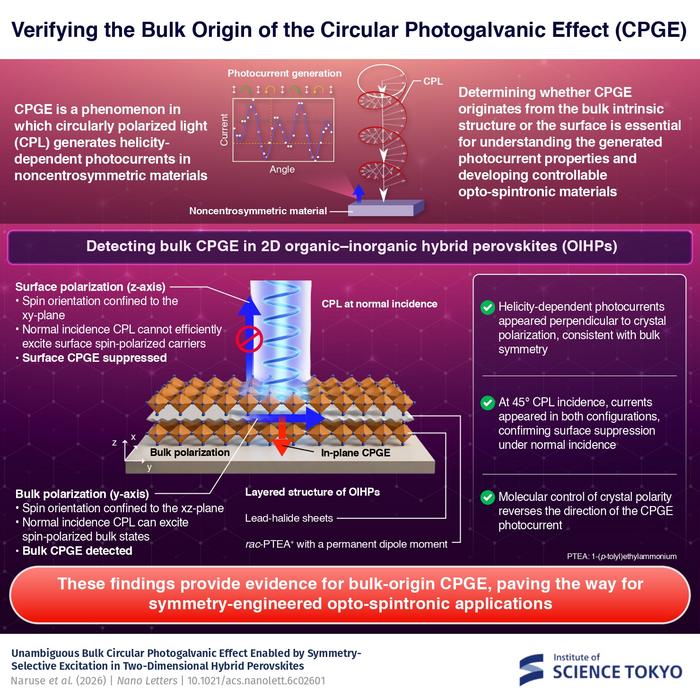
The researchers used circularly polarized light at normal incidence and found that helicity-dependent photocurrents appeared perpendicular to the crystal’s polarization but vanished when measured parallel to it, supporting a bulk origin of CPGE. @Institute of Science Tokyo The circular photogalvanic effect (CPGE), a phenomenon that generates helicity-dependent photocurrents in noncentrosymmetric materials, can originate purely from a crystal's internal structure without contribution from the...
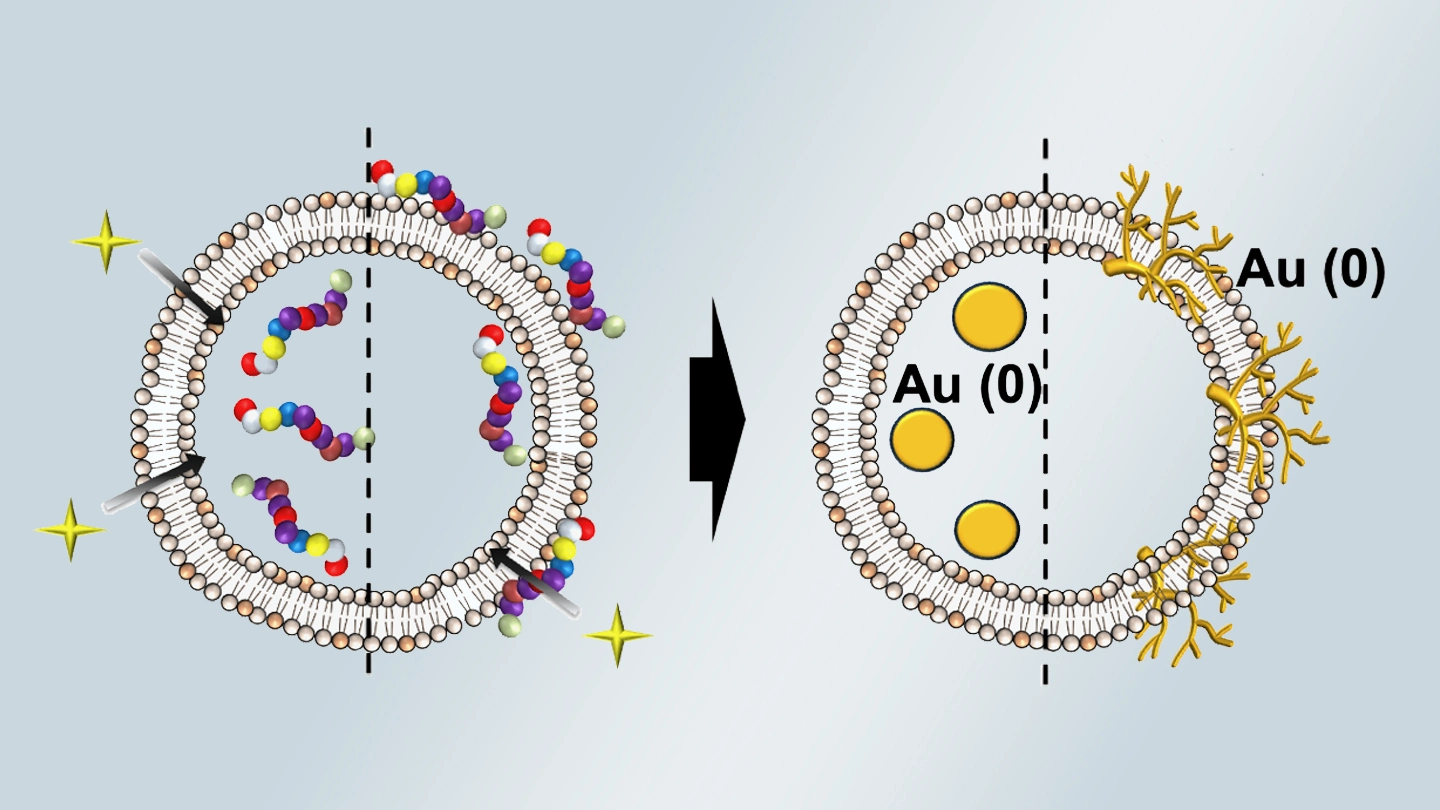
Summary of gold nanoparticle growth programming in liposome based on localization of biomineralization peptide The position of biomineralization peptides within liposomes can influence how gold nanoparticles grow, reports a research team from Institute of Science Tokyo. Peptides localized at the membrane interface promote branched structures, while those confined to the liposome interior favor spherical nanoparticles. The findings offer a new strategy for controlling nanoscale reaction...
