Osaka University
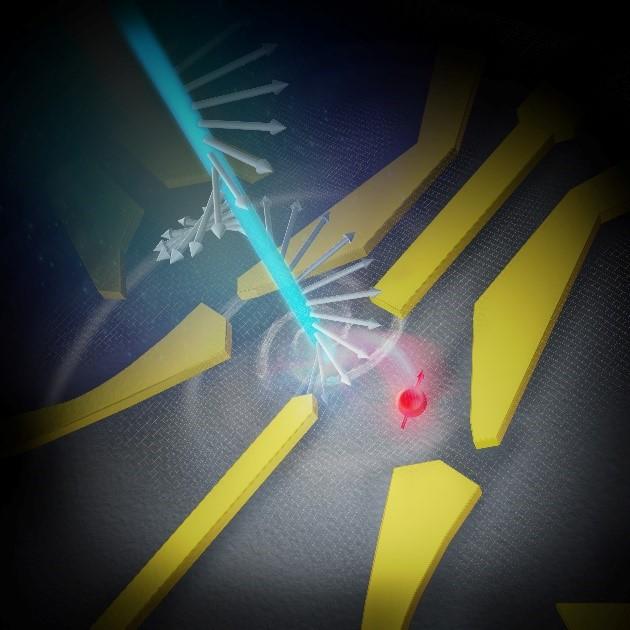
A research team led by Osaka University demonstrated how information encoded in the circular polarization of a laser beam can be translated into the spin state of an electron in a quantum dot, each being a quantum bit and a quantum computer candidate. The achievement represents a major step towards a "quantum internet," in which future computers can rapidly and securely send and receive quantum information.
Quantum computers have the potential to vastly outperform current systems because they work in a fundamentally different way. Instead of processing discrete ones and zeros, quantum information, whether stored in electron spins or transmitted by laser photons, can be in a superposition of multiple states simultaneously. Moreover, the states of two or more objects can become entangled, so that the status of one cannot be completely described without this other. Handling entangled states allow quantum computers to evaluate many possibilities simultaneously, as well as transmit information from place to place immune from eavesdropping.
However, these entangled states can be very fragile, lasting only microseconds before losing coherence. To realize the goal of a quantum internet, over which coherent light signals can relay quantum information, these signals must be able to interact with electron spins inside distant computers.
Researchers led by Osaka University used laser light to send quantum information to a quantum dot by altering the spin state of a single electron trapped there. While electrons don't spin in the usual sense, they do have angular momentum, which can be flipped when absorbing circularly polarized laser light.
"Importantly, this action allowed us to read the state of the electron after applying the laser light to confirm that it was in the correct spin state," says first author Takafumi Fujita. "Our readout method used the Pauli exclusion principle, which prohibits two electrons from occupying the exact same state. On the tiny quantum dot, there is only enough space for the electron to pass the so-called Pauli spin blockade if it has the correct spin."
Quantum information transfer has already been used for cryptographic purposes. "The transfer of superposition states or entangled states allows for completely secure quantum key distribution," senior author Akira Oiwa says. "This is because any attempt to intercept the signal automatically destroys the superposition, making it impossible to listen in without being detected."
The rapid optical manipulation of individual spins is a promising method for producing a quantum nano-scale general computing platform. An exciting possibility is that future computers may be able to leverage this method for many other applications, including optimization and chemical simulations.
Angular momentum transfer from photon polarization to an electron spin in a gate-defined quantum dot
Takafumi Fujita, Kazuhiro Morimoto, Haruki Kiyama, Giles Allison, Marcus Larsson, Arne Ludwig, Sascha R. Valentin, Andreas D. Wieck, Akira Oiwa & Seigo Tarucha
Nature Communications volume 10, Article number: 2991 (2019)
DOI: 10.1038/s41467-019-10939-x
Contact information:
Akira Oiwa
Professor of Quantum System Electronics at Institute of Scientific and Industrial Research
oiwa@sanken.osaka-u.ac.jp
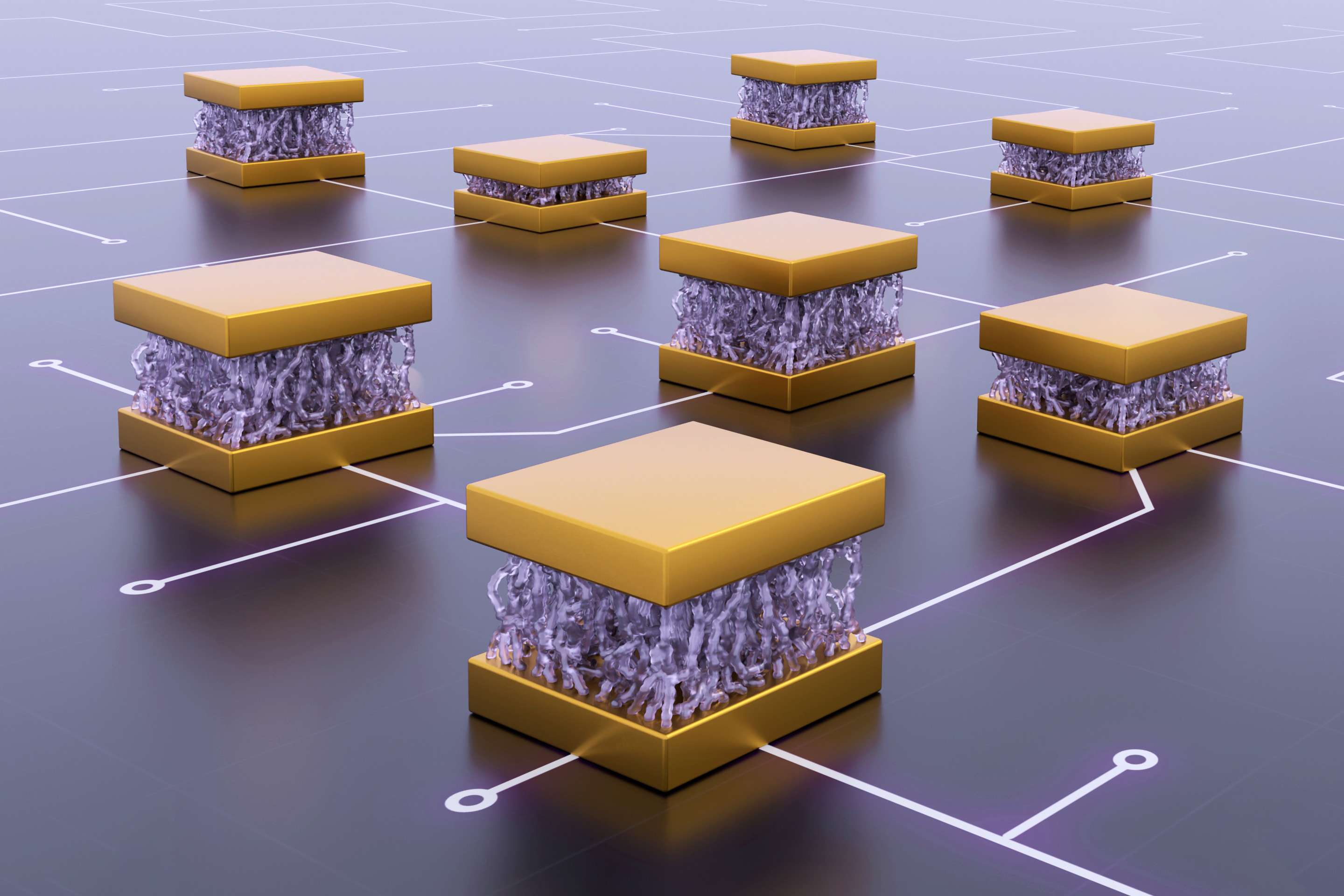
This illustration shows the nano-mechanical devices the researchers developed. Inspired by neurons, they can perform computing tasks with high energy efficiency. Image: Emily Theobald MIT researchers have created a new computing platform that could be used to develop intelligent and adaptive next-generation electronics that can simultaneously perform multiple functions, like computing and memory, all within one extremely compact, energy-efficient device. Such a platform opens opportunities...
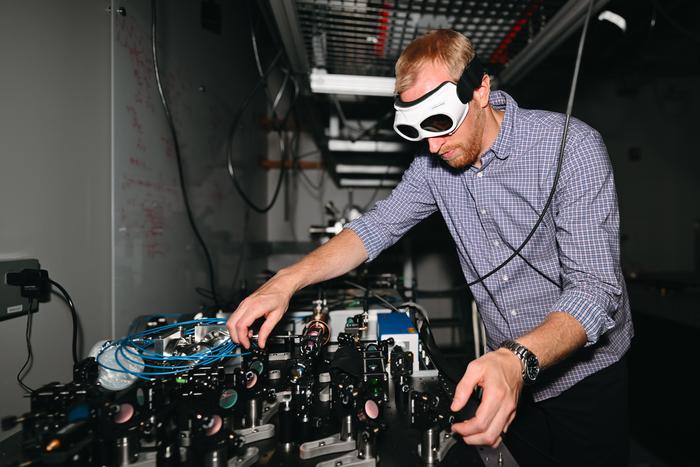
Breakthrough from a team led by Jacob Covey, associate professor in the University of Chicago’s Pritzker School of Molecular Engineering and Department of Physics, turns helium-3’s low mass into a quantum resource
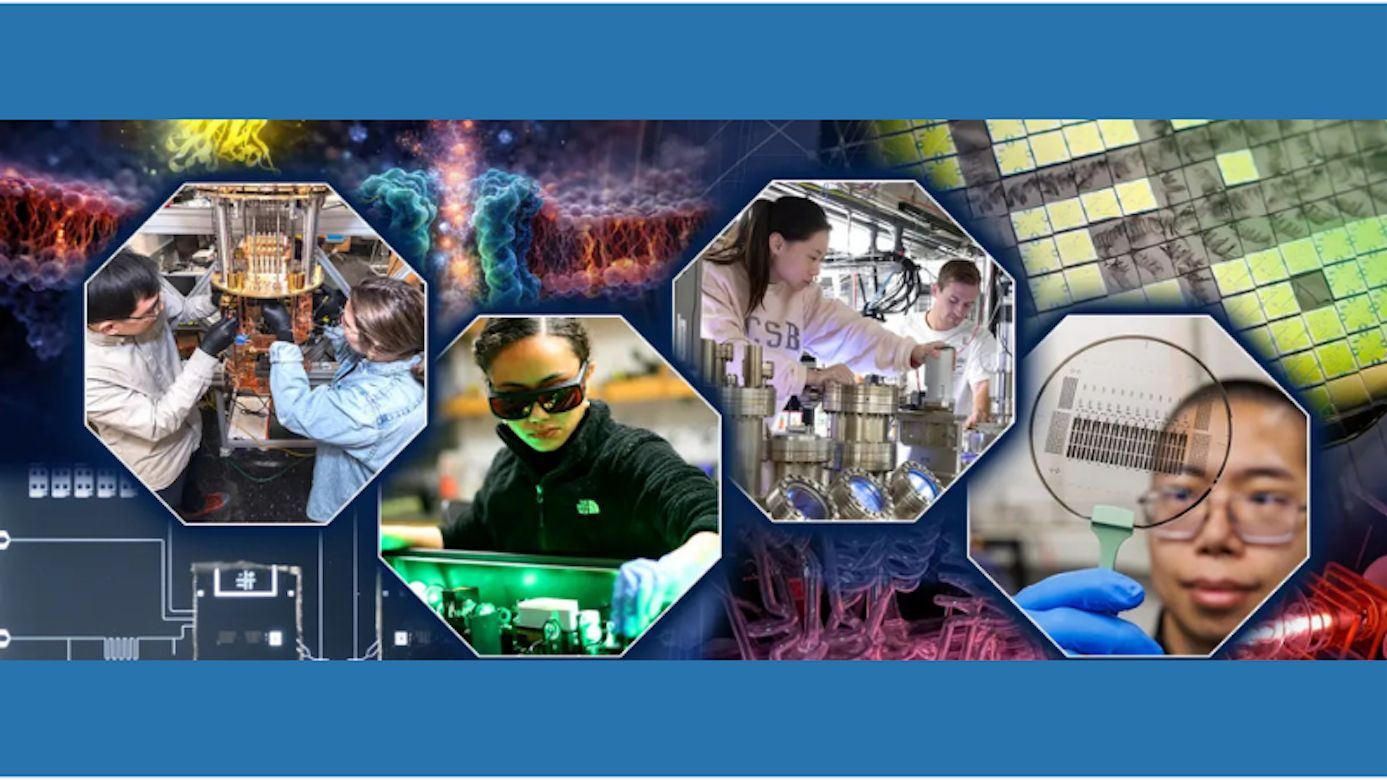
Courtesy of the National Science Foundation The NSF's Quantum Leap Challenge Institutes are taking on some of the hardest scientific hurdles in the global race to create powerful quantum-based technologies. Two UCLA computer scientists will help lead major national efforts to address some of quantum computing’s biggest challenges, serving as co-principal investigators for separate research institutes backed by five-year, $37.5 million grants from the National Science Foundation. The two...