Pacific Northwest National Laboratory
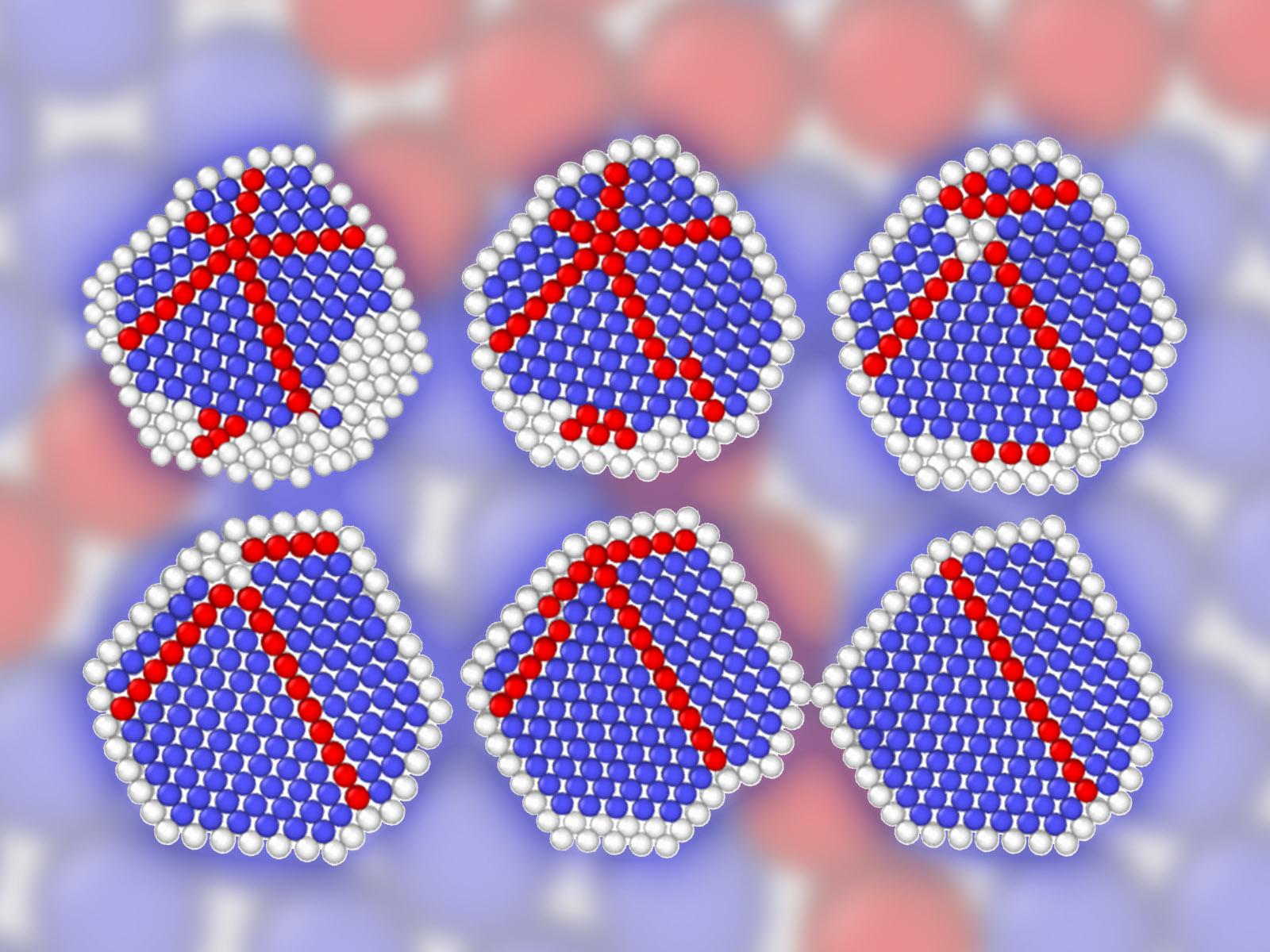
Twinned nanoparticles have regions of clear symmetry that share the same crystal lattice, separated by a clear boundary. Changing the twin structure can affect the properties of the nanoparticles, which makes controlling twinning to create tailored nanomaterials an active area of research. Researchers studied penta-twinned gold nanoparticles under an electron beam and directly observed partial dislocation slipping for the first time. Combined with molecular dynamics simulations, the team found that uneven strain distribution across the twin units induces dislocation slipping, plane guiding, and eventual detwinning in the nanoparticles.
The Impact
Twinned nanocrystals have unique physical and chemical properties, making twinning a consequential parameter in materials design. Developing practical approaches for controlling twinning and twinned structures requires understanding twinning and detwinning at an atomic level, which is currently lacking. By precisely visualizing the structure and transformations in penta-twinned nanoparticles and interpreting this information with the help of atomic-scale simulations, researchers were able to detail the interplay between surface diffusion, tensile strain relaxation, morphology evolution, and detwinning more clearly. This insight can help guide future efforts in controlling twinning and detwinning in gold nanoparticles.
Summary
Twin structures possess distinct physical and chemical properties by virtue of their specific configurations. However, twinning and detwinning processes are not fully understood at the atomic scale. By integrating in situ high-resolution transmission electron microscopy and molecular dynamic simulations, researchers found that tensile strain in asymmetrical five-fold twins of gold nanoparticles leads to twin boundary migration through dislocation sliding (slipping of an atomic layer) along twin boundaries and dislocation reactions at the fivefold axis under an electron beam. Energy barriers govern the migration of one or two layers of the twin planes. Relaxation of the total energy, including surface, lattice strain, and twin boundary energy, after consecutive twin boundary migration, leads to a detwinning process. In addition, surface rearrangement of five-fold twinned nanoparticles can aid in the detwinning process. By better understanding the processes that affect twinning at the atomic level, researchers can more precisely control the structure and properties of twinned nanoparticles.
Reference
Uneven Strain Distribution Induces Consecutive Dislocation Slipping, Plane Gliding, and Subsequent Detwinning of Penta-Twinned Nanoparticles
Miao Song, Jianming Cui, Colin Ophus, Jaewon Lee, Tianyu Yan, Kristen A. Fichthorn, and Dongsheng Li
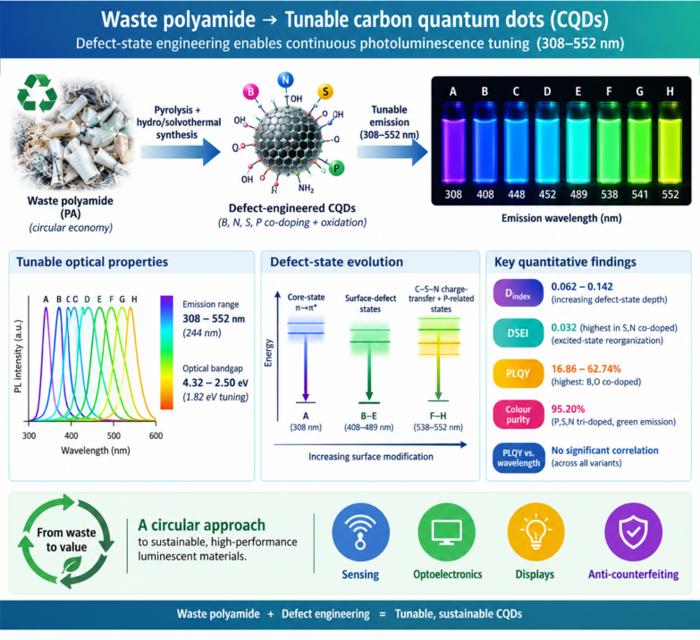
Waste polyamide-derived CQDs show continuous photoluminescence tuning from 308 to 552 nm through sequential defect-state engineering, with optical transition energies decreasing from 4.32 to 2.50 eV. @Christian Ebere Enyoh from Saitama University Carbon quantum dots (CQDs) are fluorescent carbon nanomaterials with potential applications in sensing, optoelectronics, displays, anti-counterfeiting, and environmental technologies. Their optical properties can be adjusted by modifying the carbon...
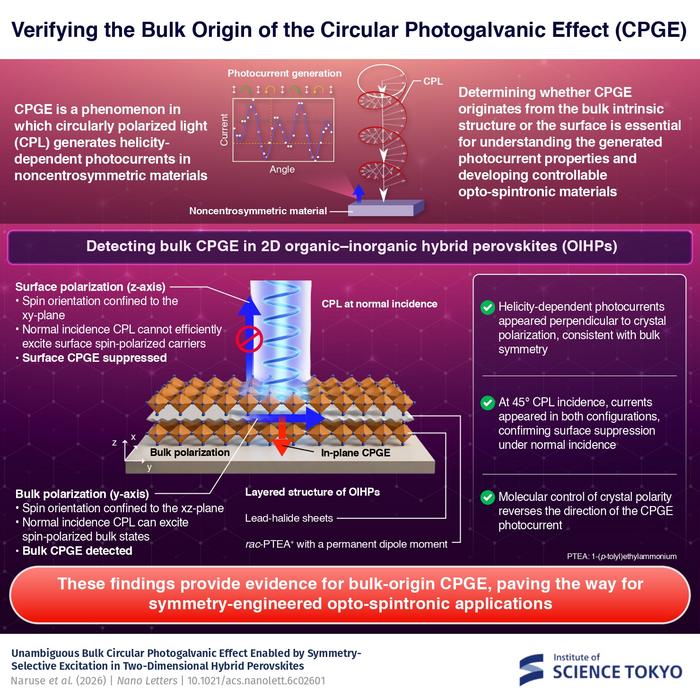
The researchers used circularly polarized light at normal incidence and found that helicity-dependent photocurrents appeared perpendicular to the crystal’s polarization but vanished when measured parallel to it, supporting a bulk origin of CPGE. @Institute of Science Tokyo The circular photogalvanic effect (CPGE), a phenomenon that generates helicity-dependent photocurrents in noncentrosymmetric materials, can originate purely from a crystal's internal structure without contribution from the...
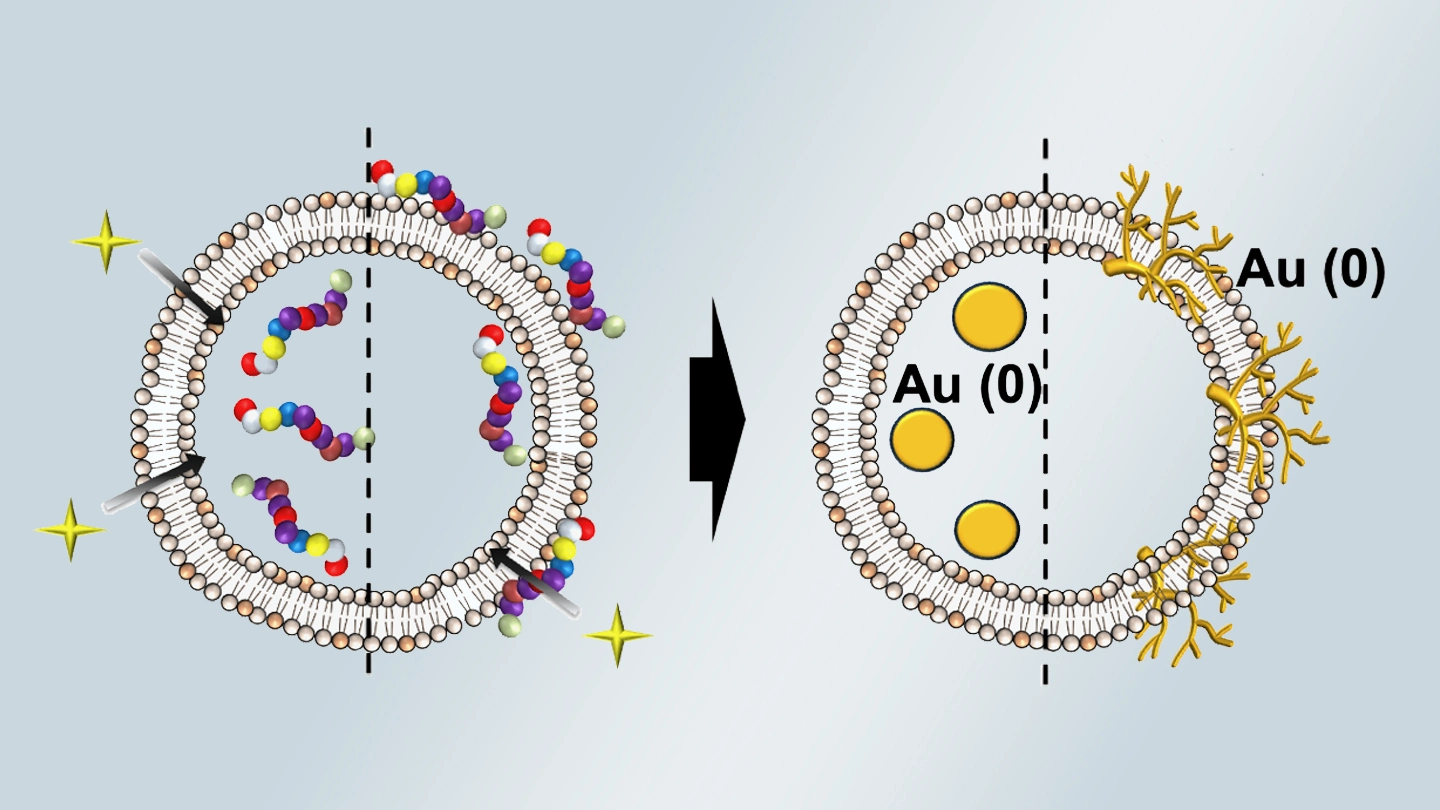
Summary of gold nanoparticle growth programming in liposome based on localization of biomineralization peptide The position of biomineralization peptides within liposomes can influence how gold nanoparticles grow, reports a research team from Institute of Science Tokyo. Peptides localized at the membrane interface promote branched structures, while those confined to the liposome interior favor spherical nanoparticles. The findings offer a new strategy for controlling nanoscale reaction...
