Durham, 7 October 2026. Wolfspeed, Inc. (NYSE: WOLF) announced it has received a conditional loan commitment letter from the U.S. Department of War, through its Office of Strategic Capital, for up to $1.5 billion of long-term financing. The financing would support domestic development and production of silicon carbide materials and wide bandgap power devices, with an additional focus on U.S. national security applications.
The conditional commitment letter contemplates a senior secured delayed-draw term loan facility of up to $1.5 billion. Wolfspeed plans to use the financing to upgrade its gallium nitride epitaxy capabilities for next generation communications infrastructure and electronic warfare systems, and to develop radiation-hardening capabilities for its current SiC and future GaN products.
In connection with the potential financing, and subject to negotiation and execution of definitive agreements, Wolfspeed would be required to issue to the DoW VWAP-based warrants to purchase, in the aggregate, up to 7.5% of Wolfspeed's fully diluted equity. The warrants would be issuable pro rata as and when financing tranches are funded.
"SiC and GaN have critical national security applications," said Robert Feurle, Chief Executive Officer of Wolfspeed. "With this financing, the company would be well positioned to not only continue to serve the DoW but also expand its capabilities for the benefit of U.S. national security as a whole."
The execution of definitive agreements and consummation of the potential financing are subject to substantial due diligence and numerous conditions. Additional details are available in Wolfspeed's Current Report on Form 8-K filed today with the U.S. Securities and Exchange Commission.
Source: Wolfspeed, Inc. news
Mivium Inc of Fremont, CA, USA has achieved production of high-purity submicron gallium nitride particles using its proprietary technology platform. Third-party characterization confirms phase-pure hexagonal wurtzite gallium nitride particles with a particle size distribution of 300–500nm.
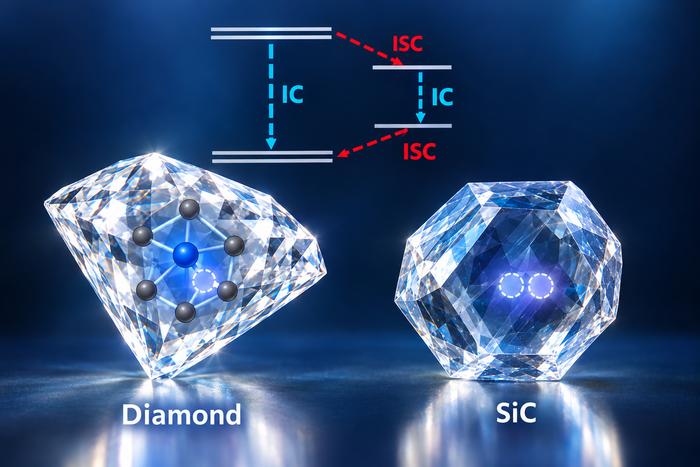
Researchers at UChicago PME developed a computational framework that models the full optical cycle of spin defects in solids, including internal conversion, the energy-loss pathway that has resisted accurate prediction. Applied to nitrogen-vacancy centers in diamond, it matched spectroscopy data; in silicon carbide divacancies, it revealed internal conversion strongly limits triplet excited-state lifetimes, resolving a long-standing theory-experiment discrepancy.
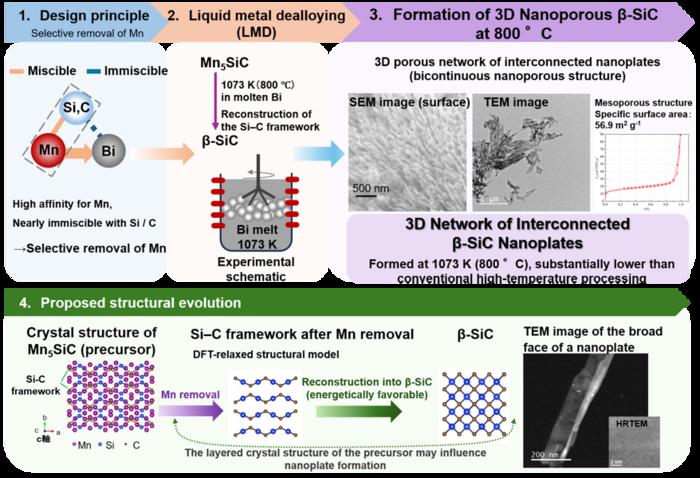
Researchers at Tohoku University have formed crystalline β-SiC at just 800°C using liquid metal dealloying, a technique previously limited to metals and intermetallics. Immersing a layered Mn5SiC precursor in molten bismuth selectively dissolves manganese, leaving a silicon-carbon framework that reorganizes into nanoporous β-SiC with interconnected nanoscale plates. First-principles calculations confirm the rearrangement is energetically favorable.






