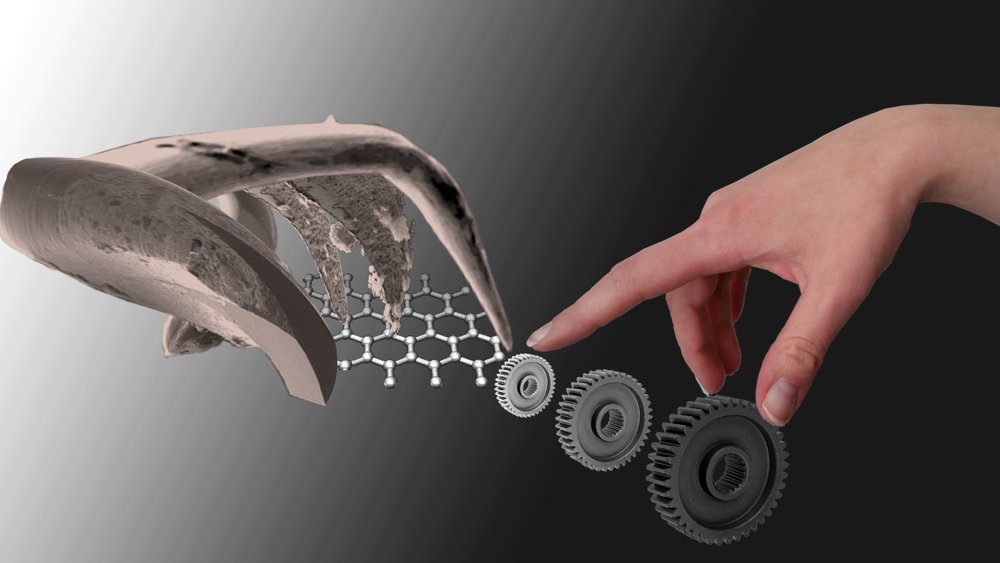
The Nanoworkbench from Klocke Nanotechnik enables the hand-eye coordination inside of SEM/FIB systems and opens the door to a complete new world of applications. Most handling, manipulation and measurement tasks done under light microscopes are now possible in any SEM/FIB: safe, easy and fast. Standard Application Packages are available including automation of the handling process and the SEM/FIB. Self Finding Tool: The 1D-Nanofinger® is used as "Scout" to detect sample and tool positions for automatic tool Approach. Live Image Positioning: Click with the mouse into the SEM image, and the tool moves automatically to this position. Assistants (Wizards): One window guides the user through any process. Sequencer for automation: Any process can be programmed by simple teaching. The SEM/FIB features are included in our automation, e.g. setting of Zoom & Focus or sample stage movements. Even the Assistants can be programmed freely. Macro Executor: establishes a selectable list of macros that can include Assistants, Live Image Positioning and anything that was programmed previously with the Sequencer. Remote Control: The Macro Executor has access to the whole control system. So it is possible to have an external master program controlling the whole Nanorobotics world by this interface – including automation of the SEM. One "standard application package" out of a list – including a standard tool, a standard sample and a pre-defined process. The hardware of the Nanoworkbench, including 2 high-end Nanorobotics Manipulators, controllers and accessory. CAD construction and components for the in SEM/FIB system integration as turnkey solution. The "Nanoworkbench Standard Packet" including the basic application package "Nanomanipulation" with the 1D-Nanofinger® operating as Scout. Choose one additional "Application Package" out of: NanoCutting or NanoCleaning or NanoProbing or TEM-Lamella handling or 3D-Nanofinger or Force-Distance Measurement or Particle sorting or NanoFriction or Spot Heating – or out of further future application packages. In light microscopy it is natural to use toolsets like tweezers, knives, probes and several different measurement tools. Without this many present-day products and methods would not exist.The operators of SEM/FIB-Systems generally work without toolsets, although the wavelength limit of light is no physical boundary. It can be imagined how technology would be pushed when a SEM/FIB Workbench reaches the same degree of practicability and utilization as toolsets for light microscopes.The Nanoworkbench is the first system substituting the eye-hand coordination effectively with nm precision in a SEM/FIB-system. The Nanoworkbench features a set of applications including TEM lamella preparation, nano probing, nano cutting, nano cleaning, force distance measurement, particle sorting and material preparation. Every application supports automated processes so almost no user interaction is needed. Even complex processes can be done within seconds and even by untrained users. Applications can be combined to create new and more complex processes.Expanding the SEM/FIB to a material processing system and a nano-analytical workbench by utilizing the Klocke Nanoworkbench enables new applications in research and production of material research, live sciences, tribology, environmental & forensic research and semiconductor technology. we are proud to present our Microscopy Today 2015 Innovation Award for the development of the Klocke Nanotechnik Nanoworkbench
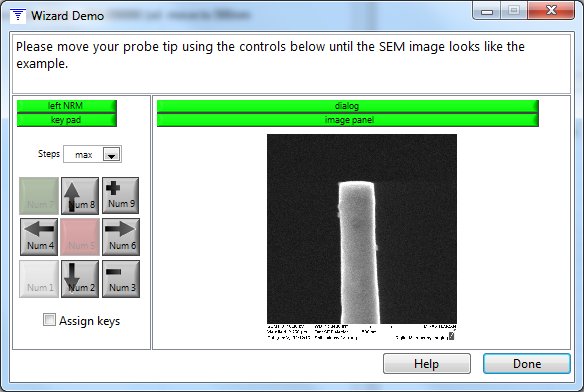
NanoControl is one Software System from Klocke Nanotechnik that controls all Nanorobotics: from a single Nanomotor® over the Nanoworkbench up to complete Micro Production Systems – in one single release. The panels for a particular Nanorobotics system are automatically configured out of the Purchase Order Confirmation for a project by our ERP system. NanoControl includes a Manual Control Graphical User Interface and many Purchase Order related modules like a Sequencer for automation by simple teaching, a macro executor, assistants, a Live Image Positioning module, measurement diagrams, pattern recognition and plenty of I/O interfaces. A few of these modules are listed here. Our modular and highly flexible software package allows manual and automated control from a single Nanomotor up to a complete micro production system. With a customizable user interface you have the controls you need for your specific task right at your fingertips. Our modular software can control a wide variety of devices including our Nanorobotics and many third-party devices like electron microscopes, stepper motors, power sources and GPIO cards. The control panels range from basic commands(e.g. move x nm) to complex procedures(e.g. automatically approach the surface with the Nanofinger) with a single button. Develop your own wizard-driven applications by recording manually controlled movements into the sequencer or create complex programs directly, no programming skills required. The ability to control the SEM stage and imaging are especially useful to automate in situ processes. Modules: Manual Control: - Design your own user interface with those commands your task needs. - Directly control movements at the nanometer scale using mouse or keypad input. - The flexible architecture allows for controlling many different hardware devices. - Use complex functions like approaching a surface with the Nanofinger®with the click of one button, just like the most simple move commands. - Traffic signs show the operation status of every device for an easy overview. Sequencer: - Record commands from the manual control window into a sequence to be repeated later. - Call the “Live Image Positioning” module or Pattern Recognition within your process to get coordinates for your processes. - Call diagram modules to record and show data sets during your process. - Include “Assitant” steps for semi-automated processes with user interactions. - Move the SEM/FIB stage, change Focus and Zoom automatically during your process. - Easily modify, move or duplicate recorded commands. - Use control structures like loops or conditions without need for programming knowledge. - Modify all the predefined Nanoworkbench sequences to your specific Needs, also those of the Standard Application packages. - Use the same sequencer from an easy few line macro up to a complex micro production process. - Although the usage is so simple this Sequencer offers flexible programming in depth like a Compiler. Assistants: - Select a few Manual Control panels to be used in this “Assistant”command step, - write an instruction text what to do with them, - add any instructive Picture if needed, - add a Done/Cancel/OK Button, - move this Assistant window to a position on the Screen. Now you have defined your Assistant step that can be used in Manual Control or called by the Sequencer(!). Live Image Positioning: - Navigate your Tools directly by dragging the cursor on the SEM or camera image. - Mark one or several positions in the live image, for later positioning of Tools or the sample stage to these target points. Vision: - Use a Vision system for Pattern Recognition of video camera images to automate your tasks - Utilize up to 4 cameras from different angles - Fully sequencer programmable Macro Executor: - Macros recorded by the Sequencer can be published in the “Macro Executor”, that seems to be just a menu list of macro entries. - Select a macro name out of this list, and that macro runs. It may be just a move command or a complete process. - In addition these macros can be called from outside of NanoControl by any other Software. In this moment NanoControl steps back: from the MASTER into the SLAVE mode. Anything taught with the Sequencer can so be called from outside, e.g. also SEM commands…
CATEGORY
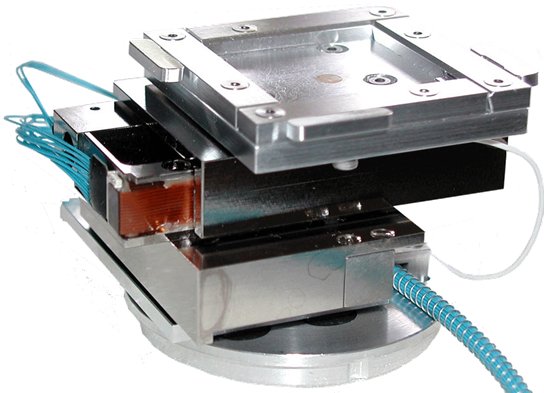
A set of motorized stages developed by Klocke Nanotechnik allows high strokes at small volumes. The modules are driven by the Nanomotor®. Loads of up to two kg can be moved over centimeters of stroke with down to 0,5 nm resolution. Manipulation in many degrees of freedom is possible without backlash. A position measurement system can be included without increasing the size. The resolution of the position sensor is 2 nm. All NMT modules can easily be fixed onto each other. Very small connectors allow the exchange of a module without removing cables. The NMT-Zxx are modules for vertical movement. They have an internal load compensation to lift up loads. - 1 nm resolution - repeatability better than 50 nm - 5-50 mm stroke - max. load up to 2000 g - small dimensions - modular system with easy handling - vacuum compatible - Horizontal stages NMT 20/30/40 - Vertical stages NMT Z15/Z20 - All stages are available with position measurement system, resolution 2 nm Principle of operation: The primary objective during the development of these Nanorobotics modules was a resolution in movement of a single Nanometer. This is made possible in principle by the Nanomotor®, developed by Dr. Klocke and his team. Compared with other high stroke piezo drives the Nanomotor has a real fine positioning stroke of more than a micron. Within this stroke the Nanomotor behaves exactly like a piezo, without backlash. The combination of the Nanomotor with mechanical guiding elements like ball bearing tables or gears should also eliminate the play of the mechanical guiding element and lead to a superior movement resolution, free of any backlash. But it didn’t. The movement of a first prototype showed a kind of backlash with 50 nm amplitude in an Electron Microscope. This value is much smaller than mechanical play and too big for a piezo drive. The analysis of the whole mechanical chain in this linear stage with a high resolution Electron Microscope led to the source of this backlash. The movement of this small motorized stage caused a compression of materials used in this setup. Even the elastic constants of materials reduce the performance of this device. After this result the linear stage was developed in a new design with other materials and geometries. The backlash caused by compression could be reduced in our new high resolution stages from 50 nm down to an amplitude of about 1 nm. Furthermore, compared with other piezo drives the Nanomotor does not press in this design against the mechanical guiding elements from the side and so avoids additional off-axis movements. Only with the precision of the Nanorobotics modules a coarse approach and a real fine adjustment can be fulfilled in one system: The fine positioning mode has a range of more than a micron without making coarse steps – another advantage compared with other systems. For manipulation tasks in Electron or Ion Microscopes this achieved precision is essential. These Nanorobotics modules are also the key elements for the precision of our Micro Production Systems.
CATEGORY
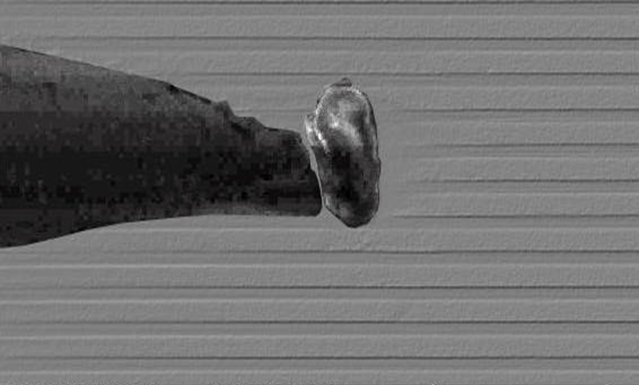
NanoCleaning is used when particles stick on the surface of expensive samples and cannot be wiped away e.g. in a chemical bath. Typical applications are cleaning after mask repair or glass master cleaning in Semiconductor industry. The requirement for NanoCleaning is a fast semi-automatic process. With the Nanoworkbench from Klocke Nanotechnik NanoCleaning is very fast, easy and secure. - customized sample cleaning tools are available, in tip or e.g. knife shape - in-situ tip cleaning module with reusable cleaner head - "discharge" tool for isolating samples - movement resolution 1 nm, repeatability 50 nm - 20 x 20 x 10 mm 3 stroke - high throughput automation - Nano Cleaning is an application package of the Nanoworkbench - Also available as a standalone module The Cleaning Process - The process starts with an overview image, a mouse-click onto a suspicious particle in the Live Image Positioning module moves with the SEM stage that particle into the image center, followed by an automatic zoom in. - When this particle shall be removed a mouse-click beneath its image moves the Nanofinger® tip automatically onto the sample beneath the particle. - One click with the keypad and the Nanofinger® tip kicks the particle away with 50 g acceleration and moves out, followed by an automatic zoom out to find the next particle. - About every 3 seconds a particle is removed, and after a while the tip gets dirty. - With an automatic macro the tips moves into a tip cleaning position and comes back cleaned after a few seconds, ready to kick the next particle from the sample. - The second Nanorobotics manipulator of the Nanoworkbench carriers the module for cleaning the Nanofinger® tip and a "Discharge" tool to collect the charge from isolating samples, e.g. from a glass master. A flood gun is not needed.
CATEGORY
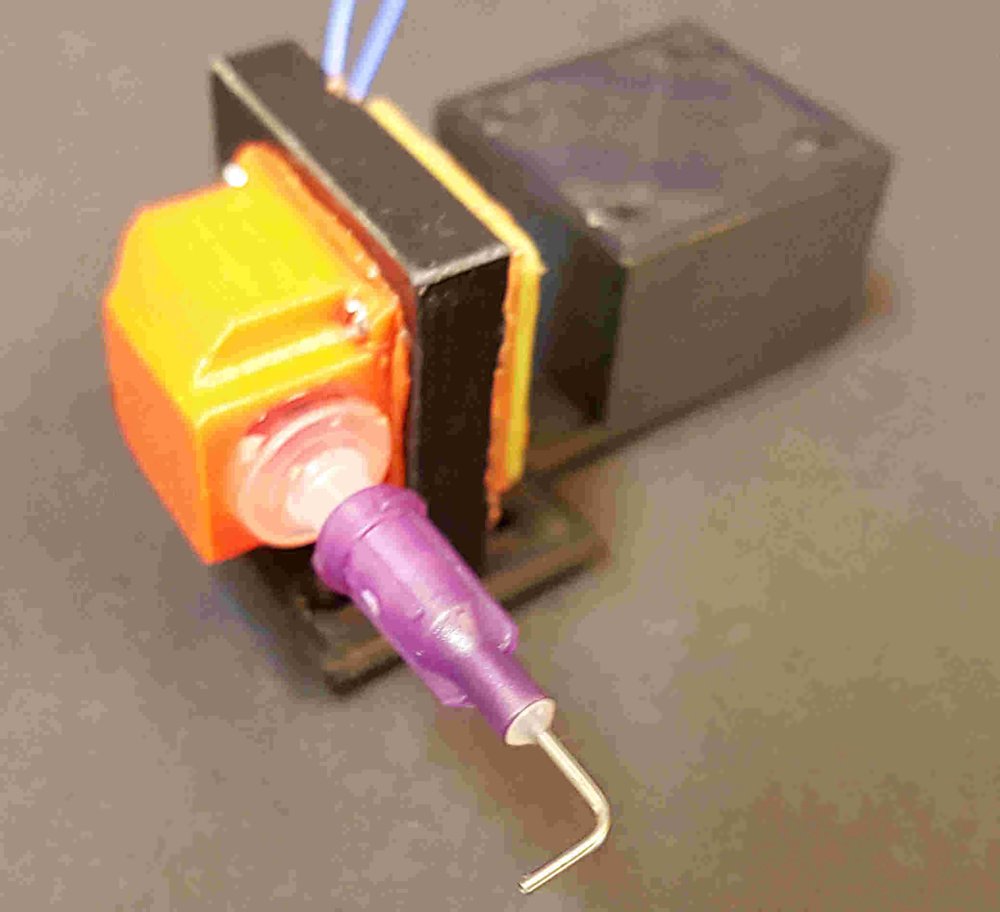
The Vacuum Gripper by Klocke Nanotechnik GmbH is an easy to use tool for many handling purposes. The system includes a connecting cable for an external remote control. A customized front end unit is included The vacuum is produced by an integrated micro-pump to achieve a very small design suitable for objects on hundred-micrometer to several-millimeter scale Stand alone vacuum gripper unit direct or remote controlled by an external switch on/off mode pulse mode for quick tests The Vacuum Gripper by Klocke Nanotechnik GmbH is designed to be an easy to use vacuum gripper for many purposes. With clearly arranged controlls in the front the vacuum gripper can be operated directly. This can be done either by using the on/off mode or the puls mode. Quick product or material Tests can be done this way. In addition the vacuum gripper provides a connector for an external switch, so the System can also be remote controlled. The System already includes a customized, professionally milled front end unit to fit your needs. For your conenience the System is deliverd with a complete set of cables and tubes, including: 5m vacuum tube with 4mm diameter. This way the vacuum unit does not have to be placed directly next to the handling area, Short vacuum tube with 2mm diameter, to minimize needed space close to the handling area. The system also includes a connecting cable for an external remote Control.
CATEGORY
