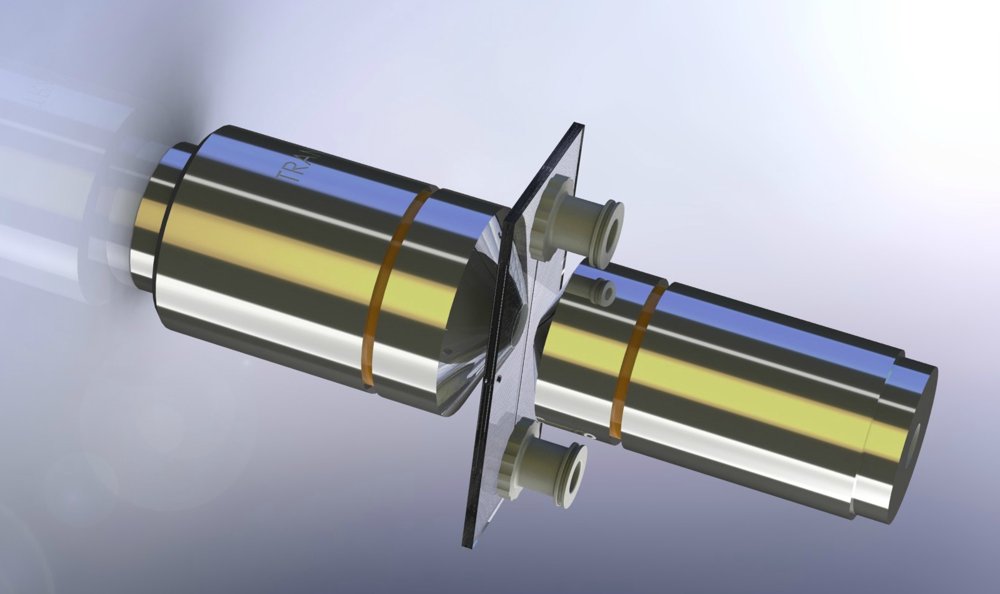
Translume offers a large selection of standard flow cells for all your lab and instrument needs. Many of these items are available immediately from our stock or on short order. Select the desired type of flow cell(s): Straight Channel, T-Channel, Cross-Channel, Y-Channel, or Reservoir by clicking on the appropriate link below. To place your order, you may either contact us by email or call our Sales office directly at (734) 528 6371.
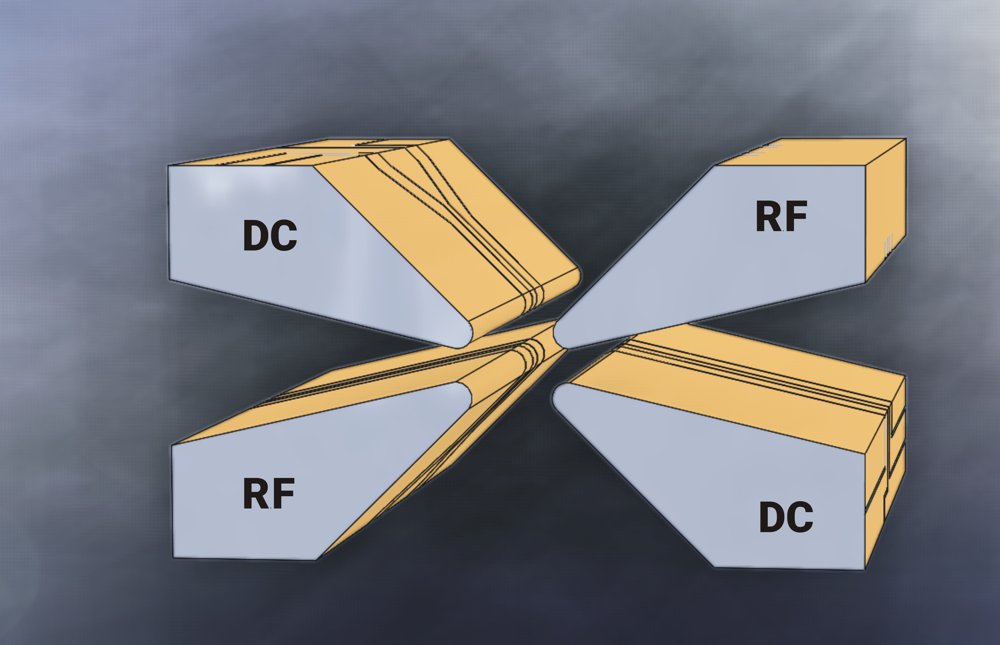
The four-blade Paul trap has long been recognized as an excellent platform for quantum studies.Its three-dimensional geometry allows for eV-deep trapping. Blade traps incorporate multiple large optical ports that provide easy access for laser cooling, ion state manipulation, and read out. The ability to collect photons over a large solid angle increases the probability to detect entanglement between emitted photons and trapped ions. Three-dimensional containment of the trapped ions is achieved by the combination of radial confinement produced by a time-dependent radio-frequency field, and axial confinement produced by static fields. Seminal experiments with 3D blade traps include the realization of a modular quantum network, small programmable quantum computers, and global or parallel entangling gates. Historically, blade traps have been manually assembled, making them prone to misalignment, lacking reproducibility and scalability. The alignment of a 3D micro-trap structure is a daunting task since multiple constraints along axial and radial directions have to be fulfilled simultaneously to maintain the symmetry required to avoid excess uncompensated micromotion. Furthermore, any hand-assembled blade alignment is susceptible to severe shifts, when the trap goes through a high-temperature outgassing cycle or a low-temperature operating cycle. To address these shortcomings, Translume has developed processes to fabricate blade traps that are monolithic. These traps are made from a single piece of fused silica. This monolithic fabrication approach eliminates assembly misalignment (there is no assembly!).The blade parallelism is excellent (micron-level between all blade pairs). The blade alignment is permanent and will not drift during thermal cycling (bake-out process for example) or when subjected to vibrations (cryo-cooling for example). Our microfabricated 3D blade traps provide multidirectional optical access and can host symmetric, trapping potentials, with trap depth in the eV range. Monolithic Structure = Splendid Blade Alignment & Rock-solid Structural Integrity The geometry of our standard GEN3-250 Monolithic Blade trap has been optimized for working with heavy ionic species (e.g., Yb+, Ba+,and Lu+, current workhorses of trapped ion quantum information science) while providing multi-directional optical access. The ion-electrode tip distance is 250-micron and the electrode isolation has been optimized for high RF voltage operations, in order to achieve secular frequencies in the 3-4 MHz range with these heavy ions. The GEN3-250 outside dimensions are 30.5 × 13 × 2 mm 3, with the central four-blade section having dimensions 6 × 3.5 × 2 mm 3. It is designed to operate at room temperature in an ultra-high vacuum. The blades are inclined to provide a bi-directional solid angle of 0.21 NA in the main plane, and 0.7 NA along the z axis from the trap center, enabling multi-directional individual-ion addressing and high photon collection efficiency. The DC blades are segmented into five electrodes for zone-based quantum operations, providing stable, reconfigurable, trapping potentials. Each electrode can be individually voltage-biased. To maximize symmetry and to reduce axial micromotion, the rf blades are also segmented (with a pattern mirroring that of the DC electrodes) but the segments are electrically connected and form a single electrical entity. The width of the central (150-micron) and middle segments (250-micron) were selected to minimize the axial inhomogeneity in the trap frequency along the trap main axis, and to minimize the voltages required for anharmonic axial potentials to trap long equidistantly spaced ion chains. The blade tips are rounded to avoid sharp corners, which would generate large local electric fields.
CATEGORY
The four-blade Paul trap has long been recognized as an excellent platform for quantum studies. Its three-dimensional geometry allows for eV-deep trapping. Blade traps incorporate multiple large optical ports that provide easy access for laser cooling, ion state manipulation, and read out. The ability to collect photons over a large solid angle increases the probability to detect entanglement between emitted photons and trapped ions. Three-dimensional containment of the trapped ions is achieved by the combination of radial confinement produced by a time-dependent radio-frequency field, and axial confinement produced by static fields. Seminal experiments with 3D blade traps include the realization of a modular quantum network, small programmable quantum computers, and global or parallel entangling gates. Historically, blade traps have been manually assembled, making them prone to misalignment, lacking reproducibility and scalability. The alignment of a 3D micro-trap structure is a daunting task since multiple constraints along axial and radial directions have to be fulfilled simultaneously to maintain the symmetry required to avoid excess uncompensated micromotion. Furthermore, any hand-assembled blade alignment is susceptible to severe shifts, when the trap goes through a high-temperature outgassing cycle or a low-temperature operating cycle. To address these shortcomings, Translume has developed processes to fabricate blade traps that are monolithic. These traps are made from a single piece of fused silica. This monolithic fabrication approach eliminates assembly misalignment (there is no assembly!). The blade parallelism is excellent (micron-level between all blade pairs). The blade alignment is permanent and will not drift during thermal cycling (bake-out process for example) or when subjected to vibrations (cryo-cooling for example). Our microfabricated 3D blade traps provide multidirectional optical access and can host symmetric, trapping potentials, with trap depth in the eV range. Monolithic Structure = Splendid Blade Alignment & Rock-solid Structural Integrity The geometry of our standard GEN3-250 Monolithic Blade trap has been optimized for working with heavy ionic species (e.g., Yb+, Ba+, and Lu+, current workhorses of trapped ion quantum information science) while providing multi-directional optical access. The ion-electrode tip distance is 250-micron and the electrode isolation has been optimized for high RF voltage operations, in order to achieve secular frequencies in the 3-4 MHz range with these heavy ions. The GEN3-250 outside dimensions are 30.5 × 13 × 2 mm3, with the central four-blade section having dimensions 6 × 3.5 × 2 mm3. It is designed to operate at room temperature in an ultra-high vacuum. Optical Access The blades are inclined to provide a bi-directional solid angle of 0.21 NA in the main plane, and 0.7 NA along the z axis from the trap center, enabling multi-directional individual-ion addressing and high photon collection efficiency. Blades Geometry The DC blades are segmented into five electrodes for zone-based quantum operations, providing stable, reconfigurable, trapping potentials. Each electrode can be individually voltage-biased. To maximize symmetry and to reduce axial micromotion, the rf blades are also segmented (with a pattern mirroring that of the DC electrodes) but the segments are electrically connected and form a single electrical entity. The width of the central (150-micron) and middle segments (250-micron) were selected to minimize the axial inhomogeneity in the trap frequency along the trap main axis, and to minimize the voltages required for anharmonic axial potentials to trap long equidistantly spaced ion chains. The blade tips are rounded to avoid sharp corners, which would generate large local electric fields.
CATEGORY
