By Avantama AG
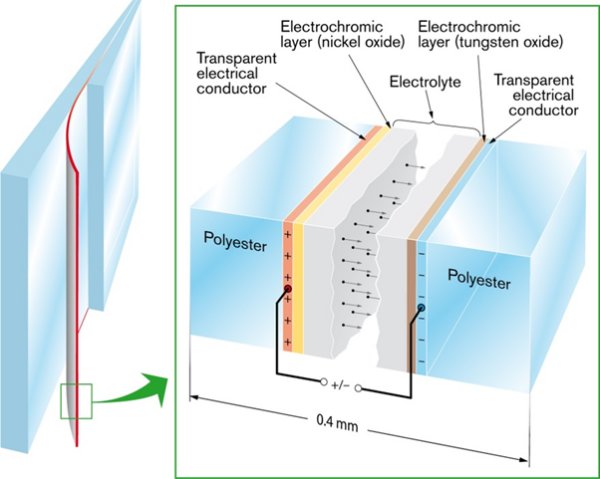
We have developed metal oxide nanoparticle formulations based on nickel oxide (NiOx) and tungsten oxide (WOx) for color-changing layers in electrochromic windows. Advantages of Avantama metal oxide formulations for electrochromic windows: - Solution processable → For e.g. roll-to-roll high-volume manufacturing - Low-temperature processing (< 80°C) → For temperature-sensitive substrates and fast deposition/drying times - Coatable on various substrates - High ink production reproducibility - High ink shelf life (12+ months) → Key for mass production - Nanoparticle production capacity equivalent to 0.2-1 Mio m2/year of electrochromic window area - Customer-specific ink customization available
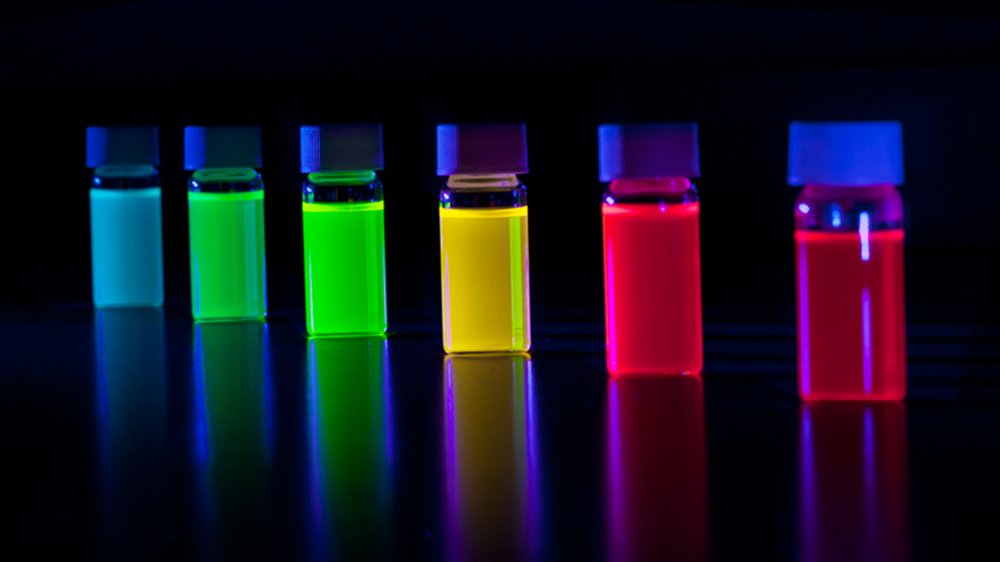
The underlying difference between quantum dots (QDs) produced by Avantama and alternative products is their chemical composition. Established QDs are synthesized from organic compounds such as indium phosphide (InP) or cadmium selenide (CdSe). Avantama QDs are based on novel metal halide perovskites, such as cesium lead bromine (CsPbBr3). These novel compounds represent significant benefits over established QDs, particularly for application in the printed electronics and display sector. Color: Determined by Chemical Composition The defining characteristic of existing QDs is their ability to transmit light of highly-defined colors when excited by incident photons of blue light. Established QDs exhibit luminescent qualities that are defined by their nanoscale dimensions, which means that larger QDs typically emit light of longer wavelengths. Controlling the size of the particles is therefore crucial to maintaining an optimally narrow particle size distribution for enhanced color gamuts and higher dynamic ranges of color. At Avantama, we tune the color of our QDs mainly by finely altering their chemical composition as opposed to their size. This enables simpler control of the emission wavelength, providing a more vibrant color output at lower manufacturing costs. Chemical Composition: Low Toxicity One of the enduring drawbacks of QD technology is the inherent toxicity of the established materials. Cadmium is regulated by RoHS and classified in group 1 of the IARC "carcinogenic to humans". Indium phosphide is not as safe as many believe. It has been REACH regulated and is on the preliminary RoHS restriction list. The new classification by IARC into group 2A suggests that indium phosphide is "probably carcinogenic to humans". More alarming, the accepted occupational exposure limit (OEL) for indium is more than 1,000 times lower than for lead and 10 times lower than for toxic cadmium. Avantama QDs based on metal halide synthesis are cadmium-free and fully-RoHS compliant. This mitigates the risk of manufacturing and transportation personnel being exposed to potentially carcinogenic or toxic materials. Manufacturing: Easier and Cost-Efficient In order to achieve suitable quantum efficiency and thermal stability, conventional quantum dots must be doped with an inorganic shell such as zinc sulfide. This represents a costly and multi-step manufacturing process that reduces the return on investment (ROI) for display manufacturers looking to compete with similarly expensive semiconductor manufacturing technologies such as organic light-emitting diodes (OLEDs). Avantama QDs can be synthesized in a cost-effective single-step process. Our metal halide nanoparticles exhibit the highest possible quantum efficiency with inherently good thermal stability, eliminating the need for a stabilizing surface additive. Performance: Unmatched by Conventional QDs The performance of Avantama QDs is currently unmatched on the display market. Our metal halide nanoparticles exhibit an absorbance per gram that is at least three times that of CdSe and more than ten times that of InP QDs, with quantum efficiencies of almost 100%. This allows the highest possible peak brightness currently available on LCD displays. The spectral output of our QDs also represents some of the best display color gamuts on the market, supporting the gradual realization of new Rec.2020 standards. QDs from Avantama Avantama is the leading supplier of metal halide perovskite QDs for the display sector. We continue to push the latter in terms of innovation for the optical and efficiency capacities of modern electronic displays.
CATEGORY
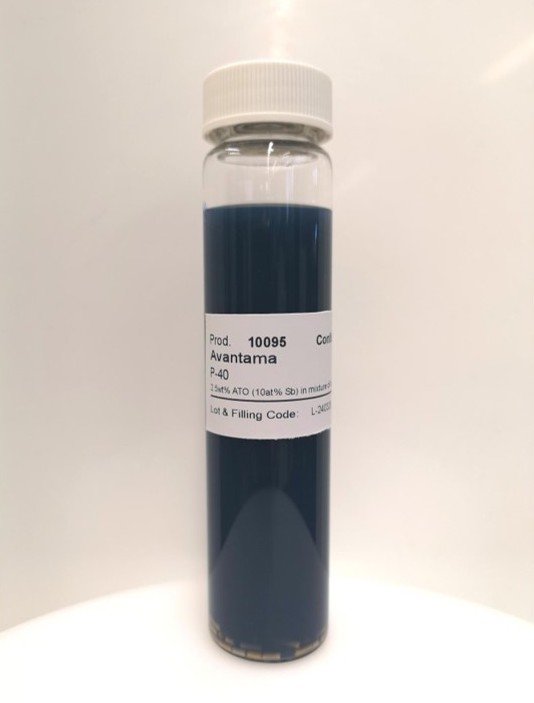
Avantama P-40 is an advanced high-performance hole transport material formulation consisting of 10at% Antimony (Sb)-doped stannic oxide (ATO) nanoparticles dispersed in a mixture of 1- and 2-butanol. Besides its application in cutting-edge photovoltaic technologies such as PSC and OPV, it also finds suitability in alternative printed electronic applications such as photodetectors (SWIR) or organic (OLED) and quantum dot light emitting diodes (QLED). In thin-film solar cells, the innovative ATO material shows outstanding performance and stability in combination with Perovskite absorbers and an organic SAM layer. Moreover, it has also proven to provide a good compatibility with NFA-based OPV photoactive material. Avantama P-40 is designed for solvent-based low-temperature deposition processes and can be conveniently applied by spin-coating, doctor-blading or slot-die technique. This makes the formulation suitable for cost-effective and scalable manufacturing techniques for next-generation printed electronics. The doping amount of the Antimony (Sb) in the SnO2-matrix can be adjusted to meet specific energy level requirements. Please contact us for further information and recommendations on the material composition. Hole transport material featuring: - No post-treatment needed - Low surface roughness - Improved wettability - Compatible with Perovskite absorbers - No damage to absorber/emitter To order this product, please contact sales@avantama.com. Product Number: 10095 Composition: Sb(10 at%)-doped SnO2 Particle size (nm): 8 Work function (eV): var. Concentration (wt%): 2.5 Solvent: Mixture of butanols Viscosity (cP): 3.5 Application Methods: - Spin coating / Doctor blading - Slot die Functions: - Hole injection - Hole transport - Electron blocking - Charge recombination Markets: - OLED - OPV - Perovskite PV - QLED - Printed photodetectors Documentation: - Specification Sheet - SDS Costs and delivery - Shipping by FedEx courier service only - Costs depend on country and shipping weight - Delivery time - Europe: 1–2 weeks - Worldwide: 1–3 weeks - Payment by Credit Card, PayPal or direct wire transfer - Import duties, taxes, and charges are not included in the item price or shipping cost. These charges are the buyer's responsibility.
CATEGORY
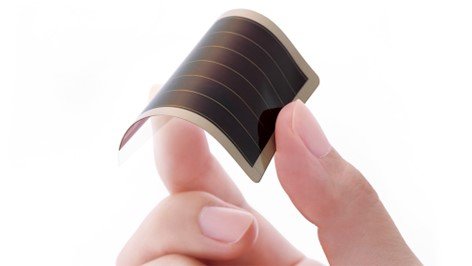
We have developed highly efficient solution processable inorganic charge transport formulations for indoor-light harvesting organic photovoltaics (OPV) cells which can be used for IoT devices such as electronic shelf labels to avoid disposable batteries. Our formulations yield very thin and stable metal oxide layers with either hole transport (HTL) or electron transport (ETL) function which ensure high photovoltaic cell efficiency and stability. Off-the-shelf ETL and HTL materials, customization on request Our off-the-shelf portfolio comprises almost 30 different standard formulations suitable for both hole and electron transport functions. With a suitable solution for practically every modern printing and coating technique, Avantama can support the production of your electronic device via spin coating, ink jet printing, roll-to-roll coating, and many more. - Various ETL/HTL compositions are available off-the-shelf - ZnO, Al:ZnO - SnO2; Sb:SnO2 - NiO - WO3 - Various solvent systems for different coating/printing processes - Nanoparticle solid loadings: 1 – 10 wt% - Proprietary ligands for: - High ink shelf life (12+ months) - good charge transport - Ink formulations tunable on customer's specifications (e.g. solid loading, solvent system, etc.) Advantages of Avantama ETL and HTL materials Enabling high-volume mass production of Perovskite PV Compared to other materials in the market, Avantama avamox materials have the following advantages for the use as ETL and HTL materials: - Solution processable → For e.g. roll-to-roll high-volume Perovskite PV manufacturing - Low-temperature processing (< 80°C) → For temperature-sensitive substrates and fast deposition/drying times - Coatable on various substrates - High ink production reproducibility - High ink shelf life (12+ months) → Key for mass production of Perovskite PV - Nanoparticle and ink production capacity equivalent to 0.2 – 2 GW Perovskite PV/year - Customer-specific ink customization available
CATEGORY
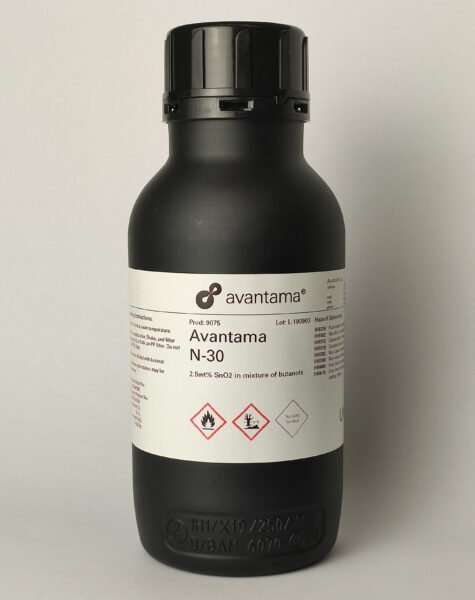
Avantama N-30 and Avantama N-31 are advanced high-performance electron transport material formulations consisting of finely tailored stannic oxide (SnO2) nanoparticles dispersed in a mixture of 1- and 2-butanol. While primarily serving as electron transport materials in thin-film solar cells, they also find suitability across a variety of functions in printed electronics applications that demand extended photodegradation stability such as photodetectors, organic light emitting diodes (OLEDs) or sensors. Avantama N-30 and N-31 are compatible with organic photoactive materials as well as Perovskite absorbers in cutting-edge photovoltaic applications. The butanol-based SnO2 formulations are designed to be conveniently applied using low-temperature coating techniques such as spin-coating, doctor-blading or slot-die. The difference of Avantama N-30 and N-31 lies in its surface chemistry and therefore band energy alignment. Please contact us for further information and recommendations which product is best suited for your application. Electron transport material featuring: - Matches ALD coated SnO2 ETL performance - Outstanding performance when printed on absorber/emitter - No photo degradation - No post-treatment needed - Very low surface roughness - Compatible with silver nanowires - Compatible with Perovskite absorbers - Long shelf life - No damage to absorber/emitter (normal architecture) Product Number: 9075 Composition: SnO2 Particle size (nm): 7 Work function (eV): 4.1 Concentration (wt%): 2.5 Solvent: Mixture of butanols Viscosity (cP): 3.5 Application Methods: - Spin coating / Doctor blading - Slot die Functions: - Electron injection - Electron transport - Hole blocking - Charge recombination Markets: - OLED - OPV - Perovskite PV - QLED - Printed photodetectors Documentation: - Specification Sheet - SDS 490.00 CHF
CATEGORY
