
A new automated, easy-to-use software module to allow you to create and edit method to automate routine qNMR assays and allow technicians to collect data effortlessly.
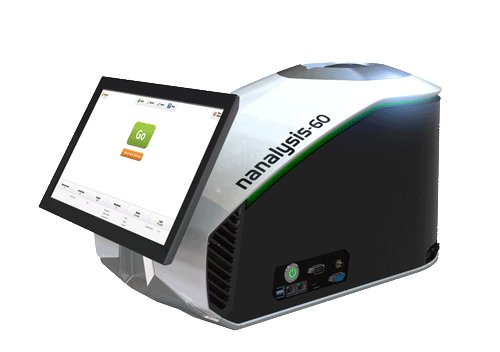
Nanalysis-60 Benchtop NMR Spectrometers Standard field strength. Superior NMR data. NEW Nanalysis-60 Nanalysis-60 benchtop NMR Nuclei 1H/19F, 1H/19F/13C, 1H/19F/7Li, 1H/19F/11B, 1H/19F/29Si, 1H/19F/31P, etc. Please inquire about custom options. Request a quote Operating Frequency 60 MHz (1.40 T) Resolution, LW (50%), LW (0.55%) < 0.5 Hz (< 0.008 ppm) < 10 Hz (< 0.17 ppm) Sensitivity, 1% Ethylbenzene, 1 scan 180:1 single channel 130:1 dual channel Dimensions with screen (w x h x d) 13 x 23.75 x 12.25’’ 33.02 x 60.3 x 31.1 cm Screen size and resolution 13.3”, 16:9, 1920 x 1080 Weight 96.5 lbs / 43.8 kg Magnet Permanent, no cryogens User Interface Built-in touchscreen and optional remote access. Connectable to external computer if desired. Lock Internal 1H and 2H options Sample Standard 5 mm NMR tubes, optional flow cell Compatibility File: JCAMP-DX, and CSV Software: Mnova, ACD/Labs, Delta, TopSpin, MATLAB, Spinit, NMRFx, etc. Stray Field < 2 Gauss line outside the enclosure Operating Temperature 18 – 26 °C Power Supply 100 – 240 VAC, 50 – 60 Hz Connectivity Ethernet/WiFi, USB, Serial, HDMI Nanalysis is excited to offer access to gradient-based pulse sequences to enhance your 2D NMR analysis and solvent suppression routines! It includes sequences such as WET, 1D-CPMG-filter-WET, gCOSY, gTOCSY, gHSQC, gHSQC-ME, gHMQC, gHMBC. To learn more about it, check out our gradient blog, the gradient video, and do not hesitate to inquire for more information. 1D, 1D{1H}, COSY, TOCSY, JRES, T1, T2, DEPT, APT, HETCOR, HSQC, HSQC-ME, HMBC, NOESY, ROESY, PRESAT, NOESY-PRESAT, DANTE, WET, Nutation (Default experiments are bolded) Gradient-based experiments Library: WET, 1D-CPMG-filter, 1D-CPMG-filter-WET, gCOSY, gTOCSY, gHSQC, gHSQC-ME, gHMQC, gHMBC Extended library: NOESY, ROESY, 1D-CPMG-filter Kinetics Please inquire about additional pulse sequences or experiment designer.
CATEGORY
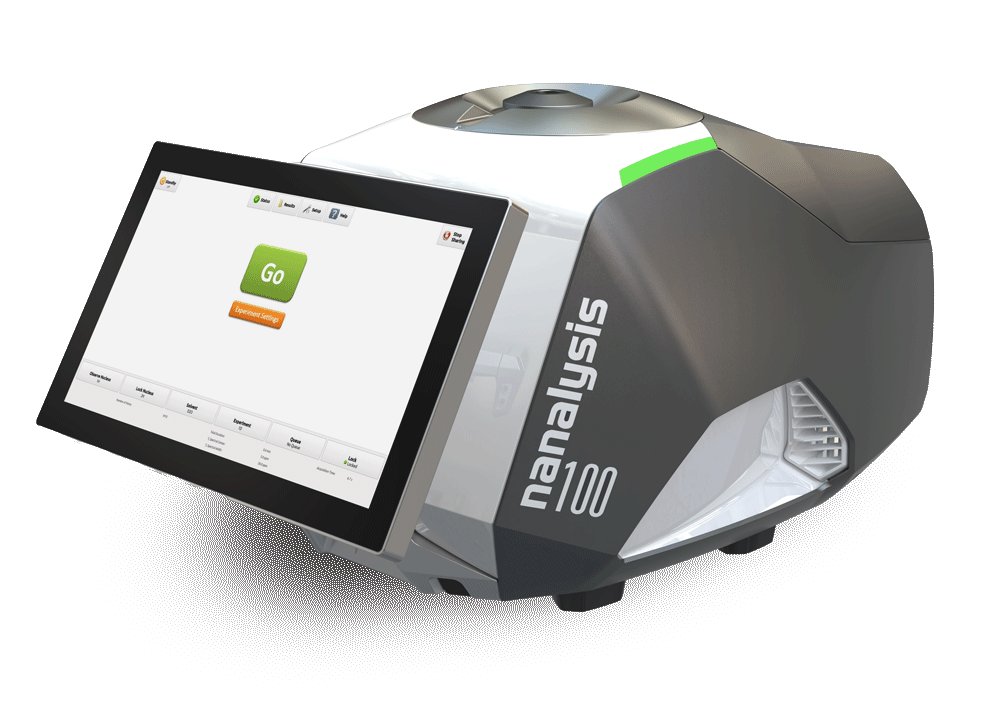
The top-of-the-line benchtop NMR. The highest field available. Easy-to-use and low maintenance. Nuclei: 1H/19F, 1H/19F/13C, 1H/19F/7Li, 1H/19F/31P, etc. Please inquire about custom options. Request a quote Operating Frequency 100 MHz (2.35 T) Resolution, LW (50%), LW (0.55%) < 0.5 Hz (< 0.005 ppm) < 10 Hz (< 0.10 ppm) Sensitivity, 1% Ethylbenzene, 1 scan 250:1 single channel 220:1 dual channel Dimensions with screen (w x h x d) 17 x 15.25 x 32" 43.2 x 38.74 x 81.28 cm Screen size and resolution 15.6", 16:9, 1920 x 1080 Weight 243 lbs /110 kg Magnet Permanent, no cryogens User Interface Built-in touchscreen and optional remote access. Connectable to external computer if desired. Lock Internal 1H and 2H options Sample Standard 5 mm NMR tubes, optional flow cell Compatibility File: JCAMP-DX, and CSV Software: Mnova, ACD/Labs, Delta, TopSpin, MATLAB, Spinit, NMRFx, etc. Stray Field < 2 Gauss line outside the enclosure Operating Temperature 18 – 26 °C Power Supply 100 – 240 VAC, 50 – 60 Hz Connectivity Ethernet/WiFi, USB, Serial, HDMI Nanalysis is excited to offer access to gradient-based pulse sequences to enhance your 2D NMR analysis and solvent suppression routines! It includes sequences such as WET, 1D-CPMG-filter-WET, gCOSY, gTOCSY, gHSQC, gHSQC-ME, gHMQC, gHMBC To learn more about it, check out our gradient blog, the gradient video, and do not hesitate to inquire for more information. Default Experiments Library: 1D, T1, T2, COSY, TOCSY, JRES, HSQC, HSQC-ME, HMBC, DEPT, APT, HETCOR Gradient-based experiments Library: WET, 1D-CPMG-filter, 1D-CPMG-filter-WET, gCOSY, gTOCSY, gHSQC, gHSQC-ME, gHMQC, gHMBC Extended library: NOESY, ROESY, 1D-CPMG-filter Kinetics Please inquire about additional pulse sequences or experiment designer.
CATEGORY
Accessible. Affordable. Automatable. Upgrade your lab with our compact and powerful chemistry tools for enhanced accuracy and precision. Benchtop NMR (Nuclear magnetic resonance) spectrometer is a powerful chemistry lab tool that helps analyze the structure and composition of materials across various industries, including fine chemicals and polymers. Its miniature size and compact design make it a fantastic alternative to the larger high-field NMR. Not only is it highly efficient and robust, but it is also a revolutionary technology in the scientific community. Benchtop Nuclear Magnetic Resonance (NMR) spectrometers are gaining global recognition for increasing the reach of NMR spectroscopy. This technique, while often considered the most information rich, has often been limited to large institutions due to both the instrument cost and size, but also by the expertise required to maintain the instrument, as well as acquire and process the data. Benchtop NMR is aimed at democratizing this powerful technique to both underserved users of high-field NMR spectroscopy, and in fields where it has been overlooked, such as reaction monitoring/process analytical technology (PAT) and industrial quality assurance/quality control (QA/QC). Nanalysis has manufactured and sold world-leading, compact benchtop NMR spectrometers since 2013. We develop and manufacture compact, portable, benchtop magnetic resonance imaging and spectroscopy products.
CATEGORY
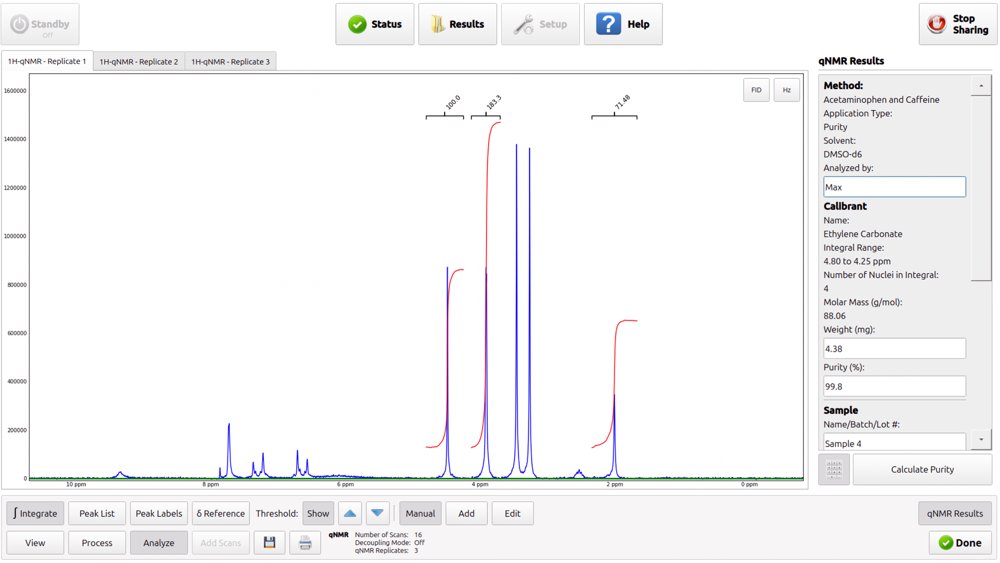
A new, automated, easy-to-use software module allowing you to create and edit method to automate routine qNMR assays and allowing technicians to collect data effortlessly. The qNMR module has its own dedicated tab to create, edit and/or manage qNMR methods. The administrator can set up acquisition parameters, integral ranges, etc. and name the method something that is easily identified, to allow any user to recall the method and run it as specified. To personalize the method to the analysis, the analyst can include their name, the calibrant weight and purity, and the sample name and/or batch identifier so that they can be easily reviewed and identified when the results are audited. Once a qNMR method is developed and saved it can be used in routine qNMR evaluation. Compatible with the Nanalysis-100 and Nanalysis-60 only. A typical qNMR module workflow includes the following steps: 1.Develop and save the qNMR method 2.Load the desired qNMR method 3.Set sample and analyst details 4.Acquire the data 5.Get the purity results
CATEGORY
