By EKSPLA
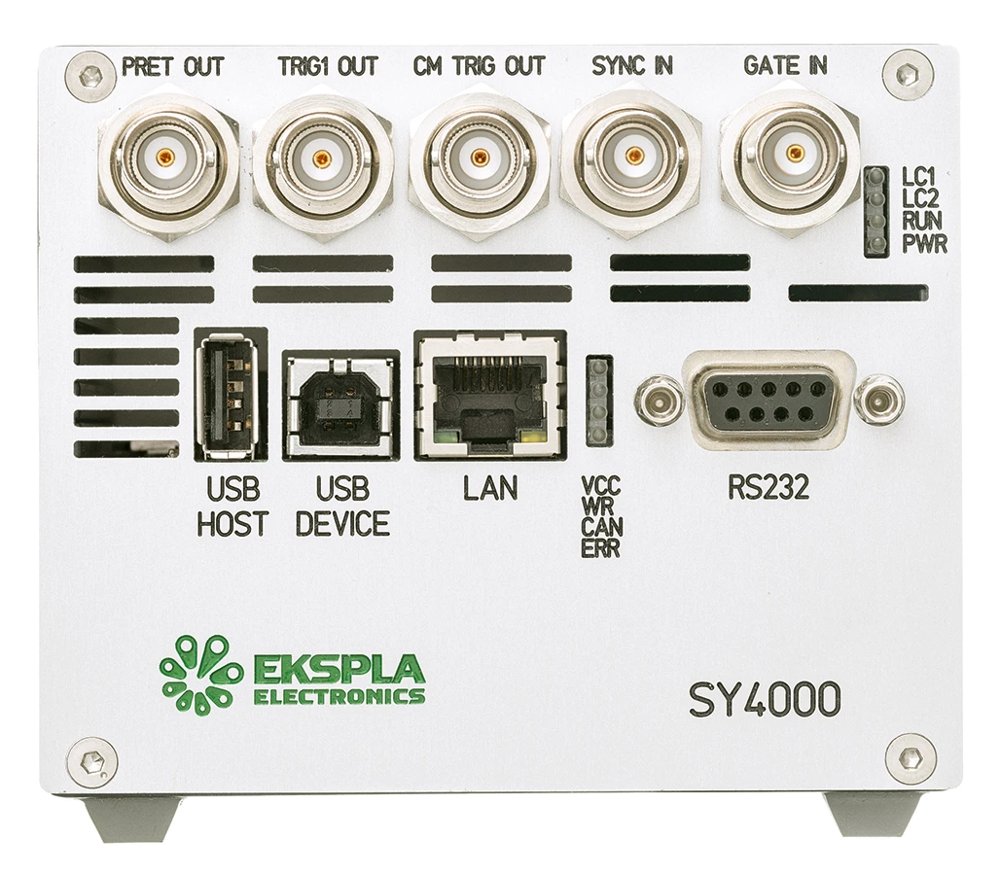
The digital delay generator SY4000 is designed to create up to 8 delayed output pulse sequences precisely synchronized with the internal or external clock. Digital delay generators can provide precise delays for triggering, syncing, delaying, and gating events. Features - 8 independent output channels - Ultra-stable internal clock 0.2 ppm - Precise delay/pulse width control in range 2 ns to 150 ms - 25 ps timing resolution - Hi-accuracy synchronization (locking) to external pulse train - Jitter <30 ps - DAC/AWG output - Both 50 Ω (6 outs) and differential (8 outs) outputs present - Frequency divider / Burst (software and hardware triggered) / Gating / Single shot - Communications: OEM version– CAN BUS; Encased version– LAN, WIFI (optional), RS232, USB (VCP)– via REST API or DLL’s. Applications - Mode locked and Q-switched fs, ps & ns lasers - Triggering of a data acquisition system - General purpose pulse generator - Precise system clock source - Laser pulse train conversion into a clean clock source - All functions above at once Highlight functions - Locking to an external clock source (typically photo-diode pulse train). Triggering system is locked to the laser oscillator and trigger time is always in phase with the optical pulse. - Trigger rate control and limiter circuit. It helps to protect laser components from damage due to exceedingly high/low triggering rates. - Single ended and differential outputs. - Instant switch between two configurations in delay blocks. Burst counter, gate input, frequency divider or software commands may serve as the configuration switching signal sources. Configuration switch is used to control optical pulse pickers (EO or AOM) in a highly flexible manner. - Low jitter sync pulse output used for high-speed acquisition systems like streak camera triggering. Typical jitter is 3…5 ps with the respect to the optical pulse. - Control connector. Software-controllable multiplexer may divert any of the output signals to this connector to monitor what is on other connectors without disturbing them. - Clock output: 1:1, 1:2 frequency. - Up to 4 pulse outputs can be combined to single signals by OR, AND, NOT logical operations. - DAC output, controlling, e.g. AOM pass though. The Ekspla’s digital delay generator SY4000 is designed to create up to 8 delayed output pulse sequences precisely synchronized with the internal or external clock. Digital delay generators can provide precise delays for triggering, syncing, delaying, and gating events. Our SY4000 digital delay generator is mainly employed for synchronization and control of different laser components: AOM drivers, Pockels cell drivers, laser diode drivers, flash lamp drivers, photodetectors, data acquisition systems, etc. Ekspla can provide both encased and OEM versions of SY4000 digital delay generator. The encased digital delay generator version can be controlled via RS232, USB, LAN, WLAN and also contains a user-friendly configuration software as well as an internal power supply. These communication options as well as software are also available in SY4000 digital delay generator’s OEM version and can be reached by adding additional Ekspla’s OEM communication board upon customer’s request. The encased digital delay generator is an optimal solution for laboratory use while SY4000 OEM version is ideal for integration and is frequently paired with an additional Ekspla’s OEM communication board. Specifications Model 1): SY4000 OUTPUT SPECIFICATIONS (general) Channel modes: Single shot, burst, normal, duty cycle, frequency divider Delay range: 0 to 150 ms Negative delay: -150 ms Pulsewidth: 2 ns to 150 ms Resolution: 25 ps Accuracy: 25 ps + 0.000001 × delay Time base: 100 MHz, 0.2 ppm Jitter: <30 ps Burst mode: 1 to 65535 Output level: 2.5 V, 4 V Impedance: 50 Ω Slew rate: 1.5 V/ns OUTPUT SPECIFICATIONS (internal generator) Mode: Duty cycle Rate: 50 ns to 100 sec Resolution: 10 ns or 300 ps Accuracy: 5 ns + 0.000001 × period Jitter: 100 ps RMS Burst: 0 … 65535 INPUT SPECIFICATION (external trigger) Rate: DC to 20 MHz Thershold: 1.3 V Input level: LVTTL, TTL Slope: rising Jitter: <100 ps RMS Delay: <13 ns; <70 ns COMMUNICATION OPTIONS Control interfaces (OEM board): CAN by default. RS232, USB, LAN, WLAN with additional communication board, provided upon request Control interfaces (encased version): CAN, RS232, USB, LAN, WLAN POWER REQUIREMENTS Power supply requirements (OEM board): 12 V DC, 500 mA Power supply requirements (encased version): 90…264 V, 50 – 60 Hz DIMENSIONS (not including connectors) OEM board (L × W × H): 100 × 77 × 20 mm Encased version (L × W × H): 105 × 86 × 85 mm ACCESORIES CAN-USB adapter: Ekspla’s CAN-USB adapter is required at evaluation stage for SY4000 OEM version board if communication via CAN interface is needed. Cable between adapter and board and beetween adapter and PC are included by default Communication board: Ekspla’s communication board which allows to control SY4000 OEM board via RS232, USB, LAN, WLAN interfaces. Can be provided upon request Input power cables: Included by default 1. Due to continuous improvement, all specifications are subject to change without notice. Parameters marked typical are not specifications. They are indications of typical performance and will vary with each unit we manufacture. Connectors Coaxial connectors, A-side, BNC type Name: PRET OUT | TRIG1 OUT | CM TRIG OUT | SYNC IN | GATE IN Function: Precision trigger, configurable source | General trigger, configurable source | Master trigger, OUT0 signal | Trigger input | Configuration switch and burst control input Description: Precise trigger, locked to the optical clock. Delay is adjustable in optical clock period time units. Jitter in respect to the optical pulse is ~4 ps RMS, almost independent on delay | General purpose or control sync out | Common trigger, general purpose output | External synchronization input. Trigger or Configuration switch source | Burst trigger or configuration switch control functions Amplitude: >1 V on 50 Ω, AC output, capacitor @ output | 2.5 V @50 Ω | 2.5 V @50 Ω | LVTTL 0.1 mA pull down to low level | LVTTL, 0.1 mA pull down to low level Pulse parameters: Rise time ~200 ps, width adjustable >100 ns | Select-able multiplexer to OUT0…OUT8 blocks, Optical clock, Optical clock/2 | OUT0 block, programmable pulse parameters | Frequency ≤100 MHz, PW ≥10 ns | Level or pulse with PW >20 ns Shape: Positive pulse | Logic level or pulse with programmable timing | Logic level or pulse with programmable timing | Positive pulse | Level or pulse Direction: Output | Output | Output | Input | Input Logic levels: 1.5 V @50 Ω | 2.5 V @50 Ω, 4.5 V @50 Ω jumper configurable | 2.5 V @50 Ω, 4.5 V @50 Ω jumper configurable | LVTTL, tolerates 5 V | LVTTL, tolerates 5 V Impedance: 50 Ω | 50 Ω | 50 Ω | 0.2 mA pull down | 0.2 mA pull down Coaxial connectors, B-side, MCX type Name: AN OUT | CM TRIG OUT | CM TRIG OUT1 | OUT2 | OUT3 | OUT4 | OUT5 | CLC IN Function: DAC analog output signal | Master trigger, OUT0 signal | Master trigger, OUT0 signal | General purpose trigger, OUT2 signal | General purpose trigger, OUT3 signal | General purpose trigger, OUT4 signal | General purpose trigger, OUT5 signal | Clock input Description: DAC output | Common trigger, general purpose output | Common trigger, general purpose output | General purpose output | General purpose output | General purpose output | General purpose output | External clock input Amplitude: 0…1 V | 2.5 V @50 Ω | 2.5 V @50 Ω | 2.5 V @50 Ω | 2.5 V @50 Ω | 2.5 V @50 Ω | 2.5 V @50 Ω | 100 mV Pulse parameters: N/A | OUT0 block | OUT0 block | OUT2 block, AND+OR+NOT logic with OUT1 | OUT3 block, AND+OR+NOT logic with OUT2 | OUT4 block, AND+OR+NOT logic with OUT3 | OUT5 block, AND+OR+NOT logic with OUT4 | PW >300ps, input frequency 10…100 MHz Shape: Two programmable analog levels | Logic level or pulse with programmable timing | Logic level or pulse with programmable timing | Logic level or pulse with programmable timing | Logic level or pulse with programmable timing | Logic level or pulse with programmable timing | Logic level or pulse with programmable timing | Sine, Meander to pulse train from photodiode Direction: Output | Output | Output | Output | Output | Output | Output | Input Logic levels: 1.5 V @50 Ω | 2.5 V @50 Ω, 4.5 V @50 Ω jumper configurable | 2.5 V @50 Ω, 4.5 V @50 Ω jumper configurable | 2.5 V @50 Ω, 4.5 V @50 Ω jumper configurable | 2.5 V @50 Ω, 4.5 V @50 Ω jumper configurable | 2.5 V @50 Ω, 4.5 V @50 Ω jumper configurable | 2.5 V @50 Ω, 4.5 V @50 Ω jumper configurable | 0.5 V…3.3 V pk-pk, sine or pulses Impedance: 50 Ω | 50 Ω | 50 Ω | 50 Ω | 50 Ω | 50 Ω | 50 Ω | 50 Ω
Picosecond Scanning Sum Frequency Generation (SFG) Vibrational Spectrometer In order to get SFG spectrum during measurement wavelength of narrowband mid-IR pulse is changed point-by-point throughout the range of interest. Narrowband SFG signal is recorded by the time-gated photomultiplier. Advantages - Sensitive and selective to the orientation of molecules in the surface layer - Intrinsically surface specific - Selective to adsorbed species - Sensitive to submonolayer of molecules - Applicable to all interfaces accessible to light - Nondestructive - Capable of high spectral and spatial resolution Applications - Investigation of surfaces and interfaces of solids, liquids, polymers, biological membranes and other systems - Studies of surface structure, chemical composition and molecular orientation - Remote sensing in hostile environment - Investigation of surface reactions under real atmosphere, catalysis, surface dynamics - Studies of epitaxial growth, electrochemistry, material and environmental problems The SFG spectrometer developed by Ekspla engineers is a nonlinear spectrometry instrument, convenient for everyday use. Ekspla manufactures SFG spectrometers, which are used by chemists, biologists, material scientists, and physicists. The spectrometer has many features that help to set up measurements and to make successful vibrational spectroscopy studies. For chemical and biochemical laboratories, this makes the Ekspla SFG spectrometer a reliable workhorse with a broad spectral region, automatically tuned from 625 to 4300 cm‑1, a high spectral resolution (3 cm‑1), and easily controlled adjustment of polarisation optics. The new SFG classic spectrometer consist of two units: laser light source PT501 and spectroscopy module. The Ekspla SFG system is based on a mode-locked Nd:YAG laser with a 29 ps pulse duration, 100 Hz repetition rate. The VIS channel of the SFG spectrometer consists of part of a laser output beam, usually with doubled frequency (532 nm) up to 0.3 mJ. The main part of the laser radiation goes to an optical parametric generator (OPG) with a difference frequency generation (DFG) extension. The IR channel of the spectrometer is pumped by the DFG output beam with energy in the range of ~40– 200 μJ. Infrared light can be tuned in a very broad spectral range from 2.3 up to 16 μm. The bandwidth is 3 cm‑1 and it is one of the main factors of SFG spectrometer spectral resolution. The second beam (VIS) is also narrowband at <2 cm‑1. The spectrometer signal detection system has a temporal gate. It significantly reduces accumulative noise and ambient light influence, which allows to use spectrometer even in a brightly illuminated room. The spectrometer does not have any acoustic noise because the laser is pumped by light emiting laser diodes. The spot size of the IR beam is adjustable. In this way, the appropriate energy density is achieved in order to avoid damaging or modifying the sample. Spectrum scanning, polarisation control and VIS beam attenuation are controlled from a computer. The spectrometer has a motorized polarisation switch for the IR, optionaly for the VIS, and optionaly the generated SFG light beams. Energy detectors continuously monitor the energy of the VIS and mid-IR laser pulses, so IR energy is recorded at each measurement point. This makes it possible to normalise the resulting SFG vibrational spectrum. Fast wavelength scan (sweep) allows fast access to a wide spectral range. Using time-synchronised motor positions enables fast and smooth wavelength tuning which allows users to scan the full range in just a few seconds or access specific wavelengths within 0.3 seconds. System Components - Picosecond mode-locked - Nd:YAG laser and optical parametric generator in one unit - Spectroscopy module with: – PMT based signal detectors – Data acquisition system – Dedicated LabView® software package for system control - Fast wavelength scan (sweep) Spectroscopy module, sample compartment A large sample compartment can be customised and enables the use of various extensions and additional instruments for simultaneous control of the sample conditions, including a Langmuir-Blodgett trough for air/water and lipid/air interface studies, temperature and humidity-controlled cells, and other instruments. Safety of the SFG spectrometer The spectrometer is safe to use: all high energy pulsed beams are enclosed. In addition, the sample area also has a special cover. During the measurements, it is possible to close the sample compartment so that radiation cannot penetrate outside. The automatic change of polarisation and energy attenuation makes it possible to perform measurements without opening the spectrometer. Laser safety precautions are required only for the alignment of the laser beams on the studied surface. Versions - Double resonance SFG spectrometer – allows investigation of vibrational mode coupling to electron states at a surface - Phase sensitive SFG spectrometer – allows measurement of the complex spectra of surface nonlinear response coefficients Options - Single or double wavelength VIS beam: 532 nm and/or 1064 nm - One or two detection channels: main signal and reference - Second harmonic generation surface spectroscopy option - Motorized polarisation control for VIS and SFG beams - Larger sample compartment to accomodate Langmuir through - Simultaneous measurement of s and p polarisation of SFG signal Specifications: Version 1) SFG Classic / SFG Double resonance / SFG Phase sensitive System (general) Spectral range: 625– 4300 cm‑1 / 625– 4300 cm‑1 (VIS 532 nm) 1000– 4300 cm‑1 (VIS 420– 680 nm) / 1000– 4300 cm‑1 Spectral resolution: <3 cm‑1 / <3 cm‑1 / <3 cm‑1 Spectra acquisition method: Scanning and fast wavelength sweep / Scanning and fast wavelength sweep / Scanning and fast wavelength sweep Sample illumination geometry: Top side, reflection / Top side, reflection / Top side, reflection Incidence beams geometry: Co-propagating, non-colinear / Co-propagating, non-colinear / Co-propagating, non-colinear Incidence angles: Fixed, VIS ~60 °, IR ~55 ° (optional: tunable) / Fixed, VIS ~60 °, IR ~55 ° (optional: tunable) / Fixed, VIS ~60 °, IR ~55 ° VIS beam wavelength: 532 nm / 532 nm and tunable 420– 680 nm / 532 nm Polarization (VIS, IR, SFG): Linear, selectable “s” or “p”, purity 1:100 / Linear, selectable “s” or “p”, purity 1:100 / Linear, selectable “s” or “p”, purity 1:100 IR Beam spot on the sample: Adjustable, ~200– 600 µm / Adjustable, ~200– 600 µm / Fixed Sensitivity: Air-water interface spectra / Air-water interface spectra / Solid sample spectra Laser light source 2) Model: PT501-SH / PT501-SH / PT501-SH Pulse duration: 29 ±5 ps / 29 ±5 ps / 29 ±5 ps Pulse repetition rate: 100 Hz / 100 Hz / 100 Hz UV-VIS source for Double resonance SFG: – / PT401 / – Physical characteristics (footprint) Standard: 1300 × 1200 mm / 1800 × 1200 mm / 1400 × 1200 mm 1. Due to continuous improvement, all specifications are subject to change without advance notice. 2. Laser is optimised for pumping parametrical generator, maximum output energy may be different than specified for stand alone application.
CATEGORY
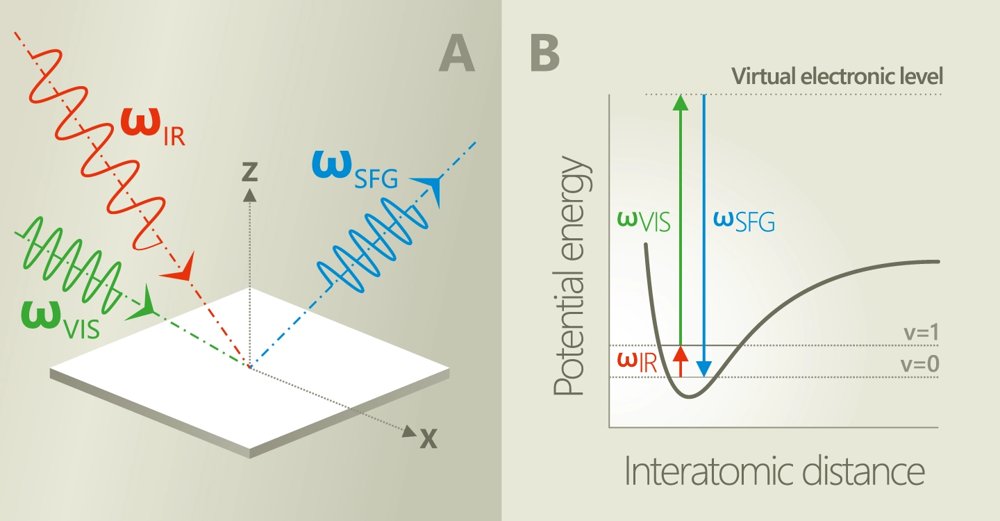
Broadband SFG Spectrometer Broadband Femtosecond Sum Frequency Generation (SFG) Spectrometer Femtosecond broadband SFG (BB SFG) spectrometer allows fast SFG spectra acquisition since most vibrational modes can be resolved without scanning. The advantage of the broadband SFG system is that intense femtosecond pulses allow efficient sum frequency generation at low pulse energies thus reducing the possibility of sample modification. It is especially important for aqueous and biological samples. Advantages - Sensitive and selective to the orientation of molecules in the surface layer - Intrinsically surface specific - Selective to adsorbed species - Sensitive to submonolayer of molecules - Applicable to all interfaces accessible to light - Nondestructive - Capable of high spectral and spatial resolution Applications - Investigation of surfaces and interfaces of solids, liquids, polymers, biological membranes and other systems - Studies of surface structure, chemical composition and molecular orientation - Remote sensing in hostile environment - Investigation of surface reactions under real atmosphere, catalysis, surface dynamics - Studies of epitaxial growth, electrochemistry, material and environmental problems Sum Frequency Generation Vibrational Spectroscopy Sum Frequency Generation Vibrational Spectroscopy (SFG-VS) is powerful and versatile method for in-situ investigation of surfaces and interfaces. In SFG-VS experiment a pulsed tunable infrared IR (ω IR) laser beam is mixed with a visible VIS (ω VIS) beam to produce an output at the sum frequency (ω SFG = ω IR + ω VIS). SFG is second order nonlinear process, which is allowed only in media without inversion symmetry. At surfaces or interfaces inversion symmetry is necessarily broken, that makes SFG highly surface specific. As the IR wavelength is scanned, active vibrational modes of molecules at the interface give a resonant contribution to SF signal. The resonant enhancement provides spectral information on surface characteristic vibrational transitions. Vibrational sum frequency generation (SFG) spectroscopy holds several important advantages over traditional spectroscopy methods for the molecular level analysis of interfaces, including surface sensitivity, vibrational specificity, and the possibility to extract detailed information on the ordering and orientation of molecular groups at the interface by analysis of polarization-dependent SFG spectra. Features and Design Femtosecond broadband SFG (BB SFG) spectrometer allows fast SFG spectra acquisition since most vibrational modes can be resolved without scanning. The advantage of the broadband SFG system is that intense femtosecond pulses allow efficient sum frequency generation at low pulse energies thus reducing the possibility of sample modification. It is especially important for aqueous and biological samples. The system is based on a femtosecond industrial grade FemtoLux® series laser with 500 fs pulse duration, more than 1 mJ pulse energy at 1030 nm and a 1 kHz repetition rate. The main part of the laser radiation is directed to a broadband mid-IR OPA module. Broad bandwidth (150–450 cm‑1) mid-IR radiation can be continuously tuned in a spectral range from 2.5 up to 10 μm, providing from 0.5 to 12 μJ close to energy transform-limited pulses for the IR channel. The VIS channel implementation depends on the system configuration. In a standard setup, a part of laser output radiation is frequency doubled (515 nm) ~20 µJ and then spectrally filtered to produce <8 cm‑1 bandwidth pulses. High resolution version consists of optically synchronised femtosecond and picosecond lasers. The combination of broadband mid-IR and narrowband VIS radiation allows to get the broadband sum frequency signal with exceptionally high spectral resolution below <3 cm‑1. Fast wavelength scan (sweep) allows fast access to wide spectral range. Using time-synchronised motor positions enables fast and smooth wavelength tuning which allows users to scan the full range in just a few seconds or access specific wavelengths within 0.3 seconds. This allows shifting the central wavelength countinuously during accumulative SFG measurements, effectively broadening the mid-IR bandwidth of a single acquisition and smoothing the mid-IR spectrum for better normalisation. Continuous, gapless tuning from 2.5 to 10 µm with a single polarisation ensures stable beam pointing, enabling seamless spectral measurements across the entire mid-IR range. Specifications Version 1) | SFG FS | SFG FS High Resolution System (general) Spectral range | 1000– 4300 cm‑1 | 1000– 4300 cm‑1 Spectral resolution | <9 cm‑1 | <3 cm‑1 Spectral bandwidth 2) | 150– 450 cm‑1 | 150– 450 cm‑1 Spectra acquisition method | Broadband accumulative | Broadband accumulative Sample illumination geometry | Top side, reflection | Top side, reflection Incidence beams geometry | Co-propagating, non-colinear | Co-propagating, non-colinear Incidence angles | Fixed, VIS ~60 °, IR ~55 ° (optional: tunable) | Fixed, VIS ~60 °, IR ~55 ° (optional: tunable) VIS beam wavelength | 515 nm | 532 nm Polarization (VIS, IR, SFG) | Linear, selectable “s” or “p”, purity 1:100 | Linear, selectable “s” or “p”, purity 1:100 Beam spot on the sample | Adjustable, ~150– 600 µm | Adjustable, ~150– 600 µm Sensitivity | Air-water spectra | Air-water spectra Pump laser 3) Model | FemtoLux series | FemtoLux series Pulse energy | Optimised to pump broadband OPA | Optimised to pump broadband OPA Pulse duration | 500 ±50 fs | 500 ±50 fs Pulse repetition rate | 1000 Hz | 1000 Hz Physical characteristics Footprint | 2000 × 1500 mm | 2200 × 1500 mm 1. Due to continuous improvement, all specifications are subject to change without advance notice. 2. Measured at 30% level. 3. Laser is optimised for pumping parametrical generator, maximum output energy may be different than specified for stand alone application.
CATEGORY
FemtoTune series Tunable Femtosecond System for Ultrafast Applications FemtoTune femtosecond optical parametric amplifier is designed to meet the demanding specifications of modern ultrafast science, while introducing valuable features that enhance measurement efficiency, convenience, flexibility, and reliability. Features - 650 – 950 nm & 1100 – 2000 nm tuning range - Extension to UV - VIS (330 – 470 nm & 550 – 650 nm) - Extension to Mid-IR (2300 – 10 000 nm) gapless tuning - < 50 fs pulse duration featuring integrated dispersion compensation - Single shot – 100 kHz repetition rate - Scan of full wavelength range in a few seconds and fast wavelength sweep - Pumped by reliable FemtoLux series lasers featuring dry or water cooling - Additional narrow spectral bandwidth optically synchronised output at 1030 or at 515 nm less than 8 cm‑1 - Optical synchronisation with picosecond Ekspla laser sources: e.g. PL2231, PT501 (bandwidth below 3 cm‑1) Applications - Ultrafast non-linear spectroscopy: – Pump-probe – SFG – CARS - Multiphoton imaging FemtoTune femtosecond optical parametric amplifier is designed to meet the demanding specifications of modern ultrafast science, while introducing valuable features that enhance measurement efficiency, convenience, flexibility, and reliability. FemtoTune is based on Ekspla’s extensive experience in developing picosecond and nanosecond tunable systems, as well as optical parametric chirped pulse amplifiers (OPCPAs) with pulse energies up to 1 joule and durations as short as 10 fs. FemtoTune delivers a compact, high-repetition-rate (up to 100 kHz) solution with sub‑50 fs pulse duration across the broad wavelength tuning range, tailored for modern ultrafast spectroscopy and imaging. The time-synchronised motor positioning enables fast and smooth wavelength tuning, allowing users to scan the full range in just a few seconds or access specific wavelengths within several tenths of a second. Continuous, gapless tuning in the mid-IR (2.5 – 10 µm) with a single polarisation eliminates the need to switch between signal and idler waves. This results in faster, more stable measurements ensuring excellent beam pointing stability. For applications requiring narrow spectral bandwidths, such as SFG or CARS, FemtoTune offers an additional narrowband channel at 1030 nm or 515 nm, providing <8 cm‑1 bandwidth without the need for complex spectral narrowing techniques. Optical synchronisation with most of our picosecond lasers and wavelength tunable systems allows achieving even narrower bandwidth (<3 cm‑1) enabling simultaneous high temporal and spectral resolution measurements. Pumped by robust award-winning industrial-grade FemtoLux series laser, FemtoTune offers long-term stability, hands-free operation, and minimal maintenance. FemtoTune delivers ultrashort pulses at high repetition rate, enhanced by advanced functionality, all in a compact system. Specifications Model: FemtoTune Tuning range: 650 – 950 nm & 1100 – 2000 nm Pulse energy at 800 nm: 30 µJ Pulse energy at 1500 nm: 10 µJ Pulse duration at 700– 900, 1100– 1900 nm: <50 fs Long-term power stability, 9 hours: <1 % Pulse-to-pulse stability, 10 sec: <1 % Repetition rate: Single shot – 100 kHz Pump laser model: FemtoLux series Mains requirements: 100– 240 V AC, single phase, 50/60 Hz Operating ambient temperature: 18– 27 °C Relative humidity: 10 – 80 % (non-condensing) Air contamination level: ISO 9 (room air) or better Due to continuous improvement, all specifications are subject to change without notice. Parameters marked typical are not specifications. They are indications of typical performance and will vary with each unit we manufacture. Please see Performance section. Pulse energy at 10 kHz repetition rate. Max repetition rate is fixed. Options and accessories - Extension to UV – VIS: 330 – 470 nm & 550 – 650 nm - Extension to Mid-IR: 2300 – 10 000 nm gapless tuning - Additional output (simultaneously): 1030 or 515 nm Spectral range and pulse energy with extensions. Pulse bandwidth in NIR, SWIR and Mid-IR wavelength ranges.
CATEGORY
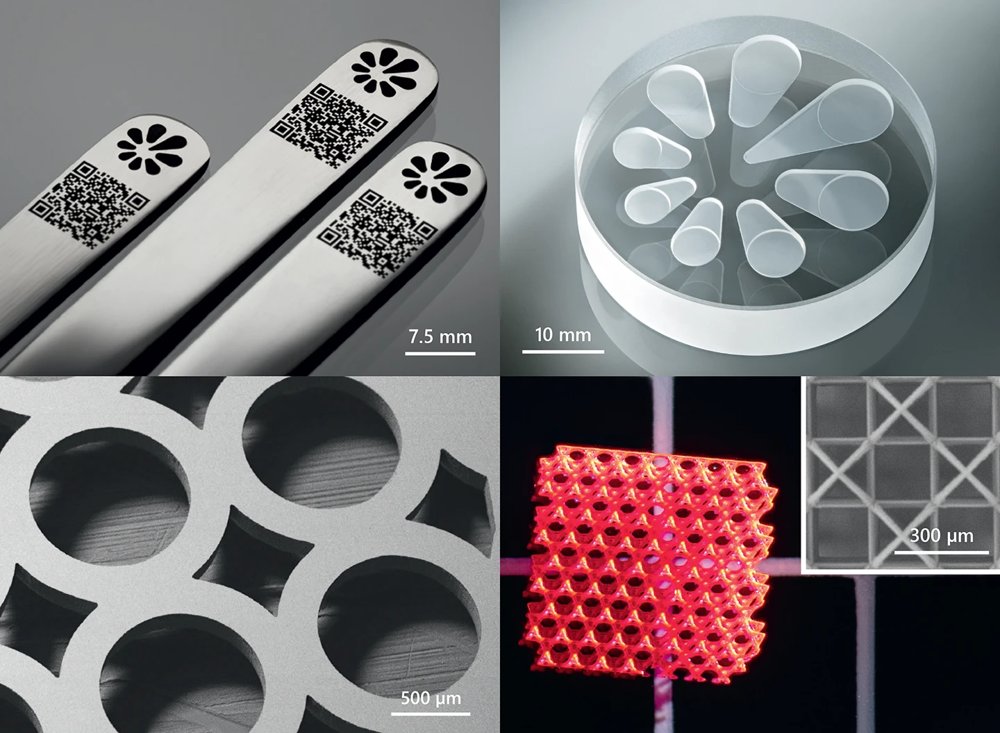
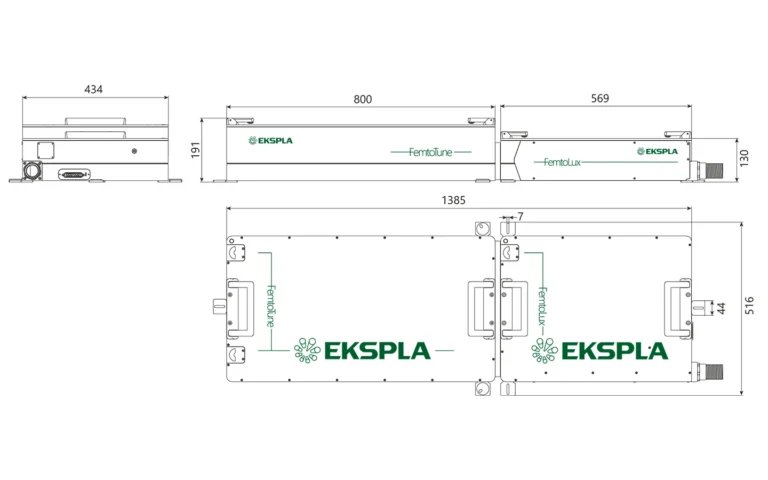
FemtoLux Industrial Femtosecond Lasers FemtoLux is designed from the get-go for maximum reliability, seamless integration and non-stop 24/7/365 zero maintenance operation with innovative ”dry” cooling. Wide range of options enable to tailor this ultrafast laser for desired material processing tasks. Features - At 1030 nm 50 W typical max output power 300 µJ typical max output energy - At 515 nm 20 W typical max output power 50 µJ typical max output energy - At 343 nm 10 W typical max output power 25 µJ typical max output energy - Up to 1 mJ for FemtoLux HE - Up to 2 mJ in a burst mode - <400 fs– 1 ps - Pulse duration extension up to 1 ns - Single shot– up to 4 MHz (AOM controlled) - MHz, GHz, MHz+GHz burst modes - Pulse-on-demand (PoD), with jitter as low as 20 ns (peak-to-peak) - <0.5% RMS power long term stability over 100 hours - M² <1.2 - Beam ellipticity 0.85 - Zero maintenance - Dry cooling (no water used) - PSU and cooling unit integrated into single 4U rack housing - Easy and quick installation - Compatible with galvo and Polygon scanners as well as PSO controllers A reliable & versatile tool for micromachining Designed from the get-go for maximum reliability, seamless integration and non-stop 24/7/365 zero maintenance operation with innovative ”dry” cooling. The FemtoLux femtosecond laser has a tunable pulse duration from <400 fs to 1 ps and can operate in a broad AOM controlled range of pulse repetition rates from a single shot to 4 MHz. The maximum pulse energy is 1 mJ operating with single pulses and can reach even up to 2 mJ in burst mode, ensuring higher ablation rates and processing throughput for different materials. The FemtoLux beam parameters will meet the requirements of the most demanding materials and micro-machining applications. Innovative laser control electronics ensure simple control of the FemtoLux laser by external controllers that could run on different platforms, be it Windows, Linux or others using REST API commands. This makes easy integration and reduces the time and human resources required to integrate this laser into any laser micromachining equipment. Seamless user experience - Easy integration– remote control using REST API via RS232 and LAN. - Reduced integration time– demo electronics is available for laser control programming in advance. - Easy and quick installation– no water, fully disconnectable laser head. Can be installed by the end-user. - Easy troubleshooting– integrated detectors and constant system status logging. - No periodic maintenance required. Application fields - Through-glass vias (TGVs) manufacturing - Thin glass cutting - Nitinol stent processing - Microelectronics manufacturing - Heat-sensitive polymer cutting - Scribing of thick glass - Black/color marking of medical tools Specifications Model | FemtoLux 30 | FemtoLux 50 | FemtoLux HE Main Specifications 1) Central wavelength | 1030 nm | 1030 nm | 1030 nm Laser pulse repetition rate (PRR) 2) | 200 kHz– 2 MHz, 4 MHz optional | 100 kHz– 2 MHz, 4 MHz optional | 10 kHz– 1 MHz Pulse picker PRR | Laser PRR / N, N=1, 2, 3, …, 65000; single shot | Laser PRR / N, N=1, 2, 3, …, 65000; single shot | Laser PRR / N, N=1, 2, 3, …, 65000; single shot Maximal average output power 3) | ≥30 W | ≥45 W (typical 50 W) | ≥30 W Pulse energy 4) | ≥100 µJ, 300 µJ optional | ≥250 µJ (typical 300 µJ) | 1 mJ Power long term stability (Std. dev.) 5) | <0.5 % | <0.5 % | <0.5 % Pulse energy stability (Std. dev.) 6) | <1 % | <1 % | <1 % Pulse duration (FWHM) @1 MHz 7) | <400 fs– 1 ps | <400 fs– 1 ps | <400 fs– 1 ps Number of pulses in MHz burst 8) | 2– 10 | 2– 10 | 2– 10 Total energy in burst mode 9) | 450 µJ | 750 µJ | 2 mJ Beam quality | M 2<1.2 (typical <1.1) | M 2<1.2 (typical <1.1) | M 2<1.3 Beam ellipticity, far field | 0.85 (typical ≥0.9) | 0.85 (typical ≥0.9) | 0.85 (typical ≥0.9) Beam divergence (full angle) | <1 mrad | <1 mrad | <1 mrad Beam pointing thermal stability | <20 µrad/°C | <20 µrad/°C | <20 µrad/°C Beam diameter (1/e 2) | 2.5 ±0.4 mm @65 cm | 2.5 ±0.4 mm @65 cm | 2.5 ±0.4 mm @65 cm Polarization | vertical | vertical | vertical Synchronization mode | internal / external | internal / external | internal / external Pulse output control | frequency divider, pulse picker, burst mode, packet triggering, power attenuation, pulse-on-demand | frequency divider, pulse picker, burst mode, packet triggering, power attenuation, pulse-on-demand | frequency divider, pulse picker, burst mode, packet triggering, power attenuation, pulse-on-demand Control interfaces | RS232 / LAN | RS232 / LAN | RS232 / LAN Length of the umbilical cord | 3 m, detachable | 3 m, detachable | 3 m, detachable Laser head cooling type | dry (direct refrigerant cooling through detachable cooling plate), water cooling optional | dry (direct refrigerant cooling through detachable cooling plate), water cooling optional | dry (direct refrigerant cooling through detachable cooling plate), water cooling optional Physical characteristics Laser head (W × L × H) | 434 × 569 × 150 mm | 434 × 569 × 150 mm | 434 × 569 × 150 mm Power supply unit (W × L × H) | 483 × 534 × 184 mm | 483 × 534 × 184 mm | 483 × 534 × 184 mm Operating Requirements Mains requirements | 100– 240 V AC, single phase, 50/60 Hz | 100– 240 V AC, single phase, 50/60 Hz | 100– 240 V AC, single phase, 50/60 Hz Maximal power rating | 1000 W | 1000 W | 1000 W Operating ambient temperature | 18– 27 °C | 18– 27 °C | 18– 27 °C Relative humidity | 10 – 80 % (non-condensing) | 10 – 80 % (non-condensing) | 10 – 80 % (non-condensing) Air contamination level | ISO 9 (room air) or better | ISO 9 (room air) or better | ISO 9 (room air) or better 1. Due to continuous improvement, all specifications are subject to change without notice. Parameters marked typical are not specifications. They are indications of typical performance and will vary with each unit we manufacture. All parameters are specified for a shortest pulse duration. Unless stated otherwise, all specifications are measured at 1030 nm and for basic system without options. 2. When frequency divider is set to transmit every pulse. Fully controllable by integrated AOM. 3. At 1 MHz. Please see graphs for power vs laser pulse repetition rate of FemtoLux series lasers. 4. For FemtoLux 30 maximal pulse energy 300 µJ at 50 kHz. Standard energy 100 µJ at 200 kHz. 5. Over 100 h after warm-up under constant environmental conditions. 6. Under constant environmental conditions. 7. Please see graph for typical pulse duration for different repetition rates. 8. Oscillator frequency ~50 MHz, ~20 ns separation between pulses. 9. For MHz burst mode or MHz+GHz burst mode at 50 kHz PRR. For Femtolux HE at 10 kHz.
CATEGORY
