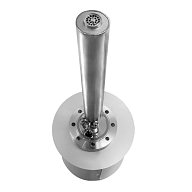
By AMT&C Group (Advanced Magnetic Technologies & Consulting Group)
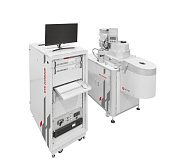
Plasma chemical etching system in combined capacitive and inductive discharge (ICP-RIE) Technologies: ICP-RIE STE ICP200E system is intended of plasma chemical etching processes using fluorine or chlorine chemistry in combined plasma of capacitive and inductive discharge. System reactor design is optimal for Bosch-process. System capacity - 7×Ø2” - 4×Ø3” - 3×Ø100 mm - 1×Ø150 mm - 1×Ø200 mm Ultimate pressure - 5x10⁻⁶ Torr ICP generator (13,56MHz) power - from 50 W to 1000 W - to 3000 W* RF generator power of RIE electrode - from 50 W to 500 W - to 1000 W* Etching uniformity on wafer Ø100 mm - ±2,5 % Key features 01 Wide library of basic technologies 02 Wide range parameters of etching 03 Versatile configuration 04 Optimized gas supply system Basic technologies - SiC deep plasma chemical etching to form metallization on the GaN transistor reverse side - GaAs deep plasma chemical etching to form metallization on the GaAs transistor reverse side - Si plasma chemical etching with high aspect ratio (Bosch-process) - Si plasma chemical etching low wall roughness - SiO2/Si plasma chemical etching with high selectivity - Si plasma chemical etching - Poly-Si high selectivity plasma chemical etching - Mo plasma chemical etching - InGaAs/AlGaAs plasma chemical etching - GaAs/AlGaAs plasma chemical etching for VCSEL
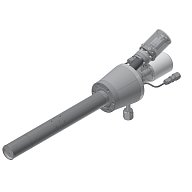
Materials: H2 Advantages: - Low energy consumption - Absence of high-energy particles and ions - Integrated water cooling Technical characteristics Thermocouple: Type C Bakeout temperature: 200°С Operating temperature: 2000°С In-vacuum length: 190-400 mm In-vacuum diameter: 36 mm Mounting flange: 40CF
CATEGORY
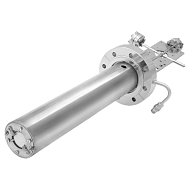
Materials: N2, H2, SiH4 ADVANTAGES: - PBN ionization chamber - Integrated matching device - Inductive plasma Technical characteristics - Input power: 50-400 W - In-vacuum length: 292 mm - Mounting flange: 63/100CF
CATEGORY
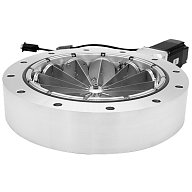
Counter-rotating vane set provides for linear control across the entire operating range of the valve. The precise setting of vane rotation of the plates is realized due to the servo-based flap control system.
CATEGORY