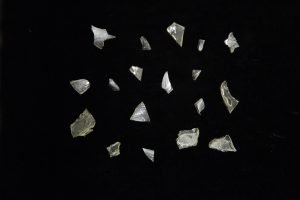
SINBIOSYS developed invisible nano tracers that can be illuminated with UV LEDs and used as inks for plastic films or as additives for virgin plastic resins. This technology permits the differentiation of plastics by the color of the emission of the quantum dots that are put into each different polymer. The readout of the signal was tested so far with commercial sorting machines at speeds up to 1 ton of material per hour and can be done with small flakes or on the whole object.
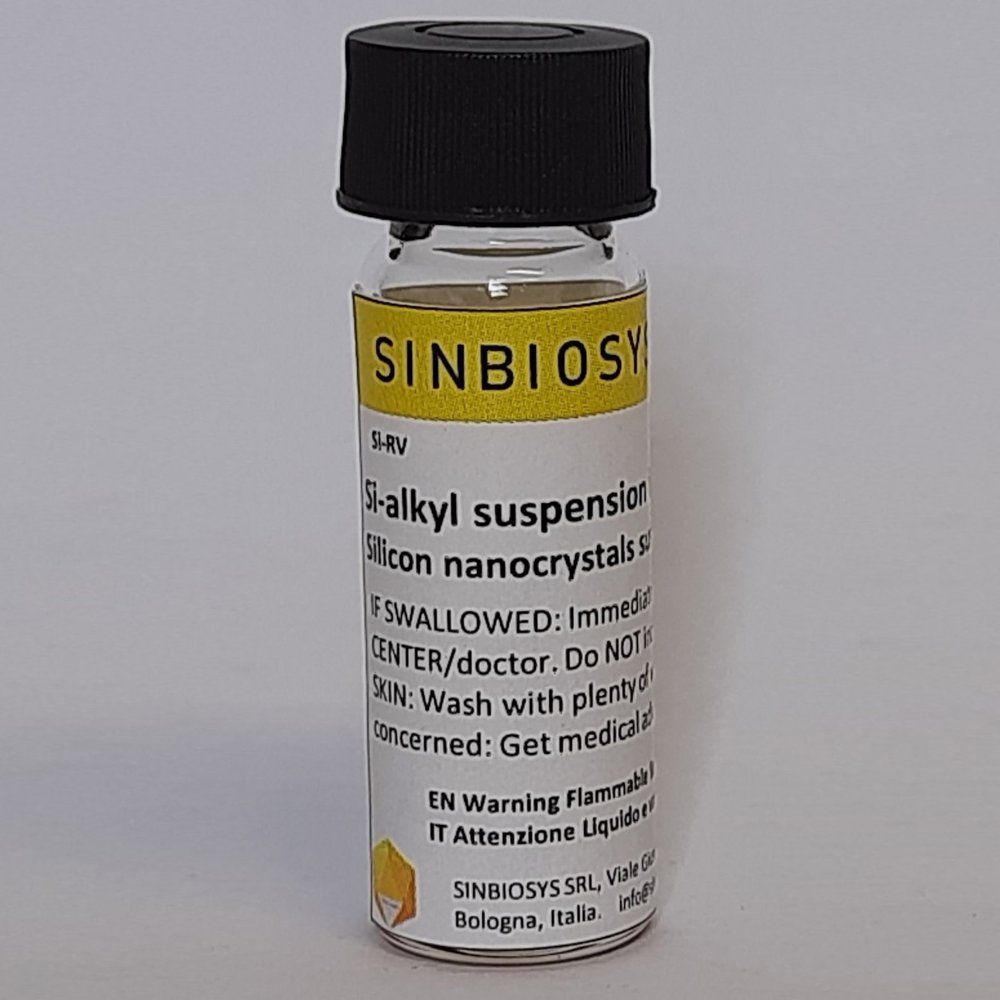
Si-alkyl are silicon nanocrystals passivated with alkyl terminated hydrocarbon chains and are sold as dispersions in toluene. Si-alkyl 700-900 have emission maxima between 700 and 900 nm. Si-alkyl 900 have emission maxima between 900 and 1000 nm Available Options Si-RV-2 | Si-alkyl 700-900 | λ=750-850 nm | V= 10mL, 200uM | 10 | 800,00€exc. VAT Si-RV | Si-alkyl 700-900 | λ=750-850 nm | V= 2mL, 200uM | 10 | 450,00€exc. VAT Si-RNIR-2 | Si-alkyl 900 | λ=900-1000 nm | V= 10mL, 200uM | 30 | 800,00€exc. VAT Si-RNIR | Si-alkyl 900 | λ=900-1000 nm | V= 2mL, 200uM | 30 | 450,00€exc. VAT For Research Use Only. Organic solvents How are SiQDs characterized? Absorption and emission spectra, quantum yield. Certificate of analysis is provided for every production lot. How is the concentration calculated? SiQDs concentration is referred to the concentration of the silicon core only and it is calculated using the Lambert- Beer equation, using absorption coefficients (εabs) reported in Korgel et al., Chem. Mater. 2012, 24, 393−401 Are the SiNCs stable at high temperature? Yes, Si-alkyl chromophore are stable up to 300°C.
CATEGORY
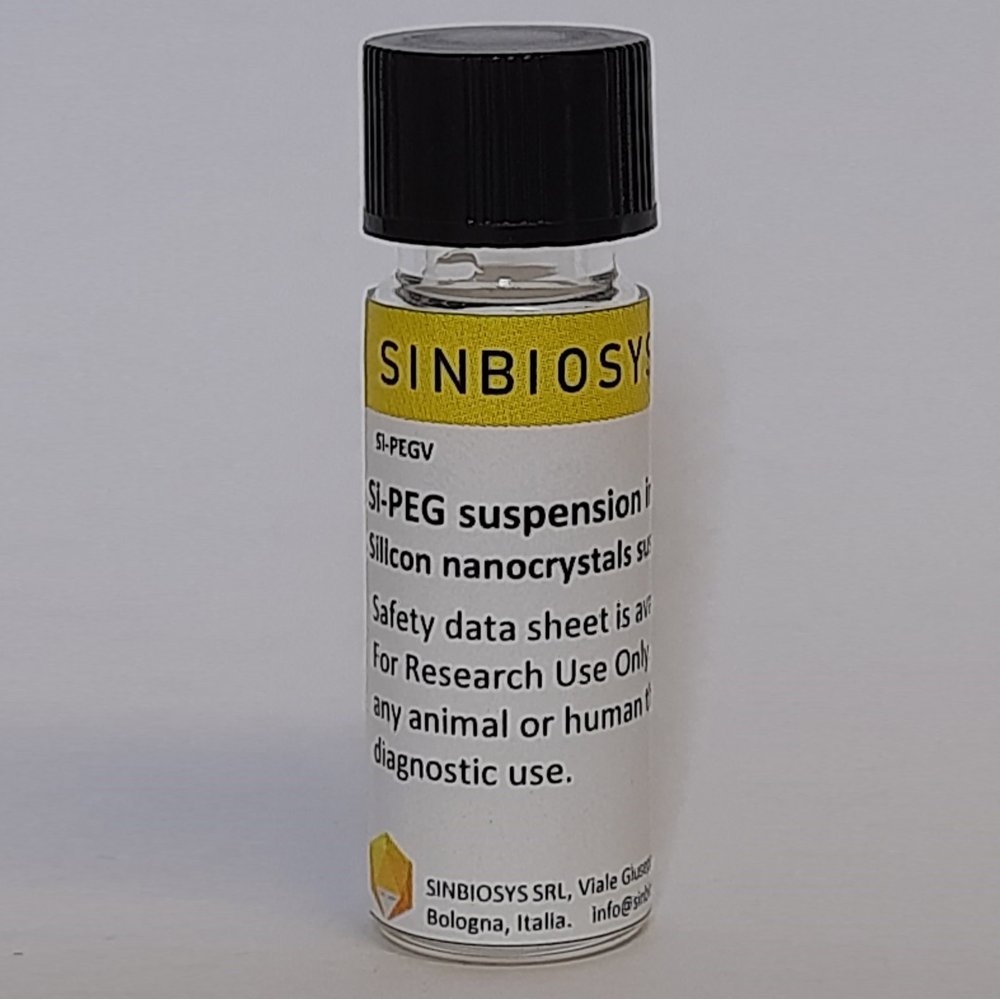
Si-PEG are sold in vials with volume of 1 ml, concentration ≅50 μM. Si-PEG are available as a dispersion in water. Si-PEG 700-900 have emission maxima between 750 and 850 nm. Suggested use within 6 months of receipt. For Research Use Only. Not intended for any animal or human therapeutic or diagnostic use. Related literature. Water suspendable How are SiQDs characterized? DLS, absorption and emission spectra, quantum yield. Certificate of analisys is provided for every production lot. How is the concentration calculated? SiQDs concentration is referred to the concentration of the silicon core only and it is calculated using the Lambert- Beer equation, using absorption coefficients (εabs) reported in Korgel et al., Chem. Mater. 2012, 24, 393−401. What is the typical size of pegylated SiQDs? Hydrodynamic radius is calculated via DLS instrument and is is typically between 40 and 60 nm. Upon request we can provide related data. Is it possible to customize the PEG terminal? The COOH terminal can be functionalized with amide or ester coupling.
CATEGORY
Si-PEG-COOH are sold in vials with volume of 1 ml, concentration ≅50 μM. Si-PEG-COOH are available as a dispersion in water. Si-PEG-COOH 700-900 have emission maxima between 750 and 850 nm. Suggested use within 6 months of receipt. For Research Use Only. Not intended for any animal or human therapeutic or diagnostic use. Water suspendable How are SiQDs characterized? DLS, absorption and emission spectra, quantum yield. Certificate of analisys is provided for every production lot. How is the concentration calculated? SiQDs concentration is referred to the concentration of the silicon core only and it is calculated using the Lambert- Beer equation, using absorption coefficients (εabs) reported in Korgel et al., Chem. Mater. 2012, 24, 393−401. What is the typical size of pegylated SiQDs? Hydrodynamic radius is calculated via DLS instrument and is is typically between 40 and 60 nm. Upon request we can provide related data. Is it possible to customize the PEG terminal? The COOH terminal can be functionalized with amide or ester coupling.
CATEGORY
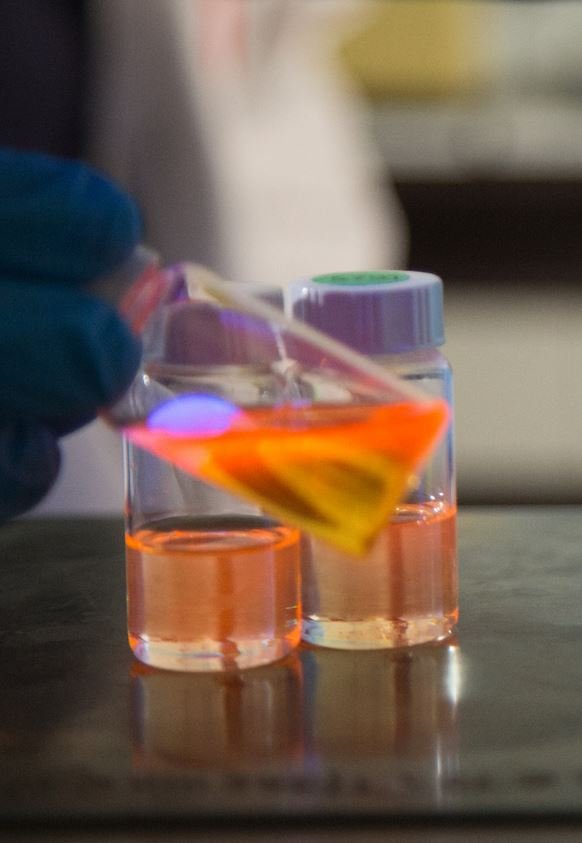
SINBIOSYS – SBY- produces SiQDs with different passivation layers that enables dispersion in different solvents. The passivation layer consists in covalently linked hydrocarbon chains that confer high stability to the system. SiQDs passivated with alkyl moieties can be dispersed in apolar organic solvents like toluene, DCM, THF, Hexane. SiQDs passivated with carboxylic terminal groups can be suspended in polar solvents like ethanol, methanol and ethyl acetate. SiQDs passivated with alkene terminal groups can be dispersed in apolar organic solvents like toluene, DCM, THF, hexane and they are active for further functionalization. SiQDs passivated with glycol terminal groups can be dispersed in polar solvents like ethanol, methanol and ethyl acetate. Typical absorption (dotted line) and emission spectra (coloured lines) of SiQDs. Emission is tunable in the range 600-1000 nm.
CATEGORY
