By Smart Material Solutions, Inc.
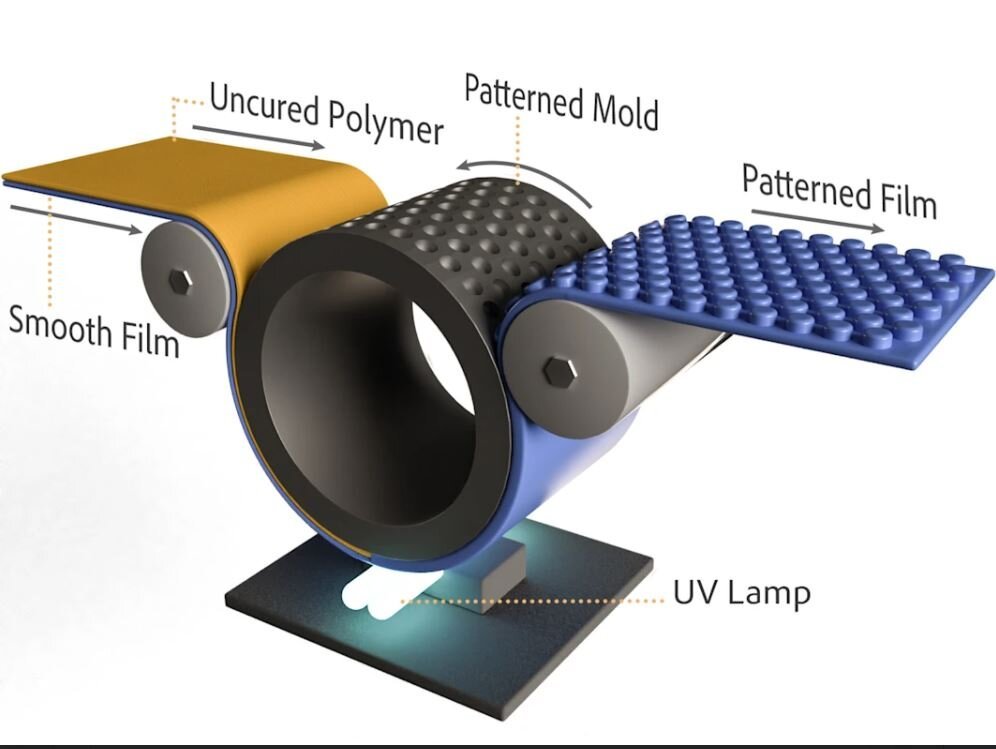
Smart Material Solutions primary mission is to supply the seamless nanopatterned drum molds needed for roll-to-roll nanoimprint lithography (R2R NIL). This continuous process allows for replication at rates much faster than step and repeat or “batch” imprinting due to the cycle time required in both thermal and UV processes. A seamless mold also allows the final patterned area in the substrate to be much larger than the pattern created in the mold. These advantages are especially potent in applications that require mass production of films. Smart Material Solutions’ advantage is its ability to seamlessly nanopattern cylindrical drum molds for R2R NIL hundreds of times faster than electron-beam lithography using its patented diamond indenting process - nanocoining.

Smart Material Solutions (SMS) has developed a multifunctional Performance-Enhancing Solar Nanocoating that increases solar panel efficiency by: - Capturing more sunlight using moth-eye anti-reflective structures and microscale light-trapping features that increase the path length of light inside the panel. - Resisting fouling by reducing adhesion of dust, pollen, sand, grime, and other particulates that can block sunlight. - Lowering operating temperature by increasing emissivity, enabling passive cooling and improving real-world efficiency. - Reducing reflection and glare, which improves energy capture and, in defense applications, help avoid revealing a soldier's position. SMS's solar nanocoatings have demonstrated efficiency gains across multiple solar technologies, including amorphous silicon, crystalline silicon, organic, and multijunction III-V cells. For example, SMS's nanocoating yields up to 5% more current from multijunction solar cells at normal incidence and over 20% more current at 80° incidence compared to state-of-the-art AR-coated solar glass. Preliminary testing also confirms UV stability and abrasion resistance. Panel without Nanocoating: Uncoated panels exhibit strong reflections, absorb less light, and are more susceptible to the buildup of dust, dirt, and grime that block incoming light, and operate at elevated temperatures. Panel with Nanocoating: Microscale light-trapping features increase optical path length and decrease operating temperature, while nanoscale moth-eye structures reduce Fresnel reflections and decrease surface soiling. This technology was developed with SBIR funding from the US Army and Space Force, in collaboration with PowerFilm Solar, MicroLink Devices, and MicroContinuum, and was selected as a winner of the Army XTechSBIR CleanTech Competition. Performance Enhancement Efficiency Increase SMS's nanocoatings provides similar relative efficiency gains across a wide range of solar technologies, including amorphous silicon, crystalline silicon, organic, and multijunction III-V cells. Efficiency increase of silicon cells due to SMS's nanocoating. As an example, we measured the efficiency of crystalline silicon solar cells covered in PET by PowerFilm as a function of incidence angle using a solar simulator with an AM1.5G filter. An adhesive-backed retrofit version of SMS's nanocoating was then applied to the same cells before repeating the measurements. The plot on the right shows the increase in power conversion efficiency after applying SMS's nanocoating. These efficiency gains were used to estimate increases in daily power output, summarized in the table below, assuming direct sunlight on a south-facing panel in the northern hemisphere on the equinox. Percent increase in daily power output of silicon solar cells due to addition of SMS's Nanocoating. Dust Mitigation SMS's nanocoating also reduces the adhesion of dust, which can accumulate on solar panels and block a significant portion of the incoming light. In addition, nanofeatures can impart self-cleaning properties that make it easier for rain to remove any dust that has accumulated. Photo showing solar cells with no coating (left) and with SMS's nanocoating (right) after dust exposure. The photo on the left shows two PowerFilm amorphous silicon solar cells after dust exposure. The uncoated cell (left) exhibits substantial dust accumulation, while the cell with SMS's nanocoating (right) remains largely free of dust, demonstrating the film's dust-mitigation capability. The same mechanism can also impart self-cleaning properties by helping water more effectively remove adhered dust. Passive Cooling SMS's nanocoating can also substantially lower panel operating temperature. Since panel efficiency drops as temperature increases, a decrease in panel temperature can result in a measurable increase in real-world power output. Researchers have shown that engineered microstructures can increase emissivity and promote radiative cooling. Emissivity of SMS's nanopatterned film and other coatings measured with FTIR. SMS therefore measured the emissivity of its patterned film and compared it to other solar cover glass solutions. The plot on the right highlights the high emissivity and superior passive cooling of SMS's nanopatterned film relative to state-of-the-art AR-coated solar cover glass. Preliminary results suggest a 6-8°C reduction in panel operating temperature, which can result in as much as 3-4% increase in real-world panel efficiency compared to AR-coated solar cover glass. Suppression of Bright, Specular Reflections Photo of a PowerFilm panel with reflection suppression due to SMS's nanocoating on the top, right corner. SMS's nanocoating also suppresses bright, specular reflections. The photo on the left shows sunlight reflecting off a flexible PowerFilm panel with our light-trapping nanocoating on the top, right corner of the panel. The nanocoating suppresses the bright reflection in this region.
CATEGORY
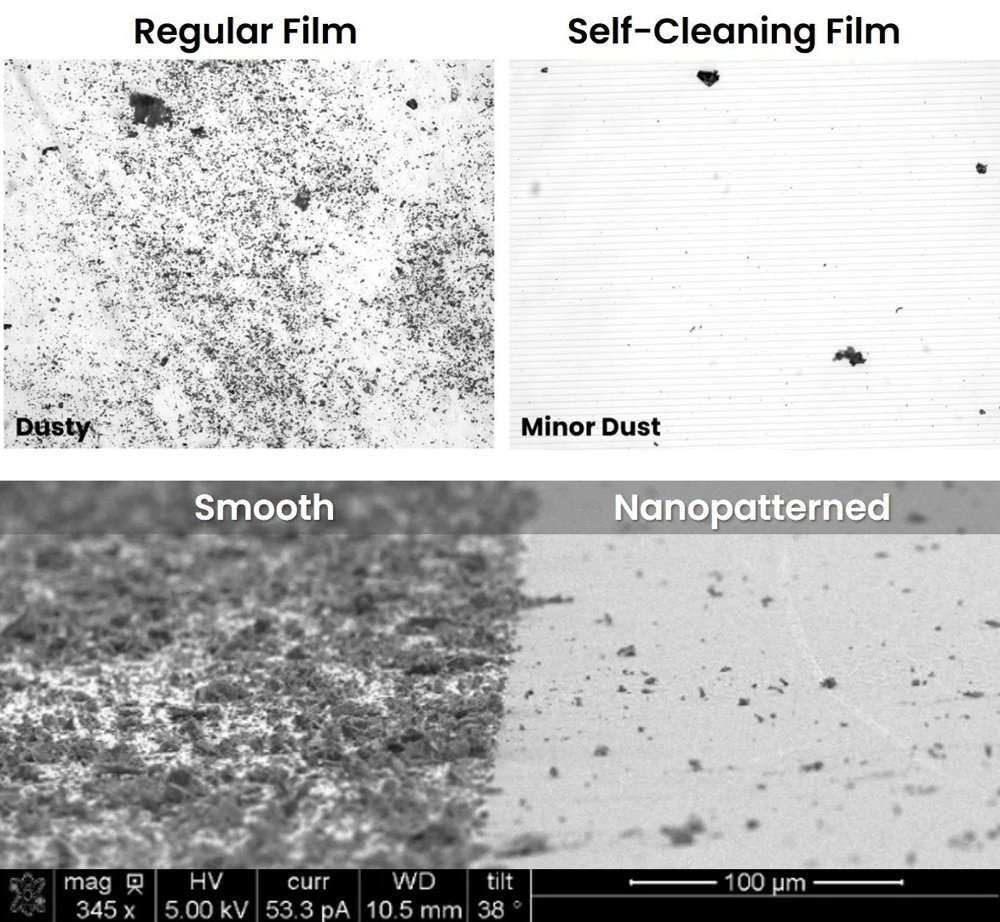
Smart Material Solutions (SMS) has developed nanopatterned self-cleaning surfaces that reduce the adhesion and buildup of dust and other particulates, including dirt, sand, pollen, potash, and similar contaminants. The technology can help maintain the performance of solar panels, sensors, thermal-control surfaces, mining equipment, and other hardware exposed to particulate contamination. SMS’s self-cleaning surfaces have demonstrated a 73% reduction in dust adhesion force compared with a smooth film, leading to <5% dust coverage on vertically mounted surfaces. SMS combines engineered nanopatterns with tailored surface chemistry to create dust-mitigating and anti-fouling surfaces that reduce particulate adhesion. As shown in the video below, dust readily falls from SMS’s nanopatterned surface while remaining adhered to an untreated surface. Comparison of dust adhesion to smooth (left) and nanopatterned self-cleaning surfaces (right), shown by optical microscopy (top) and SEM (bottom). The effect can be seen across multiple length scales, as seen in the figure on the right. The optical microscopy images at the top compare two separate samples exposed to the same dust, while the higher-magnification scanning electron microscopy (SEM) image at the bottom shows a single sample with a smooth region on the left and a nanopatterned region on the right. In both cases, the nanopatterned self-cleaning surface retains far less dust. Beyond dust, preliminary experiments have demonstrated decreased adhesion of potash on mining equipment, showing the potential for these particulate-repellent surfaces to reduce buildup in demanding industrial environments. Applications SMS’s dust mitigation technology can be tailored for applications where particulate buildup reduces performance or increases cleaning and maintenance requirements. Potential applications include: - Solar panels and other optical surfaces - Cameras and sensors - Thermal-control surfaces and radiators - Mining and industrial equipment - Vehicle surfaces, optics, sensors, and thermal-management hardware operating in dusty or desert environments - Spacecraft and lunar surface hardware SMS has developed dust-mitigating surfaces for solar panels and high-emissivity radiators, as well as surfaces designed for demanding terrestrial, industrial, and space environments. From Lunar Dust to Terrestrial Applications SMS originally developed this dust-mitigating technology to reduce lunar regolith contamination under a NASA SBIR program in collaboration with Professor Chih-Hao Chang at the University of Texas at Austin. Since then, SMS has expanded the technology toward Earth-based applications where dust and particulate buildup create similar challenges. These include solar panels that experience soiling, mining equipment exposed to potash, and other equipment operating in dusty or desert environments. A sample of SMS’s patterned nanocoating is also planned for flight aboard Astrolab’s FLIP rover on Astrobotic’s Griffin-1 mission. Materials, Integration & Scale-Up SMS can tailor self-cleaning surfaces to the requirements of a particular application. The technology has been demonstrated using a range of materials including polyimide, polycarbonate, PET, glass, and metal substrates, with options including both optically clear and hazy surfaces. Roll-to-roll fabrication of SMS dust-mitigating material with both hazy and optically clear regions. Depending on the application, SMS can provide the technology as an adhesive-backed film, a surface coating, or another configuration designed for integration with the customer’s hardware. The technology is also compatible with scalable roll-to-roll fabrication. The photo on the right shows a dust-mitigating film with both hazy and optically clear regions being produced on a roll-to-roll platform.
CATEGORY
Smart Material Solutions (SMS) has developed nanopatterned self-cleaning surfaces that reduce the adhesion and buildup of dust and other particulates, including dirt, sand, pollen, potash, and similar contaminants. The technology can help maintain the performance of solar panels, sensors, thermal-control surfaces, mining equipment, and other hardware exposed to particulate contamination. SMS’s self-cleaning surfaces have demonstrated a 73% reduction in dust adhesion force compared with a smooth film, leading to <5% dust coverage on vertically mounted surfaces. SMS combines engineered nanopatterns with tailored surface chemistry to create dust-mitigating and anti-fouling surfaces that reduce particulate adhesion. As shown in the video below, dust readily falls from SMS’s nanopatterned surface while remaining adhered to an untreated surface. Comparison of dust adhesion to smooth (left) and nanopatterned self-cleaning surfaces (right), shown by optical microscopy (top) and SEM (bottom). The effect can be seen across multiple length scales, as seen in the figure on the right. The optical microscopy images at the top compare two separate samples exposed to the same dust, while the higher-magnification scanning electron microscopy (SEM) image at the bottom shows a single sample with a smooth region on the left and a nanopatterned region on the right. In both cases, the nanopatterned self-cleaning surface retains far less dust. Beyond dust, preliminary experiments have demonstrated decreased adhesion of potash on mining equipment, showing the potential for these particulate-repellent surfaces to reduce buildup in demanding industrial environments. SMS can tailor self-cleaning surfaces to the requirements of a particular application. The technology has been demonstrated using a range of materials including polyimide, polycarbonate, PET, glass, and metal substrates, with options including both optically clear and hazy surfaces. Depending on the application, SMS can provide the technology as an adhesive-backed film, a surface coating, or another configuration designed for integration with the customer’s hardware. The technology is also compatible with scalable roll-to-roll fabrication. The photo on the right shows a dust-mitigating film with both hazy and optically clear regions being produced on a roll-to-roll platform.
CATEGORY
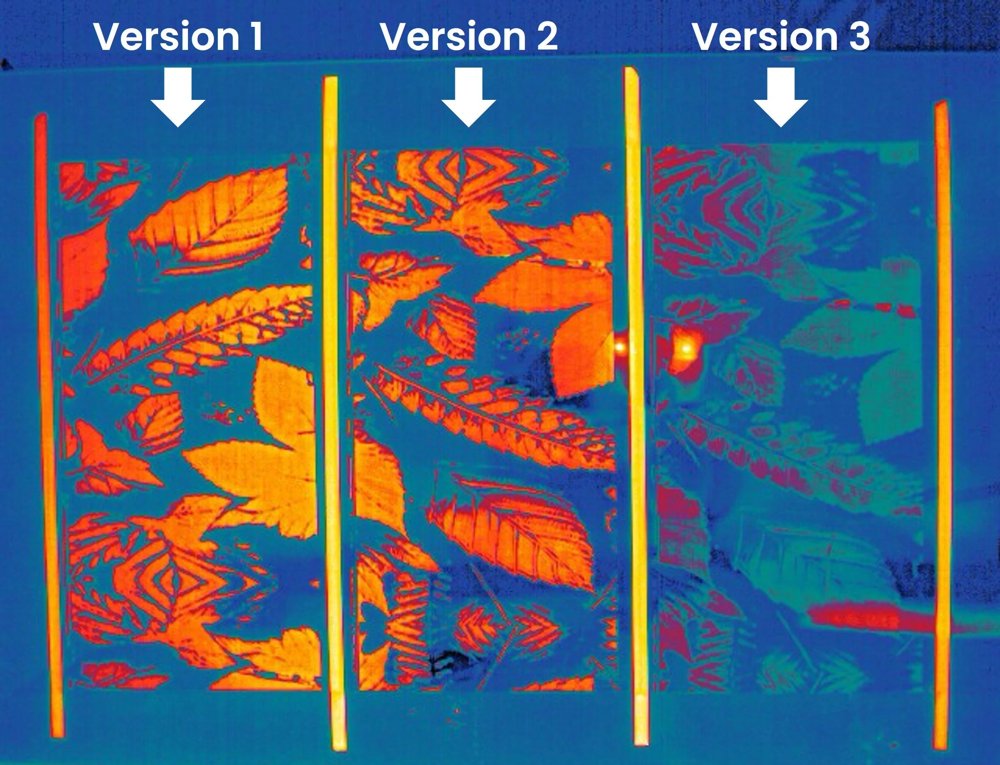
The technology leverages the advanced optical properties of metamaterials, which were previously limited to lab-scale demonstrations. Using SMS’s nanomanufacturing platform, these structures can now be produced at scale in flexible film form factors. Initial prototype testing demonstrates the film’s effectiveness as infrared camouflage across a range of thermal conditions. The IR Camo Film offers customizable patterns, emissivity contrast, and different visual appearances. Although the prototype film is reflective in the visible region, SMS has already demonstrated the ability to make a visibly transparent and opaque IR Camo Films in the lab. Future work will focus on improving transparency and opacity while maximizing IR contrast. Lyra, our Chief Security Officer, helped us demonstrate how the IR Camo Film can hide a living being by wearing a belt made of our prototype IR Camo Film and posing for pictures outside. The belt, patterned with a foliage pattern, helped her midsection blend in with the surroundings. Planned development efforts include: - Field testing in representative operational environments - Performance improvements informed by end-user feedback - Fabrication of large-area visibly transparent or low-reflectance IR Camo Film - Development of a version that can be applied similarly to automotive wrap vinyl - Scaling up manufacturing
CATEGORY
