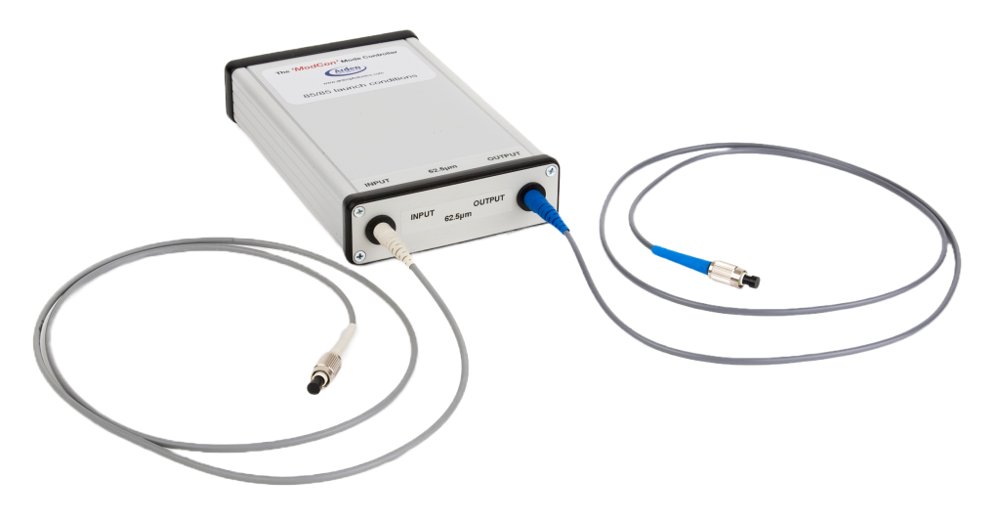
For source independent mode control fit the ModCon to your light source to improve measurement accuracy, ensure stable launch conditions for multimode fiber measurements and meet 85/85 launch conditions required in some aerospace applications. The ModCon Mode Controller is designed to ensure that whatever source you use to test the loss and bandwidth of your multimode optical fiber network, LED, VCSEL or FP laser, you launch the same distribution of modes into the fiber. As a result you can eliminate the variations due to the widely different modal characteristics of the sources commonly used in fiber optic measurements and networks. Measurements of loss and bandwidth in multimode fibers are known to be highly dependent on the modal condition of the light source used for the measurement. For example, OTDR and LS/PM loss measurements can differ significantly simply because an OTDR uses a laser source and not an LED. Now there is a way to dramatically improve agreement AND ensure you meet international standards at the same time – the ModCon. The ModCon is a passive device which ensures that the correct launch conditions are achieved independent of the light source used. This results in more accurate measurements, better agreement between different test sets, and compliance with international standards. Every ModCon is rigorously tested using Arden’s MPX Modal Explorer to ensure that its output meets the standard regardless of the modal distribution of the input. ModCon – Aerospace Our Modal Controllers for Aerospace are available in 50/125µm and 62.5/125µm Graded Index fiber, with either FC, ST, SC or LC connectors. The Modal Launch Condition for our Aerospace modal controllers is specified in terms of the width of the Near Field Pattern at 5, 15 and 75% of the maximum. The specification limits are shown below. A Certificate of Conformance or a Test Certificate(850 and 1300nm) giving details of how it was measured are available as options. Plot of typical source showing compliance with the Near Field Width requirements for 85/85 launch condition 70/70% Limited Phase Space ModCons are also available. The Near Field Width of the intensity profile at the 5% level is 70% of the nominal core diameter.
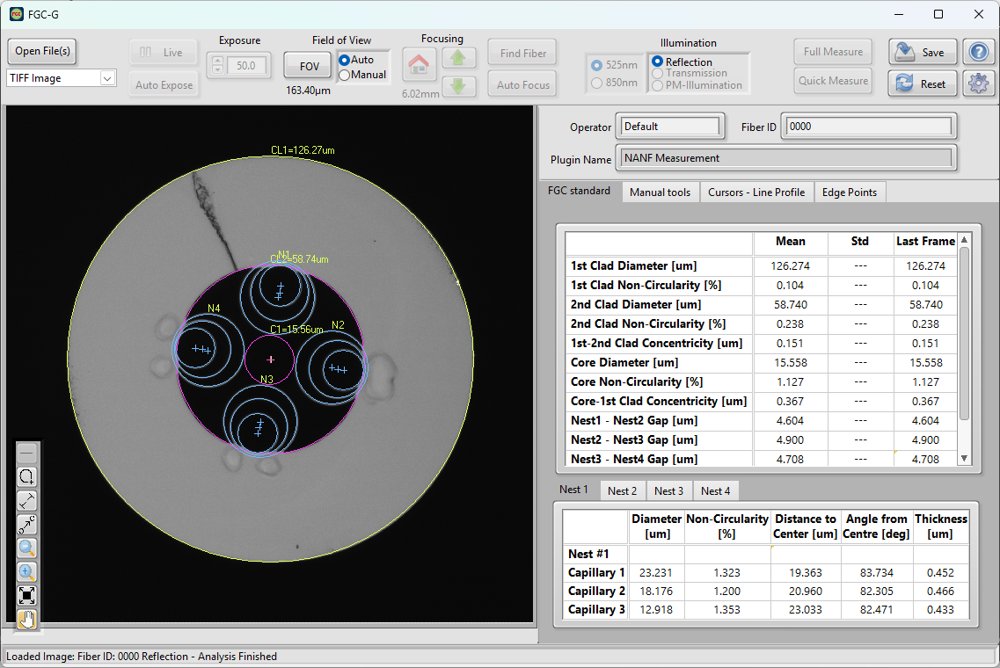
Designed to measure the fiber geometric parameters of Hollow Core Fiber (HCF), Multi-Core Fiber (MCF), Polarising-Maintaining Fiber (PMF) and other specialty fiber designs with fiber cladding diameters from 80 µm to 250 µm. Designed to measure the latest specialty fibers The FGC-GH Fiber Geometry Measurement System is specifically designed to measure the fiber geometric parameters of Hollow Core Fiber (HCF), Multi-Core Fiber (MCF), Polarising-Maintaining Fiber (PMF) and other specialty fiber designs with fiber cladding diameters from 80 µm to 250 µm. Its software plug-in architecture enables dedicated measurement capabilities for specific fiber types, ensuring automatic, user-independent results for next-generation specialty fibers. Driven by a proprietary software algorithm and high-magnification lens objectives, the FGC-GH delivers exceptional measurement repeatability: - Core Diameter: 40 nm - Core-to-Cladding Concentricity: 30 nm - Capillary Diameter: 20 nm Smaller cladding diameter available on request. Key technical features include: - Optimised for the Latest Optical Fibers: Precision geometric measurement and characterisation of the latest generation of HCF and DNANF is now possible with the FGC-GH’s built-in, ultra-high numerical aperture optical system. Other specialty fibers, such as Multi-Core Fiber (MCF), are equally well addressed, ensuring the instrument remains the definitive solution for the most demanding fiber geometry characterisation. - Fast Validation of Manufactured Fibers: Manufacturers can validate HCF with high-precision measurements of each double-nested set of tubes within the DNANF structure, obtaining critical data that relates directly to the loss per km of the manufactured fiber. The FGC-GH is equally adept at providing critical measuring data to verify the location of cores, cladding, and core-to-cladding concentricity of each signal path in MCF. - R&D and Production Compatibility: Specialty fiber geometry characterisation in a production environment is deskilled and streamlined, and made highly repeatable and user-independent through the use of software plugins tailored to each specific fiber type. In an R&D environment, an extensive set of manual tools allows engineers to measure novel or unique features of any innovative or proprietary specialty fiber design. - Traceable In-Field Calibration: To maintain confidence and eliminate production downtime, there is no need to return the FGC-GH to Arden Photonics for recalibration. Users can simply utilise our traceable calibration artifact alongside built-in software algorithms for effortless and fast re-calibration in the field. - Software Plug-in Architecture: The FGC’s plug-in architecture enables dedicated automatic measurement for specific fiber types, optimising quality control and production routine. Currently, available plug-ins include: PM fibers, Single mode / Multi mode fibers, Active fibers, Multi-core fibers, and Hollow-core (NANF & DNANF) fibers. We can customise plug-ins to rapidly standardise testing of tomorrow’s fibers. Screenshots Measuring small NANF Measuring Hollow-core Fiber Measuring PM Fiber Measuring Multi-core Fiber Measuring Active Fiber
CATEGORY

We proudly announce the introduction of our groundbreaking product category, the Fiber Rotational Alignment System. The FRA Fiber Rotational Aligner is designed to assist optical fiber researchers and specialty fiber manufacturers in achieving precise alignment of cores and other elements of their fibers with intricate structures prior to splicing. This breakthrough innovation ensures optimal optical fiber and fiber laser system performance. David Robinson, CEO and founder of Arden Photonics Limited, highlighted the importance of this launch, stating, "The Fiber Rotational Aligner System addresses a critical and costly challenge faced by specialty fiber manufacturers – reduced data transmission during the splicing of fibers with intricate features such as hollow core fibers, multi core fibers and polarisation maintaining fibers. Low-loss splicing is a critical process in ensuring the performance of an optical fiber network. Drawing upon our extensive expertise in optical fiber measurement solutions, including fiber geometry measurement and interferometric end-face inspection, we have developed a solution that not only facilitates fiber structure rotational alignment before splicing but also ensures user-friendly accessibility and operation. Our solution empowers manufacturers to maintain the quality of their spliced fibers, minimising data loss and ensuring superior splicing quality. We anticipate that more specialty fiber manufacturers will benefit from the precise and customisable rotational fiber alignment offered by our new product, the FRA system." The Arden Fiber Rotational Aligner features a built-in high-resolution camera and an extra-large LED screen, allowing users to rotate the fiber and monitor the fiber's rotational angle in real-time, thereby ensuring precise alignment before splicing with another fiber. The fiber aligner is specifically designed to work with a wide range of fiber types and fiber sizes before splicing. Both the instrument and its production-ready software can be customised to meet various fiber rotational alignment measurement requirements. If you would like to find out more about this product or have any bespoke optical fiber measurement requirements, please reach out to our team of dedicated optical fiber measurement specialists. To find out more about Arden's Fiber Rotational Aligner, please download the FRA's datasheet.
CATEGORY
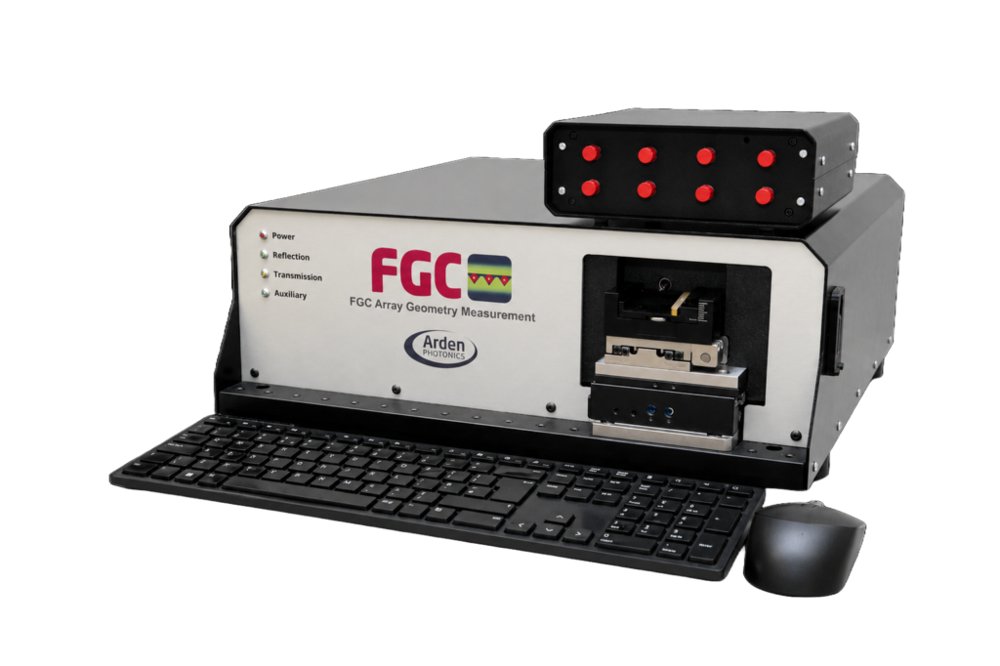
Measures the fiber geometry of 1D & 2D Fiber Array Units (FAUs) and MT Ferrules Key Upgrades & New Features - Multi-Row 2D Array Measurement: The FGC Array now supports multi-row 2D geometries up to 22 mm wide and 0.8 mm tall, specifically optimised for the fast-growing 2D MPO connector and 2D Fiber Array Unit applications in high performance data centres. - Lower latency FGC Array V2.0 Software: New software enhances the user experience. It also features customisable measurement templates designed specifically to streamline and automate complex 2D array analysis of units that could contain a mix of single mode, multi mode and PM fiber. - Additional Fiber Core Illuminators: A new external illuminator supporting pigtails terminated with 32 mm wide FAUs, along with the existing range of illuminators for pigtails terminated with FC/PC, FC/APC, MTP/MPO, and supporting unterminated single and ribbon fibers using Fujikura style holders. Key Features of the FGC Array - Core Illumination Technology: The core of each fiber in the array is illuminated to enhance the core-to-core measurement accuracy and repeatability. The system supports FAU pigtails with bare fiber, ribbon fiber, or MTP, FC and FC/APC connectors. Up to six illumination units can be linked to an FGC-Array system. - Fully Automated Translation Stage: The precision linear stage delivers repeatability down to 0.05 μm for core X & Y position, ensuring consistent and repeatable results are generated using the newly-designed software and mounting system. - Advanced Fiber Array Unit Mounting: A newly designed tiltable 32 mm mount and adjustable-width array holder provides a versatile mounting solution for fiber arrays ranging from 2.5 mm to 22 mm, with tilt angles from -8° to +8°. - Enhanced Optical System & Algorithm: Refined imaging quality is achieved using an infinity-corrected objective and a high-resolution CMOS camera for sharper, more evenly illuminated images. Proprietary distortion correction algorithms ensure highly accurate imaging and measurement results, setting new benchmarks for precision.
CATEGORY
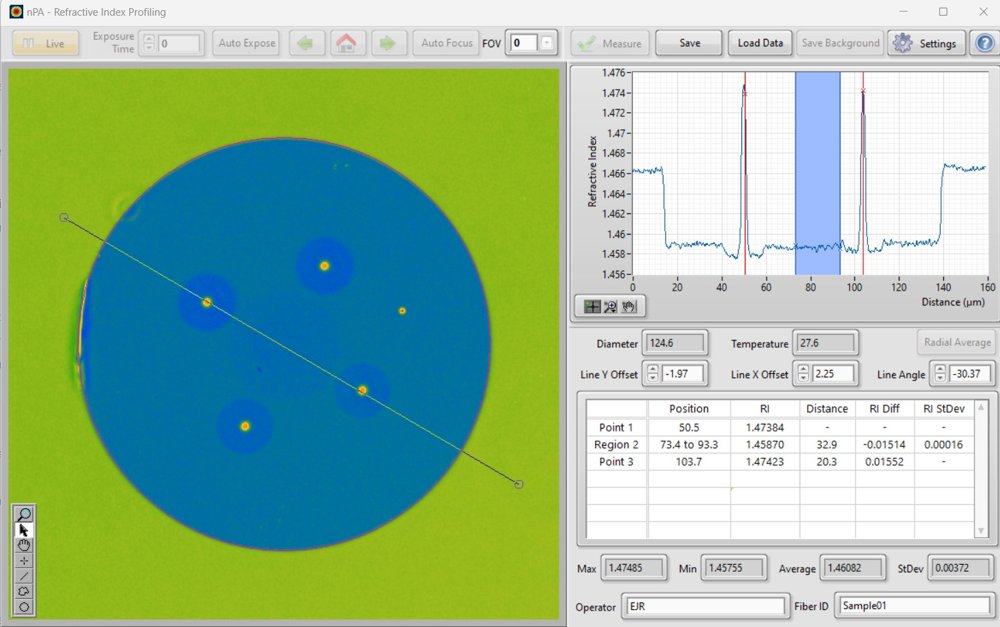
Measure refractive index of optical fibers up to 600 µm in seconds! The nPA-600 Refractive Index Profiler uses a modified refracted near-field technique to analyse a fiber end-face to determine the full 2D refractive index distribution. The nPA-600 is the quick and easy way to get the Refractive Index data you need to verify your specialty fiber design and manufacturing processes. The nPA-600 comes with the nPA v4.0 software which improves measurement speed, enhances user experience, and enables greater measurement customisation possibilities. Its API allows the nPA-600 to integrate to users’ systems seamlessly. Optional software plug-ins enable new functionalities such as measuring the geometry of single-mode fibers, PM fibers, multi-core fibers and various parameters of bend-insensitive multimode (BIMM) fibers. Features and Benefits - Measure fibers up to 600 μm in diameter - Prepare and measure a fiber sample in under 2 minutes (2D measurement in seconds) - Measure circularly symmetric fibers and non-circularly symmetric fibers – good for PM, octagonal, multi-core fibers - Preinstalled with production-ready nPA v4.0 software - User Experience enhancement: Various measurement options (refractive index scales, measurement areas) and output options (e.g. PDF measurement reports) - Faster measurement of smaller fibers - Customisable measurement template for easy comparison vs target values - API facilitates users customisation and integration with other systems - Optional software plug-ins enabling new functionalities - In-field traceable re-calibration enabled by the new calibration tool and the new optional calibration fiber certified by the National Physical Laboratory (NPL) and Arden, without having to send the instrument to Arden service centres. Screenshots Measurement of circular fiber Measurement of octagonal fiber Measurement of multicore fiber Download Datasheet
CATEGORY
