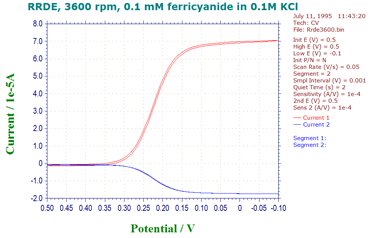
The Model 700F series are computerized general-purpose potentiostat / bipotentiostat / galvanostat instruments. A typical application involves a rotating ring-disk electrode (RRDE), but these systems can also be used for other applications where dual channel measurements are essential, such as dual channel electrochemical detection. The system contains a fast digital function generator, a direct digital synthesizer for high frequency ac waveforms, high speed dual channel data acquisition circuitry, (bi)potentiostat, and a galvanostat (only available in select models). The potential control range is ±10 V and the current range is ±250 mA. The instrument is capable of measuring current down to tens of picoamperes. The steady state current of a 10 μm disk electrode can be readily measured without external adapters. With the CHI200B Picoamp Booster and Faraday Cage (fully automatic and compatible with the 700F series), currents down to 1 pA can be measured (primary current channel only). These instruments are very fast. The function generator can update at a 5 MHz rate. Two high speed and high resolution data acquisition channels allow both current channels or current and potential (or external voltage signal) to be sampled simultaneously at 1 MHz rate at 16-bit resolution. The instrument provides a very wide dynamic range on experimental time scales. For instance, the scan rate in cyclic voltammetry can be up to 500 V/s with a 0.1 mV potential increment or 5000 V/s with a 1 mV potential increment. The potentiostat / galvanostat uses a 4-electrode configuration, allowing it to be used for liquid/liquid interface measurements and eliminating the effect of the contact resistance of connectors and relays for high current measurements. The data acquisition systems allow an external input signal (such as spectroscopy signals to be recorded simultaneously with electrochemical data). The instrument will also automatically re-zero both potential and current, so that periodic re-calibration of the instrument can be avoided. The 700F series can do everything the 600F series can, and more. When used as a single channel potentiostat, the instrument is identical to the model 600F series. The bipotentiostat is realized by adding the second channel potential control and current measurement board to the model 600F series. There are also two filter stages, three extra gain stages, and channel selection circuitry on the board. When it is used as a bipotentiostat, the second channel can be controlled at an independent constant potential or to scan/step at the same potential as the first channel. In case of CV, it can also scan with a constant potential difference with the first channel. Techniques available for the second channel include CV, LSV, SCV, CA, DPV, NPV, SWV, and i-t. The 700F series is the latest upgrade in our very popular 700 series. The changes will be faster data acquisition, 16-bit resolution, two channel simultaneously AD conversion will be 2.5M Hz. It was 1M Hz two channel simultaneous ADC. It allows CV at 2500V/s scan rate with 1 mV sample interval. It was at 1000V/s scan rate for 1mV sample interval. CA sample interval is changed from 1 usec to 0.4 usec, two channel simultaneously. The new model has faster data transfer with USB 3 port. The real time data transfer for CV is changed from 3V/s to 12V/s. For time based techniques (such as CA and i-t), the sample interval for real time data transfer is changed from 0.0003333 sec to 0.0001 sec. AC impedance has a frequency up to 3M Hz. We added current interrupt iR compensation, galvanostatic intermittent titration technique (GITT) and potentiostatic intermittent titration technique (PITT). Two 16-bit highly stable bias circuits are used for current and potential bias, allowing wider dynamic range in AC measurements. These can also be used to re-zero the DC current output. The instrument is capable of a wide variety of electrochemical techniques, and is available with integrated simulation and fitting software functions for both impedance and cyclic voltammetry. These features provide powerful tools for both electrochemical mechanistic studies and trace analysis. We provide several different models in the 700F series. The model comparison table compares the different models. Other than what is listed, the specifications and features of these models are identical. Models 700F and 710F are basic units for mechanistic study and electrochemical analysis, respectively. Models 720F and 730F are comprehensive electrochemical analyzers. Model 750F and 760F are advanced electrochemical workstations. Potentiostat - Zero resistance ammeter - 2- or 3- or 4-electrode configuration - Floating (isolated from earth) or earth ground - Maximum potential:±10 V for both channels - Maximum current: ±250 mA continuous (sum of two current channels), ±300 mA peak - Compliance Voltage:±13 V - Potentiostat rise time:< 1 μs, 0.8 μs typical - Applied potential ranges (volts): ±0.01, ±0.05, ±0.1, ±0.65, ±3.276, ±6.553, ±10 - Applied potential resolution: 0.0015% of potential range - Applied potential accuracy: ±1 mV, ±0.01% of scale - Applied potential noise: < 10 μV rms - Measured current range: ±10 pA to ±0.25 A in 12 ranges - Measured current resolution: 0.0015% of current range, minimum 0.3 fA - Current measurement accuracy: 0.2% if current range >=1e-6 A/V, 1% otherwise - Input bias current: < 10 pA Galvanostat - Galvanostat applied current range: 3 nA - 250 mA - Applied current accuracy: 20 pA ±0.2% if > 3e-7A, ±1% otherwise - Applied current resolution: 0.03% of applied current range - Measured potential range (volts): ±0.025, ±0.1, ±0.25, ±1, ±2.5, ±10 - Measured potential resolution: 0.0015% of measured range Electrometer - Reference electrode input impedance: 1x10 12 ohm - Reference electrode input bandwidth: 10 MHz - Reference electrode input bias current: <= 10 pA @ 25°C Waveform Generation and Data Acquisition - Fast waveform update: 10 MHz @ 16-bit - Fast data acquisition: dual channel 16-bit ADC, 2,500,000 samples/sec simultaneously - External signal recording channel at maximum 2.5 MHz sampling rate Experimental Parameters - CV and LSV scan rate:0.000001 to 10,000 V/s, two channels simultaneously - Potential increment during scan:0.1 mV @ 500 V/s - CA and CC pulse width:0.0001 to 1000 sec - CA minimum sample interval: 0.4 μs, both channels - CC minimum sample interval: 1 μs - True integrator for CC - DPV and NPV pulse width:0.001 to 10 sec - SWV frequency: 1 Hz to 100 kHz - i-t sample interval: minimum 0.4 μs, both channels - ACV frequency: 0.1 Hz to 10 kHz - SHACV frequency:0.1 Hz to 5 kHz - FTACV frequency: 0.1 to 50 Hz, simultaneously acquire 1st, 2nd, 3rd, 4th, 5th, and 6th harmonics ACV data - IMP frequency:0.00001 Hz to 3 MHz - IMP amplitude: 0.00001 V to 0.7 V rms Other Features - Automatic and manual positive-feedback iR compensation - Current interrupt iR compensation - Current measurement bias: full range with 16-bit resolution, 0.003% accuracy - External potential input - Potential and current analog output - Programmable potential filter cutoff: 1.5 MHz, 150 KHz, 15 KHz, 1.5 KHz, 150 Hz, 15 Hz, 1.5 Hz, 0.15 Hz - Programmable signal filter cutoff: 1.5 MHz, 150 KHz, 15 KHz, 1.5 KHz, 150 Hz, 15 Hz, 1.5 Hz, 0.15 Hz - RDE control output (selected models):0-10 V (corresponding to 0-10000 rpm), 16-bit, 0.003% accuracy - Digital input/output lines programmable through macro command - Flash memory for quick software update - Serial port or USB selectable for data communication - Cell control: purge, stir, knock - CV simulation and fitting program, user-defined mechanisms - Impedance simulation and fitting program - Maximum data length:256K-16384K selectable - Dimensions:14.25”(W) x 9.25”(D) x 4.75”(H) - Weight: 12 lb.
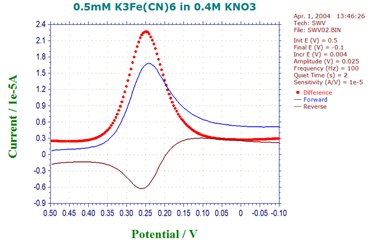
The Model 600F series is designed for general purpose electrochemical measurements. The figure below shows the block diagram of the instrument. The system contains a fast digital function generator, a direct digital synthesizer for high frequency ac waveforms, high speed dual-channel data acquisition circuitry, a potentiostat, and a galvanostat (available only in select models). The potential control range is ±10 V and the current range is ±250 mA. The instrument is capable of measuring current down to picoamperes. With the CHI200B Picoamp Booster and Faraday Cage (fully automatic and compatible with the 600F series), currents at sub-picoamperes can be measured. The instrument is very fast. The function generator can update at a 5 MHz rate. Two high speed and high resolution data acquisition channels allow both current and potential (or an external voltage signal) to be sampled simultaneously at a rate of 2.5 MHz, with 16-bit resolution. The instrument offers a very wide dynamic range of experimental time scales. For instance, the scan rate in cyclic voltammetry can be up to 500 V/s with a 0.1 mV potential increment or 5000 V/s with a 1 mV potential increment. The potentiostat / galvanostat uses a 4-electrode configuration, allowing it to be used for liquid/liquid interface measurements, and eliminating the effect of the contact resistance of connectors and relays for high current measurements. The data acquisition systems also allow an external input signal (such as spectroscopic) to be recorded simultaneously during an electrochemical measurement. The 600F series is the latest upgrade in our very popular 600 series. The changes will be faster data acquisition, 16-bit resolution, two channel simultaneously AD conversion will be 2.5M Hz. It was 1M Hz two channel simultaneous ADC. It allows CV at 2500V/s scan rate with 1 mV sample interval. It was at 1000V/s scan rate for 1mV sample interval. CA sample interval is changed from 1 usec to 0.4 usec, two channel simultaneously. The new model has faster data transfer with USB 3 port. The real time data transfer for CV is changed from 3V/s to 12V/s. For time based techniques (such as CA and i-t), the sample interval for real time data transfer is changed from 0.0003333 sec to 0.0001 sec. AC impedance has a frequency up to 3M Hz. We added current interrupt iR compensation, galvanostatic intermittent titration technique (GITT), and potentiostatic intermittent titration technique (PITT). Two 16-bit highly stable bias circuits are used for current and potential bias, allowing a wider dynamic range in AC measurements. These can also be used to re-zero the DC current output. The model 600F series can be upgraded to the corresponding model 700F bipotentiostat with an add-on board that includes circuitry for the second channel's potential control, current measurement (including sensitivity switching), two low-pass filters, three gain stages, and channel selection. It is therefore identical to the 600F series when used for single channel measurements. When it is used as a bipotentiostat, the second channel can be controlled at an independent constant potential, to scan or step at the same potential as the first channel, or to scan with a constant potential difference with the first channel. The second channel is available for many voltammetric and amperometric techniques. The instrument is capable of a wide variety of electrochemical techniques, and is available with integrated simulation and fitting software functions for both impedance and cyclic voltammetry. These features provide powerful tools for both electrochemical mechanistic studies and trace analysis. We provide several different models in the 600F series. The model comparison table compares the different models. Other than what is listed, the specifications and features of these models are identical. Models 600F and 610F are basic units for mechanistic study and electrochemical analysis, respectively. They are also great for teaching purposes. Models 602F and 604F are for corrosion studies. Models 620F and 630F are comprehensive electrochemical analyzers. Models 650F and 660F are advanced electrochemical workstations. Specifications Model 600F Series Specifications - for older series (600A, etc.), contact us. Potentiostat - Zero resistance ammeter - 2- or 3- or 4-electrode configuration - Floating (isolated from earth) or earth ground - Maximum potential:±10 V - Maximum current: ±250 mA continuous, ±300 mA peak - Compliance Voltage:±13 V - Potentiostat rise time:< 1 μs, 0.8 μs typical - Applied potential ranges (volts): ±0.01, ±0.05, ±0.1, ±0.65, ±3.276, ±6.553, ±10 - Applied potential resolution: 0.0015% of potential range - Applied potential accuracy: ±1 mV, ±0.01% of scale - Applied potential noise: < 10 μV rms - Measured current range: ±10 pA to ±0.25 A in 12 ranges - Measured current resolution: 0.0015% of current range, minimum 0.3 fA - Current measurement accuracy: 0.2% if current range =1e-6 A/V, 1% otherwise - Input bias current: < 10 pA Galvanostat - Galvanostat applied current range: 3 nA - 250 mA - Applied current accuracy: 20 pA ±0.2% if 3e-7A, ±1% otherwise - Applied current resolution: 0.03% of applied current range - Measured potential range (volts): ±0.025, ±0.1, ±0.25, ±1, ±2.5, ±10 - Measured potential resolution: 0.0015% of measured range Electrometer - Reference electrode input impedance: 1x10 12 ohm - Reference electrode input bandwidth: 10 MHz - Reference electrode input bias current: <= 10 pA @ 25°C Waveform Generation and Data Acquisition - Fast waveform update: 10 MHz @ 16-bit - Fast data acquisition: dual channel 16-bit ADC, 2,500,000 samples/sec simultaneously - External signal recording channel at maximum 2.5 MHz sampling rate Experimental Parameters - CV and LSV scan rate: 0.000001 to 10,000 V/s - Potential increment during scan:0.1 mV @ 500 V/s - CA and CC pulse width: 0.0001 to 1000 sec - CA minimum sample interval: 0.4 μs - True integrator for CC - DPV and NPV pulse width:0.001 to 10 sec - SWV frequency: 1 Hz to 100 kHz - i-t sample interval: minimum 1 μs - ACV frequency: 0.1 Hz to 10 kHz - SHACV frequency:0.1 Hz to 5 kHz - FTACV frequency: 0.1 Hz to 50 Hz, simultaneously acquire 1st, 2nd, 3rd, 4th, 5th, and 6th harmonics ACV data - IMP frequency:0.00001 Hz to 3 MHz - IMP amplitude: 0.00001 V to 0.7 V rms Other Features - Automatic and manual positive feedback iR compensation - Current interrupt iR compensation - Current measurement bias: full range with 16-bit resolution, 0.003% accuracy - External potential input - Potential and current analog output - Programmable potential filter cutoff: 1.5 MHz, 150 KHz, 15 KHz, 1.5 KHz, 150 Hz, 15 Hz, 1.5 Hz, 0.15 Hz - Programmable signal filter cutoff: 1.5 MHz, 150 KHz, 15 KHz, 1.5 KHz, 150 Hz, 15 Hz, 1.5 Hz, 0.15 Hz - RDE control output (selected models):0-10 V (corresponding to 0-10000 rpm), 16-bit, 0.003% accuracy - Digital input/output lines programmable through macro command - Flash memory for quick software update - Serial port or USB selectable for data communication - Cell control: purge, stir, knock - CV simulation and fitting program, user-defined mechanisms - Impedance simulation and fitting program - Maximum data length:256K-16384K selectable - Dimensions:14.25”(W) x 9.25”(D) x 4.75”(H) - Weight: 12 lb.
CATEGORY
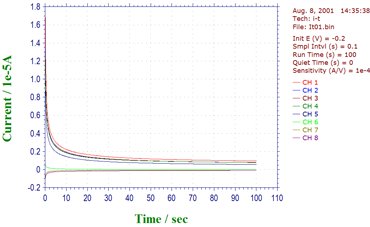
The model 1000D series instrument is a computerized eight-channel potentiostat. The system contains a digital function generator and multiplexed data acquisition circuitry. The multi-potentiostat can work with eight independent cells or eight working electrodes in the same solution with common reference and counter electrodes. The potential control range is ±10 V for all channels and the current range is ±10 mA. The instrument is capable of measuring current down to picoamperes. Each electrode can be individually controlled, including on/off control, potential, and sensitivity settings; each can be set to an independent potential or the same potential as the primary channel, so that they can sweep or step potentials together with the primary channel. The model 1000D series is the latest upgrade to the model 1000 series. The instrument allows eight independent cells, simultaneous or sequential measurements, fast waveform generation and data acquisition speed (1 MHz @ 16-bit), and easy software update using flash memory. Compared with Model 1000C series, the data transfer rate is increased when USB 3 port is used. The internal data storage is increased from 64K to 256K, it allows more data point for high data sampling rate. Many electrochemical techniques are available in the 1000D series, including cyclic voltammetry and amperometric i-t measurements, with all eight channels available (except for open circuit potential measurements). The parameters for all channels must be set before running an experiment; you cannot alter parameter settings during experiments. During a run, you can toggle between single and multi-data set display (parallel or overlay plots). After a run, you can choose data from any channel for parallel or overlay plotting. The instrument can be controlled by an external PC running Windows 7/10/11. It is easy to install and use. The instrument connects to your PC using USB (default) or serial port connectivity; no plug-in card or other hardware is required on the PC side. The commands, parameters, and options have been written using terminology that most chemists are familiar with. A customizable toolbar allows quick access to the most commonly used commands. A comprehensive help system provides context-sensitive information from each dialog box. The instrument provides many powerful functions, such as straightforward file handling, extensive experimental control, flexible graphics, various data analyses, and efficient digital simulation. Additional features include macro commands, working electrode conditioning, color, legend and font selection, data interpolation, visual baseline correction, data point removal, visual data point modification, signal averaging, Fourier spectrum, and a convenient technique-specific electrochemical equation viewer. The maximum data length is 128K – 8192K points (selectable) if real-time data transfer is allowed. Specifications: 8-Channel potentiostat (8 independent cells or a multi-working electrode cell) Potential range (all channels): ±10 V Applied potential accuracy: ±1 mV, ±0.01% of scale Potentiostat rise time: < 2 μs Applied potential noise: < 10 μV rms Potential control noise: < 10 uV Compliance voltage: ±12 V Current range (each channel): 10 mA Reference electrode input impedance: 1x10 12 ohm Sensitivity scale: 1x10⁻⁹ - 0.001 A/V in 7 ranges Minimum current resolution: 0.0015% of current range, minimum 0.3 pA Input bias current: < 50 pA Fast waveform update: 5 MHz @ 16-bit Fast data acquisition: up to 1 MHz @ 16-bit CV and LSV scan rate: - 0.000001 to 5000 V/s (sequential scan) - 0.000001 to 25 V/s (8 channel simultaneous scan) - Potential increment during scan: 0.1 mV @ 500 V/s CC and CA pulse width: 0.0001 to 1000 s CA and CC sample interval: - 1e-6 to 50 s (sequential step) - 8e-5 to 50 s (8 channel simultaneous step) DPV and NPV pulse width: 0.001 to 10 s SWV frequency: - 1 Hz to 100 KHz (sequential scan) - 1 to 3125 Hz (8 channel simultaneous scan) ACV frequency: - 1 to 10000 Hz (sequential scan) - 1 to 312 Hz (8 channel simultaneous scan) SHACV frequency: - 1 to 5000 Hz (sequential scan) - 1 to 250 Hz (8 channel simultaneous scan) FTACV frequency: simultaneously acquire 1st, 2nd, 3rd, 4th, 5th, and 6th harmonics ACV data - 0.1 to 50 Hz (sequential scan) - 0.1 to 34 Hz (8 channel simultaneous scan) i-t sample interval: - 1e-6 to 100 s (sequential scan) - 8e-5 to 100 s (8 channel simultaneous scan) Current low-pass filters Current analog output Cell control: purge, stir, knock Maximum data length: 128K - 4096K selectable Chassis dimensions: 14.25”(W) x 9.25 ”(D) x 4.75”(H) Model Comparison - Functions: Cyclic Voltammetry (CV) Linear Sweep Voltammetry (LSV) & Chronoamperometry (CA) Chronocoulometry (CC) Differential Pulse Voltammetry (DPV) & Normal Pulse Voltammetry (NPV) & Square Wave Voltammetry (SWV) & AC Voltammetry (ACV) & 2nd Harmonic AC Voltammetry (SHACV) & Fourier Transform AC Voltammetry (FTACV) Amperometric i-t Curve (i-t) Differential Pulse Amperometry (DPA) Triple Pulse Amperometry (TPA) Sweep-Step Functions (SSF) Multi-Potential Steps (STEP) Open Circuit Potential - Time (OCPT) Full version of CV simulation and fitting program Limited version of CV simulation and fitting program &: Corresponding stripping mode can be performed.
CATEGORY
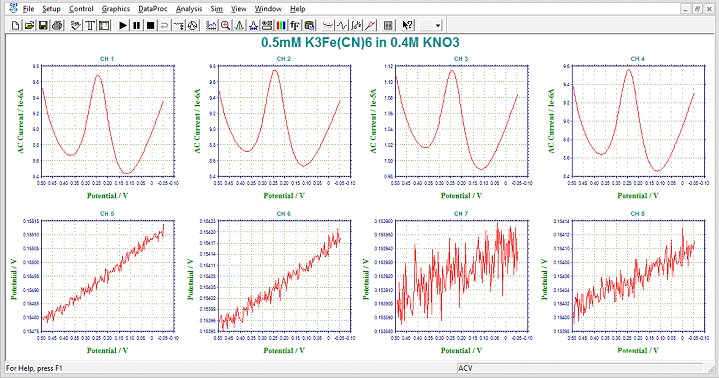
The Model 1400 is a computerized four-channel potentiometer and four-channel potentiostat. The system contains a digital function generator and multiplexed data acquisition circuitry. The instrument can work with eight independent cells or eight working electrodes in the same solution with common reference and counter electrodes. The potentiometer has high input impedance and low input bias current. The input range is ±10 V, allowing dc coupled or ac coupled. A gain of 10 is also allowed. The potentiostat has a potential control range of ±10 V and the current range is ±10 mA. The instrument is capable of measuring current down to picoamperes. Each electrode can be individually controlled, including on/off control, potential, and sensitivity settings; each can be set to an independent potential or the same potential as the primary channel, so that they can sweep or step potentials together with the primary channel. The instrument allows eight independent cells, simultaneous or sequential measurements, fast waveform generation and data acquisition speed (1M Hz @ 16-bit), and easy software update using flash memory. The model 1400 series can be use for array electrode characterization and sensor studies which require simultaneous measurement at a combination of sensors requiring techniques such as amperometry or voltammetry with sensors employing open-circuit methods, such as ion selective electrodes. The analyzer is essential for real-time sensing at sensor arrays employing combinations of sensors for real-time detection of analytes in flux in cellular metabolism, either in 2D or 3D culture. The combination of open circuit potential with other methods allows for the addition of ion sensors such as H+, K+, and Cl-, with sensors critical to metabolism, such as glucose, lactate, and oxygen. Additional sensing can be achieved through the Macro function in the Analyzer program, allowing for switching between amperometric and voltammetric measurements at the same electrodes, or conductivity measurements to determine salinity at additional electrodes in the array. This flexibility allows for a wide range of sensors measurements schemes. Many electrochemical techniques are available in the 1400 series. The parameters for all channels must be set before running an experiment; you cannot alter parameter settings during experiments. During a run, you can toggle between single and multi-data set display (parallel or overlay plots). After a run, you can choose data from any channel for parallel or overlay plotting. The instrument can be controlled by an external PC running Windows XP or after. It is easy to install and use. The instrument connects to your PC using USB (default) or serial port connectivity; no plug-in card or other hardware is required on the PC side. The commands, parameters, and options have been written using terminology that most chemists are familiar with. A customizable toolbar allows quick access to the most commonly used commands. A comprehensive help system provides context-sensitive information from each dialog box. Model 1400 Series Specifications Four-channel Potentiometer: Input potential range: ±10 V Input impedance: 10^13 ohm Input bias current: <=1 pA Dc and ac coupling Gain selection: 1 or 10 Four-channel Potentiostat: Potential range (all channels): ±10 V Applied potential accuracy: ±1 mV, ±0.01% of scale Potentiostat rise time: < 2 μs Applied potential noise: < 10 μV rms Compliance voltage: ±12 V Current range (each channel): 10 mA Reference electrode input impedance: 10^12 ohm Sensitivity scale: 10^-9 - 0.001 A/V in 7 ranges Measured current resolution: 0.0015% of current range, minimum 0.3 pA Input bias current: < 50 pA Fast waveform updating rate: 5 MHz @ 16-bit Current low-pass filters CV and LSV scan rate: - 0.000001 to 5000 V/s (sequential scan) - 0.000001 to 25 V/s (8 channel simultaneous scan) Potential increment during scan: 0.1 mV @ 500 V/s CC and CA pulse width: 0.0001 to 1000 sec CA and CC sample interval: - 1e-6 to 50 s (sequential step) - 8e-5 to 50 s (8 channel simultaneous step) DPV and NPV pulse width: 0.001 to 10 s SWV frequency: - 1 Hz to 100 KHz (sequential scan) - 1 to 3125 Hz (8 channel simultaneous scan) ACV frequency: - 1 to 10000 Hz (sequential scan) - 1 to 312 Hz (8 channel simultaneous scan) SHACV frequency: - 1 to 5000 Hz (sequential scan) - 1 to 250 Hz (8 channel simultaneous scan) FTACV frequency: simultaneously acquire 1st, 2nd, 3rd, 4th, 5th, and 6th harmonics ACV data - 0.1 to 50 Hz (sequential scan) - 0.1 to 34 Hz (8 channel simultaneous scan) i-t sample interval: - 1e-6 to 100 s (sequential scan) - 8e-5 to 100 s (8 channel simultaneous scan) Other features: - Fast data acquisition: up to 1 MHz @ 16-bit for single channel, 12.5K Hz for 8 channel simultaneous - Independent cells or a multi-working electrode cell - Simultaneous eight channel measurements or sequential single channel measurements for higher speed and better signal averaging - Current analog output - Cell control: purge, stir, knock - Maximum data length: 128K - 4096K selectable - Chassis dimensions: 14.25”(W) x 9.25 ”(D) x 4.75”(H) Model Comparison Functions | 1400 | 1410 | 1420 | 1430 | 1440 Cyclic Voltammetry (CV) | ● | ● | ● | ● | ● Linear Sweep Voltammetry (LSV) & | ● | ● | ● | ● | ● Chronoamperometry (CA) | | | | ● | ● Chronocoulometry (CC) | | | | ● | ● Differential Pulse Voltammetry (DPV) & | | | ● | ● | ● Normal Pulse Voltammetry (NPV) & | | | ● | ● | ● Square Wave Voltammetry (SWV) & | | | ● | ● | ● AC Voltammetry (ACV) & | | | | | ● 2nd Harmonic AC Voltammetry (SHACV) & | | | | | ● Fourier Transform AC Voltammetry (FTACV) | | | | | ● Amperometric i-t Curve (i-t) | ● | ● | | ● | ● Differential Pulse Amperometry (DPA) | | ● | | ● | ● Triple Pulse Amperometry (TPA) | | ● | | ● | ● Sweep-Step Functions (SSF) | | | | ● | ● Multi-Potential Steps (STEP) | | | | ● | ● Open Circuit Potential - Time (OCPT), total 5 channels | ● | ● | ● | ● | ● Full version of CV simulation and fitting program | | | | ● | ● Limited version of CV simulation and fitting program | ● | ● | ● | | &: Corresponding stripping mode can be performed.
CATEGORY
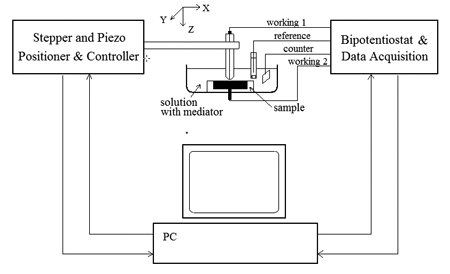
The scanning electrochemical microscope (SECM) was introduced in 1989 as an instrument that could examine chemistry at high resolution near interfaces. By detecting reactions that occur at a small electrode (the tip) as it is scanned in close proximity to a surface, the SECM can be employed to obtain chemical reactivity images of surfaces and quantitative measurements of reaction rates. Numerous studies with the SECM have now been reported from a number of laboratories all over the world, and the instrument has been used for a wide range of applications, including studies of corrosion, biological systems (e.g., enzymes, skin, leaves), membranes, and liquid/liquid interfaces. Trapping and electrochemical detection of single molecules with the SECM has also been reported. The CHI920D Scanning Electrochemical Microscope consists of a digital function generator, a bipotentiostat, high resolution data acquisition circuitry, a three dimensional nanopositioner, and a sample and cell holder. Diagrams for the SECM and cell/sample holder are shown below. The three dimensional nanopositioner has a spatial resolution down to nanometers but it allows a maximum traveling distance of 50 millimeters. The potential control range of the bipotentiostat is ± 10 V and the current range is ± 250 mA. The instrument is capable of measuring current down to sub-picoamperes. In addition to SECM imaging, other modes of operation are available for scanning probe applications: Probe Scan Curve, Probe Approach Curve, Surface Interrogation SECM, and Surface Patterned Conditioning. Probe Scan Curve mode allows the probe to move in the X, Y, or Z direction while the probe and substrate potentials are controlled and currents are measured. The probe can be stopped when the current reaches a specified level. This is particularly useful for searching for an object on the surface and determining approach curves. Probe Approach Curve mode allows the probe to approach the surface of the substrate. It is also very useful for distinguishing the surface process using PID control. The step size is automatically adjusted to allow fast surface approach, without letting the probe touch the surface. Surface Patterned Conditioning allows the user to edit a pattern for surface conditioning by controlling the tip at two different potentials and durations. Constant height, constant current, potentiometric, and impedance modes are available for SECM imaging and probe scan curve. The 920D can do everything the 760F can do, and more. The 920D is designed for scanning electrochemical microscopy, but many conventional electrochemical techniques have also been integrated for convenience, such as CV, LSV, CA, CC, DPV, NPV, SWV, ACV, SHACV, FTACV, i-t, DPA, DDPA, TPA, SSF, STEP, IMP, IMPE, IMPT, and CP. When the instrument is used as a bipotentiostat, the second channel can be controlled at an independent constant potential, to scan or step at the same potential as the first channel, or to scan with a constant potential difference with the first channel. The second channel works with CV, LSV, CA, DPV, NPV, DNPV, SWV, and i-t. The 920D SECM is the latest upgrade to the 900 series SECM. The 920D uses a stepper motor positioner in conjunction with a closed-loop 3-dimensional piezo positioner. The stepper motor positioner has a resolution of 8 nanometers with 50 mm travel distance. Closed-loop piezo control allows improved linearity and reduced hysteresis of the piezo devices. Improvements include very stable and accurate potential and current control, and dual-channel data acquisition at high speed (1 MHz with 16-bit resolution). Specifications Nanopositioner - X, Y, Z resolution: 1.6 nm with Piezo positioner, closed loop control, 8 nm with stepper motor positioner - X, Y, Z total distance:50 mm Potentiostat / Bipotentiostat - Zero resistance ammeter - 2- or 3- or 4-electrode configuration - Floating (isolated from earth) or earth ground - Maximum potential:±10 V for both channels - Maximum current: ±250 mA continuous (sum of two current channels), ±350 mA peak - Compliance Voltage:±13 V - Potentiostat rise time:< 1 μs, 0.8 μs typical - Applied potential ranges (volts): ±0.01, ±0.05, ±0.1, ±0.65, ±3.276, ±6.553, ±10 - Applied potential resolution: 0.0015% of potential range - Applied potential accuracy: ±1 mV, ±0.01% of scale - Applied potential noise: < 10 μV rms - Measured current range: ±10 pA to ±0.25 A in 12 ranges - Measured current resolution: 0.0015% of current range, minimum 0.3 fA - Current measurement accuracy: 0.2% if current range =1e-6 A/V, 1% otherwise - Input bias current: < 20 pA Galvanostat - Galvanostat applied current range: 3 nA - 250 mA - Applied current accuracy: 20 pA ±0.2% if 3e-7A, ±1% otherwise - Applied current resolution: 0.03% of applied current range - Measured potential range (volts): ±0.025, ±0.1, ±0.25, ±1, ±2.5, ±10 - Measured potential resolution: 0.0015% of measured range Electrometer - Reference electrode input impedance: 1x10 12 ohm - Reference electrode input bandwidth: 10 MHz - Reference electrode input bias current: <= 10 pA @ 25°C Waveform Generation and Data Acquisition - Fast waveform update: 10 MHz @ 16-bit - Fast data acquisition: dual channel 16-bit ADC, 1,000,000 samples/sec simultaneously - External signal recording channel at maximum 1 MHz sampling rate Other Features - Automatic and manual iR compensation - Current measurement bias: full range with 16-bit resolution, 0.003% accuracy - Potential measurement bias: ±10 V with 16-bit resolution, 0.003% accuracy - External potential input - Potential and current analog output - Programmable potential filter cutoff: 1.5 MHz, 150 KHz, 15 KHz, 1.5 KHz, 150 Hz, 15 Hz, 1.5 Hz, 0.15 Hz - Programmable signal filter cutoff: 1.5 MHz, 150 KHz, 15 KHz, 1.5 KHz, 150 Hz, 15 Hz, 1.5 Hz, 0.15 Hz - RDE control output:0-10 V (corresponding to 0-10000 rpm), 16-bit, 0.003% accuracy - Digital input/output lines programmable through macro command - Flash memory for quick software update - Serial port or USB selectable for data communication - Cell control: purge, stir, knock - Maximum data length:256K-16384K selectable - Real Time Absolute and Relative Distance Display - Real Time Probe and Substrate Current Display - Dual-channel measurements for CV, LSV, CA, DPV, NPV, SWV, i-t - CV simulation and fitting program, user-defined mechanisms - Impedance simulation and fitting program Scanning Probe Techniques - SECM Imaging (SECM): constant height, constant current, potentiometric and impedance modes - Probe Approach Curves (PAC) - Probe Scan Curve (PSC): constant height, constant current, potentiometric, impedance, and constant impedance modes - Surface Patterned Conditioning (SPC) - Surface Interrogation SECM (SISECM) - Z Probe Constant Current Control Sweep Techniques - Cyclic Voltammetry (CV) - Linear Sweep Voltammetry - Tafel Plot (TAFEL) Step and Pulse Techniques - Staircase Voltammetry (SCV) - Chronoamperometry (CA) - Chronocoulometry (CC) - Differential Pulse Voltammetry (DPV) - Normal Pulse Voltammetry (NPV) - Differential Normal Pulse Voltammetry (DNPV) - Square Wave Voltammetry AC Techniques - AC Voltammetry (ACV) - Second Harmonic AC Voltammetry (SHACV) - Fourier Transform AC Voltammetry (FTACV) - AC Impedance (IMP) - Impedance versus Potential (IMPE) - Impedance versus Time (IMPT) Galvanostatic Techniques - Chronopotentiometry (CP) - Chronopotentiometry with Current Ramp (CPCR) - Multi-Current Steps Other Techniques - Amperometric i-t Curve (i-t) - Differential Pulse Amperometry (DPA) - Double Differential Pulse Amperometry (DDPA) - Triple Pulse Amperometry (TPA) - Integrated Pulse Amperometric Detection (IPAD) - Bulk Electrolysis with Coulometry (BE) - Hydrodynamic Modulation Voltammetry (HMV) - Sweep-Step Functions (SSF) - Multi-Potential Steps (STEP) - Electrochemical Noise Measurement (ECN) - Open Circuit Potential - Time (OCPT) - Various Stripping Voltammetry - Potentiometry Experimental Parameters - CV and LSV scan rate:0.000001 to 10,000 V/s, two channels simultaneously - Potential increment during scan:0.1 mV @ 1,000 V/s - CA and CC pulse width: 0.0001 to 1000 sec - CA minimum sample interval: 1 μs, both channels - CC minimum sample interval: 1 μs - True integrator for CC - DPV and NPV pulse width:0.001 to 10 sec - SWV frequency: 1 Hz to 100 kHz - i-t sample interval: minimum 1 μs, both channels - ACV frequency: 0.1 Hz to 10 kHz - SHACV frequency:0.1 Hz to 5 kHz - FTACV frequency: 0.1 Hz to 50 Hz, simultaneously acquire 1st, 2nd, 3rd, 4th, 5th, and 6th harmonics ACV data - IMP frequency:0.00001 Hz to 1 MHz - IMP amplitude: 0.00001 V to 0.7 V rms 2D and 3D Graphics: - Interactive visualization of SECM surfaces - Color mapping - Laplacian smoothing - Stereoscopic 3D anaglyph imaging - High compatibility: Windows 98 and up, 256 colors (VGA) and up, no special video card or display required
CATEGORY
