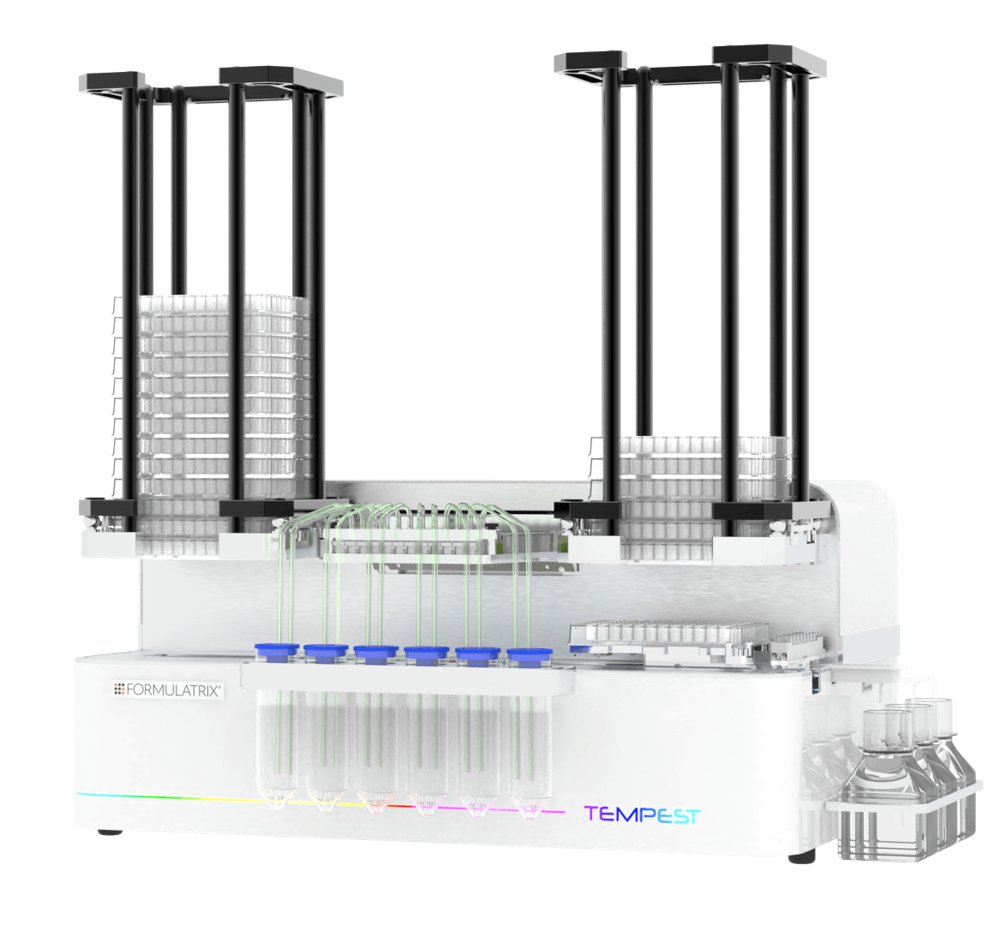
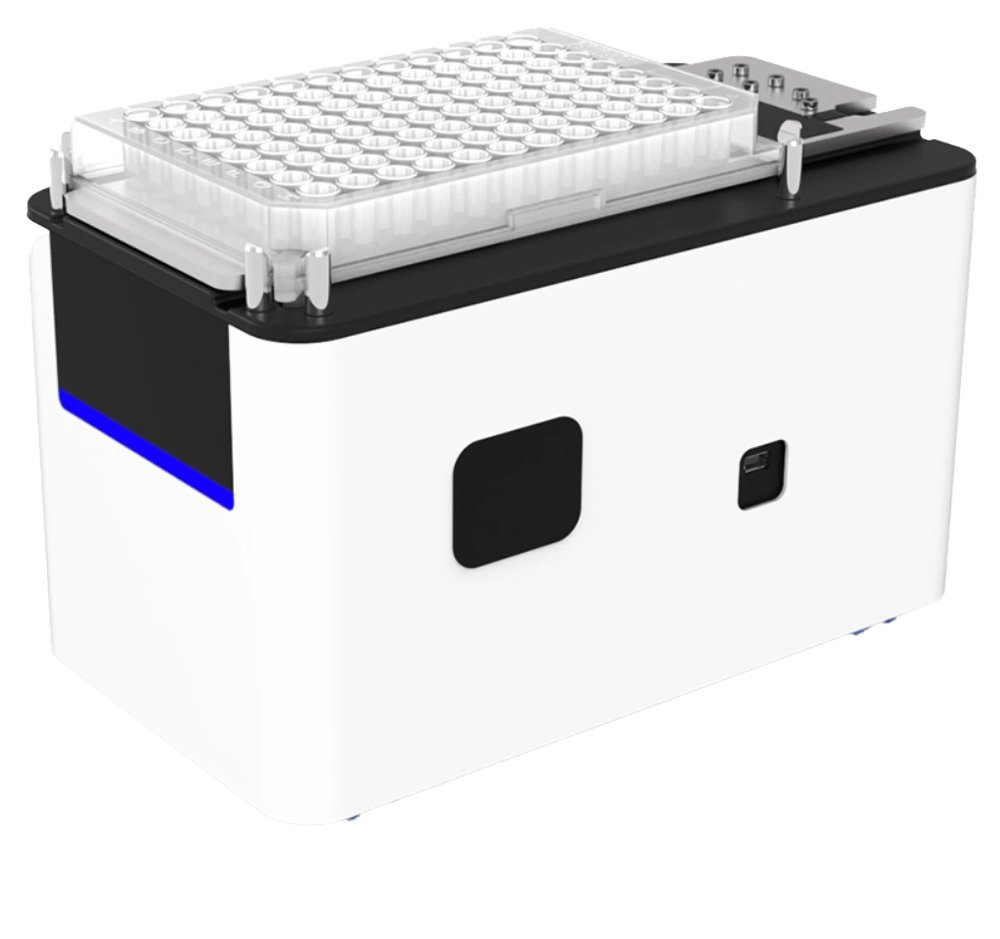
High-Throuhput Liquid Dispenser Non-contact microdiaphragm dispensing across any volume, any reagent, and any well. Engineered for the precision and reproducibility that high-throughput workflows demand. Volume Range Min: 0.2 µL Max: ∞ Technology Micro-Diaphragm Pumps + Continuous Flow Precision CV <5% @ 0.2 µL Flexible and Precise Reagent Dispensing The Tempest is a consumable-free, non-contact, multipurpose liquid dispenser that leverages microdiaphragm pump and continuous flow chip technologies for high-throughput liquid dispensing. It allows researchers to dispense up to 12 different reagents simultaneously through 96 independently controlled outputs, delivering any volume of any reagent, into any well. Reduce Costs Miniaturize reactions with tipless dispensing Reproducible and Accurate Dispense volumes down to 200 nL at CV < 5% Versatile and Flexible Reagent dispensing for a broad range of applications Benefits Precision: Uses non-contact microfluidic technology, ensuring high accuracy and precision across a broad range of reagent types, including cells and beads. Speed: Dispense up to 12 reagents across 96 individually controlled nozzles in just seconds. e.g., 200 nL to a 96-well plate in 3 seconds; 1 μL to 384-well plate in 5 seconds. Fill a 96-deep-well plate with 2 mL per well in under 2 minutes. High Throughput: Stackers and barcode reader for automated high throughput screening workflows. Flexibility: The Tempest supports diverse inputs (pipette tips, tubes) and reagents (cells, beads, harsh chemicals), and is compatible with all SBS plates. Low Dead-Volume: Non-recoverable dead volume as low as 48 μL per chip. Cost Savings: Miniaturize assay design to reduce reagent usage, while tip-free, easy-to-clean components eliminate the need for consumables. Biosafety Cabinet Compatible: With its compact dimensions (555 mm x 309.67 mm x 266.56 mm), the Tempest can be used in various biosafety cabinets to accommodate workflows that require this level of safety. Automation-Friendly: Integrate with external systems effortlessly with a network API. Broad Range of Applications - High Throughput Screening (HTS) - Assay Development and Design of Experiment (DoE) - Enzyme-Linked Immunosorbent Assays (ELISA) - Polymerase Chain-reaction (PCR) Workflows - Real-time and Digital - Biochemical assay development and screening - Cell Culture and Bead-Based Assays - Next Generation Sequencing (NGS) - Library Preparation State-of-the-art Dispensing Technology At the core of each Tempest channel is a microdiaphragm pump that meters and dispenses discrete volumes of liquid. This valve cluster has two microdiaphragms (select either 200 nL and 1 μL, or 1 μL and 5 μL) that can fill and dispense as fast as 8 times per second. This technology is incredibly precise and can handle a wide range of viscosities. Key Features - High Precision - Low Volume Dispensing - Minimize Reagent Waste - Speed and Throughput - Keep Cells and Beads Suspended - Integrate with External Systems - Import CSV Templates - Incubation Re-Stack Option - No Consumables - Micro-diaphragm Technology Unparalleled Ease and Excellence The Tempest Liquid Dispenser utilizes patented microdiaphragm pump technology to allow researchers to maximize workflow efficiency from genomics to high-throughput screening workflows. Ease of Use: The Tempest software is extremely user-friendly allowing for easy experimental design. The standard gradient and backfill buttons make designing an experiment even easier and faster. Cost Savings: - Miniaturize assay design and reduce reagent usage - Save precious reagents through low dead volumes - Prevent failed experiments with clog-free dispensing technology - Intuitive software interface and experimental design - No Consumables. All components can be easily cleaned and re-used Stackers for Plate Storage and Incubation “Smart Batch-Delay” – facilitates incubation step by adding reagents, storing and cycling plates based on time-specific addition of reagents. The stackers are bidirectional, enabling plates to be cycled in from either stacker. Deep Well Block Dispensing and More TEMPEST supports nearly all SBS-footprint plates, including 24-, 96-, 384-, and 1536-well plates. Plate clearance able to accommodate dispensing into deep well blocks. Versatile Sample Control Dispense up to 12 different reagents simultaneously 12 microfluidic chips, each featuring eight independently-controlled dispensing nozzles. Automated re-circulation ensure quality data and minimize costly rework by keeping cells and beads in suspension. Variable Reagent Size Conserve reagents Return excess sample from the microfluidics back to the reagent container achieve a low dead-volume, 48 μL Reagents can be placed in nearly any container size and no pressurized bottles or special containers are needed Integrate and Customize Optional barcode scanner can be integrated to custom dispense unique reagent profiles based on each plates barcode The small instrument size and powerful automation interface enables the Tempest to be easily integrated with robotic plate handling arms, grippers and scheduling software. Hands-Free Maintenance Automated dual-solution wash cycle: Clean the entire fluid pathway without user intervention. The reverse fluid flow wash aspirates solution through the nozzle and forces any particles backward through increasingly larger channels for thorough, clog-free cleaning. Recirculate Small Recirculation Automated re-circulation ensures quality data and minimizes costly rework by keeping cells and beads in homogeneous suspension
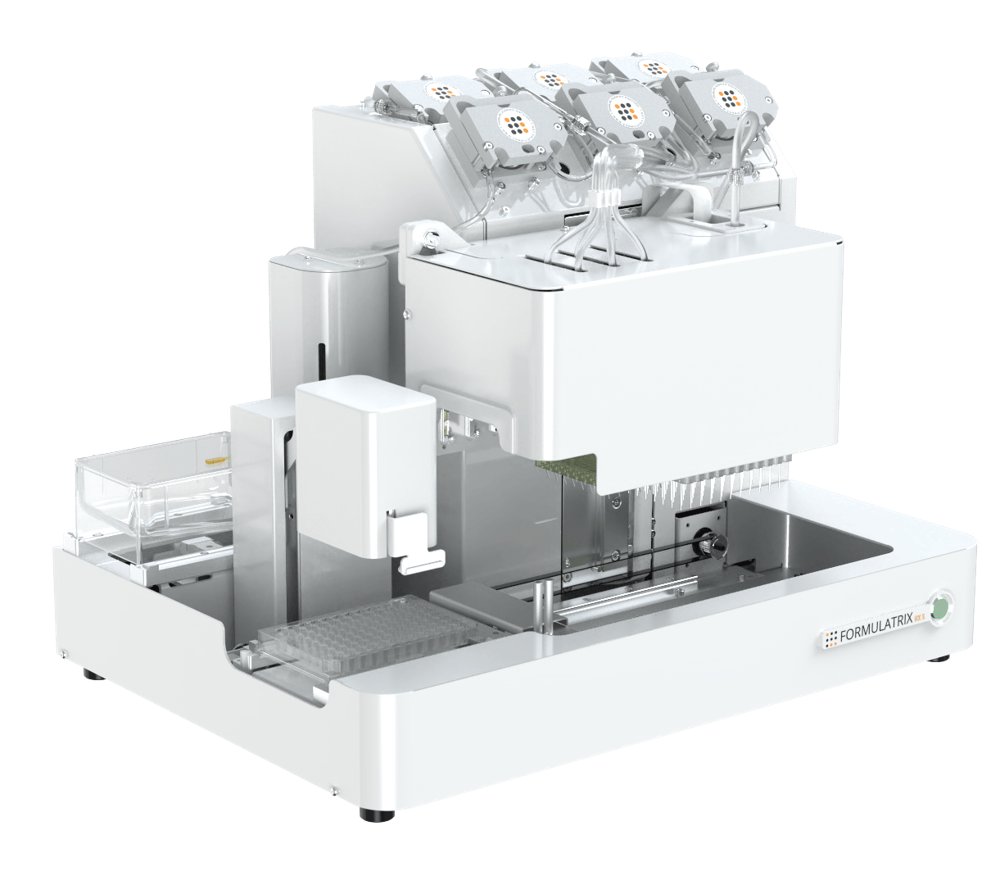
Automated Plate Washer A versatile automated plate washer designed to support a wide range of microplate formats and complex laboratory workflows. Volume Range Min: 20 µL Max: ∞ Self-Cleaning Up to 2 Cleaning Liquids Precision CV 5% @ 50 µL Reliable Plate Washer for a Wide Range of Applications and Microplate Formats The Reagent Exchanger (RX) is a versatile automated washer designed to support a wide range of microplate formats and complex laboratory workflows. It features integrated automation for delidding, plate tilting, dispensing, aspiration, and nozzle cleaning, delivering streamlined unattended operation. The RX easily integrates with automation platforms and supports robotic reagent loading to maximize efficiency, consistency, and workflow flexibility. Ease of Use Simplify liquid handling and reduce setup and operation time with the intuitive design and automated functionality Automation Friendly Integrate with automated systems and robotic arms to enhance workflow efficiency and minimize manual intervention Low Cost Consumables Reduce costs with affordable SBS-sized Automation Reagent Reservoirs and reusable tips that are washed between transfers Benefits Fast, Uniform Aspiration Across Plate Formats: Equipped with 96 nozzles for fast, precise, and uniform aspiration across 96- and 384-well plates, supporting high-throughput workflows with maximum efficiency Optimized Aspiration through Liquid Pooling: The tilting plate stage enables liquid pooling to optimize aspiration efficiency Preserve the Integrity of Loosely Adherent Cells: Non-contact side-wall dispensing minimizes fluid shear, preserving the integrity of loosely adherent cells Consistent Cell Dispensing with Maintained Suspension: Cells are consistently dispensed into 96- and 384-well plates by maintaining suspension with a stir bar Flexible Multi-Reagent Dispensing: Supports up to six dispensers, externally sourced or from Automation Reagent Reservoirs Contamination-Free Reusable Nozzles: Integrated cleaning stations ensure reusable aspirator and dispenser nozzles remain contamination-free Quick Reagent Changeover for Multi-Step Protocols: Easily swap reagent reservoirs for flexible, multi-reagent dispensing. Versatile loading options support both automatic and manual loading for seamless operation Seamless Compatibility with Lidded Microplates: Integrated delidder automatically removes and replaces lids, enabling uninterrupted processing of lidded microplates Efficient Transwell Plate Processing The RX uniquely enables efficient processing of transwell plates without the need to remove the insert, reducing manual handling and accelerating workflows while maintaining assay integrity. By automating the aspiration from the basolateral wells before the apical wells, the system effectively manages hydrostatic pressure and prevents the upward force that can delaminate or stress membrane-bound cell layers. This approach, combined with controlled sidewall dispensing into both the apical and basolateral chambers, ensures that delicate monolayers remain undisturbed even during high-throughput workflows. By repeating the dispensing sequence across columns, the RX eliminates variability from manual pipetting, reduces the risk of contamination, and delivers the high reproducibility required for sensitive transwell assays. Gentle Media Exchange for Sensitive Cells The RX performs controlled aspiration and gentle side-wall dispensing to protect sensitive, loosely adherent cells during media exchanges. This approach minimizes disturbance to the cell layer and reduces bubble formation and localized cell loss. To demonstrate this in practice, HEK-293T (loosely adherent) cells were cultured in 8-well plates and subjected to partial media exchange either manually or using the RX system. The RX performs controlled, gentle aspiration followed by slow side-wall dispensing to minimize disturbance to the cell layer. Cell detachment was quantified through pre- and post-feed imaging. The RX preserved sensitive HEK-293T cells significantly better than manual handling, resulting in only 4.9 ± 1.5% confluency loss, compared to 10.1 ± 2.7% with manual feeding. RX-fed cultures consistently recovered to ~80% confluence with uniform growth. In contrast, manually fed wells showed greater variability, localized cell loss, and bubble formation that interfered with imaging. RX media exchange reduces cell detachment Uniform, Reproducible Cell Seeding To evaluate seeding consistency at scale, HEK-293T and T47D cell suspensions were prepared in an Automation Reagent Reservoir with continuous stirring and dispensed into 96-well plates. After 6 hours of incubation, plates were imaged to assess well-to-well confluency and calculate plating uniformity (CV%). Manual controls were seeded using an 8-channel pipette with intermittent mixing. RX media exchange improves confluency, reduces bubbles and detachment Ensure Sterile Operation The RX supports sterile media exchange when integrated in an automated environment that provides VHP and/or HEPA control and validated decontamination workflows. In a representative sterile workflow, DMEM/F-12 media was dispensed using the RX integrated within the Cellmatic system following VHP sterilization and fluidic decontamination with 3% H₂O₂, followed by sterile water rinsing. Between media exchanges, fluid lines were flushed with 70% IPA and rinsed with sterile distilled water to minimize carryover. Daily monitoring of four 96-well plates demonstrated background signals consistently below 5%, indicating no detectable biological contamination. These results confirm that the RX cleaning and decontamination workflow supports reliable, routine sterile cell culture operations. Cell growth during multi-passage maintenance No Detectable Cross-Contamination The RX reduces inter-well carryover by using controlled aspiration/dispense behavior and optional nozzle washing during repeated media exchanges. To test this under repeated exchange conditions, two fluorescent iPSC lines (red and green) were seeded into defined columns of 96-well plates and subjected to multiple full media exchanges, performed both with and without nozzle washing. Imaging showed no inter-well fluorescence carryover, with colonies remaining confined to their original wells throughout the experiment. All colonies maintained expected phenotypes and expanded to confluence, demonstrating reliable multi-line co-culture without detectable cross-contamination. Cross-contamination assessment using fluorescent iPSC culture Common Applications Media Exchange Cell Dissociation Cell Plating Technical Specifications Liquid Handling and Labware Features - Dispense Volumes: 20 μL - Dispense Performance: 5% CV @ 50 μL - Aspiration: < 0.5 mL residual volume for 1-well; < 5 μL residual volume per well for 96-well - Labware Compatibility: 1-well, 4-well, 6-well, 8-well, 96-well, 96-Transwell, 384-well - Trough Capacity: 250 mL - Protocol Durations: Media Exchange < 30 sec (1-well plate full aspiration & dispense 15mL); Cell Plating < 30 sec (96-well plate 200 μL/well) User Interface Specifications - Browser / Web-based: Google Chrome Version 90 Electrical Requirements - 110-240 V, 50-60 Hz, 350 W Max, Standard or European Outlet Physical Dimensions - Width: 538 mm (21.2”) - Height: 425 mm (16.75”) - Depth: 391 mm (15.41”) - Weight: 25 kg (56.2 lbs) FAQs What is the Reagent Exchanger (RX)? The RX is an automated plate washer that performs media exchanges, aspiration, dispensing, plate delidding, tilting, and nozzle cleaning on microplates with minimal user intervention. What microplate formats does the RX support? The RX supports multiple SBS-format microplates, including 1-well, 4-well, 8-well, 96-well, 96-well transwell, and 384-well plates. It also supports lidded microplates courtesy of the integrated delidder. What is the aspiration and dispense performance of the RX? Aspiration achieves <0.5 mL residual volume in 1-well plates and <5 µL per well in 96-well plates. Dispense volumes are 20 µL, with ~5% CV and ~5% accuracy at 50 µL. What throughput can the users expect? The RX can perform a full media exchange in a 1-well plate (<30 seconds for aspiration + dispensing of ~15 mL) and cell plating into a 96-well plate at 200 µL per well in under 30 seconds. How does the RX minimize shear stress and protect sensitive adherent or loosely adherent cells? Angled dispense nozzles enable non-contact side-wall dispensing, which reduces turbulent liquid flow to delicate cell layers. Adjustable aspiration and dispense parameters like liquid flow rate and nozzle positioning minimizes cell detachment. What reagent or plate handling options are included? The RX features interchangeable reagent reservoirs and multiple external liquid connections (including waste, 2 cleaning liquids, and up to five externally plumbed dispense lines). A stirrer enables use of a stir bar in the Automation R
CATEGORY
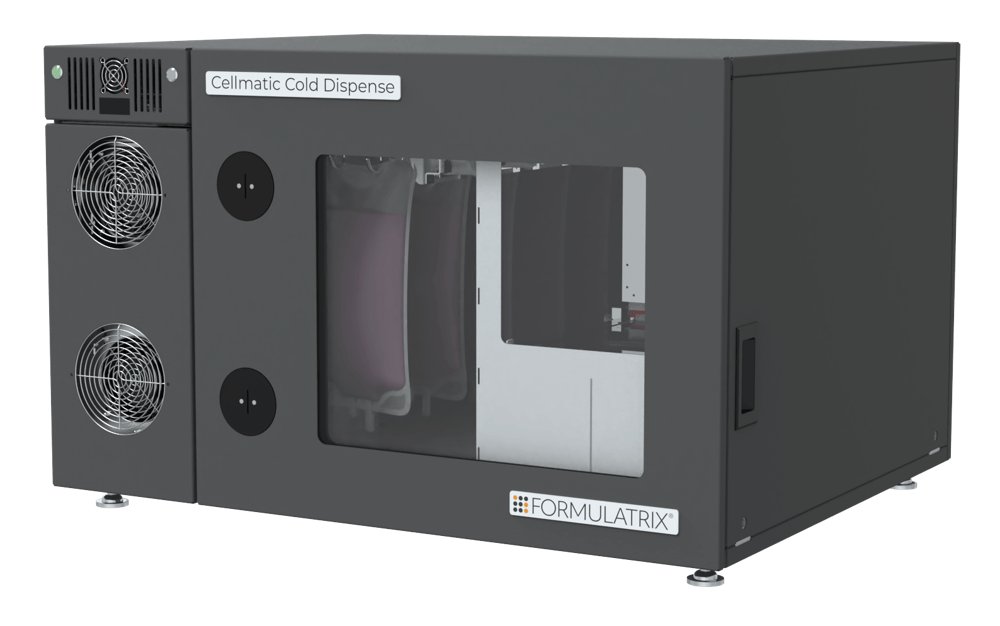
Automated Cold Reagent Storage Designed for automated reagent preparation and delivery within temperature-controlled, integrated laboratory workflows. 1 mL/s Dispense Rate 4 % CV at 2 mL Dispense 0.1 mL Dispensing Accuracy ISO 5 Cleanroom Class - Dispensing Channel On-Demand Reagent Preparation Within a Controlled Cold Environment The Cellmatic Cold Dispense stores up to five reagent containers, either 1 L bottles or 5 L media bags, and automatically dispenses them into SBS-format reservoirs based on user-defined protocols. Reagent containers, plumbing lines, and the dispensing station are all housed within the refrigerated chamber, preserving reagent stability from storage through to delivery. Reservoirs are automatically delidded for dispensing and relidded before handoff, minimizing contamination risk and evaporation at every step. Right Reagent, Right Time Reagents dispensed on demand, eliminating manual loading and preventing warming on deck Automated Reservoir Preparation Multiple bulk reagents can be dispensed into a single reservoir, simplifying preparation for complex protocols Maintain Sterility at All Times The dispensing area is positively pressurized with HEPA filtration and meets ISO 5 cleanroom standards Key Features Software-Defined Reagent Protocols: Reagent compositions and volumes are defined entirely in the software, and the system dispenses automatically, eliminating manual premixing and enabling multiple users and protocols to run simultaneously. Bulk Reagent Storage: Stores up to five reagent containers (1 L bottles or 5 L media bags) within the refrigerated chamber. Reagents, plumbing lines, and the dispense station all remain at a controlled cold temperature throughout. Automated Delidding and Relidding: Reservoirs are automatically delidded inside the dispensing station, filled according to protocol, and relidded before exiting the system, reducing evaporation and protecting reagents from contamination. On-Board Reagent Mixing: Multiple reagents can be combined into a single reservoir within the system, enabling the automated preparation of custom reagent mixtures without manual intervention. ISO 5-Compliant Dispensing Chamber: The dispensing area is positively pressurized with HEPA filtration and meets ISO 5 cleanroom standards, with UV sterilization and internal HEPA air filtration to maintain a clean dispensing environment. Built-In CCTV Monitoring: An integrated camera inside the chamber enables remote monitoring of dispensing operations and system status without physical access. Precise Temperature Control: A variable-speed compressor with automatic defrost, soft-start control, and real-time pressure and temperature monitoring delivers ±0.2 °C temperature accuracy at a 4 °C setpoint. Ethernet and API Integration: Supports remote access, scheduling, and control by third-party automation platforms via Ethernet connectivity and an available software API. Automating Reagent Preparation From Storage to Handoff Rather than delivering reagents directly to a single instrument, the Cellmatic Cold Dispense prepares filled reservoirs that a robotic arm retrieves and transfers to any liquid handler in the workcell. This makes a single prepared reservoir available across the full system rather than tethering reagent delivery to a single instrument. Users define reagent compositions and dispensing schedules in software; the system handles the rest, including multi-reagent mixing into a single reservoir when the protocol requires it. The result is a hands-off preparation step that supports flexible experiment design and minimizes waste by dispensing only what is needed for each run. Clean, Stable, and Built for Continuous Operation The dispensing chamber is positively pressurized and conforms to ISO 5 cleanroom standards, with HEPA air filtration and UV sterilization maintaining a contamination-free environment throughout reagent preparation. Automated delidding and relidding of reservoirs further limit exposure of reagents to the ambient environment. A variable-speed compressor maintains ±0.2 °C accuracy at a 4 °C setpoint, with automatic defrost cycles, soft-start control, and real-time monitoring of suction and discharge line pressure and temperature. The modular design simplifies maintenance and minimizes downtime in automation environments requiring continuous operation. Part of the Cellmatic Cell Culture Automation Platform The Cellmatic Cold Dispense integrates natively with the Cellmatic Cold Store, Incubator, and automated plate washer, purpose-built modules that together cover the full cell culture workflow. Each component is also compatible with third-party robotic platforms, giving labs the flexibility to adopt Cellmatic components selectively within existing or custom workcell designs. Technical Specifications Electrical - Voltage: 100–240 VAC - Frequency: 50–60 Hz - Rated Power: 400 W Environmental - Operating Temperature: 18–25 °C - Operating Humidity: 0–60% RH - Temperature Control Accuracy: ±0.2 °C at 4 °C setpoint Reagent Capacity - 5 × 5 L media bags or 5 × 1 L bottles - Dispensing Channels: 5 Dispensing Performance - Dispensing Precision (CV): 4 % - Dispensing Accuracy: 0.1 mL - Minimum Dispensing Volume: 2 mL - Maximum Dispensing Volume: Unlimited Robotics Interface - Maximum robotic gripper entrance width: 200 mm Physical Dimensions - Width: 1006 mm (39.6'') - Height: 633 mm (24.9'') - Length: 805 mm (31.7'') - Weight: 156 kg (345 lb)
CATEGORY
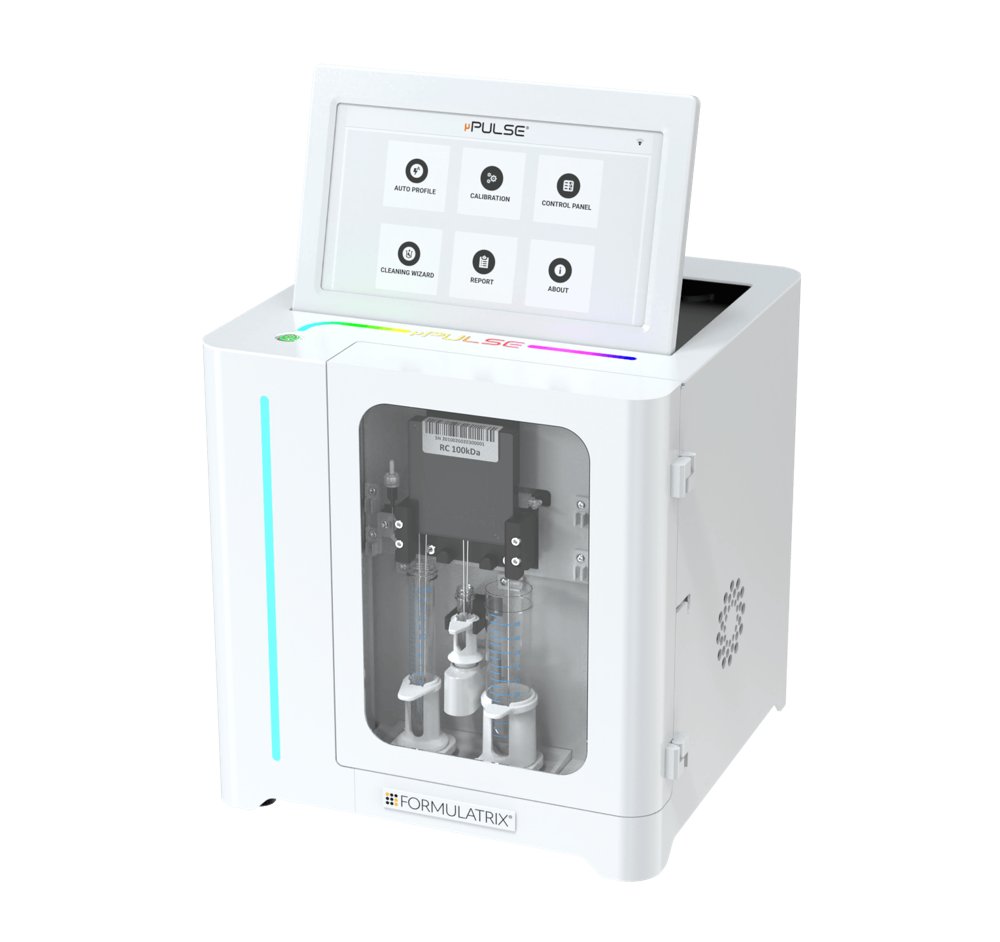
Sample Concentration - Buffer Exchange A fully automated, walk-away benchtop TFF system for sample concentration, diafiltration, buffer exchange, and desalting. Smarter Automation for Sample Concentration and Buffer Exchange The µPulse v4 is a fully automated walk-away benchtop TFF system for sample concentration and diafiltration, including buffer exchange and desalting, featuring improved consumables and enhanced process control to deliver gentle handling, high recovery at low volumes, and reproducible results while replacing manual centrifugation and dialysis with a smarter workflow. Key Benefits Faster Processing: Achieve permeate flow rates up to 4x faster than centrifugation while maintaining smooth, consistent flow across the membrane for reliable, reproducible filtration. Low Hold-Up Volume, Higher Recovery: Minimize sample loss with the next-generation µniPulse chip and confidently concentrate valuable samples to final volumes as low as 250 µL. Uninterrupted Buffer Exchange: Enable consistent diafiltration with unattended, automatic buffer transfer from an external reservoir. Walk Away: Set your parameters and let the µPulse handle concentration and buffer exchange automatically. Monitor progress remotely through a web-based interface and return only when your sample is ready. Flexible Operating Volumes: Process volumes from 0.5 to 100 mL, without compromising efficiency. Cleaner, Simpler Setup: Protect your sample from contamination throughout processing. An enclosed sample chamber and filter chip with integrated transfer tubing help eliminate contamination risk from setup to recovery. Fast Permeate flow rates up to 4x faster than centrifuges with dead-end filters Low Hold-Up Volume Ultra-low 0.25 mL hold-up volume with up to 100% recovery via automated recovery options Walk-Away System Load your samples, set your parameters, and let the system handle the rest Faster Sample Concentration with TFF Traditional centrifuge-based dead-end filtration pushes fluid directly into the membrane, creating a high concentration gradient at the membrane surface. As this layer builds, permeate flow can slow over time, and recovery may suffer. The µPulse moves the sample parallel to the membrane, keeping the pores open and enabling up to 4x faster filtration than dead-end filtration while preserving sample integrity. The dual-diaphragm pump and a larger membrane (~50-75% larger than typical dead-end devices) in the filter chip enable continuous flow and higher flux, so you can reach your target volume sooner and continue your research. The exact concentration rate depends on sample composition, starting volume, and membrane MWCO. Effortless Buffer Exchange and Desalting In addition to sample concentration, the µPulse supports automated diafiltration for buffer exchange and desalting with minimal hands-on effort. Once parameters are set, the system automatically manages buffer addition and removal, helping ensure consistent exchange without constant user intervention. Front-access centrifuge tubes simplify setup for both the sample and exchange buffer, while an external buffer reservoir with an integrated peristaltic pump enables uninterrupted diafiltration for larger buffer volumes, allowing true walk-away operation even for large diavolumes. Set Up Every Run with Confidence The µPulse v4 removes guesswork from setup with automatic chip tracking. The system identifies the membrane MWCO and chemistry as soon as a chip is installed, helping ensure the correct configuration is applied before each run. Chip usage and run history are tracked automatically, making it easier to maintain consistency across experiments, monitor chip lifetime, and standardize workflows across users. By reducing manual input and setup errors, the µPulse delivers more reproducible results with less day-to-day effort. Reliable Results Without Supervision Built-in controls keep every run predictable and your sample protected—without constant supervision. Precise TMP control: Electronically controlled feed and backpressure valves maintain a stable, application-specific TMP to protect sensitive samples and minimize membrane fouling. Accurate volume tracking: A high-sensitivity, low-volume load cell continuously monitors sample volume with ±0.02 mL accuracy, enabling confident endpoint control, preventing over-concentration, and ensuring buffer exchange reaches the desired extent. Monitor Your Run from Anywhere The µPulse features an intuitive web-based software interface that can be accessed directly on the system or from other devices on the same network. Setup is straightforward, allowing users to define starting and target volumes, concentration goals, and diafiltration or buffer exchange parameters with ease. Advanced settings are available to optimize performance for specific samples, while real-time run data lets users monitor progress remotely without repeated manual checks at the instrument. Consistent Filtration with Uniform Samples The µPulse includes a mixing cycle that helps keep samples uniform throughout the run. Recirculating the sample across the filtration membrane, it minimizes localized high concentrations, supporting more consistent filtration performance over time and helping protect overall sample quality.
CATEGORY
Lab Automation Platform Self-driving, vision-guided plate handling that connects your entire lab - modular, scalable, and reconfigurable. Flexible to Fit Any Layout Customize the system to connect existing automation to optimize efficiency or build a new automation workflow from the ground up. Scale as Your Needs Grow The modular design allows the system to easily expand with your lab’s needs. Quickly add more tracks or Rovers to grow your system in as little as two days. Maximize Your Lab Space The system is light enough to hang from the ceiling to free up valuable floor space. Elevators provide access to the automation stations below. Low Maintenance Rovers self-calibrate through machine vision and can be easily swapped or removed to keep your automation running. Autonomous Plate and Labware Handling for Lab Automation Rover, a laboratory automation platform, uses self-driving "cars" to move microplates and other labware from one laboratory instrument to another. The Rovers use machine vision to navigate virtual maps, providing researchers with a flexible and scalable solution. The platform can scan barcodes, perform plate transfers at designated locations, and move freely in its environment with precise, omnidirectional motion. The Rover system can automate many of the repetitive tasks involved in laboratory work to free up researchers to focus on more important tasks, such as experiment design and analyzing data. Benefits Scalable Without Limits Rover doesn’t restrict your growth. Unlike systems limited to daisy chains or fixed modular configurations, Rover’s infrastructure is easy to expand, reposition, and reconfigure. Easy Modular Setup Rover infrastructure—tracks, mats, and elevators—is modular and lightweight, enabling quick rearrangement. New tracks or Rovers can be added in just two days. Plug & Play Rovers Add or remove Rovers on the fly with plug-and-play simplicity. Just scan, dock, and go — the system instantly recognizes new units and gets them up and running with no complex alignment routines. Remote Fleet Monitoring and Control The software dashboard provides a real-time view of all active Rovers, making monitoring and troubleshooting straightforward. Intelligent Path Planning and Coordination The Rovers follow editable digital paths using machine vision, while the Fleet Manager software optimizes routes and traffic flow for seamless, adaptable automation—no physical lab changes required. Built-In Fault Tolerance Rovers recover from disturbances without halting operations, ensuring uninterrupted workflows, even if a unit is moved, paused, or encounters an error. Energy-Efficient Automation The Rovers operate at only ~15W per device — orders of magnitude lower than magnet-based systems, eliminating the need for extra cooling and reducing both energy waste and HVAC load across your lab. Flexible to Fit Any Lab Layout The Rover system is designed to be completely customized to your lab’s individual space and workflow requirements. Regardless of the level of automation employed, there is a Rover solution that can help optimize your laboratory’s efficiency. Use the Rovers to connect existing automation, or use them to build a new automation workflow from the ground up. The system can be customized with a variety of track and layout components to meet your needs. Rover tracks can be sized to a variety of lengths and widths. The tracks can also be suspended from the ceiling, coupled with elevators, allowing plates and labware to be transferred between instrumentation without occupying floor space. Wall pass-throughs can even be installed to connect multiple rooms together. This flexibility allows users to optimize the usage of their current laboratory automation (such as liquid handlers, readers, etc.) to take their throughput to the next level. Quickly Scale as Your Lab Grows The Rover platform is modular by design to allow users to easily and rapidly expand as your lab’s requirements change. The system can be integrated into existing automation setups and easily reconfigured and expanded to meet changing needs. The platform consists of three major components: 1. Rovers (aka “cars”) 2. Fleet Manager Software 3. Infrastructure (the navigable environment of the Rovers, including tracks and elevators) Each of these components can be adjusted to provide more flexibility and through to your automation workflow. The lightweight Rovers can be easily picked up and added or swapped out in a matter of minutes. The Fleet Manager Software continuously schedules and tracks the status of every Rover and features an open API to enable easy integration. Adding new Rovers to the software will give it greater flexibility in scheduling transfer tasks. Finally, the infrastructure is also lightweight and modular, allowing it to be pieced together and rearranged as needed. Installing new track and/or new Rovers to your system can be done in as little as two days. Low Maintenance Automation The intention of laboratory automation is to increase efficiency. That cannot be achieved if your system is constantly down for maintenance or recalibration. The Rover platform was created to allow easy maintenance for increased up-time, while minimizing system downtime. The Rovers self-navigate within a defined laboratory space, utilizing downward-facing cameras and barcode-encoded mats. The need for precise calibration is eliminated by utilizing real-time visual alignment as the Rovers interface with instruments during plate transfers. The Fleet Management Software monitors the status of each Rover and notifies the user of any potential issues. At only 2.5 kg (5.3 lbs), the Rovers are lightweight enough to be picked up and swapped out if needed. The “Last Mile” Problem of Lab Automation Enabling the Lab of the Future with the Formulatrix Rover and F.A.S.T. In this talk, Bob Gantzer from Beam Therapeutics presents the company’s lab automation strategy, pushing to a fully automated, integrated laboratory, including the use of the Rover Platform and the F.A.S.T. Liquid Handler. Specifications & Requirements Rover Footprint: Dimensions: 106 mm x 186 mm x 123 mm (4.2 inch x 7.3 inch x 4.8 inch) Height at Base of Labware: 116 mm (4.6 inches) Recommended Lane Width: 170 mm (6.7 inches) Weight w/ Power Pack: 2.4kg Operational Limitations: Payload Compatibility: Anything with an SBS format Spatula Payload Limit: 650 g (can support full 1-well SBS plate) Ambient Working Temperature: 4°C - 37°C Rover Positional Accuracy: Rover X-Y Repeatability: ± 0.4 mm Rover Rotation Repeatability: ± 0.15° Est. Max. Handoff Deviation: ± 1 mm Speed: Maximum Travel Speed: 600 mm/s Plate Transfer Time (pick up or drop off): 6 seconds What is the Rover Autonomous Plate Handler and how does it work? The Rover is a self-driving robotic system that automates the movement of SBS-format labware between automation pods or nests across your lab. Using machine vision, barcode scanning, and virtual maps, it enables flexible, scalable plate handling without fixed tracks or complex infrastructure. What labware formats is the Rover compatible with? The Rover supports all labware that conforms to Society for Biomolecular Screening (SBS) dimensions. It can handle payloads up to a full 1-well SBS plate, making it compatible with virtually all standard plate types. What are Rover’s speed, repeatability, and positioning accuracy? The Rover travels up to 600 mm/s and completes a pick-up or drop-off in about 6 seconds. It maintains positional repeatability of ±0.4 mm in X-Y and ±0.15° in rotation, ensuring reliable handoffs with ±1 mm deviation to instruments. This precision allows consistent transfers without manual intervention. What is the payload and physical size of the Rover? Each Rover weighs approximately 2.4 kg (with power pack), measures ~106 × 186 × 123 mm, and can carry up to 650 g—sufficient for heavy plate loads while remaining compact enough to operate in tight lab spaces. Under what environmental conditions does the Rover operate? The Rover is designed for ambient lab environments (4 °C to 37 °C), allowing it to handle all environments from refrigerators to incubators. Plate Spatula Performs plate pickup and dropoff Ground-facing Camera Enables precise omnidirectional motion Power Pack Charged automatically at docks, and user-replaceable Front-facing Camera Enables barcode scanning & smart-alignment for plate handovers Omni-wheels Enable precise omnidirectional motion
CATEGORY
