By L.U.M. GmbH
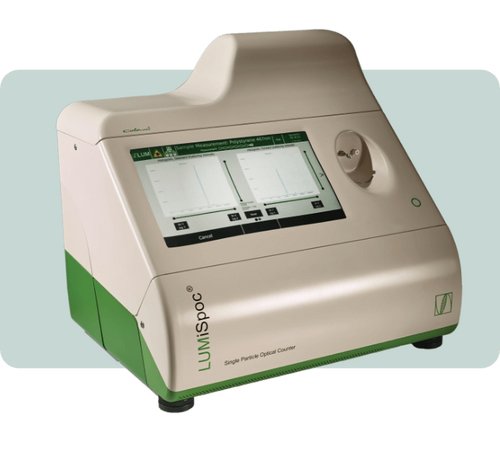
The LUMiSpoc® offers these highlights - High-precision characterisation of single particles - Nanoparticle concentration - Large measuring range (particle size & concentration 40 nm to 8 µm) - Easy cleaning - Multimodal & polydisperse size distributions with high resolution - Sample volume only 250 µl - Compact design Very high resolution of monomodal, multimodal and polydisperse size distributions Very high resolution of monomodal, multimodal & polydisperse size distributions extremely high classification high counting rate (high-frequency digitisation, pulse analysis & classification) Large dynamic range (particle sizes from 40 nm - 8 µm) without range switching or component changes Short measurement time Easy operation (measurement, rinsing) Small sample volume Touch display with embedded PC & server/browser based software One-point calibration by reference particles LUMiSpoc® - the new standard in nanoparticle counting An advanced single particle analysis system The LUMiSpoc® is a highly advanced single particle analysis system, similar to a flow cytometer, that measures particle size distribution and particle concentration of nano- and microparticles in suspensions and emulsions with an unparalleled resolution and dynamic range. The instrument uses the patented Single Particle Light-Scattering Technology®, a technology which records light that is scattered into into forward and sideward directions by single nano- and micro particles while passing a laser beam of a special beam cross-section. It enables you to get a deep insight into complex nano- and submicro-particulate systems, which helps you to design tailored particles and dispersions. International norms and guidelines THE LUMiSpoc® MEETS THE FOLLOWING STANDARDS ISO 21501-2 MATERIAL OVERVIEW The following materials can be analyzed with the LUMiSpoc® Nanoparticle design Number-based particle concentration Number-based size distribution Classification of nanomaterials Agglomeration & flocculation kinetics Protein aggregation Coalescence/Ostwald ripening Coarse grain fractions Membrane testing/cut-off Homogenisation Functionalised particles Reference particles CMP slurries Biological samples and many more materials... Technical Data LUMiSpoc® Particle size range 40 nm - 400 nm (sideward scattering) 300 nm - 8,000 nm (forward scattering) Min. size resolution (x < 1 µm)< 10 nm Particle concentration range 10 3 ml-1 to 10 9 ml-1 Counting rate up to 10,000 per second Typical measurement time 1 min Light source Diode laser, violet, adjustable Particle counting precision< 2 % Sample volume 250 µl Conformity ISO 21501-2 Dimensions (W x H x D), Weight 60 cm x 52 cm x 59 cm, 40 kg Power supply 24 V DC, 220W
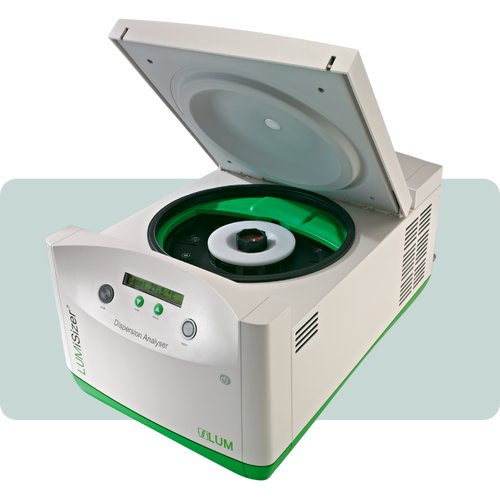
Exceptional possibilities The LUMiSizer® masters these kinds of analyses - Particle size distribution - Droplet size distribution - Separation velocity - Sauter Diameter - Particle magnetization - Density distribution - Hansen Solubility/Dispersibility Parameters - Sedimentation - Creaming - Agglomeration - Flocculation - Coalescence - Emulsification - Dispersibility - Shelf-life (comparative & predictive) - Direct, accelerated stability analysis Test up to 12 samples simultaneously Obtain unique "fingerprints" for your samples Optimize your dispersions Achieve stability measurements quickly and directly Measure particle size even at high concentrations Obtain particle densities Compare and predict the shelf life Differentiate between the different instability mechanisms Measure samples within a wide temperature range (4 ˚C to 60 ˚C) Analyze (highly) concentrated samples (up to 90%) LUMISIZER® – See and understand your complete sample Analyze aqueous, non-aqueous, Newtonian, non-Newtonian systems - the choice is yours. The LUMiSizer is an evolutionary development based on the LUMiFuge platform with some significant additional capabilities that instantaneously measures the extinction (space- and time-resolved) of the transmitted light across the entire length of your sample using the STEP-Technology®. Because of an enhanced optical system, the LUMiSizer lets you analyse particle and droplet velocity distributions for creaming and sedimentation phenomena without the need of any material data and performs particle sizing (ISO 13318- 2). Run 12 samples at a time under a wide range of viscosities, temperatures, and real-world concentrations. The LUMiSizer is the only instrument in the world that allows you to obtain particle velocity distributions without having to know any material constants. Analyse aqueous, non-aqueous, Newtonian or non-Newtonian systems – the choice is yours. You can measure the effects of concentration, shape, and colloidal forces on your particle size distribution and stability. You can create your own hindrance functions or work with published ones. Either way, you can accurately measure and predict ideal and non-ideal particle behaviour. The exceptional precision of the system ensures that all particle size fractions are measured in a short time. Immediate data collection across the entire sample ensures exceptional results, whereby you can measure wide particle size distributions, determine non-idealities and gain the ability to resolve multimodalities. Think of the LUMiSizer as a LUMiFuge on steroids, a direct stability and particle size analyser forged into one. It can do all the things the LUMiFuge can, only more. In addition to measuring stability directly and making shelf life prediction, you can also distinguish between flocculated and nonflocculated dispersions and measure particle size distributions using the highest industry norms and regulations. Several wavelengths are available, allowing for a broad particle size spectrum coverage. Comes with state-of-the-art software SEPView®. The LUMiSizer comes certified, factory precalibrated and is ready-to-go. International norms and guidelines The LUMiSizer® meets the following standards ASTM STP1527 CFR 21 Part 11 DIN 51817 GB/T 42342.2 GB/T 41316 ISO 13318-1 ISO 13318-2 ISO 18747-1 ISO 18747-2 ISO 20427 ISO/TR 13097 ISO/TR 18811 ISO/TS 22107 JIS Z 8823-1 NF X31-107 WHO Technical Report Series No. 962, Annex 3 Material overview The following materials can be analyzed with the LUMiSizer Abrasives Beverages Carbon black Carbon nanotubes Ceramics Color pastes Cosmetics & personal care Fine chemicals Foams Fuel cells Graphenes Inks Nano-dispersions Pharmaceuticals Polymers Slurries Wastewater and many more materials... Multi-wavelengths Separation and consolidation phenomena By integrating two different light sources into one device, LUM combines the functionalities of both individual versions of the near-infrared (NIR) and blue LUMiSizer in the new multi-wavelength LUMiSizer 65x. The multi-wavelength LUMiSizer for the rapid characterization of the most diverse demixing and consolidation phenomena as well as the quantification of the velocity and particle size distribution according to ISO 13318 is predestined for users with changing challenges, such as top research institutes, universities and industrial development departments. In nanotechnology, two separate LUMiSizers were previously required for particle characterization of e.g. nanosilica (blue device), core-shell samples... Download & Technical Data Technical Data LUMiSizer® Accelerated phase separation 6–2300 times compared to gravity Particle size distribution 20 nm to 100 µm (20 nm to 50 μm rec. with blue wavelengths) Consolidation measurements concentrated dispersions and sediments Observation time 1 s to 99 h Conformity ASTM STP1527, CFR 21 Part 11, DIN 51817, GB/T 42342.2, GB/T 41316, ISO 13318-2, ISO 18747-1/2, ISO 20427, ISO/TR 13097, ISO/TR 18811, ISO/TS 22107, JIS Z 8823-1, NF X31-107, WHO Technical Report Series No. 962, Annex 3 Samples up to 12 simultaneously Volume 0.05 ml to 2.0 ml Concentration 0.00015 Vol % – 90 Vol % Density up to 22 g/cm³ Viscosity 0,8 - 10 8 mPas Particle size 10 nm to 1000 µm Light source multi-wavelength Temperature control 4 °C to 60 °C, +/– 1K Cells different material and optical path Dimensions (WxHxD), weight 37 cm x 27 cm x 60 cm, 40 kg Power supply 100 V | 120V | 230 V, 50/60Hz
CATEGORY
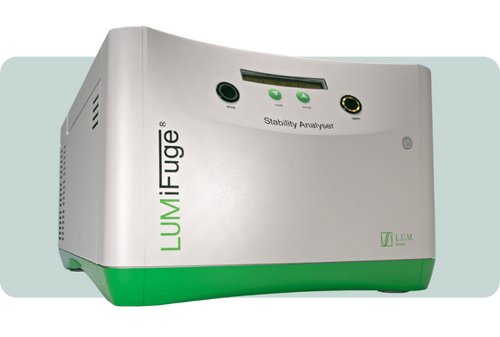
The only direct and accelerated stability analysis Up to 8 samples simultaneously THE LUMiFuge® MASTERS THESE KINDS OF ANALYSES - Direct accelerated stability testing - Comparative & predictive shelf-life analysis - Surfactant efficiency - Destabilization phenomena - Phase separation - Solidosity - Clarification - Dewaterability, consolidation - Segregation - Creaming rate - Sedimentation rate - Magnetization - Emulsifier efficiency - Instability index Measure up to 8 samples simultaneously Physical stability - compare and predict Deliver fast and direct stability measurements Compare and predict shelf life Analyse magnetic particles Work with high sample concentrations and a wide range of temperatures Flocculant and demulsifier selection Needs no material constants Immediately see and understand your complete sample top to bottom Optimize your dispersion Measure and differentiate various degrees of destabilization phenomena Use disposable cells Quick and easy to use LUMiFuge® – Fast and direct stability measurements Eight samples simultaneously thanks to special powerful LED elements The LUMiFuge is an analytical centrifuge that measures instantaneously the extinction of transmitted light across the full length of your sample using the STEP-Technology®. It is the only instrument in the world that enables you to perform physically accelerated, direct and efficient stability testing and ranking of your formulations. It features an advanced optical system enabling multi-sample analysis at user defined speeds, light intensities and temperatures. The optical blocks consist of high-powered special light sources of different wavelengths. The parallel light illuminates the whole sample from top to bottom. Even the smallest changes across the entire sample height are detected by a sensor featuring high optical and spatial resolution. Immediate data collection ensures the ability to measure everything that occurs in your sample; no matter how simple or complex. There is no need to dilute or to know any material constants; just input your samples and you have your results. By looking at the fingerprint patterns of the whole sample, you can classify and understand the causes of instability, e. g. creaming, sedimentation or flocculation, as well as measure and rank stability. Use this knowledge to develop new formulations and optimize current ones easily. You can analyse up to eight different samples simultaneously in a wide range of viscosities and virtually any concentrations at operator preset temperatures (+/- 0.5 K). A truly one-of-a-kind feature also allows you to measure the separation behaviour and magnetic properties of micro- and nano particles in variable superimposed orthogonal or parallel magnetic fields in addition to the conventional sedimentation field. This provides you with the unique opportunity to analyse magnetic nano- and microparticles. Comes with state-of-the-art software SEPView. The LUMiFuge comes certified, factory pre-calibrated and is ready-to-go. THE LUMiFuge® MEETS THE FOLLOWING STANDARDS ASTM STP1527 CFR 21 Part 11 GB/T 41316 ISO 18747-1 ISO/TR 13097 ISO/TR 18811 MATERIAL OVERVIEW The following materials can be analyzed with the LUMiFuge® Abrasives Beverages Carbon black Carbon nanotubes Ceramics Color pastes Cosmetics & personal care Fine chemicals Foams Fuel cells Graphenes Inks Nano-dispersions Pharmaceuticals Polymers Slurries Wastewater and many more materials... Download & Technical Data Technical Data LUMiFuge® Accelerated phase separation 6–2300 times compared to gravity Consolidation measurements concentrated dispersions and sediments Observation time 1 s to 99 h Conformity ASTM STP1527; CFR 21 Part 11; GB/T 41316; ISO 18747-1; ISO/TR 13097; ISO/TR 18811 Samples suspensions, emulsions, suspo-emulsions, sludges, slurries Channels up to 8 simultaneously Volume 0.05 ml to 2.0 ml Concentration 0,00015 Vol % - 90 Vol % Density up to 22 g/cm³ Viscosity 0.8–10 8 mPas Light source NIR, special versions Temperature control 4 °C to 60 °C, +/– 1K Cells different material and optical path Dimensions (WxHxD), weight 37 cm x 27 cm x 60 cm, 40 kg Power supply 100 V, 230 V; 50/60Hz
CATEGORY
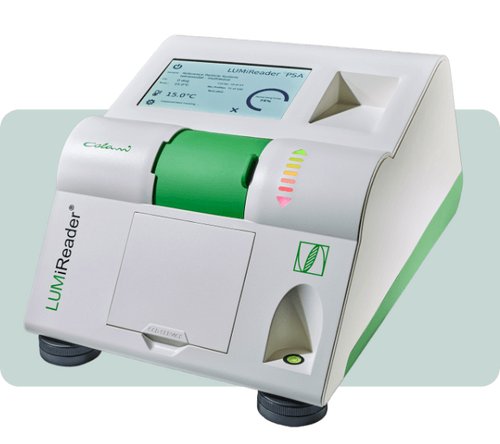
THE LUMiReader® PSA MASTERS THESE KINDS OF ANALYSES - Particle size distribution - Direct real-time stability testing - Dispersion classification (Fingerprinting) - Separation velocity distribution - Sauter diameter distribution - Droplet & particle density distribution - Hansen dispersibility parameters - Turbidity index - Asphaltene separability number - Flocculation & coalescence - Sedimentation & creaming rate - Clarification rate - Accelerated gravity separation (Boycott effect) - Comparative & predictive shelf-life analysis See & understand complex dispersion processes instantly Direct stability testing Obtain volume PSD without refractive indices and without assumption of spherical & homogeneous particle shapes Get separation velocity distribution (sedimentation and creaming) Optimize sensitivity by simultaneous multi-wavelength approach Determine hydrodynamic particle density based on ISO 18747-1 Cloud Point Determination Monitor aggregation and crystallization Calculate density of your dispersed particles Investigate temperature effects up to 80 °C Differentiate between the various instability mechanisms Handle any dispersing media: water, oils, organic solvents Uses disposable cells, customizable LUMiReader® PSA – What the naked eye cannot see Maximum comparison precision and no material data such as viscosity or density required The LUMiReader PSA instantaneously measures the extinction profile of the transmitted light across the entire length of your sample using the STEP-Technology®. It may be recalculated in terms of clarification and particle concentration. Each LUMiReader contains an optical block and temperature control element. In addition, the specially designed PSA module also opens new horizons for high resolution particle sizing and allows you to measure the velocity distribution of separating particles. There is no need for you to know any material constants such as viscosity or density. Our proprietary design ensures that the light strikes the sample across its entire height, ensuring maximum optical sensitivity and reproducibility. The optical detector assembly features micro-scale spatial resolution capable of accurately measuring even the smallest local changes instantaneously across the entire sample height. This design eliminates the time-consuming and less accurate task of scanning your sample, allowing you to capture even very fast micro-changes occuring in your dispersion without mechanical vibration. The LUMiReader also uses a patented tilt technology based on the Boycott effect. The well-known principle allows accelerated, real-time stability testing at gravity by tilting the sample from its normal upright position. The magnitude of acceleration (up to 10 times) depends on geometric factors, such as tilt angle, vial dimensions, and sample type. Analyse in a wide range of viscosities, temperatures, and concentrations. With the advantage of looking at the entire sample from top to bottom instantaneously, you can observe and understand different stability/instability phenomena concurrently; for example, creaming, sedimentation coalescence, aggregation and flocculation at original product concentration. Comes with state-of-the-art software SEPView. The LUMiReader comes certified, factory pre-calibrated and is ready-to-go. International norms and guidelines THE LUMiReader® PSA MEETS THE FOLLOWING STANDARDS ASTM D7827 CFR 21 Part 11 ISO 13317-1 ISO 13317-5 ISO 18747-1 ISO 20427 ISO/TR 13097 MATERIAL OVERVIEW The following materials can be analyzed with the LUMiReader® PSA Abrasives Asphaltenes Carbon black Ceramics Crude oil Fine chemicals Food Gas oil Ink Petrol Pharmaceutical dispersions Polymers Sludges Slurries and many more materials. MULTI-WAVELENGTHS Determination of the volume-weighted particle size distribution The LUMiReader PSA allows for the first time the determination of the volume based particle size distribution (ISO 13317) for emulsions and suspensions, without the necessity of knowing the refractive index or software input and no assumption regarding particle shape and shape distribution. This opens new horizons for the characterization of industrial products, where above parameters are often not available or not applicable. LUM’s patented STEP-Technology, the measurement of Space and Time-resolved Extinction Profiles, was extended to an unique new multi-wavelength approach: alterations of ratio of transmission at different wavelengths monitors any particle or droplet size variation over product life without sizing particles itself. Giving particle size distribution (ISO 13317), separation velocity distribution and hydrodynamic particle density in addition to the direct stability result according to ISO TR 13097, the new LUMiReader PSA is one instrument for the comprehensive understanding of complex industrial products in an easy way. PARTICLE SIZE AND DENSITY ANALYSIS The specially developed PSA module The specially designed PSA-module allows you to measure the velocity distribution of separating particles. There is no need for you to know any material constants such as viscosity or density. Velocity Distribution Qv(v), qv(v) Direct measurement, no calibration / no material properties Always available - fast information for quality control Qualitative information about particle size and polydispersity Intensity Weighted Particle Size Distribution QInt(x), qInt(x) Quantitative information about particle size distribution Volume Weighted Particle Size Distribution Q3(x), q3(x) Quantitative information about particle size and volume fraction of each class Conversion into mass or number distribution Download & Technical Data Technical Data LUMiReader® PSA Accelerated phase separation up to 10 times at gravity (acceleration depends on sample properties) Particle size distribution range< 500 nm to 300 µm Observation time 0.5 s to unlimited Conformity ASTM D7827; CFR 21 Part 11; ISO 13317; ISO 18747-1; ISO 20427; ISO/TR 13097; ISO/TR 13097 Samples suspensions, emulsions, suspo-emulsions, sludges, slurries Channels 1 sample Volume 0.2 ml to 4.0 ml Concentration 0.00015 Vol% – 75 Vol% Density up to 22 g/cm³ Particle size 200 nm to 2000 µm Light source multi-wavelength (NIR, red, blue) Working temperature range4 °C to 80 °C (+/- 0.03 K) Temperature stability0.4 K Temperature uniformity (in sample)0.2 K Ambient temperature 5 °C to 40 °C Tilt vertical (0°) to 5°, 10°, 15°, 20°, 25°, 30° Cells different materials, optical path 1 mm to 10 mm Dimensions (WxHxD), Weight 29 x 24 x 44 cm / 11 kg Power supply 24 V, Adapter (100 V to 240 V) included Data interface Network adapter
CATEGORY
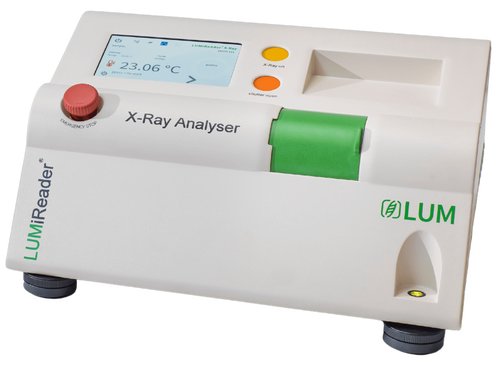
Gravity Separation & Particle Analyser Reveal what light can’t. Analyse what matters. Gain entirely new insights THE LUMIREADER® X-RAY MASTERS THESE KINDS OF ANALYSES - Particle dispersibility, sizing, dispersion stability & consolidation fingerprinting. - Particle & droplet size distribution also for higher concentrations. - Direct real-time stability testing in original concentration. - Sedimentation velocity & sedimentation velocity distribution. - Creaming velocity & creaming velocity distribution. - Determine sediment height & height of cream layers - Accelerated stability testing by higher temperature: 15 - 40 °C. - Identify concentration gradients in sediments. - Dispersions, emulsions, pastes, solutions... - From transparent to black samples - see more than UV/Vis/NIR. - Closed sample cells - easy operation. - Works in accordance with ISO/TR 13097, ISO/TR 18811, ISO 18747, ISO 13317-3. In-situ analysis of transparent & opaque particle systems No dilution of emulsions or suspensions Signal does not depend on particle shape See/understand complex dispersion behaviour Study the various instability mechanisms High resolution of phase separation of multicomponent systems Detect concentration gradients within phases and sediment Determine mean and space resolved packing sediment densities Endless monitoring of sample behaviour for long-time storage information Use any continuous phase of dispersing agent Real time, non-invasive and non destructive High-end analyser for QC, process monitoring and R & D LUMiReader® X-Ray – Illuminating even the most concentrated samples Maximum comparison precision and no material data such as viscosity or density required The LUMiReader® X-Ray is a gravity particle and dispersion analyser: to study dispersability, stability, separation, and consolidation phenomena for completely transparent to completely opaque emulsions or suspensions. For the first time, X-rays illuminate your sample instantaneously from top to bottom. Solve your most challenging inorganic material problems with complete insight. Go places light cannot. Our patented solution combines X-ray vision with the proven STEP-Technology®, permitting highest spatial resolution, short sampling intervals and powerful detection technique. The LUMiReader® X-Ray creates monochrome and parallel X-rays with the help of a special crystal, which transmits the entire sample cell of 20 mm height. The X-ray line detector records the transmitted beam, giving an unprecedented resolution. Instantaneous transmission profiles across your whole sample are converted into stability and separation rates. Particle concentration, sediment packing density can also be calculated based on the extinction profiles. The obtained Space- and Time-resolved Extinction Profiles across your whole sample are converted into concentration gradients as well as stability and separation rates. Particle size distribution, particle density, volume concentration and sediment packing density can also be calculated based on the extinction profiles 4 - 7. The LUMiReader® X-Ray allows you to characterize and optimize particle, formulation and product properties, from dispersibility via stability & separation to the quantification of separated phases and solid matrices. Regardless of the shape or concentration of your dispersed particles and droplets. In-situ, real-time, non-invasive and non-destructive. Typical applications are cosmetics, pharmaceutics, paint & pigments, construction materials and fillers, as well as mining, ceramics and petrol industry dealing with complex emulsions, slurries and sludges. There are many claims out there about the ability to analyze concentrated systems. When pressed however, it turns out that what is concentrated to one person is dilute to another. With that in mind, and wanting to avoid any confusion, all we can state unequivocally is that the LUMiReader X-Ray was designed with one goal in mind: to allow you to analyze and understand concentrated and totally opaque emulsions and suspensions. How concentrated? As high as you want to go. As opaque as you want it to be. Top to bottom, instantaneously. No other technology can do this. Not even close. The LUMiReader X-Ray is simple to operate. It comes certified, factory pre-calibrated and ready-to-go. Discover the possibilities of the state-of-the-art software SEPView. Advanced Particle Sizing with the LUMiReader® X-Ray X-ray extinction for particle sizing beyond optical limits Particle sizing of inorganic materials with the LUMiReader® X-Ray (LRX), all advantages of separating techniques apply, is based on monochrome X-ray transmission, providing a powerful alternative to optical methods that struggle with opaque or highly concentrated dispersions. By applying Lambert-Beer’s law, the instrument translates X-ray attenuation into direct information about the volume concentration of suspended particles, even in samples that are impenetrable to visible or near-infrared light. Analysis of particle size distribution follows ISO 13317-3:2001 “Determination of particle size distribution by gravitational liquid sedimentation methods; Part 3: X-ray gravitational technique”. Display the raw data and apply several fit functions. ADVANTAGES OF PARTICLE SIZING WITH LRX 1. Particle and droplet sizing over whole sample (STEP). 2. True raw data – direct physical measurement. 3. From nm to µm same principle. 4. Multimodal systems with high resolution. 5. Higher concentrations than other techniques. 6. No restrictions regarding liquid continuous phase (closed cell). 7. No refractive indices required for volume-weighted particle size distribution. International norms and guidelines THE LUMiReader® X-Ray MEETS THE FOLLOWING STANDARDS CFR 21 Part 11 ISO 18747-1 ISO/TR 13097 ISO/TR 18811 ISO 13317-3 ISO 20427 MATERIAL OVERVIEW The following materials can be analyzed with the LUMiReader® X-Ray Abrasives Agrochemistry Batteries & fuel cells Carbon black (modified) Catalysts Ceramics Clays Coated particles Construction materials Cosmetics Ferrofluids Fillers Inks Laqueurs Lubricants Magnetic particles Metals Minerals Nanosuspensions Oil sands Paints Paper Dispersions Pharmaceuticals Pigments Rigid foams Silicone oil emulsions Sludges Solid electrolytes Titanium dioxide Wastewater APPLICATION EXAMPLES Examples of X-ray measurements single and combined with centrifugal consolidation Real-time monitoring of battery paste and black mass during gravity sedimentation in original concentration. Fingerprinting of a topical formulation, e.g. with ZnO. Homogeneity before and consolidation after physically accelerated separation. Discover what the naked eye can’t quantify in transparent solutions. Quantify powder dispersibility based on different attenuation coefficients. Spatially resolved sediment concenrtration & concentration gradient Dispersed state of solid objects Quantification by standard deviation of mean natural extinction. Download & Technical Data Technical Data LUMiReader® X-Ray Measurement principle Monoenergetic X-ray attenuation / transmission Phase separation Low to high concentrated dispersions (transparent or opaque) In situ sediment analysis Packing density & structure Stability analysis - observation time 1s to ∞ Particle size distribution range 70 nm to 100 µm Consolidation measurements Typically 10 seconds, also in combination with LUMiFuge & LUMiSizer Conformity ISO 13317-3, ISO 18747, ISO/TR 13097, ISO/TR 18811, CFR 21 Part 11 Samples Suspensions, emulsions, suspo-emulsions, sludges, slurries, foams, chemical solutions, solid flat objects, powders Channels One Volume 0.2 ml to 1.5 ml Dispersion concentration 0.015 Vol% to 75 Vol% Radiation source Molydenum X-ray tube, 17.48 keV Temperature control 15 °C to 40°C, specific applications have successfully been tested at 60 °C (with thermostat) Cells Different materials, optical pathlength 1 mm – 10 mm Dimensions (WxHxD), Weight 47 x 24 x 52 cm, 25 kg Power supply Main power connection = 24 V DC, power consumption max. 9.2 A / 221 W Safety Directive 2013/59/EURATOM Full protection device according to § 21 StrlSchV Radiation control requirements none Type approval according to German X-ray ordinance (PTB 1/25 V StrlSchG) Individual advice is important to us We will be happy to advise you on our equipment, processes and technologies.
CATEGORY
