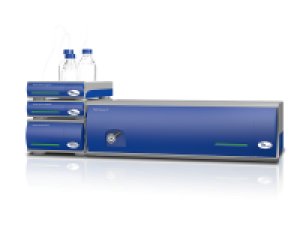
The most Advanced System for Separation of Natural and Synthetic Polymers and Gel Particles! Professional Modular System The new award winning Postnova TF2000 Thermal FFF Series was invented to become the first professional modular Thermal FFF system available. It is completely integrated by the NovaFFF single software platform which runs the entire system from autosampler to detectors. The TF2000 Series incorporates the combined solid know-how and the proven technologies from three decades of leadership in FFF. Due to its unique design the TF2000 Thermal FFF system offers more flexibility, higher robustness and better performance than traditional chromatographic systems. A separation column with stationary phase is not required anymore and consequently the TF2000 technology sets a complete new standard and offers a real alternative to column-based polymer characterization techniques. Broad Separation Range The TF2000 system has a wide separation range and is able to separate small and large molar masses with high resolution. This allows the separation of various polymers, such as starches, polystyrenes, polymethylmetacrylates, synthetic and natural rubbers as well as other elastomers. In contrast to traditional chromatographic separation techniques, such as GPC/SEC, no sample treatment is necessary as the samples can be injected without filtration. This allows the characterization of quite complex polymer samples without any potential alteration and damage. Also, Thermal FFF has no Size Exclusion limit and because of this fact even ultra-high molar mass, branched and cross-linked polymers as well as gels, aggregates and particles can be separated. Molar Mass and Composition Separation The TF2000 Series system is based on the Thermal FFF principle, using a temperature gradient as driving force for the separation. Polymers affected by this field show Thermal Diffusion which allows the separation by both the Molar Mass and Chemical Composition. This unique feature allows the separation of different polymer material having the same molar mass. The separation can be further optimized by the use of different eluents and various temperature programs. Therefore, the TF2000 can be ideally used for separation of complex polymer samples in the area of Petrochemical, Adhesives, Rubbers, Polymers and Nanomaterials. Advanced Thermal FFF Detection In order to enable the user to fully access this wide application range, the TF2000 Thermal FFF is available with various add-on modules and special FFF detectors, such as Refractive Index (RI), Multi-Angle Light Scattering (MALS) and Dynamic Light Scattering (DLS). All Postnova FFF modules and FFF detectors have been especially designed for FFF and optimized not only for the use with the TF2000 Thermal FFF but also for the other Postnova FFF versions. Additionally, the TF2000 Series has been designed for easy interfacing with existing high-end detection technologies from leading instrument suppliers, so that the user can ideally integrate the Postnova FFF technology into the existing laboratory infrastructure in order to maximize efficiency and investment. Why TF2000 Separation of Polymers, Gels and Particles The TF2000 allows the simultaneous separation, characterization and fractionation of polymers, gels and particles within one measurement. The channel is reusable and only needs to be cleaned from time to time. There is no consumable which needs to be replaced frequently. Broad Separation Range Other than in chromatography, the separation in Thermal FFF can also be performed for polymers from approx. 10 kDa up to molar masses of 10 GDa. No size exclusion effect is observed, making the TF2000 the ideal tool for the separation of large and ultra-large cross-linked polymers. Gentle Separation Conditions Because of the open channel and the absence of any stationary phase the separation can be performed under the absence of shear forces and stress to the macromolecule. Typical chromatography problems, such as filtering/adsorption effects, shear induced chain degradation and late elution effects can be avoided. Broad Range of Eluents Because of the absence of the stationary phase, nearly any kind of organic and even some aqueous liquids can be used in Thermal FFF. Only the thermal diffusion properties of the polymers under investigation need to be sufficiently strong in the given eluent. This allows to easily use also aggressive and otherwise difficult to use eluents such as DMSO for starch analysis etc. There is no need to add salt such as LiBr which is often essential in chromatography to avoid polymer interacting with stationary phases. R&D as well as QC Capability Because the TF2000 does not use any membrane and is a very robust and easy to use instrument it can be easily employed as a routine tool for QC analysis 24/7 directly integrated into the chemical manufacturing processes. The TF2000 can be remote controlled, meets and conforms with the most stringent international security regulations and offers a series of automatic security features to allow unattended use. Temperature, pressure, leak and gas sensors are constantly monitoring the system for reproducibly and stable operation even in rough production environments. Flexibility & Interfaceability The TF2000 series was developed to be used as Stand-Alone system or interfaced with existing chromatographic systems from various manufacturers. This gives the advantage that FFF and GPC/LC can be performed using the same set or detectors, providing 2D information. Applications: - Latex Coatings - Nanoparticles - High-Tech Materials - Technical/ Industrial Polymers - Starches - Paints - Polymers and Particles from approx. 10 kDa up to 10 GDa and more in organic/ aqueous solvents General Sample Size and Molar Mass Range: Polymers: 10 kDa-10 GDa Particles: 10 nm-10 µm Analysis Time: Typical 10-120 min, no software limitation Channel Dimensions: Volume: 1.15 or 2.21 mL (130 μm or 250 μm Spacer) Length: 456 mm Breadth: 20 mm Thickness: 130 or 250 µm Channel Flow Rates: Typically 0.01-2.0 mL/min (other flow rates possible) Carrier Liquids: Organic solvents, only limited applicable for aqueous solvent Detectors: UV, RI, light scattering, fluorescence detection, etc. multiple detectors in-line Thermal-Field Strength: Maximum ΔT up to 120°C Hot wall maximum: 180°C Cold wall maximum: 60°C (THF, 220 V, coolant water at 20°C, 12 L/min) Temperature Control: PC controlled for accurate, constant and programmed field options Channel Pressure: Up to 200 psi (approx. 14 bar) to pressurize the channel for any analysis at higher temperatures System Requirements: 220-230 V, 50/60 Hz; 12 A for basic set-up max. power consumption 3.5 kW (depending on cooling system, carrier liquid and used voltage) Coolant water at 20°C, 12 L/min, max. 2 bar System Software: NovaFFF TF2000 Integrated Software Platform Maintenance: Rugged reuseable channel with no special maintenance required Injection Volume: 1-1000 µL Standard 20 µL optional > 1000 µL Injected Sample Mass: Up to 500 µg and more; depending on sample characteristics; Typical injection mass 20-100 µg Injection Method: Via Rheodyne© manual injection valve or autosampler with different options Dimension (L x W x H): 820 x 490 x 235 mm Weight: 53 kg
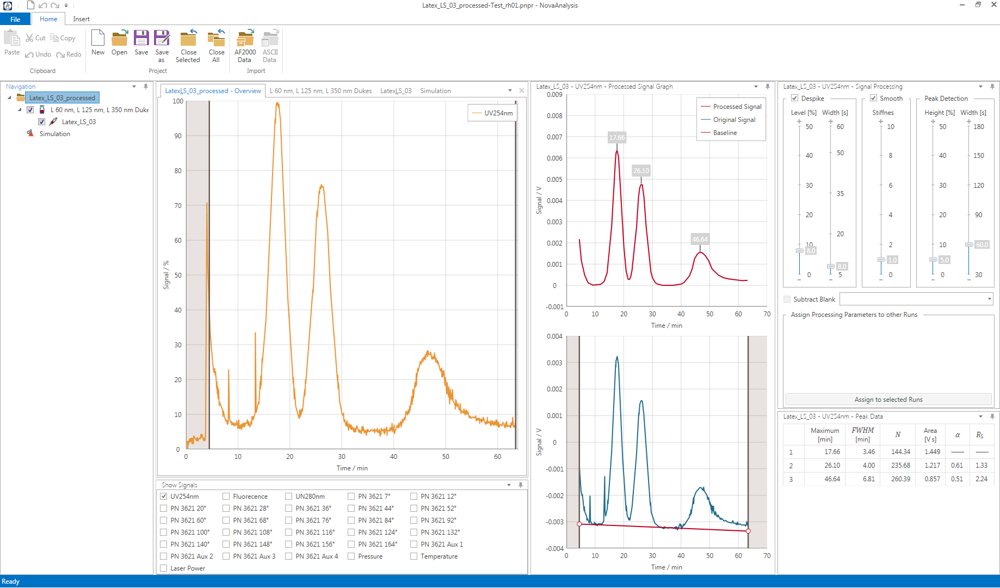
NovaAnalysis is a new and dynamic evaluation software package with integrated method simulation based on published FFF theory. The NovaAnalysis software has been developed based on the theoretical work of Prof. Giddings, who invented the technique, and the many years of continuous research and development since. With its aid, the user can significantly reduce the time required for method development in FFF by running a series of virtual experiments. All method parameters such as channel flow, cross-flow profile, channel dimensions and focusing conditions can be varied and their effect on the results simulated and checked immediately. The resulting virtual method can be loaded into the AF4 or EAF4 instrument and used to make a real analytical run with the sample. Features Simulating an FFF Run The software fully simulates separations on an advanced Postnova AF2000 (AF4), EAF2000(EAF4), CF2000 (CF3) or TF2000 (TF3) system, including the ability to enter sample information and all possible dimensional variants of FFF channels and the corresponding flows. Any method parameter can be applied to virtual runs and compared with other sets of parameters. The simulation avoids performing multiple real fractionation runs and consuming sample material, and also reduces laboratory analysis time. Optimizing FFF Methods Advanced software features allow the optimization of FFF methods by simulating fractionation runs with different parameters to find the best combination of parameters to achieve optimal measurement results. After optimizing the method by simulation, a real fractionation can be performed by exporting the optimized method and then running it on the AF2000 or EAF2000 system. EAF4 License EAF4 allows a size-resolved determination of the electrophoretic mobility and zeta potential of components in complex mixtures. There are 3 calculation models selectable: Smoluchowski, Hückel and Debye length. Calculations are based on the effective E-field strength from conductivity at each shifted peak. MALS License MALS allows the calculation of the molar mass and size based on light scattering detection. Calculation methods are Zimm, Berry, Debye, Guinier-Approximation, Mie. Geometry models are sphere, hollow sphere, random coil, rod, and thin disk. Ordering Information P-NVA-FFF-005 NovaAnalysis Software Basic License incl. FFF Theory, Simulation, Evaluation, Reporting and Optimization P-NVA-FFF-006 NovaAnalysis Software EAF4 Add-on License P-NVA-FFF-008 NovaAnalysis Software MALS Add-on License P-NVA-FFF-009 NovaAnalysis Software Viscometer Add-on License P-NVA-FFF-010 NovaAnalysis Software 21 CFR part 11 Add-on License Specifications Supported Operating Systems: Windows 10 – 64 bit Windows 11 – 64 bit () (recommended) Hardware Requirements: Intel® Core® i5 – 7500 (3.41 GHz) recommended Intel® Core® i7 – 7500 or better 16 GB RAM or more Color Display min. 1920 x 1080 USB port for the software dongle Security Certification: SHA256/SHA1 Processing • Signal alignments for multiple detectors • Automatic baseline detection • Automatic peak detection • Despiking • Smoothing • UV scattering correction Calibration • Signal alignments • Effective height • Particle size (relative) • Molar mass (relative) • Quantitative with matching peaks • Quantitative by direct injection • Universal calibration Calculation • Particle size (Rh) from FFF theory and by relative calibration • Molar mass and size distribution with cumulative and differential distributions • Molar mass by relative an universal calibration • Quantitative results by peak integration with calibrations • Compositional analysis: Protein-conjugates, Copolymers • Viral vector analysis and lipid nanoparticle analysis • Cargo-Mass evaluation with CF3 • Mark-Houwink-Plot • Branching analysis • Electrophoretic mobility, zeta potential, net charge • Patented EAF4 data evaluation for a true size-resolved electrophoretic mobility and zeta potential distribution • MALS evaluations methods: Zimm, Berry, Debye, Guinier-Approximation, Mie • MALS geometry models: sphere, hollow sphere, random coil, rod, thin disk Import • .dat files with data and methods from NovaFFF software •.txt,.csv files with data from external software as e.g. ICPMS • Import of 21 CFR part 11 files Report • Fully integrated rich text editor • One click to PDF-document or MS-Word .docs file
CATEGORY
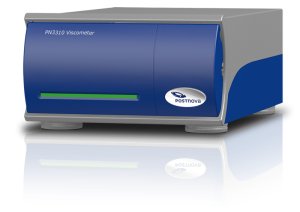
PN3310 Viscometer - Online Viscometry for FFF and GPC The Postnova PN3310 Viscometer detector is a state-of-the-art intrinsic viscosity detector for Field-Flow Fractionation (FFF) and Size Exclusion Chromatography (GPC/SEC). It is based on the proven Wheatstone-Bridge design for measuring the intrinsic viscosity of macromolecules in solution. The instrument is designed in the modern and compact Postnova FFF detector design. The Postnova PN3310 Viscometer detector shows an outstanding performance and is equipped with highly sensitive pressure transducers. The special pressure sensor protection system (PSP) automatically avoids critical overpressure on the pressure transducers. The instrument shows excellent baseline stability with extremely low drift and superior signal-to-noise ratio. Up to four analog signals from external detectors (e.g. RI, UV, Fluorescence) can be connected to the PN3310 Viscometer detector. The instrument is fully controlled by the powerful and user-friendly NovaMALS software that can integrate additional detectors such as Multi-Angle Light Scattering (MALS), Refractive Index (RI) and UV Absorbance. Together with the Postnova PN3621 MALS detector and the Postnova PN3150 RI detector a modular, flexible and compact “Triple Detection System” can be set up. With a Postnova PN3211 Dual Wavelength UV or a PN3242 Diode Array UV as a second concentration detector even a “Quadruple Detection System” can be configured. Using the Postnova PN3310 Viscometer detector in combination with a concentration detector (RI, UV) and a light scattering detector (MALS) the molecular size (hydrodynamic, gyration) and the molecular structure (shape, branching) of macromolecules can be determined. Both with and without the addition of a Light Scattering detector to the PN3310 Viscometer, the Mark-Houwink plot (molecular weight vs. intrinsic viscosity) can be derived using the NovaMALS software. The Mark-Houwink plot is the most powerful structure plot in macromolecular analysis containing a large amount of information about the size, shape, structure and molecular weight of macromolecules in solution. Environmental Conditions: 20 – 80 % relative humidity (noncondensing) at an ambient temperature range of 0 – 40 °C Maximum Flow Rate: 1 – 3 mL/min (solvent dependent - water max. 1.5 mL/min; THF max. 3 mL/min) Hold-up Volumes: 13 mL, 9 mL, 5 mL (user-selectable) Bridge Arm Volume: 30 µL Bridge Operating Temperature: Ambient +4 – 60 °C Bridge Temperature Stability: < 0.01 °C at 35 °C bridge temperature Measurement Accuracy: +/- 0.25 % of full scale Measurement Range: Bridge pressure: 240 kPa (35 psi) Differential pressure: 5.1 kPa (0.74 psi) Max. Allowed Bridge Pressure: 400 kPa (58 psi) Max. Allowed Differential Pressure: 10 kPa (1.45 psi) Max. Differential Pressure Noise (): < 0.175 Pa (2.53x10⁻⁵ psi) Max. Differential Pressure Drift (): < 1.8 Pa/h (2.61x10⁻⁴ psi) Max. Absolute Pressure Load: 500 kPa (72.5 psi) Shear Rate: 5000 Hz Wetted Materials: Stainless steel, Inconel®, FFKM, PVDF Transducer Protection: Pressure Sensor Protection (PSP) Alarms: Vapor alarm for organic solvents, optical leakage alarm Power Requirements: 100 – 240 VAC @ 50 – 60 Hz, max. 100 W Dimensions (DxWxH): 460 x 260 x 160 mm Weight: 10 kg () measured with h5O; Flow rate: 1.0 mL/min
CATEGORY
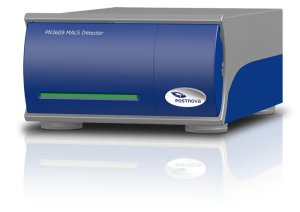
PN3609 Multi-Angle Light Scattering Detector Since the 1990s Postnova has been a leading innovator and developer of special advanced online Light Scattering solutions for coupling with chromatographic separation systems. The first model was the PD2000 - Static Light Scattering detector for coupling with Asymmetric Flow FFF. Later on the models PN3020 SLS and PN3070 MALS have been launched. Based on over two decades of practical experience, Postnova has collected a unique competence in the area of Laser Light Scattering and has developed the unique PN3609 MALS - Multi-Angle Light Scattering detector series. The model PN3609 MALS is a completely new type of high performance MALS detector system with a unique range of specifications. Economic Angular Range The Postnova PN3609 MALS detector system employs a well selected range of 9 scattering angles and therefore offers a very good economic performance ratio. It does not have the same full range of angles as the high-end model PN3621 MALS but still has all angles needed to become a reliable, rugged and precise light scattering instrument for all main applications of today's bio-, nano- and polymer laboratories. All angles in the PN3609 are carefully selected in such a way that the majority of the applications is easily possible and that the resulting molar mass and size determination yields precise and stable results. Because of its more restricted number of angles the PN3609 MALS system may not be eligible for all high-end nanotech and polymer applications, especially for molar masses above 10 9 Da and sizes above 300 nm. However, because it employs 9 full angles the PN3609 has a superior performance compared to any other mid range MALS detector system, thus allowing high quality data and angular fits providing fully scientific and meaningful results for smaller to mid size samples. For a precise and robust determination of molar mass and particles size, it is important to cover a broad range of angles which also includes sufficiently low angles. Historically, many approaches to employ mid range MALS detector systems have been strongly limited by the lack of low angles. In order to ensure a superior performance the PN3609 employs angles starting from as low as 28°. Although the most demanding nanoparticle and polymer applications would need even smaller angles than this, still the PN3609 has all „on board" which makes it a reliable and robust day-to-day work tool in modern laboratories investigating small to mid-sized sample systems on a routine basis. Clean Vertical Flow Cell MALS is typically being used to measure larger sample species, such as protein aggregates, high molar mass macromolecules and particles. Because of their size and fragile nature these samples have to be treated in a gentle way to avoid any alteration. Potentially shear forces, chain degradation, conformational changes and deterioration or complete loss of bioactivity can be induced by too complex light scattering cells. Also aggregation, adsorption and sedimentation phenomena can cause trouble inside light scattering cells especially when they have edges, dead volumes or right angle flow path changes inside. The new Postnova PN3609 avoids all these limitations and offers a vertical flow cell where the sample can pass though easily without any obstacles in its way. The flow cell has no right angle entry and outlets which could induce shear forces or cause particles to settle and adsorb. Advanced Electro Optics The PN3609 MALS employs the latest opto-electronic designs, including digital signal processing for each of the 9 angles. The electronics is based on a true 24 bit resolution AD system and offers a broad dynamic signal range. For maximum flexibility it is possible to read-in up to 4 external analogue signals. The PN3609 has the smallest footprint available in the market, saving rare lab space and allowing a flexible use at different locations and also seamlessly fits into the line of other Postnova products, such as the PN3150 Refractive Index detector. Economic Application Range Because of its unique design and advanced performance features the instrument is ideally suited for the most challenging applications from various areas in science and technology: - Biotechnology: Alginates, Carrageenans and Cell Proteins - Biopharmaceutical: Peptides, Proteins, Antibodies and Aggregates - Food and Agro Science: Pectins, Polysaccharides and Wheat Proteins - Polymer Science: Polystyrene, Polycarbonate and Polyelectrolytes - Environmental Research: Humic-Fulvic Acids and Exopolysaccharides Sample Cell Volume: 63 µL Pressure Stability: up to 5 bar Light Scattering Volume: < 7.8 nL Wetted Parts: Glass, Stainless Steel, PTFE +25 % carbon, titan Solvent Compatibility: Aqueous and organic solvents with the same flow cell Light Scattering Angles: 28° – 156° at 9 angles 0-10 Volt at 24 Bit 0.6 nV Resolution Signal Processing: DSP on every single Photo Detector, Different Filter Algorithms possible Molar Mass Range: 200 Da to 10 9 Daltons depending on sample and wavelength Radius of Gyration Range: Approx. 8 nm to 300 nm depending on sample and wavelength Laser Specifications: 532 nm (green) 2.5 – 50 mW adjustable other wavelength and filter options available on request Laser Life Time: Approx. 10.000 hours Safety Functions: Vapor Sensor Leak Sensor Cell Temperature Control: 10°C above Room Temperature up to 50°C Stability± 0.01°C at 35°C Dimensions: 46 cm x 26 cm x 16 cm Shipping Weight: 13 kg Power Requirements: 100 - 240 V, 50/60 Hz, 155 W, Universal Power Input Computer Requirements: Needs a PC/System with a free Ethernet connection or a Ethernet Hub for operation! Electronic Inputs/Outputs: Error In/Out, Injection Ready In/Out, Ethernet Interface Environmental Conditions: 20 – 80 % relative humidity (noncondensing) at an ambient temperature range of 4 – 30°C (when the laser is activated above 10°C)
CATEGORY
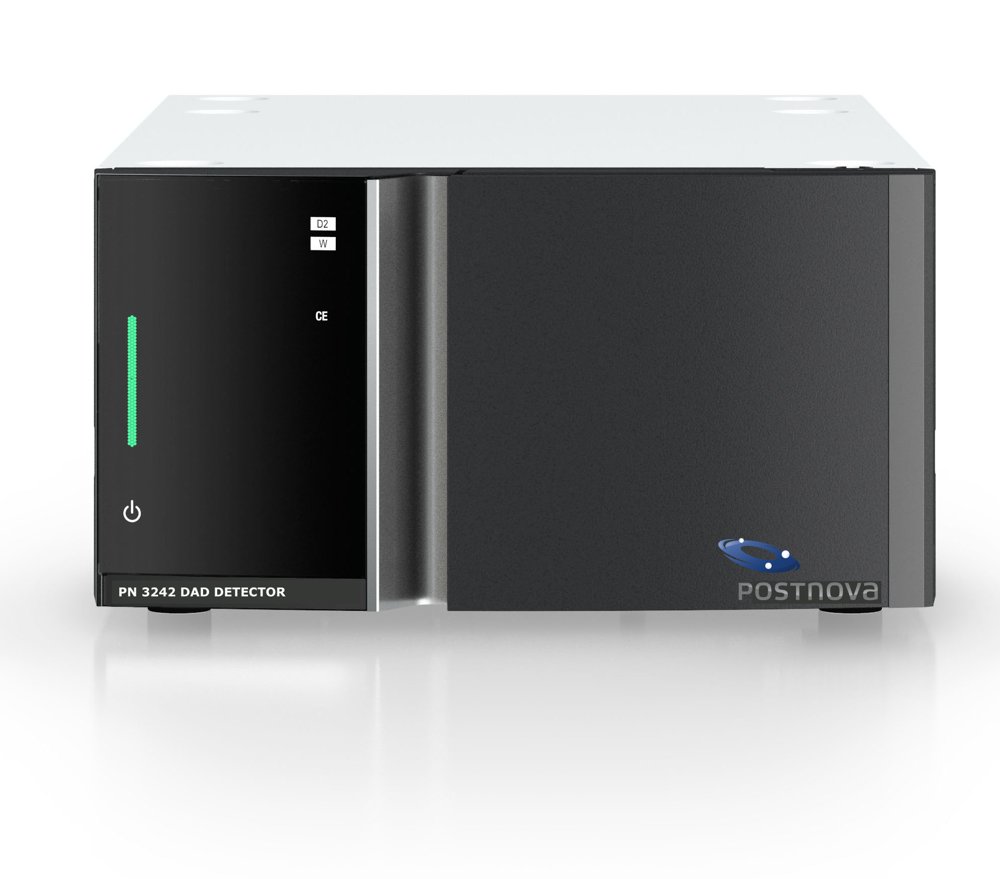
The PN3242 4-channel UV-Vis/DAD detector is designed for use with a Field-Flow Fractionation (FFF) system or any other liquid chromatography system, and was developed to satisfy demands for greater accuracy and sensitivity in analysis. Features: High Sensitivity Measurement can be Obtained Over the Entire Wavelength Range A photodiode array continuously monitors spectra over the entire wavelength range. The instrument uses a D2 and a tungsten lamp as light sources, which enables obtaining chromatograms and absorbance spectra with high sensitivity over the wide measurement. wave-length range. Wide Linearity Range can Reduce the Time for Analysis Preparation Improved optical system has accomplished both wide linearity range and superb signal-to-noise ratio performance at the same time. The wide linearity range makes it possible to measure main components and trace components simultaneously, thereby allowing for reducing the time to dilute thick samples. Use of variable slits allows for achieving higher sensitivity in accordance with the analysis objective. Improved Stability in Analysis Through Flow Cell / Polychromator / Lamp Compartment Temperature Control Mobile phases have higher absorbances in shorter wavelengths than in longer ones, which allows variation in the ambient temperature to affect the absorbance of the mobile phase in the cell and leads to change in the baseline or peak areas. The instrument stabilizes analysis by controlling the temperature of the fl ow cell, polychromator, and the lamp compartment. Decomposition of Samples Due to UV Light can be Prevented for Improving Data Reliability The UV light cut-off fi lter can prevent samples from being decomposed by UV light. This can suppress the variations in absorbance due to the decompostion of samples to improve data reliability. Easy Maintenance and Part Replacement When replacing the lamp, troublesome optical axis adjustment is unnecessary. Futhermore, the total lamp usage time is monitored, so a quick glance lets you know when to replace the lamp. The photodiode array exposure time setting can be automatically optimized for easy maintenance. Wavelength accuracy is checked automatically from the UV to visible wavelength range using the built-in holmium oxide fi lter absorbance spectrum and deuterium emission line spectrum, providing easy performace verifi cation. Cell Memory And Lamp Memory Functions A cell memory in which the type of cell is stored is embedded in the fl ow cell for automatic recording the type of the cell used for analysis in the analysis data, achieving improved trace-ability of analysis. Likewise, the memory embedded in the lamp can control the lighting time properly. The lighting time and serial number of the lamp used for analysis are automatically recorded in the analysis data, improving the traceability of analysis. Ordering information: S-DET-3242-001 PN3242 UV-Vis/DAD Detector Flow Cells - Z-DET-3242-001 Analytical, Peek - Z-DET-3242-002 Analytical, Stainless Steel - Z-DET-3242-003 Preparative, Stainless Steel Detector Lamps - Z-DL-PN3242 D2-Lamp, Pre-aligned, Longlife - Z-DL-PN3242 Vis-Lamp DAD Software - P-DL-SHI-002 LC Workstation Single PDA Light Source: Deuterium lamp, Tungsten lamp Wavelength Range: 190 – 800 nm Wavelength Accuracy: ± 1 nm Element Resolution: 0.6 nm / element Spectral Resolution: 1.4 nm (using 253.7 nm Hg emission line, 1.2 nm slit width) Noise Level: < 4.5 x 10⁻⁶ AU Drift: < 0.4 x 10⁻³ AU/h Linearity: 2.5 AU (Caffeine, 273 nm, 1.2 nm slit) Operating Temeprature: 4-35°C Optical Path Length: 10 nm (analytical flow cell) Cell Volume: 12 µL (analytical flow cell) Pressure Resistance: 12 MPa (analytical flow cell) Wetted Surface Materials: SUS316L, quartz glass, PFA, PEEK Cell Temperature Control: 19°C to 50°C (in 1°C steps) Dimensions (WxHxD)/Weight: 260 x 140 x 500 mm; 10 Kg Power Requirements: 100/120/220-240 V, 50/60Hz
CATEGORY
