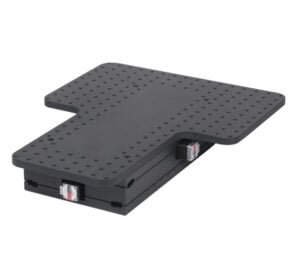
Whole Microscope Movement For Electrophysiology and Neuroscience The ZDP50 Microscope Translation Stage is designed for electrophysiology and neuroscience applications that need extreme stability. It moves the whole microscope while the sample remains stationary to image different areas of the sample without disturbing it. This allows other imaging system components, such as patch clamps, to remain stationary while imaging mutliple locations. The ZDP50 is compatible with any modern research microscope weighing up to 60 kg and is available in motorized or manual versions. Both versions provide 50 mm XY travel range. It is fully compatible with Prior’s ZDeck platforms to create a complete motorized or manual electrophysiology system with movement in the X, Y, and Z axes. - Available in manual or motorized versions - Integrated universal mounts for metric and imperial vibration tables - Seamlessly compatible with the Prior Z-Deck and V-Deck electrophysiology platforms - 50 x 50 mm of travel - 60 kg weight capacity Max Travel Range 50 x 50 mm Resolution (ZDP50T only)0.02 µm XY Repeatability±3 µm Max Load Capacity 60 kg Stepper Motor (ZDP50T only)2 phase, 1 amp per phase, micro stepping Profile 99.2 mm (approx.) Specifications as per datasheet. Please see datasheet for details. translation-stage-3.pdf
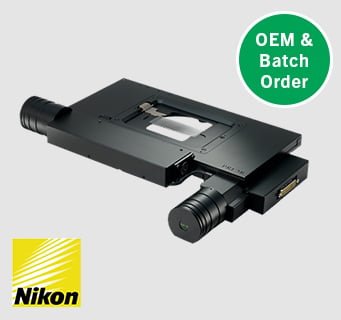
High Resolution Stage For Nikon Upright Microscopes (114 mm x 75 mm) The HEP4 is an encoded motorized XY stage adapted for Nikon upright microscopes. The most accurate and precise stage in the ProScan H101 range, it uses a 1 mm pitch ballscrew and 400 step motor drive configuration to provide four times the resolution of the H101A stage, making it ideal for applications that require reliable, short stage movements. Linear encoders ensure long-range repeatability while Prior's patented Intelligent Scanning Technology (IST) optimizes stage accuracy and linearity. The HEP4 (Nikon) accommodates a variety of specimen types including glass slides, multiwell plates, semiconductor wafers, and metallurgical samples. Alternative drive configuration options may be available depending on your region. This stage is compatible with Nikon NIS Elements software (appropriate package required). See the product compatibility tab for the full list of options available. This is an 'OEM & Batch Order' product. - Adapted for Nikon upright microscopes - 100 nm linear encoders for enhanced repeatability - High step resolution and accuracy - Wide range of sample holders - Intelligent Scanning Technology™ (US Patent 7,330,307) Travel range 114 mm x 75 mm Unidirectional repeatability < 0.4 µm Bidirectional repeatability < 1.1 µm Metric accuracy 0.09 µm/mm Full travel metric accuracy < 7.6 µm Resolution 0.1 µm Squareness < 35 arcsec Maximum velocity 15 mm/s Maximum load 10 kg Encoders 0.1 µm linear encoders Motor type 400 step Screw pitch 1 mm Weight 3.5 kg Travel range 114 mm x 75 mm Unidirectional repeatability < 0.5 µm Bidirectional repeatability < 1.2 µm Metric accuracy 0.09 µm/mm Full travel metric accuracy < 7.9 µm Resolution 0.1 µm Squareness < 35 arcsec Maximum velocity 30 mm/s Maximum load 10 kg Encoders 0.1 µm linear encoders Motor type 200 step Screw pitch 1 mm Weight 3.5 kg - H230 Aluminum plate. - H220 Glass plate (not suitable for transmitted light microscopy). - H473UP Universal specimen holder (slides, Petri dishes and small flasks) for stereo microscopes - H649 Holder for a single 1 in, 1.25 in and 1.5 in mounted metallurgical specimen - H224LP Low profile slide holder for one 76×26 mm microscope slide. H1P4A-EN-Datasheet.pdf Nikon-EN-US-Sales-Guide.pdf HEP4A-REFERENCE-PART-NONAMES(1).zip HEP4A-REFERENCE-IGES.zip
CATEGORY
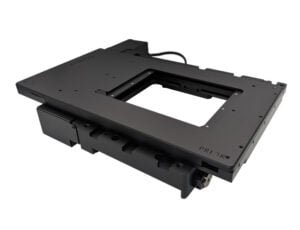
High Performance Encoded Automation for Evident/Olympus IX85 Microscopes (114 mm x 75 mm) The H117E1E4 inverted stage is designed for use with the Evident/Olympus IX85 microscopes. The flat top design facilitates compatibility with many stage top incubation systems and positioning of periphal equipment around sample for complex imaging operations. Featuring Prior's patented Intelligent Scanning Technology (IST) to optimize stage accuracy, linearity and other performance characteristics, and being directly compatible with NanoScan SP Series piezo stages, the H117E1E4 is ideal for high-end life science imaging. Whilst it is typically configured with a 1 mm pitch ballscrew and 400 step motor for maximum resolution, it is also available with a 2 mm pitch ballscrew and 200 step motor for applications requiring higher throughput of samples. - Directly compatible with Evident/Olympus IX85 microscopes and CellSens Dimension software. - Flat top design for easy sample loading. - Compatible with NanoScan SP series piezo stages, stage top incubators and other peripheral equipment. - Optimized for resolution and repeatability. - Intelligent Scanning Technology™ (U.S. Patent 7,330,307). Specifications (1 mm pitch / 400 step configuration): Travel range: 114 mm x 75 mm Unidirectional repeatability: < 0.5 µm Bidirectional repeatability: < 0.8 µm Metric accuracy: 0.10 µm/mm Full travel metric accuracy: < 8.2 µm Resolution: 0.1 µm Squareness: < 15 arcsec Maximum velocity: 15 mm/s Maximum load: 10 kg Encoders: 0.1 µm linear encoders Motor type: 400 step Screw pitch: 1 mm Weight: 5 kg Specifications (2 mm pitch / 200 step configuration): Travel range: 114 mm x 75 mm Unidirectional repeatability: < 0.5 µm Bidirectional repeatability: < 1.0 µm Metric accuracy: 0.11 µm/mm Full travel metric accuracy: < 8.9 µm Resolution: 0.1 µm Squareness: < 15 arcsec Maximum velocity: 60 mm/s Maximum load: 10 kg Encoders: 0.1 µm linear encoders Motor type: 200 step Screw pitch: 2 mm Weight: 5 kg Holders: - H223XRNC Extra recessed holder for micro titer plates (85 x 128 mm) with diagonal corner sections removed - H229XR Adjustable Petri dish holder, dish diameter up to 90 mm - H473XR Universal specimen holder, extra recessed, for slides and Petri dishes - H234XR Low profile slide holder, recessed, for four 76 x 26 mm microscope slides - H224XRLP Low profile slide holder, extra recessed, for one 76 x 26 mm microscope slide Compatibility options: H117E1E4 - Evident/Olympus - IX85 H117E2E2 - Evident/Olympus - IX85
CATEGORY
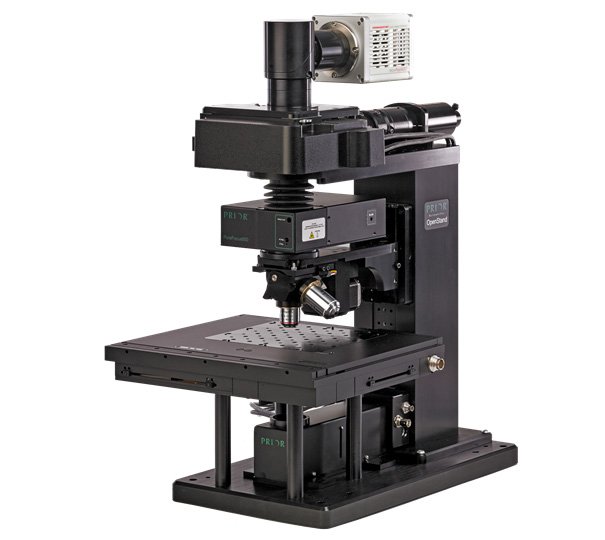
The OpenStand-M is a flexible and fully customizable system for upright optical microscopy and automated imaging. It features a compact design to allow developers to readily integrate into larger assemblies, minimize the footprint of their product, or focus purely on reflected light imaging. Episcopic Illumination The OpenStand-M is designed with episcopic illumination in mind. This facilitates widefield fluorescence or enables switching between brightfield and darkfield imaging, as is typical in industrial microscopy. The path is designed to provide as wide a field of view as possible with commercially available objectives. It can also be adapted for to take dual light source input. Diascopic Illumination The OpenStand-M can be fitted with transmitted illumination to provide an easy-to-use complement to more advanced reflected light illumination. Critical illumination has the benefit of minimizing the number of components between the light source and the sample, enabling the system to stay compact. Prior’s critical illumination options have been designed to provide excellent flatness of illumination. Where more complex transmitted illumination methods are required, the OpenStand-U is often the natural choice, but there is scope to develop customized critical illuminators to take advantage of the smaller footprint of the OpenStand-M. Motorized Stage The OpenStand-M is compatible with many of Prior’s flagship motorized upright stages, such as the H101A, ES111 and H101N2F, making it well-suited for slide scanning, industrial inspection or other automated microscopy applications. Travel ranges up to 150x150mm are supported. Objective Changer Prior is constantly developing new motorization hardware for OpenStand products. By motorizing the nosepiece, the correct optics can be moved into the lightpath, with the correct illumination settings, at the right time during an experiment without intervention from the user when supported by appropriate software. OpenStand nosepieces allow the fitting of objectives with various thread sizes. Laser Autofocus Our PF850 laser autofocus system provides real-time focus control by interfacing with the OpenStand-M focus drive or a piezo-based nanopositioning system and is suitable for both biological and industrial samples. The autofocus utilizes reflective planes either present in the sample itself or on associated glass interfaces, such as coverslips, to recapture focus. As such, it is a natural companion to the OpenStand-M. Tube Lens / Camera Mount Camera mounts enable a variety of cameras to be connected to the microscope for image capture. We offer C-mount, F-mount and T-mount options. The OpenStand-M camera mounts feature a built in tube lens which can be changed depending on the objectives being used, to optimize image quality and to correct aberrations and magnification errors. Many Prior camera mounts feature folded optics, improving the stability of the camera and reducing the vertical footprint of the imaging system.
CATEGORY
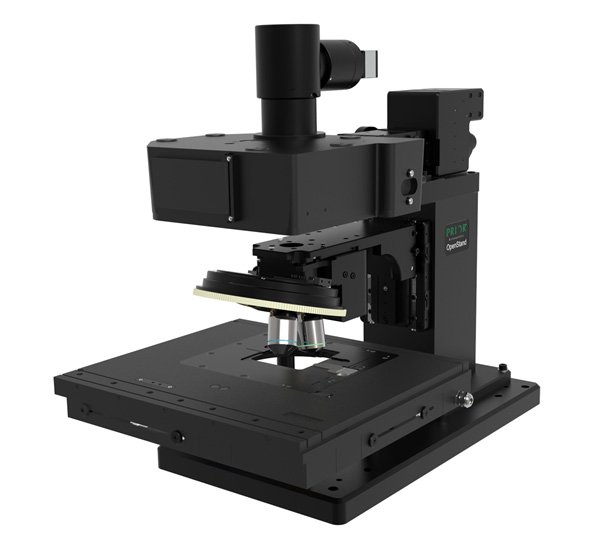
The OpenStand-L is a flexible and fully customizable system for large samples. It is underpinned by the H275LMT extended travel focus pillar, which allows the microscope optics to be moved vertically up to 145 mm relative to the sample. Typical applications include materials science and semiconductor inspection, but the OpenStand-L can also be used for life science applications, such as neuroscience or whole animal work. Episcopic Illumination OpenStand-L features an optional episcopic illumination pathway with a multi-position turret. This facilitates widefield fluorescence or enables switching between brightfield and darkfield imaging, as is typical in industrial microscopy. The path is designed to provide as wide a field of view as possible with commercially available objectives. It can also be adapted for to take dual light source input. The OpenStand-L is also readily compatible with commercially available with stereomicroscope and macroscope optics for lower magnification applications. Diascopic Illumination The OpenStand-L can also offer transmitted light illumination, which can be used to observe specimens with inherent contrast. Although most typically offered with critical illumination to complement episcopic illumination, development pathways are also open to develop more complex diascopic options. Motorized Stage Prior's largest stages are supported by the OpenStand-L, which makes it the premier option for applications such as 12-inch wafer scanning or industrial sample inspection. Prior's H112/ST and H116 stages offer high load capacity alongside long travel ranges, and the HT1111LC stage can support loads up to 100kg. This makes the OpenStand-L especially flexible when imaging very complex samples or assemblies. We offer a dedicated mount optimized for Prior stages which is readily compatible with the same imperial and metric breadboards that the OpenStand-L is typically mounted to. Objective Changer Prior is constantly developing new motorization hardware for OpenStand products. By motorizing the nosepiece, the correct optics can be moved into the lightpath, with the correct illumination settings, at the right time during an experiment without intervention from the user when supported by appropriate software. OpenStand nosepieces allow fitting of objectives with various thread sizes. Laser Autofocus Our PF850 laser autofocus system provides real-time focus control by interfacing with the OpenStand-L focus drive or a piezo-based nanopositioning system, and is suitable for both biological and industrial samples. The autofocus utilizes reflective planes either present in the sample itself or on associated glass interfaces, such as coverslips, to recapture focus. Tube Lens / Camera Mount Camera mounts enable a variety of cameras to be connected to the microscope for image capture. We offer C-mount, F-mount and T-mount options. The OpenStand-L camera mounts feature a built-in tube lens which can be changed depending on the objectives being used, to optimize image quality and to correct aberrations and magnification errors. Many Prior camera mounts feature folded optics, improving the stability of the camera and reducing the vertical footprint of the imaging system.
CATEGORY
