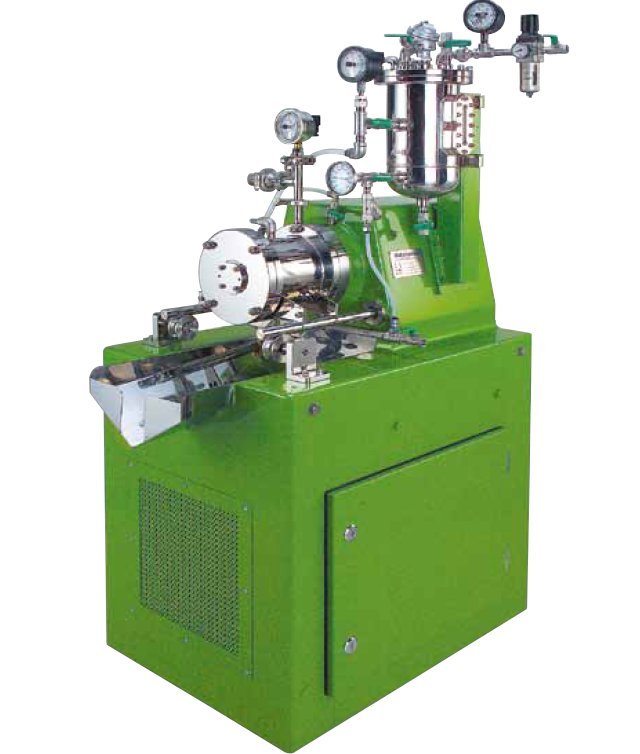
Minute Bead Compatible Model for High-Flow Circulation Operation Capable of Grinding to the Nanometer Range Using Minute Beads for Grinding and Dispersing ZRS is a high-performance model that enables nanoization even with samples of high viscosity, which could not be achieved with LMZ. With its enhanced separation ability using the centrifugal separation screen, micro beads can also be used, resulting in the production of finer particles. Model: ZRS2 – ZRS25 Grinding chamber volume: 1.5L – 25L Electric motor: 7.5kW – 45kW
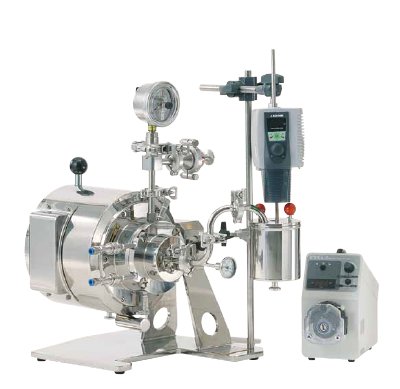
For R&D Smalles laboratory Bead Mill for Research and Development and Small Volume Samples This machine can be used as either a “dispersing type” or “grinding type” by replacing wetted parts(grinding chambers and rotors). To expand the scope of experiments, we recommend preparing both types. In addition, the machine features a common frame design that supports three different functions, allowing it to also be used as a batch type for processing small-volume samples. Product Lineup/Features Either “grinding,” “dispersing,” or “for small volume dispersion (batch type)” can be selected by replacing wetted parts(grinding chambers and rotors). MGF015 MGF015 is a laboratory-sized STARMILL LMZ high-flow circulation operation type standard model. This model is for grinding, whereas DMS65 is for dispersing. DMS65 DMS65 is a small-sized NANO GETTER for dispersing nano particles. There are records that this machine has been scaled up to manufacturing size. HFM02 HFM02 is a batch type MAX NANO GETTER mill for dispersing nano particles. This machine can be operated with minimum sample volumes of 100 mL. - Easy to handle - Scaleup to production size - Common frame for three different uses with one machine Model Sizes -from the laboratory to large-scale production Drive【kW】: 2.2kW Grinding chamber volume: 0.12L (DMS65); 0.17L (MGF015); 0.2L (HFM02) Batch volume: About 0.1L (HFM02) Batch type operation; 0.3L – 0.5L (DMS65/MGF015) Re-circulation System Bead diameter: φ0.03mm – 0.2mm (HFM02); φ0.03mm – 0.3mm (DMS65); φ0.03mm – 1.0mm (MGF015) Application - Electronic component materials / - Various paints / - Inkjet ink / - Battery materials / - Ferrites / - Ceramics / - LCD color resist / - Pigments / - Metals / - Cosmetics / - Food / - Pesticides / - Pharmaceuticals
CATEGORY
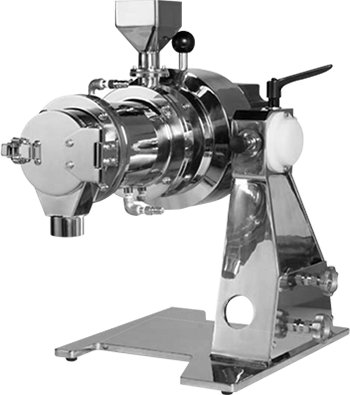
Continuous Operation Type Dry Bead Mill The Only table-sized Continuous Dry Bead Mill in the Industry The DRYSTAR SDA1 achieves submicron-size particles by dry grinding without classifiers. This machine has a 100 times better grinding ability compared to ball mills. A trial can be started from 0.5L as a minimize volume. User friendly design. Structual drawing / Feature - Achieving submicron-size particles by dry grinding - Capable of testing 0.5 L as a minimum sample volume - Particle diameter of 10 μm at maximum without using classifiers - 100 times better grinding ability compared to ball mills Process Examples Dry bead mills (DRYSTAR) vs Wet bead mills: - Bead diameter: Φ1.5 – 8mm / Φ0.03 – 2mm - Shaft seal: Easy (Oil seal・Air seal) / Precision (Mechanical seal) - Material wear: Low (1/10, Compared with wet processing) / High - Re-agglomeration: More likely / Less likely - Particle compounds: Good / Possible - Mechanochemical effect: Large / Extremely small Application Mohs hardness 7 – 9: Quartz, Silica, soft ferrites, Hard ferrites, Carrier ferrites, Alumina, Silicon nitride, Iron oxide, Tungsten oxide, Sodium silicate Mohs hardness 4 – 6: Glass, Carbon, Black silica, Blast furnace ash, Fly ash, Burned ash, Organogermanium Mohs hardness Less than 4: Gypsum, Magnesium hydroxide, Aluminum hydroxide, Barium titanate, PZT, Powdered green tea, Rice flour Model Sizes -from the laboratory to large-scale production Model: SDA1 – SDA500 Drive【kW】: 3.5kW – 200kW Grinding chamber volume: 1.0L – 500L Bead diameter: φ1.5 – 8mm
CATEGORY
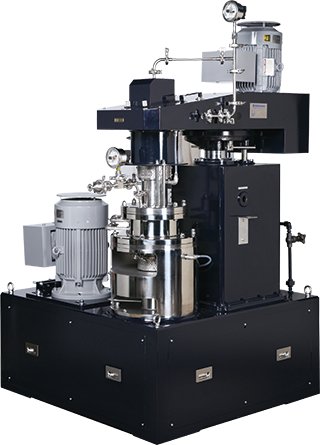
Dispersing Machine for Mass-Producing Nano Particles Mild Dispersion that minimizes particle damage The MAX NANO GETTER is a bead mill for dispersing and mass-producing nano particles. This machine has performance equivalent to the existing NANO GETTER. With bead mills incorporating mixer and stirrer structures, it has been easy to scale up to increased volumes, enabling large-scale production of nano particles (around hundreds of kilograms per hour at maximum "the industry's largest scale"). The MAX NANO GETTER can be used for various types of raw materials as the movement of beads can be easily controlled depending on the material type and change in viscosity. Features - Capable of mass-producing high-quality, high-precision nano particles - Supporting wide applications by setting mild dispersing, grinding, and optimal processing conditions - Reliable bead separation and stable use of microbeads (due to its adoption of the independently driven centrifugal separator) Ideal Beads' Movement "Spiral Laminar Flow" Application - Inkjet ink - Multi Layered Ceramic Capacitor - Photocatalysts - Automobile paint - Magnetic recording materials - Battery materials - Cosmetics - Pigments - Dyes - Semiconductor abrasive - Other applications of nano particles in general Model Sizes (-from the laboratory to large-scale production) Model: HFM02 - HFM125 Drive [kW]: 2.2kW - 55kW Grinding chamber volume: 0.2L - 50L Bead diameter: φ0.015mm - 0.5mm
CATEGORY
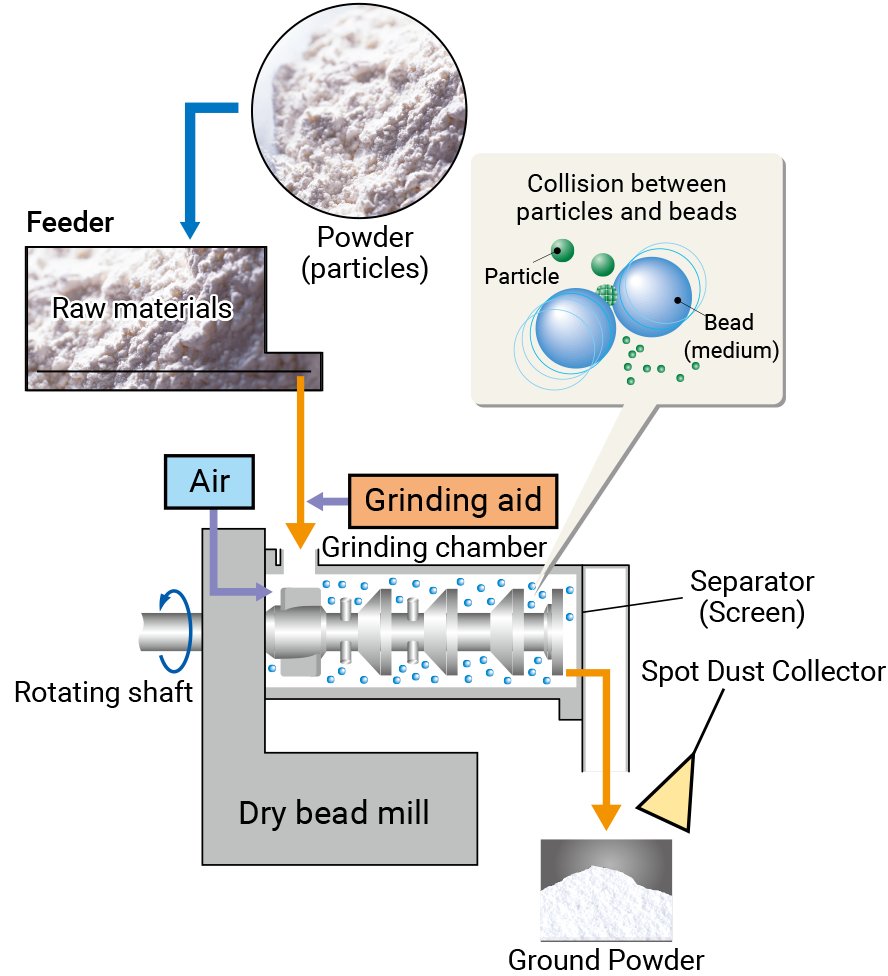
Dry bead mills employ a system to produce fine particles in air or inert gas atmosphere. With beads of relatively large diameter inside, large and coarse particles can be ground easily. There are two types of dry bead mill operations: continuous or batch operations. Ashizawa Finetech dry bead mills adopt continuous (pass) operation capable of mass-producing fine particles. Dry processing is optimal for micro-size particles. As beads with a relatively large diameter are employed in dry bead mills, large and coarse particles can be readily ground by vigorous agitation.
CATEGORY
