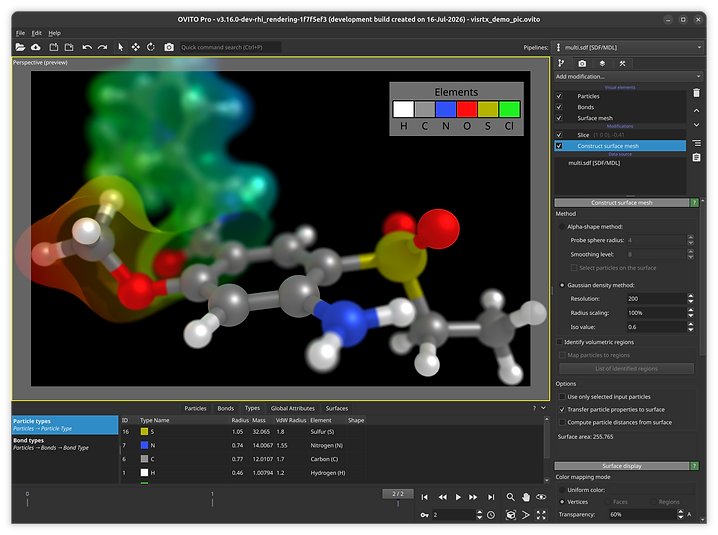
Materials Design, Inc., developer of the MedeA® software platform for materials simulation, and OVITO GmbH, creator of the widely used OVITO® Pro visualization and analysis software, today announced a new integration that gives MedeA users direct, one-step export of atomistic structures, structure lists, and trajectories into OVITO Pro. The capability is available starting with the MedeA 3.13 release, marking a significant step forward in streamlining the path from simulation to insight. For years, OVITO has been a go-to tool for researchers and engineers who need to visualize and analyze large-scale atomistic and particle-based simulation data. With this new integration, MedeA users no longer need to manually convert or reformat their data to take advantage of OVITO's capabilities. Structures, structure lists, and full trajectories can now be sent directly from the MedeA Environment into OVITO Pro, ready for immediate post-processing. "By connecting the MedeA Environment directly to OVITO Pro, we're giving our users a faster, more intuitive path to the kind of deep structural and dynamical analysis that today's materials challenges demand," said Dr. Clive Freeman, CEO of Materials Design. MedeA users generate large volumes of structural and trajectory data across a wide range of simulation methods. Getting that data into a purpose-built analysis and visualization environment has traditionally required extra steps, custom scripting, or third-party conversion tools. With direct OVITO export now built into the MedeA 3.13 release, users gain immediate access to OVITO Pro's rich toolset, including advanced structure identification, defect analysis, dislocation extraction, and high-quality rendering, all with just a few clicks. The MedeA software system integrates world-leading structural databases, electronic structure programs (VASP, Gaussian, MOPAC), molecular dynamics (LAMMPS), Monte Carlo methods (GIBBS), and continuum methods (PhaseField). With state-of-the-art tools for building, editing, and analyzing, along with adaptable high-throughput (HT) workflows, forcefields, data mining (Polymer Expert), and machine learning methods (MLPG), the MedeA software system enables you to tackle complex research and technology challenges efficiently and productively.
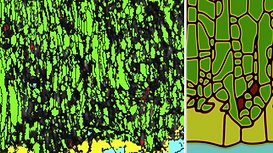
MedeA PhaseField is a versatile, multiscale simulation environment for predicting microstructure evolution in materials under realistic processing and operating conditions. By feeding the continuum phase-field models with material parameters derived from first-principles calculations, machine-learning potentials, thermodynamic databases, or experimental data, MedeA PhaseField enables physically grounded simulations across length scales from nanometers to micrometers and time scales from seconds to engineering lifetimes. This integrated approach allows users to directly connect processing conditions to microstructural outcomes, providing actionable insight for materials design, process optimization, and performance prediction across a wide range of industrially relevant applications, including corrosion, thin-film deposition, and sintering. Understanding corrosion of metallic alloys: Using MedeA PhaseField, corrosion processes that take place over engineering timescales can be modeled within a single integrated, multiscale simulation environment. The left panel of the image is a colorized experimental micrograph of a Zr alloy aqueous corrosion film formed in an autoclave. Metallic Zr is shown in blue, monoclinic and tetragonal ZrO2 in green and red, respectively, and the ω-phase of ZrO in yellow. The right panel shows a simulated corrosion film microstructure obtained with MedeA PhaseField using the same phase coloring. The material parameters for this simulation were obtained exclusively from DFT calculations and MLP-driven atomistic simulations fitted to a DFT training set, requiring no experimental data inputs. These simulations realistically describe corrosion film microstructural evolution, which is an essential starting point for accurate prediction and mitigation of material corrosion performance. Controlling thin film growth in PVD: MedeA PhaseField enables users to predict the resulting microstructures of physical vapor deposition (PVD) processes. Thin film growth, morphology evolution, and interface formation are simulated over relevant time scales (seconds to hours) and length scales (micrometers). PhaseField simulations resolve the key controlling mechanisms, such as grain nucleation, surface diffusion, and competitive growth, providing insight into film texture, surface roughness, and compositional segregation under varying deposition conditions. As PhaseField is fully integrated into the MedeA user environment, its material and kinetic input values can be derived from atomistic calculations, thermodynamic models, or literature data when experimental values are unavailable. MedeA PhaseField thus enables users to directly link deposition conditions to resulting film micro- structures. Sintering of ceramic pellets: MedeA PhaseField provides a powerful framework for understanding the relationships between sintering process parameters and resulting microstructures. The physics of pore evolution, grain morphology, and interface development during densification are all accounted for. By resolving the coupled mechanisms of surface diffusion, grain-boundary diffusion, and bulk transport, PhaseField enables realistic predictions of pore shrinkage and microstructural coarsening as a function of thermomechanical processing history. Fully integrated within the MedeA platform, PhaseField simulations can be parameterized using atomistic calculations, thermodynamic data, or experimental inputs, allowing users to quantitatively link processing conditions to resulting microstructures. This power enables users to explore and optimize sintering schedules, reduce trial-and-error in manufacturing process development, and gain mechanistic insight into densification behavior. Supported supported materials physics: - Multiple phases - Multiple diffusing species - Bulk diffusion - Grain-boundary diffusion - Correlated diffusion - Temperature - Interface mobility - Elastic deformation - Material eigenstrain - Periodic or columnar boundary conditions Initial conditions: - Spherical grains - Voronoi-derived grain structures - Layered columnar systems - Random perturbed fields Analysis tools: - Automatic analysis of bulk ratio and surface areas - 3D visual analysis of all fields - Images of 2D simulations - Export to advanced analysis software Technical specifications MedeA PhaseField MedeA PhaseField delivers predictive, physics-based simulations of microstructure evolution, fully integrated with atomistic and thermodynamic modeling workflows. Learn how it can accelerate materials and process optimization in the detailed PhaseField datasheet. Simulation engines MedeA PhaseField complements electronic-structure and atomistic simulations by enabling continuum-scale modeling of microstructure evolution, with material and kinetic parameters derived from VASP first-principles calculations or LAMMPS-based atomistic simulations with classical or machine-learning potentials. This tight integration allows users to translate quantum- and atomistic-level insights into predictive phase-field models that operate at experimentally relevant length and time scales. Building tools MedeA's builders enable the the design and constructions of complex atomistic structures, atomic microstructures, surfaces, and interfaces, assisting in the calculation of material parameters for phasefield. The state-of-the-art tool to predict the microstructure of materials
CATEGORY
OVITO GmbH develops OVITO® Pro, a powerful, versatile, and widely recognized software platform for the 3D visualization and analysis of atomistic and particle-based simulation data, scaling seamlessly from small systems to large-scale simulations with many millions of atoms. Trusted by researchers around the world, OVITO® Pro provides advanced tools for structure identification, defect analysis, trajectory processing, and scientific visualization. OVITO® Pro and OVITO® Basic have been cited in tens of thousands of scientific publications, with roughly 10 new papers appearing every day that reference the company's software tools. As part of this expanded partnership, Materials Design is now an official distributor of OVITO Pro, making it easier than ever for MedeA users to license and access the software directly through Materials Design. "We're excited to see OVITO Pro become a natural extension of the MedeA workflow," added Alexander Stukowski, CEO of OVITO GmbH. "OVITO was built to handle the scale and complexity of modern simulation data, and this partnership means MedeA users can now tap into that power without leaving their familiar workflow behind." To help users realize the full value of this new integration right away, Materials Design and OVITO GmbH are offering all current MedeA users with access to the 3.13 release a complimentary six-month trial license of OVITO Pro. This gives users the opportunity to explore OVITO Pro's full feature set, apply it to their own MedeA-generated data, and experience firsthand how the two platforms work together. OVITO Pro can be downloaded from your Materials Design account, together with installation and activation instructions.
CATEGORY
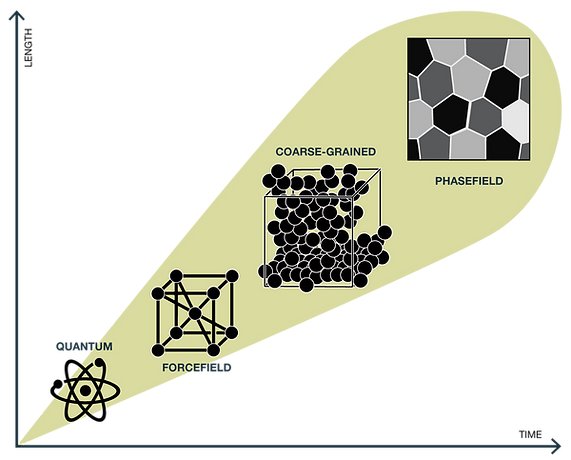
The MedeA Computational Materials Simulation Environment enables researchers to move seamlessly between: [scales] The MedeA Environment is an integrated platform for multiscale materials modeling. It combines advanced simulation methods, machine learning, automated workflows, model building, and analysis tools. Results at different scales can build on each other - for example, high-accuracy atomistic models can calculate inputs for models of the mesoscopic or macroscopic scales. This unique combination of software tools, AI and deep scientific expertise offers a unified framework for true multiscale workflows and enables efficient collaboration between computational scientists and engineering teams. With integrated support for leading technologies, the MedeA Environment helps organizations accelerate materials innovation, reduce development costs, and design better-performing products with greater confidence.
CATEGORY
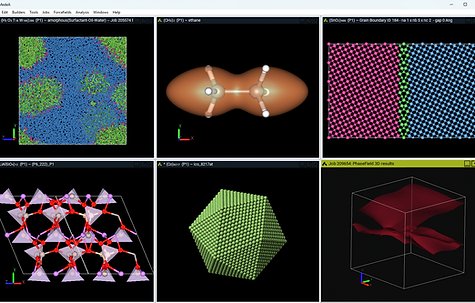
Reduce costly experimental iterations and accelerate advanced materials research with the MedeA Computational Materials Simulation Environment. Integrating the best available computational methods with user-friendly workflows, the MedeA environment streamlines discovery for researchers and engineers by automating complex calculations, from quantum chemistry, to molecular dynamics, to thermodynamic property prediction. Access validated engines like VASP, LAMMPS, GIBBS, GAUSSIAN, MOPAC and PhaseField – all in one place. Reduce R&D cycles, accelerate material screening, gain physics-based confidence in your results, and easily share workflows and results. Whether optimizing crystal structures, predicting diffusion pathways, or forecasting mechanical properties, The MedeA platform transforms simulation into actionable engineering insight.
CATEGORY
