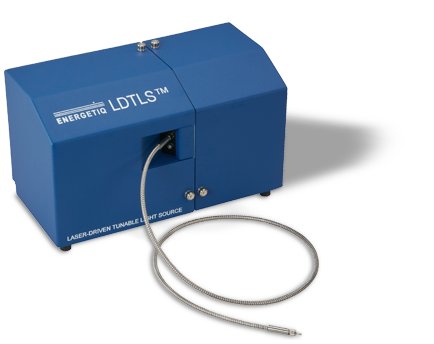
Flexible, Stable Tunable Broadband Light Source The TLS-EQ-9-S is based on the EQ-9 LDLS, offering mid-range output power in a flexible, easy-to-use package. The spectral resolution of the TLS-EQ-9-S is user-configurable, allowing users to select different bandwidths for different applications. The stable performance of the TLS-EQ-9-S translates to consistent, reliable results, while the fast step time and high brightness enable high process throughput. TLS-EQ-9-S is extremely easy to use and maintain. The intuitive graphic user interface (GUI) allows for the creation of automated scans to rapidly step between prescribed wavelength bands. The fiber-coupled output of the TLS-EQ-9-S makes it simple to integrate into a variety of optical configurations. Features - Fast wavelength tuning - Configurable/flexible spectral resolution - Low noise & high stability - User friendly computer interface - Convenient optical fiber output - Aberration free collection and focusing Applications - Semiconductor Metrology - Sensor Calibration and Testing - Scientific Development Adjustable Bandwidth A kit of removable monochromator slits is available for purchase with the TLS-EQ-9-S. The kit contains three (3) additional pairs of slits to adjust the size of both the entrance and exit slit of the monochromator. Slit Size Bandwidth (FWHM) - 1 mm*: 6 nm - 0.5 mm: 3.5 nm - 0.25 mm: 2 nm - 0.10 mm: 1.5 nm * Standard slit size shipped with system In-Band Light Flux Comparison Average in-band light flux with standard output fibers. For reference only. Product Properties - Wavelength Range: 380 nm – 1100 nm - Wavelength Accuracy: +/- 0.5 nm - Scan Speed: <20 ms for a 2 nm step - Output Type: 1500 µm fiber optic cable - Numerical Aperture: 0.39 NA - Spectral Resolution: 6.0 nm - Laser Class: Class 1 (IEC 60825: 2014) Typical Performance - Maximum In-Band Flux: 2.37 mW at 824 nm - Average In-Band Flux: ~1.20 mW Flexible Spectral Resolution & High Throughput Results

The Energetiq Tunable Light Source (TLS) pairs Energetiq's unique Laser-Driven Light Source (LDLS™) with a customized monochromator that is matched to the characteristics of the source to maximize coupling efficiency. This combination offers the high resolution required for ambient light sensor calibration, while enabling increased process throughput in the manufacturing environment. The monochromator of the TLS scans light by wavelength. The width of the entrance and exit slits of the monochromator plays a key role in the tradeoff between wavelength bandwidth and in-band light flux. Wider slits allow more light to pass, but with a broader bandwidth. Conversely, narrower slits enable a narrow bandwidth (high resolution), but also restrict the amount of light that can be delivered. The TLS is unique because of the high spectral radiance of the LDLS around which the product is built. The high radiance of the LDLS source allows more light to be efficiently coupled through a narrow monochromator slit. This means that more light flux can be delivered within a narrow bandwidth than is possible with other tunable light sources. The amount of light delivered through the Energetiq TLS monochromator slit, as compared to that of a typical xenon arc lamp-based system, is illustrated in the two inset diagrams near the center of Figure 1. The spectral radiance of the LDLS is approximately 7-times higher than that of a xenon arc lamp, enabling higher light throughput, and therefore, higher process throughput during sensor calibration. For effective calibration of ambient light sensors, the bandwidth of the light source must be narrow enough to accurately characterize the performance of the sensors. The standard configuration of the Energetiq TLS provides a bandwidth of 6.5 nm, which has been demonstrated to be effective for the calibration procedure. The area of illumination in which the sensors are calibrated is typically approximately 25 square centimeters. While the bandwidth of the monochromatic light source is a critical parameter for the accuracy of the calibration, it is the in-band light flux that drives process efficiency and throughput. With higher flux, a larger area can be illuminated, and more sensors can be calibrated simultaneously. In this way, the high in-band flux of the Energetiq TLS directly drives profitability in the manufacturing environment. Additional Benefits of Energetiq TLS The high light throughput of the Energetiq TLS is not the only benefit for ambient light sensor calibration. The table below highlights several additional benefits. Laser-Drive Light Source/TLS Features Benefits High radiance - High in-band light flux enables high process throughput High spatial stability of plasma - Consistent output for accurate measurements Long-term light flux stability - Consistent output for accurate measurements Convenient fiber-coupled output - Ease of integration Infrequent maintenance - 9,000 hours between bulb replacements (4x longer than xenon bulbs) High long-term spectral stability - Consistent output for accurate measurements
CATEGORY
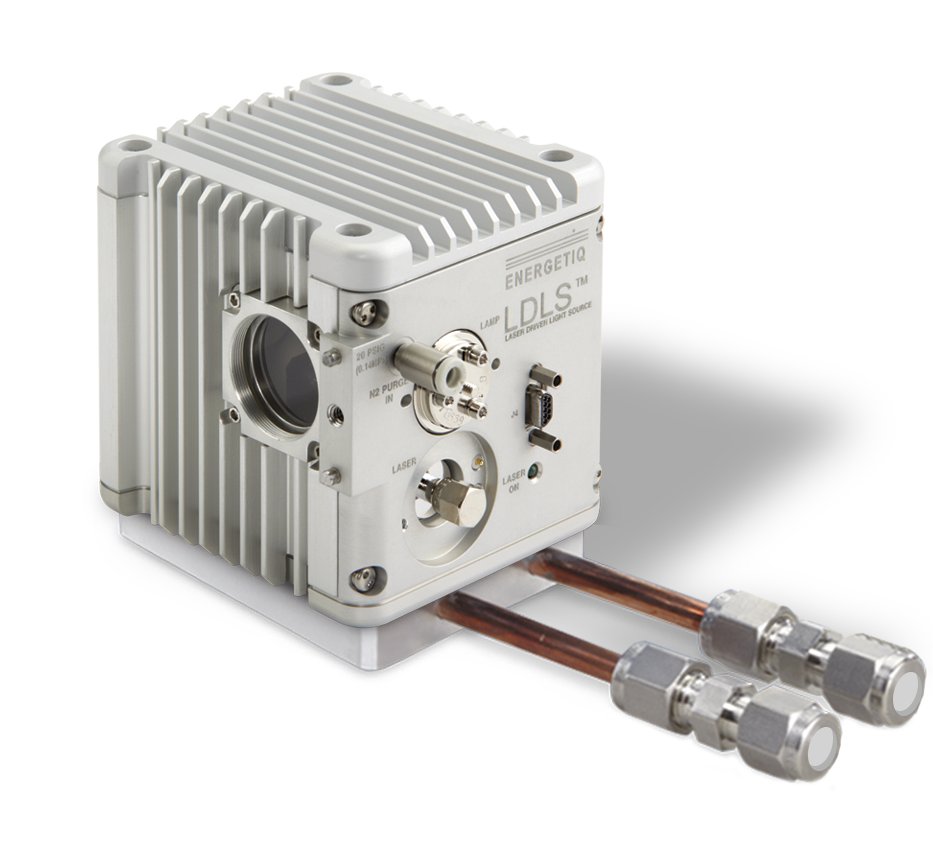
High-Brightness, Broadband Calibration Source Stable Radiometric Calibration EQ-99X-CAL reaches past spectral range limitations and covers the full UV-Visible range. Traditional calibration sources for radiometric calibration, such as Deuterium, Quartz Tungsten Halogen, and Xenon-arc, all have limitations in spectral range. None of these standard sources covers the full UV-Visible range from 200 nm-800 nm with output at comparable levels across that spectrum. Additionally, traditional sources require recalibration after 100 hours or less of use and lamp replacement typically after 500 hours. With its revolutionary Laser-Driven Light Source™ (LDLS), Energetiq offers a calibration solution that addresses these limitations and provides a single, broadband, high brightness source for radiometric calibration. The EQ-99X-CAL combines radiometric performance with long life, longer recalibration intervals, and low cost of ownership. Calibrations made in the 350 nm range are particularly challenging with Deuterium and Quartz Tungsten Halogen lamps. In the case of Deuterium lamps at 350 nm, the irradiance is approximately an order of magnitude lower than its value in the deep UV at 200 nm. Similarly, Quartz Tungsten Halogen lamps at 350 nm are more than an order of magnitude lower in irradiance compared to their value in the visible range. It can be problematic to have the two separately calibrated lamps agree at the overlapping wavelengths. With the LDLS, a single calibrated light source covers the whole range from 200 nm to 800 nm, and at 350 nm exhibits an irradiance an order of magnitude higher than traditional calibrated Deuterium and Quartz Tungsten Halogen lamps. Energetiq’s EQ-99X-CAL product is calibrated at our calibration partner, Bentham Instruments, Ltd. Bentham’s calibration standards are traceable to the Physikalisch-Technische Bundesanstalt (PTB) in Germany. A certificate of calibration, which comprises the calibration data and the uncertainty analysis, is included with each EQ-99X-CAL. Sample calibration reports are available upon request. Long intervals between calibrations Low drift compared to D2/Tungsten/Xenon sources Low cost of ownership Traceable calibration Calibrations performed by our calibration partner, traceable to NPL Temperature stabilized lamp house For highly stable measurements Applications Light Source Spectral Radiometry Spectral Sensitivity Measurements for Sensors, Detectors, Cameras Manufacturing Quality Control
CATEGORY
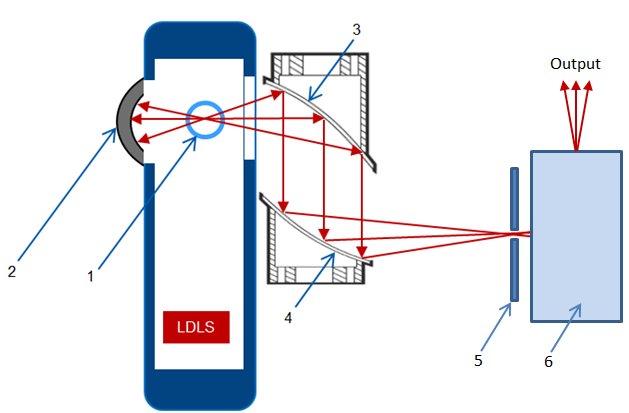
Tunable light source powered by LDLSTM with far-UVC output is proposed and evaluated. Experimental results of in-band fluxes, FWHM bandwidths between 200 nm and 400 nm, are presented. OCIS codes: (120.0120) Instrumentation, measurement, and metrology; (120.4820) Optical systems The pandemic from the recent outbreak of COVID-19 calls for rapid mobilization of every possible clinical tool, including phototherapy, which has been demonstrated to be one of the most effective ways to reduce the impact of the 1918 “Spanish influenza” pandemic [1]. Evidences show that far-UVC light (207 nm–222 nm) efficiently inactivates bacteria without harm to exposed mammalian skin, since far-UVC light cannot penetrate even the outer layers of human skin or eye due to its strong absorbance in biological materials [2]. Further evidence shows that UV and blue light can inactivate several viruses, including the common flu coronavirus [3]. These findings attract more attention and efforts to further explore the clinical value of light, which is helpful to avoid another pandemic to serve as a reminder. The unique property of wavelength tunable light sources, especially with capability of tuning range covering from far-UVC to visible, makes it suitable to function as a key role in the research and development in phototherapy activities, as researchers can manipulate desired wavelength to observe the response from the virus or bacteria under test. In this study, a TLS powered by an LDLSTM with specific design to facilitate UV output is presented. The output wavelength could cover from visible to UVC as deep as 200 nm. The light emitting Xe plasma in the LDLS is sustained by focusing a high power laser beam into the Xe plasma [4]. LDLS sources are superior than other light sources including higher spatial and temporal stability, smaller plasma size, higher brightness, longer lifetime, and lower maintenance. The FWHM for the output could be configured to desired value by adjusting the slits width in the monochromator. A schematic of the LDLS powered TLS with high UV output is shown in Fig.1. The operation principles of an LDLS could be reached in an earlier publication [5]. In design, an LDLS (model EQ-77) serves as the light source for the LDTLS. A spherical retroreflector with enhanced UV coating is aligned to image the Xe plasma back onto itself for a higher forward emitting radiance. Achromatic reflective optics including two off-axis-parabolic (OAP) mirrors (3, 4) with UV reflectance coating are optimized to etendue-match the LDLS and the monochromator (6) to maximize optical throughput. OAP-3 has 2" effective-focal-length (EFL) for light collection from the LDLS, and beam collimation as well; OAP-4 has an 8" EFL, functioning as beam focusing to the UV monochromator. The UV monochromator is a diffraction grating based wavelength selector which functions dissolving and selecting single wavelength to the output. The width adjustable slit is designed for wavelength bandwidth control for the output signal to facilitate different requirements. The output from the UV monochromator is coupled into a 600 µm core diameter UV fiber for easier beam deployment in applications. 1- High-pressure Xe bulb 2- Retroreflector 3- OAP mirror 4- OAP mirror 5- Width adjustable slit 6- UV monochromator Fig.1: Schematic diagram for LDLS based UV tunable light sources Figure 2 shows the output performance of the TLS, where (a) is the in-band fluxes from 200 nm to 400 nm, (b) shows spectral density for the TLS. As seen in Figure 2 (a), the in-band flux range is between 329 µW (at 200 nm) and 1574 µW (at 300 nm), with a flux average of 1171.7 µW. The spectral density shown in Fig. 2 (b) ranges from 284.5 µW/(nmmm2) to 1124.6µW/(nmmm2). The min spectral density locates at 210 nm and the max locates at 300 nm. The spectral density average is 819.2 µW/(nmmm2, which is much higher than current broad-band UV light sources on market. Fig.2 In-band flux and spectral density for the UV LDTLS, (a) in-band fluxes from 200nm to 400nm; (b) spectral density for the TLS Figure 3 presents spectral performance for the TLS, with (a) showing the FWHM bandwidth from 200 nm to 400 nm, and (b) showing spectral output at 260 nm, and (c) showing spectral output when the wavelength set to 400 nm. The FWHM bandwidth ranges from 3.4nm to 6.2nm with an increasing trend versus wavelength. The mean value of the FWHM is 5.1nm. The spectral output at different wavelength is consistent with slight FWHM variation, as shown in Fig.3 (b) and (c). Fig.3 Spectral performance for the UV LDTLS, (a) FWHM bandwidth over 200 nm to 400 nm range; (b) spectral output at 260 nm; (c) spectral output at 400 nm A tunable light source with far-UVC output powered by a LDLS was presented and experimentally demonstrated. The in-band flux coupled by a 600µm core diameter UV fiber ranges from 329 µW and 1574 µW, the spectral density ranges from 284.5 µW/(nmmm2) to 1124.6 µW/(nmmm2), and the FWHM from 3.4 nm to 6.2 nm. Giving its superior properties of broad band coverage from 200 nm to visible range, high brightness, high-reliability light source and long life, the proposed TLS can be a good fit for certain applications, especially in phototherapy. References 1. Richard A. Hobday, and John W. Cason, “The Open-Air Treatment of PANDEMIC INFLUENZA,” American Journal of Public Health, Supplement 2, Vol 99, No. S2, 2009. 2. David Welch, Manuela Buonanno, et al. “Far-UVC light: A new tool to control the spread of airborne-mediated microbial diseases,” Scientific Reports, 8: 2752 (2018) 3. Chukuka Samuel Enwemeka, Violet Vakunseh Bumah, et al. “Light as a potential treatment for pandemic coronavirus infections: A perspective”, J Photochem Photobiol B, 207: 111891, published online May 1, 2020 4. Donald K. Smith “Laser-driven light source,” US patent, Pub. No.: US7435982B2 (2006). 5. Donald K. Smith, “High brightness laser-driven light source,” US patent, Pub. No.: US9048000B2 (2015).
CATEGORY
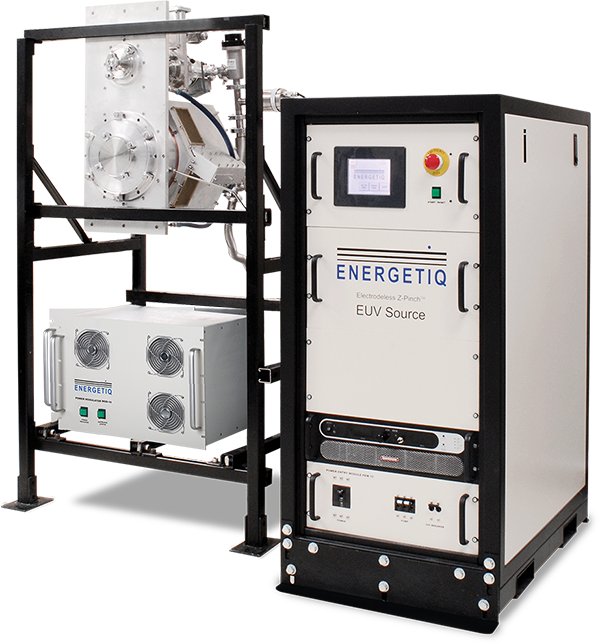
Electrodeless Z-Pinch™ 10 Watt EUV Source Enables EUV Lithography The EQ-10R is a perfect choice for EUV research and development projects. For researchers in EUV lithography, existing sources of light are often too low in power, unreliable in operation, large, costly, and complex. The EQ-10R is a compact, easy-to-use, reliable, and cost-effective EUV light source, based on Energetiq's proven Electrodeless Z-Pinch™ technology using Xenon gas. With over 50 EQ-10R units installed around the world, it has become the workhorse for the EUV community through its proven reliability, ease of use, and low operating cost. Its modular design makes it easy to integrate into your process. The system includes the Electrodeless Z-Pinch™ source assembly, vacuum and gas subsystems, power delivery subsystem, and control electronics. The EQ-10R is capable of delivering up to 10 Watts of in-band EUV into 2 pi steradians, and will run continuously at pulse repetition rates of up to 2 kHz. Features Unique patent-pending Electrodeless Z-Pinch™ technology Low debris / low consumable cost 10 W into 2 pi using Xenon Sufficient power for a wide variety of applications Up to 2 kHz repetition rate Continuous mode, 24/7 Small plasma size Below 1 mm diameter Cost-effective and compact Low cost per EUV Watt Small footprint CE-Mark and SEMI S2-0715 compliant Applications EUV Metrology EUV Resist Development Defect Inspection EUV Microscopy Electrodeless Z-Pinch Technology Clean Operation, Small Plasma Size, and Maximum Flexibility - Clean operation with no electrode debris and magnetically confined plasma - Unmatched spatial stability - Lower cost and complexity - Flexible, adjustable operating conditions - Optimized for peak power or peak brightness - Small plasma size (typically below 1 mm in diameter) - Simple, flexible, customizable optical interface with color touch screen display - Manual and automatic operation Patent Numbers: US 7,307,375 -- US 7,948,185 -- DE 1774838 -- DE 2187711 -- GB 1774838 -- GB 2187711 -- JP 5179175 -- KR 10-1173324 NL 1774838 -- NL 2187711 -- US 8,143,790 -- US 7,199,384 -- US 7,183,717 -- US 7,569,791 -- US 8,019,043 Does the EQ-10R meet your performance demands? We'll work with your team to develop the high brightness, high throughput system that meets your requirements.
CATEGORY
