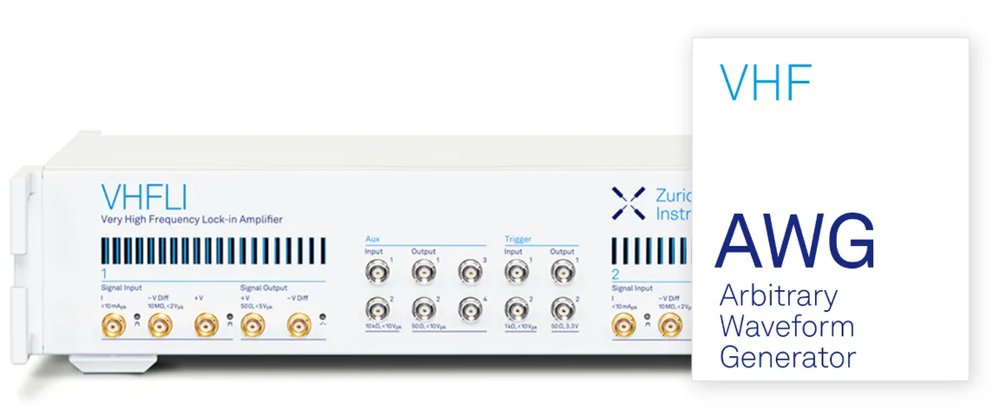
Dual-channel AWG with digital modulation capability Optimal phase coherence and minimal jitter between generated and measured signals Multiple detection options: lock-in amplifier, pulse counter, scope/digitizer
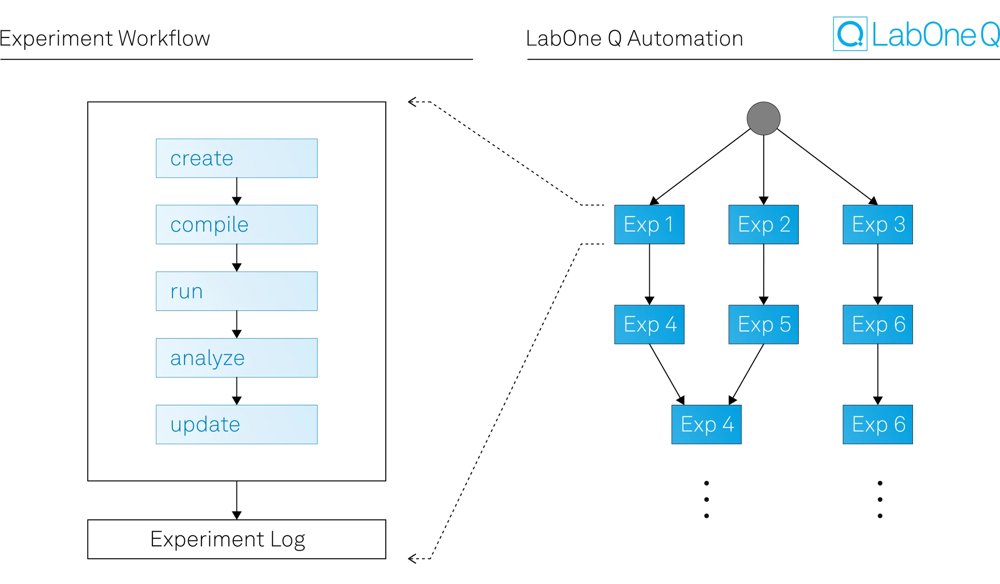
LabOne Q is the software framework for quantum computing that accelerates the progress in your laboratory. - Spend time where it matters. Your experiments. - Program large setups in Python as a single machine. - Transform complex quantum circuits into simple code. - Track every detail down to the last sample. - Optimize your setup for a high duty cycle. - Scale up with drop-in code replacement. - Increase your throughput with a streamlined interface. Designed for Your Experiments on the Most Advanced Control Electronics With LabOne Q you can express experiments in a language that connects the digital world of quantum gates with the analog world of signals. The Python based, high-level interface provides intuitive tools for specifying multi-channel signals with precise timing control. LabOne Q makes it easy to reuse code. Sections allow you to group pulse patterns across signal lines. They support looping, sweeping, and averaging structures to express all levels of timing consistently, from sample-precise pulse-level control up to the arrangement of multi-experiment protocols. LabOne Q streamlines and automates time-consuming tasks such as optimizing instrument settings, generating and uploading waveforms, and synchronizing pulses between multiple instruments. Even with this control and measurement automation, users still have complete low-level access to the instruments. Setup details and instrument settings are accessible through a single line of code. LabOne Q also provides browser-based tools for visualization of the experimental sequence and pulses before execution, giving a simplified overview of complex experiments, even with hundreds of pulses. Supporting High Duty Cycles LabOne Q enables users to get the most out of their setups by helping them extend the time the experiment is providing results. With an optimal duty cycle a quantum computer spends the highest possible computing time on the quantum processing unit. LabOne Q supports the user to maximize computational duty cycles by minimizing communication overhead, optimizing control instructions, pipelining and queuing experiments with a separation in offline and online functionality, and with the interfaces for automation. Additionally, experiments have a clear distinction between real-time execution, when the instruments execute instructions and gather data autonomously, and near-time instructions, when communication with an outside process is necessary. For example, when tuning up a quantum gate with optimal control, real-time calibration sequences are interleaved with optimization steps, where intermediate measurement results are used to optimally calibrate the required gate pulse. Scale Up Your QPU without Scaling Up Your Effort LabOne Q includes a powerful DAG-based automation framework that streamlines QPU calibration and eliminates manual tune-up bottlenecks by turning mundane repetitive tasks into automated, reusable workflows. Your tune-up time will be reduced by orders of magnitude, freeing you up to focus on discovery rather than configuration. Built to scale with growing QPUs, LabOne Q Automation transforms parameter handling into a one-time investment, which ensures predictable performance as system complexity increases. Its flexible architecture adapts easily to evolving research goals and enables fast iteration and long-term innovation. Scale your qubit control with confidence and accelerate your path from setup to results. Ready for Your Application Workflow The LabOne Q Applications Library enables you to quickly ramp up your qubit experiments and focus on the physics and results that interest you. With this framework, you get the tools to describe your measurements in terms of quantum devices and their operations. The Applications Library covers all parts of a tune-up workflow: experiment definition, measurement, analysis and plotting, and physics parameter updates. The framework can be extended and adapted to include your automated tune-up workflows, as well as supporting manual or mixed workflows. Common types of superconducting qubits and gate operations are readily available and easily customizable to minimize your development time. By ensuring the most efficient usage of the Quantum Computing Control System and promoting best practices in a straightforward way, the Application Libraries ensure optimal uptime and a sustainable performance.
CATEGORY
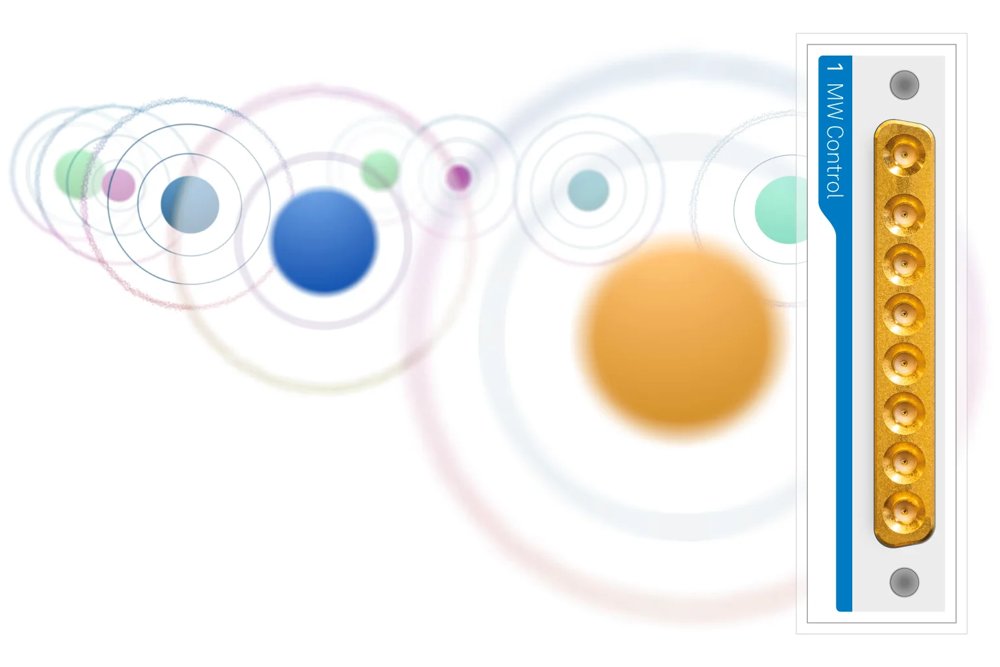
Your tool to master the long-lived logical qubit challenge The ZQCS Quantum Control System is Zurich Instruments' solution to operate 1000-qubit-scale quantum computers. It is built to tackle the pivotal challenges on the path towards fault-tolerant quantum computing: operate at scale, master quantum error correction, and push quantum fidelities to the next level. Highlights - Modular system with flexible combination of qubit control and readout channels - Powerful real-time processing architecture optimized for quantum error correction - Up to 1092 channels per 19'' rack - Market-leading signal-to-noise ratio with first Nyquist zone direct RF signal generation - Scales seamlessly from single shelf/chassis to multi-shelf - Comprehensive control software interface at pulse, gate, and workflow level Truly scalable Scalable quantum control begins with an architecture trusted to operate flawlessly at unprecedented system sizes, and continues with serviceability, low operating cost, and seamless infrastructure compatibility. The ZQCS delivers this by embedding specialized quantum control technology in a framework proven in telecom and big-physics experiments. Its synchronization scheme is optimized for large-scale quantum program execution, maintaining a wall clock to always play the right pulse at the right time. A high-density design allows for over 1000 channels per 19 inch rack, and the system is tested for operation in water-cooled enclosure to optimally manage heat dissipation, thermal fluctuations, and workplace health & safety. QEC research without boundaries Developing decoders to stabilize the quantum processing unit requires a tight integration of quantum and classical computing resources. For fastest progress, quantum R&D needs full flexibility in how these resources are combined. The ZQCS provides real-time compute power with the freedom to use it without bounds. Each shelf hosts a programmable FPGA with direct access to up to 364 channels. Multiple shelves are freely connected in a full-mesh network. A RDMA over Converged Ethernet (RoCE) interface serves as a high-bandwidth, low-latency link to classical computing CPU/GPU resources. Enabling best quantum fidelities The roadmap to fault-tolerant quantum computing depends on boosting quantum fidelities reliably on large chips. With an analog design led by a deep insight into control error and decoherence mechanisms, the ZQCS enables your push for quantum fidelities beyond 5 nines without limits imposed by the control. The ZQCS achieves this with an analog front end based on direct-RF technology in the first Nyquist zone. It offers the optimal balance of signal properties most relevant to qubit control: the highest SNR on the market, low spurs, stable amplitude and phase, low latency. Scalable software stack The upper layers of the quantum stack bears far too many uncertainties that can slow down or even block quantum computing scale-up: performance ceilings, fragile tune-up workflows, and unreliable interfaces. Zurich Instruments' scalable software architecture keeps these risks in check. LabOne Q lets users design complex experiments at the right abstraction: pulse, gate, or workflow. An optimized compiler and runtime map them to hardware with minimal overhead. Proven automation support keeps performance consistent from single chips to large systems. Channel specifications The ZQCS provides 3 channel types for control and readout of a broad range of superconducting qubit types. All are provided on high-density multicoax SMP connectors. Microwave (MW) control channel - Direct RF, 24 GSa/s, 16 bit - 0.1 to 10.5 GHz frequency range - 1.6 GHz instantaneous bandwidth - High signal-to-noise ratio of −160 dBFS/Hz - 7 outputs per multicoax SMP Microwave (MW) readout channel - Low-latency ADC input, 12 bit - 3 to 11.5 GHz input frequency range - 1.4 GHz instantaneous bandwidth - Output: Direct RF, 24 GSa/s, 16 bit, 0.1 to 10.5 GHz - 2 inputs and 2 outputs per multicoax SMP Low-frequency (LF) control channel - 2 GSa/s, 16 bit - Output range ±2 V into 50 Ω - DC to 300 MHz (−3 dB bandwidth) - Low voltage noise of 12 nV/√Hz ( 100 kHz) - 7 outputs per multicoax SMP Modules The ZQCS is composed of one or multiple SHL14 System Shelves with 14 module slots each. Up to 13 of these slots are available for analog I/O modules. Those come in 3 variants with different counts of MW control, MW readout, and LF control channels: - MWM2102 Microwave Module: 21× MW control, 2× MW readout I/O - MWM1404 Microwave Module: 14× MW control, 4× MW readout I/O - LFM2800 Low-Frequency Module: 28× LF control By free combination of those modules, you can realize your desired channel counts with fine granularity. In addition, each SHL14 System Shelf holds one TDM14 Timing and Decoding Module. The TDM14 provides synchronization and data communication for all analog I/O modules within a shelf, as well as inter-shelf communication in a flexible network topology. Through its programmable FPGA, it serves as a decoder resource in quantum error correction applications.
CATEGORY
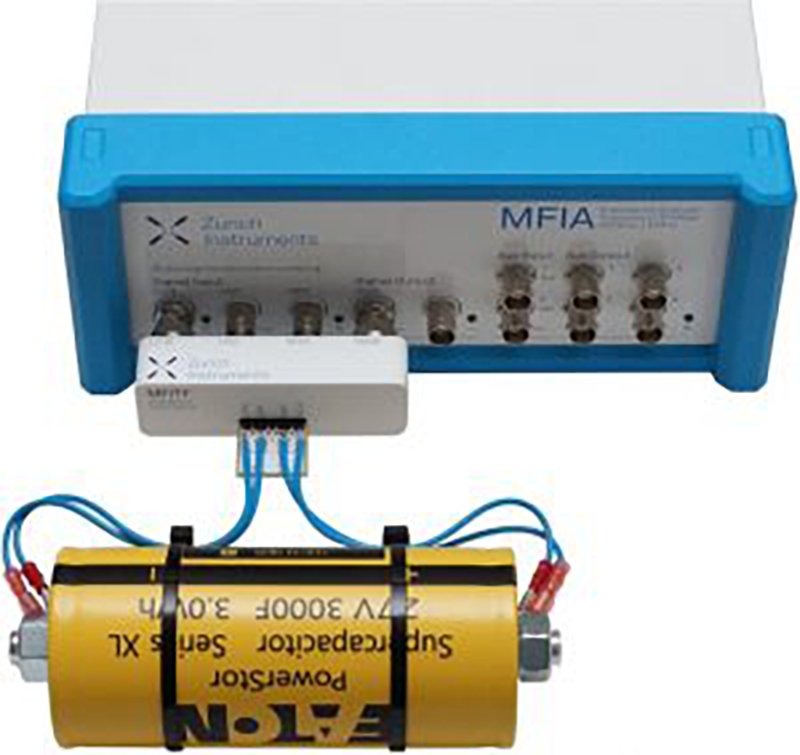
Supercapacitors, also known as ultracapacitors or electrochemical capacitors, are promising energy storage devices that bridge the gap between electrolytic capacitors and batteries. Thanks to their high power and long lifespan, supercapacitors are widely used in applications ranging from SRAM to high-speed trains. The key to such high performance is often a low equivalent series resistance (ESR), which reduces the energy wasted via Ohmic heating during charging and discharging cycles. Characterization of the supercapacitor impedance at different frequencies is thus important to determine the ESR and other critical device parameters. At low frequencies, such characterization sets a unique measurement challenge that requires an instrument capable of measuring current and voltage directly and of measuring impedance with high accuracy. With the Zurich Instruments MFIA Impedance Analyzer, it is possible to avoid the above drawbacks by measuring supercapacitors over a wide frequency range, from 1 mHz to 5 MHz, with a small AC test signal. In the four-terminal configuration shown in Figure 1, voltage and current on the device are monitored simultaneously and can be displayed together with calculated impedance parameters in the Sweeper module of the LabOne instrument control software. Switching visualization between Bode and Nyquist plots (see Figure 2) helps to determine other useful parameters in addition to the device's capacitance: these include the ESR, the charge transfer resistance and the Warburg elements with their corresponding frequencies. The ESR is an indicator of the 'health status' of the device as a whole. The charge transfer resistance and the Warburg elements relate to the interface between the electrode and the electrolyte, and are especially relevant to electrochemists who study the device's materials on the microscale. Thanks to the time-domain LabOne Plotter module (see Figure 3) and the configurable LabOne APIs, these parameters can be swiftly streamed to the computer and monitored over the device's lifespan. - Minimize the measurement time by probing two frequencies simultaneously, or by recording all relevant impedance parameters in a single sweep. - Automate your measurements easily and record test parameters as a function of frequency, test signal amplitude and bias offset with the LabOne software and its APIs.
CATEGORY
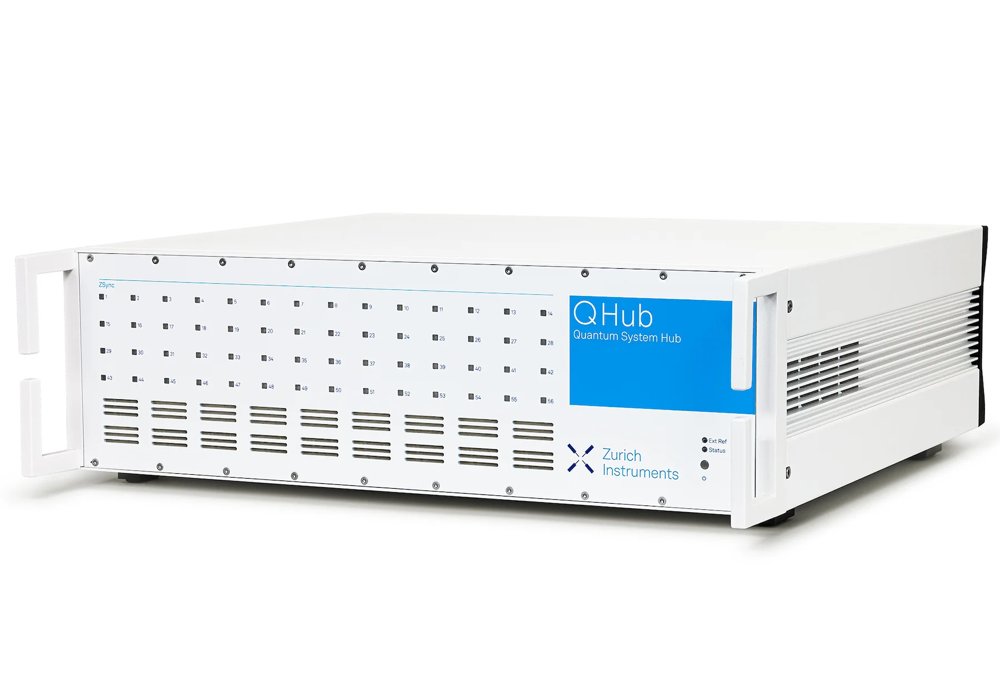
The Zurich Instruments QHub enables scalable quantum processor control through automated synchronization and low-latency communication between all components of a Quantum Computing Control System (QCCS). It provides high-level software access to powerful real-time capabilities designed for the most pervasive use cases in quantum computing. With 56 ZSync ports, the QHub supports systems with up to 448 microwave channels for precisely timed and stable gate and readout operations. Central data processing enables feedback methods that require global information of the system state, e.g. for quantum error correction, with a latency down to 550 ns including all signal processing. Decoding algorithms can be efficiently implemented on a powerful FPGA core using a ready processing infrastructure accessible in Python. Optional direct programming of the FPGA provides the flexibility required in developing novel decoder algorithms. Key Features - Scale your quantum system up to 448 microwave channels - Plug-and-play operation through automated instrument synchronization - Perform low-latency feedback between any instrument in <550 ns - Perform demanding quantum error correction algorithms through large processing power - Intuitive system control through LabOne Q Benefits Proven system scalability Up to 56 instruments can be synchronized through a QHub, leading to coordinated readout and control of up to 300 fixed frequency qubits using only SHFQCs, or up to 200 tunable-frequency qubits. New instruments can be added by plugging one cable without rework of the existing system. Simplified feedback programming The QCCS comes with the LabOne Q software interface that lets users control feedback operations on the system level. LabOne Q translates a user’s high-level sequence into real-time instructions for all components of the QCCS so they can operate in sync, with QHub at the center. A Python API gives users the full flexibility to integrate QHub into their own software. High-fidelity feedback operations Due to the star topology of the QCCS architecture, QHub is able to evaluate the global state of all the qubits that it controls. This enables feedback methods that require global knowledge of the system state, such as Quantum Error Correction. The low-latency global feedback is complemented with local feedback operations inside the SHFQC Qubit Controller with further reduced latency.The powerful FPGA core of QHub enables the user to create advanced closed-loop feedback algorithms, while achieving a low and deterministic latency. Reliable synchronization The ZSync interface distributes all clocks and timing signals needed to synchronize the system. Automated calibration procedures make the synchronization stable across reboots and changing environmental conditions. You can count on weeks of operation without the need for delay calibration.
CATEGORY
