By Nuvu Cameras
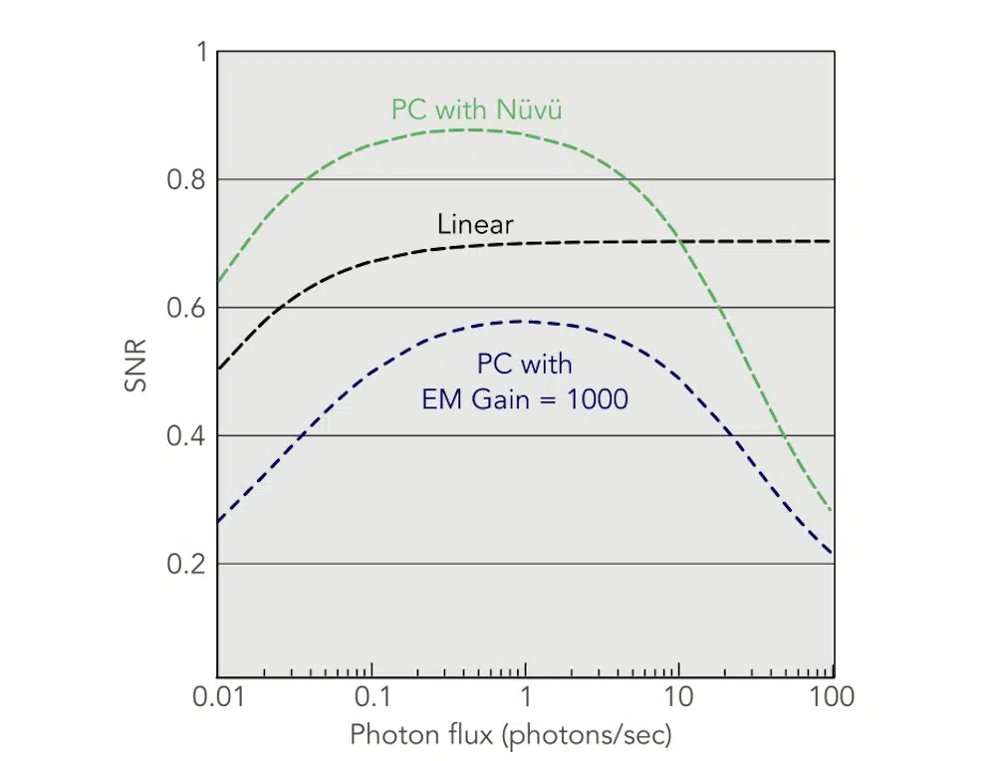
Photon counting imaging basics Photon Counting is an acquisition mode suited for extreme faint-flux imaging. Taking full advantage of the EMCCD's unique sensitivity, photon counting allows to image signals down to a scarce few photons per hour with a single-photon resolution power and a wide field of view. When signals are under 1 photon/pixel/frame, photon counting is the best option available and has the potential to significantly improve acquisitions, all with remarkable ease of use. Photon counting imaging benefits Increased sensitivity Chief among the reasons to use photon counting (PC) is its increased sensitivity compared to typical linear EMCCD acquisitions (linear mode - LM). All imaging technologies using gain (e.g. avalanche diodes, EMCCD detectors) suffer from what is called the excess noise factor (ENF). Gain is a stochastic process and electrons have a certain probability to be multiplied at each stage of the multiplication register so even for a set gain, there is a pixel by pixel uncertainty on the exact number of electrons at the output of multiplication. The ENF is a representation of this phenomenon and has the same effect on the signal-to-noise ratio (SNR) as dividing your camera's quantum efficiency in half. More details on this subject are available in EMCCD noise sources. Using photon counting eliminates the effect of ENF; the same impact as multiplying your signal two-fold. This increased sensitivity makes a crucial difference when imaging low signal levels. It can be observed that the benefits of photon counting do not extend beyond a signal of 1 photon/pixel/frame. That is because photon counting produces binary images, with each pixel either being a 0, where no photon was detected, and 1, where a photon was detected. As such, if a pixel receives more than 1 photon, this information is not registered by the image which results in a coincidence loss. Added flexibility While a single photon counting image is binary, multiple images can be stacked to produce an easy-to-interpret final image with a dynamic range. By balancing the sampling rate and the number of images stacked, an acquisition can be tailored to specific needs. This is where Nüvü Camēras' EMCCDs performance levels are crucial because each image stacked adds its own noise, making low clock-induced charges (CIC) a priority. Another advantage of photon counting is the possibility of over-sampling. In all acquisitions with long exposure times, the risk of a high energy particle (also known as cosmic ray) hitting the detector increases. This particle deposits a high amount of energy on the detector, generating a considerable number of electrons and compromising the accuracy of an image sometimes acquired over several minutes. With photon counting, the use of several shorter exposures over this longer period allows the easy removal of frames affected by a high energy particle. Tresholding Technique To achieve unique low-light imaging performances, photon counting relies on a technique called thresholding. A straightforward way to illustrate thresholding is to take a look at histograms of EMCCD images. Histograms are a way of representing images that identify the number of pixels (counts) with a certain value in ADUs (the units of intensity in an EMCCD image). When looking at dark frames, images without signal, the histogram reveals a wealth of information regarding the noise sources of the camera. Impact of noise sources On CCD dark frames the histogram will have the look of a Gaussian distribution. When no EM Gain is used, EMCCDs obtain a similar result; the readout noise dominates. Readout noise occurs when the photo-electrons on the sensor are converted to an analog signal that can be interpreted by the camera's electronics. As readout noise is sensor-dependent, it will not change between manufacturers and cannot be lowered unless lower readout speeds are used. With low signal in regular CCDs, only a few photoelectrons are generated and so the signal will be of low intensity on the histogram. If this signal intensity is too low and falls in the same range as the readout noise, there is no way to distinguish between noise and signal, leading to inconclusive results. By using EM Gain, EMCCDs amplify the signal several orders of magnitude before digitization of the photoelectrons. This means even if the measured signal is very low, a large number of electrons will be read. As such, the readout noise will be distinct from the signal in the histogram. This is why readout noise is considered negligible in EMCCDs. Without readout noise, smaller noise sources must be considered with EMCCDs. Dark current (i.e. thermal noise) occurs due to the thermal agitation of the sensor and increases linearly with exposure time (characterized in e/pixel/second). The sensor's temperature is the only parameter that influences dark current. As dark current is time-dependent and EMCCDs are deep cooled (<-50°C), it becomes negligible when using shorter exposures times; which is the norm in photon counting acquisitions. The final noise source is clock-induced charges (also known as spurious events), generated by the clock signals used to move charges on the EMCCD chip. This noise source is fixed per image (e/pixel/frame) and so becomes the dominant noise source in photon counting. Reducing clock-induced charges is critical to both linear and photon counting imaging. With EM Gain, the histogram of EMCCD dark frames shows a combination of the readout noise Gaussian and a tail created by both the clock-induced charges (CIC) and dark current. This histogram can be used to compare the performances of different EMCCD cameras and is at the base of photon counting thresholding. Treshold Selection With photon counting, instead of an image displaying intensity/pixel you obtain a binary image with 0 or 1 in each pixel (0 for no photon and 1 for a photon). This process is what allows to eliminate the excess noise factor, as the exact intensity value of each pixel is no longer important to the measurement; the photon counting image only measures whether a pixel was hit by a photon or not. This technique is not only used in EMCCDs but also in e.g. avalanche diodes, X-Ray imaging. To achieve this binary image, an intensity threshold is set and if a pixel's intensity is under the threshold no photon has hit the pixel whereas if the intensity is over the threshold, the pixel has been hit by a photon. This threshold can be clearly illustrated on a histogram. Correctly establishing the threshold is crucial, as it must be low enough to capture a high number of photons but high enough to avoid registering too many noise events. A standard way to base the choice of a threshold is by using a measure of the standard deviation (σ) of the readout noise's Gaussian curve. For EMCCDs, a universally recognized interval of confidence is achieved with a 5σ threshold. As such, there is only a 1 out of 3 million chance that readout noise on a pixel registers as a photon. Advanced users can select their own specific threshold according to their application and signal flux. Photon counting performance requirements Higher EM gain and lower CIC Using high EM Gain is crucial for efficient photon counting as EM Gain increases the intensity of the signal, pushing the signal farther away from the readout noise Gaussian and allowing more photons to be detected above the threshold. It could be inferred that using the highest EM Gain possible would be ideal in all cases but higher EM Gain also increases the clock-induced charges (CIC). Unlike readout noise, this noise source is generated on the detector and is multiplied along with signal photoelectrons. If the CIC gets too preeminent, the benefits of using higher EM Gain are cancelled. Most EMCCD camera manufacturers will cap their maximum EM Gain at ~1000, to prevent the user from acquiring images dominated by their higher CIC. However, this EM Gain is insufficient to use EMCCD photon counting efficiently and will offer minimal to no benefits compared to linear mode (LM) operation even though the ENF is eliminated. Although photon counting (PC) is a powerful acquisition technique, other manufacturers will rarely promote photon counting due to these stringent performance requirements. Thanks to Nüvü Camēras' patented technology that significantly reduces CIC, our EMCCD detectors can operate at an EM Gain of up to 5000 while keeping CIC in check allowing unmatched photon counting performances. Nüvü's photon counting has remained the choice of the most rigorous EMCCD users in demanding low light applications. Considering CIC Stacking photon counting images is very useful to produce a more comprehensive image with a dynamic range and encompassing your dataset. However, CIC are fixed per image (e/pixel/frame). Each frame added in a stack will also add its own CIC value. If an image with 50 levels is created, the image contains 50 times the amount of CIC found in a single image. This consideration makes it even more crucial to have the lowest CIC possible. Not all photon counting (PC) acquisitions are equal, as camera specifications play a key role in the final results. Even though thresholding eliminates the excess noise factor (ENF), if the camera's performances are insufficient, photon counting will never actually lead to a gain in SNR; there will be too much noise and not enough signal above the threshold. Most EMCCD detectors on the market are not appropriate for photon counting but Nüvü Camēras' proprietary EMCCD electronics are designed for high-performance photon counting. Additional photon counting resources If you are interested in a more in-depth analysis of the mathematics & statistics supporting PC with EMCCD detectors as well as some additional data, there are several articles available for your consultation. Many more general questions are also answered in our EMCCD FAQ.
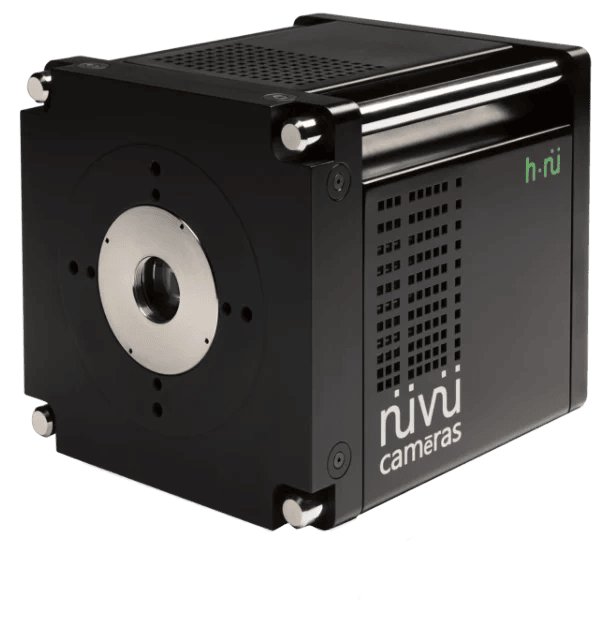
Built for high frame rates Achieve sub-millisecond exposures with continuous frame rates and single-photon sensitivity. Outstanding SNR performances Operation rate up to 1460 fps full frame < 0.004 ē/pixel/frame background noise EM gain up to 5000 Air-cooling down to -60°C The EMCCD camera optimized for speed Frame rates exceeding 1460 fps in full frame Made for high-speed applications such as Adaptive Optics (AO) and neural and cardiac imaging, the HNü 128 camera exceeds expectations, with unmatched sensitivity thanks to Nüvü’s patented electronics. With virtually no noise in each image, this EMCCD enables highly efficient low-flux imaging – allowing faster acquisitions while maintaining superior image quality. Highest quantum efficiency The HNü 128 integrates the high QE (up to 95%) typical to high-end EMCCD detectors. Coupled with Nüvü’s patented electronics for the lowest background noise and the highest EM gain, this HNü 128 camera is ideal for ultra-fast imaging in photon-counting conditions. The HNü 128 EMCCD camera is also available with UV-enhanced detectors or a UV Lumogen® coating for higher quantum efficiency in the UV spectral range. Different models for increased versatility Nüvü offers the HNü 128 in both Gamma and Omega variants to suit different requirements. With a 30 MHz readout speed, the Omega model reaches higher frame rates, while the Gamma model supports slower but more sensitive readout rates. With unmatched performances across the board, pick the best model for your project. Features for faster acquisition - Crop Mode - Fast Kinetics Mode - Time-Delay Integration (TDI) Mode - Multiple Region of Interest (mROI) & ROI Designed for easy integration The user-friendly HNü camera provides many advantages to efficiently bridge the gaps between purchase, setup and discoveries. The HNü camera is a compact and easy-to-use device with a Windows or Linux operating system. To allow quick and easy integration into any system, all standard HNü cameras come with a C-mount optical interface, imperial and metric mechanical holes on the faceplate, and standard holding posts on the sides of the camera. For fast and reliable image data transmission, the HNü camera communication interface are either Gigabit Ethernet or Camera Link. A built-in shutter enhances detector longevity, allows dark frame acquisitions, and is remotely controllable with our software tools for all application requirements. Options available Further customize the camera to your requirements for improved performances in your measurement contexts and increased versatility. A variety of options are available. Darker EMCCD — Less noise The darkest EMCCD cameras are manufactured by Nüvü Camēras. The secret? The CCD Controller for Counting Photons (CCCP), an innovative technology that virtually suppresses clock-induced charges (CIC), and a cooling Peltier unit integrated into an ingenious packaging. The thermoelectrically cooled HNü camera operates between -60 and -90°C with outstanding precision to optimize CIC and dark current to their ground level. The images below illustrate the accumulation of dark current when the shutter is closed. The darker the image, the less noise is present. No pixel leaking, superior image quality At high readout speeds, the electron transfer from one potential well to the next may be incomplete, leaving a few charges behind. Consequently, the leftover electrons artificially increase the brightness of certain pixels, thereby diminishing the overall image quality with the addition of arbitrary blurry spots. However, Nüvü Camēras’ CCCP preserves charge transfer efficiency (CTE), even at low operating temperature and increased EM gain, while decreasing CIC, yielding highly superior image quality. New standard for photon-counting imaging cameras As stated in its name, Nüvü Camēras’ proprietary CCD Controller for Counting Photons was purposely designed for photon-counting imaging. As such, no noise-filtering algorithms are used. The amount of noise generated is simply lower, eliminating the risk of removing genuine photoelectrons. Resorting to arbitrary clocks rather than regular square clocks to shift the electrons through the EMCCD, the CCCP clamps down the generation of clock-induced charges and significantly reduced the detector’s total background noise. Consequently, the EMCCD ability to discriminate single-photon events is considerably increased, and the camera can effectively operate in photon-counting mode as long as the background noise is low. In extreme cases where the expected intensity is about a single photon per pixel per second or even less, the photon counting (PC) mode is the ideal solution to obtain high-quality images. By eliminating the excess noise factor (ENF) and using a statistically significant threshold, pixels are individually analyzed to determine whether or not they truly detected a photon despite various noise sources.
CATEGORY
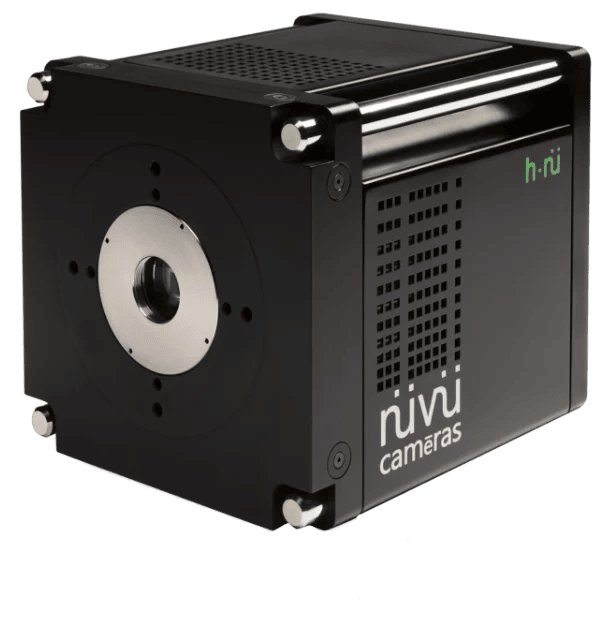
Built for maximum sensitivity The ultimate imaging sensitivity with the lowest noise on the EMCCD market, along with versatile options for all acquisition speeds. Outstanding SNR performaces - Operation rate up to 90 fps full frame - < 0.0009 ē/pixel/frame background noise - EM gain up to 5000 - Air-cooling down to -85°C The EMCCD camera optimized for performance With industry-leading low-light SNR Made for applications requiring the ultimate sensitivity in Space & Defense, Life Sciences, Physics, Industry and many other fields, the HNü 512 camera exceeds expectations, with unmatched sensitivity thanks to Nüvü’s patented electronics. With virtually no noise in each image, this EMCCD enables highly efficient low-flux imaging – allowing faster acquisitions while maintaining superior image quality. Typical spectral response as a function of wavelength, as specified by the EMCCD detector manufacturer Highest quantum efficiency The HNü 512 integrates the high QE (up to 95%) typical to high-end EMCCD detectors. Coupled with Nüvü’s patented electronics for the lowest background noise and the highest EM gain, this HNü 512 camera is ideal for applications requiring the utmost sensitivity in ultra-low light conditions. The HNü 512 EMCCD camera is also available with a Low fringing detector, UV Lumogen coating or a blue enhanced sensor for higher quantum efficiency in the blue and UV spectral region. HNü 512 benefits for photon counting imaging Photon counting performance comparison Thanks to Nüvü’s CCD Controller for Counting Photons, less clock-induced charges (CIC) are generated, the dominant source of noise in low light EMCCD imaging, providing up to 10x less noise than other cameras using the same detector whilst counting at least 15% more genuine photons. mROI on NüPixel Software Features for faster acquisition - Crop Mode - Fast Kinetics Mode - Time-Delay Integration (TDI) Mode - Multiple Region of Interest (mROI) & ROI Built for easy integration The user-friendly HNü camera provides many advantages to efficiently bridge the gaps between purchase, setup and discoveries. The HNü camera is a compact and easy-to-use device with a Windows or Linux operating system. To allow quick and easy integration into any system, all standard HNü cameras come with a C-mount optical interface, imperial and metric mechanical holes on the faceplate, and standard holding posts on the sides of the camera. For fast and reliable image data transmission, the HNü camera communication interface are either Gigabit Ethernet or Camera Link. A built-in shutter enhances detector longevity, allows dark frame acquisitions, and is remotely controllable with our software tools for all application requirements. Options available Further customize the camera to your requirements for improved performances in your measurement contexts and increased versatility. A variety of options available. Fully integrated services NüPixel software Darker EMCCD — Less noise The darkest EMCCD cameras are manufactured by Nüvü Camēras. The secret? The CCD Controller for Counting Photons (CCCP), an innovative technology that virtually suppresses clock-induced charges (CIC), and a cooling Peltier unit integrated into an ingenious packaging. The thermoelectrically cooled HNü camera operates between -60 and -90°C with outstanding precision to optimize CIC and dark current to their ground level. The images below illustrate the accumulation of dark current when the shutter is closed. The darker the image, the less noise is present. With Nüvü Camēras' EMCCD technology Other EMCCD technology Acquisition conditions: -85 °C cooling, 10MHz readout speed, EM gain of 5000 for Nüvü Camēras, and 1000 for other EMCCD manufacturers. No pixel leaking, superior image quality At high readout speeds, the electron transfer from one potential well to the next may be incomplete, leaving a few charges behind. Consequently, the leftover electrons artificially increase the brightness of certain pixels, thereby diminishing the overall image quality with the addition of arbitrary blurry spots. However, Nüvü Camēras’ CCCP preserves charge transfer efficiency (CTE), even at low operating temperature and increased EM gain, while decreasing CIC, yielding highly superior image quality. Nüvü Camēras EMCCD technology Other EMCCD technologies Acquisition conditions: -85 °C cooling, 10MHz readout speed, EM gain of 5000 for Nüvü Camēras, and 1000 for other EMCCDs. New standard for photon-counting imaging cameras As stated in its name, Nüvü Camēras’ proprietary CCD Controller for Counting Photons was purposely designed for photon-counting imaging. As such, no noise-filtering algorithms are used. The amount of noise generated is simply lower, eliminating the risk of removing genuine photoelectrons. Resorting to arbitrary clocks rather than regular square clocks to shift the electrons through the EMCCD, the CCCP clamps down the generation of clock-induced charges and significantly reduced the detector’s total background noise. Consequently, the EMCCD ability to discriminate single-photon events is considerably increased, and the camera can effectively operate in photon-counting mode as long as the background noise is low. In extreme cases where the expected intensity is about a single photon per pixel per second or even less, the photon counting (PC) mode is the ideal solution to obtain high-quality images. By eliminating the excess noise factor (ENF) and using a statistically significant threshold, pixels are individually analyzed to determine whether or not they truly detected a photon despite various noise sources. Displayed below are images of extremely dim light sources — low concentration bioluminescent samples — and illustrate the power of photon-counting imaging in such conditions. All figures are courtesy of the Université de Sherbrooke Hospital Centre. Single 30 seconds acquisition in conventional (CCD) mode. No details are visible where we should have seen several bioluminescent ATP samples. Applying electron multiplication to suppress the readout noise reveals the bioluminescent ATP samples in 5 seconds. As such, all six ATP concentrations are detectable with SNR values varying from 1.9 to 14.1 (or, equivalently, 2.8 dB to 11.5 dB). Photon counting mode with an EMCCD increases the contrast of all ATP samples by suppressing the excess noise factor (ENF), thus allowing considerable improvements in image quality. The SNR increases from 6.6 to 51.3 (equivalent to a range of 8.2 dB to 17.1 dB).
CATEGORY
Built for resolution Acquire images with a large field of view and single-photon sensitivity, from standard video rates to complex acquisition modes tailored to your applications. Outstanding SNR performances Operation rate up to 25 fps full frame < 0.0015 ē/pixel/frame background noise EM gain up to 5000 Air-cooling down to -80°C The EMCCD camera optimized for wide field of view With industry-leading low light SNR Made for applications requiring a large field of view along with photon counting capabilities in the fields of Space & Defense, Life Science, Physics, Industry and more. The HNü 1024 camera exceeds expectations, with unmatched sensitivity thanks to Nüvü’s patented electronics. With virtually no noise in each image, this EMCCD enables highly efficient low-flux imaging – allowing faster acquisitions while maintaining superior image quality. Typical spectral response as a function of wavelength, as specified by the EMCCD detector manufacturer Highest quantum efficiency The HNü 1024 integrates the high QE (up to 95%) typical to high-end EMCCD detectors. Coupled with Nüvü’s patented electronics for the lowest background noise and the highest EM gain, this HNü 1024 camera is ideal for large field-of-view measurements in ultra-low light conditions. The HNü 1024 EMCCD camera is also available with a Low fringing detector, UV Lumogen coating or a blue enhanced sensor for higher quantum efficiency in the blue and UV spectral region. Now with multiple region of interest (mROI) feature Instead of imaging an object with the entire EMCCD detector area, a user can set multiple smaller portions of the detector to perform the same task faster. Selecting a particular region of interest (ROI) or multiple ROI (mROI) is a trade-off that offers higher frame rates at the cost of a reduced field of view. A ROI is subject to the same limitations as binning, namely that the speed gain occurs with smaller vertical regions but is restricted by the horizontal pixel rate. Features for faster acquisition - Crop Mode - Fast Kinetics Mode - Time-Delay Integration (TDI) Mode - Multiple Region of Interest (mROI) & ROI Designed for easy integration The user-friendly HNü camera provides many advantages to efficiently bridge the gaps between purchase, setup and discoveries. The HNü camera is a compact and easy-to-use device with a Windows or Linux operating system. To allow quick and easy integration into any system, all standard HNü cameras come with a C-mount optical interface, imperial and metric mechanical holes on the faceplate, and standard holding posts on the sides of the camera. For fast and reliable image data transmission, the HNü camera communication interface are either Gigabit Ethernet or Camera Link. A built-in shutter enhances detector longevity, allows dark frame acquisitions, and is remotely controllable with our software tools for all application requirements. Options available Further customize the camera to your requirements for improved performances in your measurement contexts and increased versatility. A variety of options are available. Darker EMCCD — Less noise The darkest EMCCD cameras are manufactured by Nüvü Camēras. The secret? The CCD Controller for Counting Photons (CCCP), an innovative technology that virtually suppresses clock-induced charges (CIC), and a cooling Peltier unit integrated into an ingenious packaging. The thermoelectrically cooled HNü camera operates between -60 and -90°C with outstanding precision to optimize CIC and dark current to their ground level. The images below illustrate the accumulation of dark current when the shutter is closed. The darker the image, the less noise is present. No pixel leaking, superior image quality At high readout speeds, the electron transfer from one potential well to the next may be incomplete, leaving a few charges behind. Consequently, the leftover electrons artificially increase the brightness of certain pixels, thereby diminishing the overall image quality with the addition of arbitrary blurry spots. However, Nüvü Camēras’ CCCP preserves charge transfer efficiency (CTE), even at low operating temperature and increased EM gain, while decreasing CIC, yielding highly superior image quality. New standard for photon-counting imaging cameras As stated in its name, Nüvü Camēras’ proprietary CCD Controller for Counting Photons was purposely designed for photon-counting imaging. As such, no noise-filtering algorithms are used. The amount of noise generated is simply lower, eliminating the risk of removing genuine photoelectrons. Resorting to arbitrary clocks rather than regular square clocks to shift the electrons through the EMCCD, the CCCP clamps down the generation of clock-induced charges and significantly reduced the detector’s total background noise. Consequently, the EMCCD ability to discriminate single-photon events is considerably increased, and the camera can effectively operate in photon-counting mode as long as the background noise is low. In extreme cases where the expected intensity is about a single photon per pixel per second or even less, the photon counting (PC) mode is the ideal solution to obtain high-quality images. By eliminating the excess noise factor (ENF) and using a statistically significant threshold, pixels are individually analyzed to determine whether or not they truly detected a photon despite various noise sources.
CATEGORY
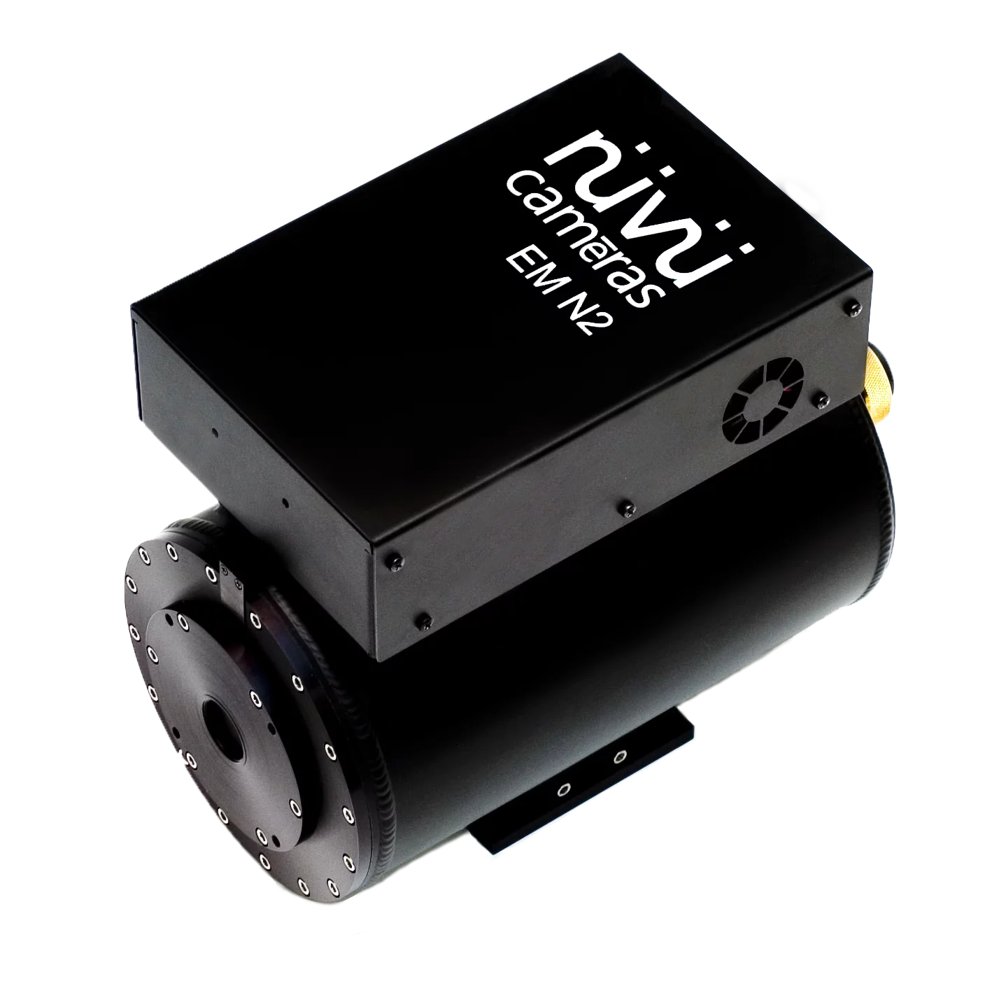
Built for long exposure times A highly customizable platform for CCD & EMCCD sensors, powering your project with Nüvü's signature electronics. Outstanding SNR performances - Cooled down to –110ºC for the longest exposures - Down to < 0.001 ē/pixel/frame background noise - EM gain up to 5000 - Up to 10 MHz readout for fast acquisitions The liquid nitrogen-cooled EMCCD & CCD camera With the highest signal-to-noise ratio for photon-counting imaging applications Thanks to cooling down to -110°C, the EM N2 camera line generates the least amount of dark current. Combined with Nüvü's patented CCCP technology to significantly reduce clock-induced charges, this EMCCD camera provides unmatched sensitivity for long exposures. The highly personalized EM N2 camera supports 3 standard EMCCD detector sizes (128, 512 and 1024) in addition to custom sizes CCD and EMCCD detectors for specific requirements. Highest quantum efficiency The EMN2 camera line is available with scientific-grade back-illuminated EMCCD detectors offering a high QE (up to 95%). Additionally, it supports all CCD and EMCCD sensor formats provided by high-end detector manufacturers. Midband coatings are available for all standard EM N2 models. EM N2 128 The EM N2 128 camera is also available with UV-enhanced detectors or a UV Lumogen® coating for higher quantum efficiency in the UV spectral range. EM N2 512 & EM N2 1024 The EM N2 512 & EM N2 1024 cameras are also available with a Low fringing detector, UV Lumogen coating or a Blue Enhanced sensor for higher quantum efficiency in the blue and UV spectral region. What cooling temperature? The EM N2 liquid nitrogen cooling system offers flexible means to optimize sensors' performances: the ability to cool all the way down to -110 °C allows users to attain their desired balance between dark current and charge transfer efficiency (CTE). The very best image quality can be attained via adjustable cooling temperature with any high sensitivity sensor — even those of non-standard or custom size ratios. Features for faster acquisition - Binning - Crop Mode - Variety of pixel rates - Multiple Region of Interest (mROI) & ROI Designed for easy integration The user-friendly EM N2 provides many advantages to efficiently bridge the gaps between purchase, setup, discoveries and publications. The EM N2 camera is an easy-to-use device made for Windows or Linux operating systems. To allow quick and easy integration into a system, the EM N2 camera comes with a C-mount optical interface and mounting slots. For fast and reliable image data transmission, the EM N2 camera offers data transfer through either Gigabit Ethernet or Camera Link. A built-in shutter enhances detector longevity, allows dark frame acquisitions, and is remotely controllable with our software for all application requirements. Options available Further customize the camera to your requirements for improved performances in your measurement contexts and increased versatility. A variety of options are available. Fully integrated services NüPixel Software Software tool NüPixel control, acquisition and analysis software Software development kit (SDK) for customizable programming Windows & Linux compatibility Various drivers available for commercial software Worldwide professional customer support Support In addition to an intuitive user manual for the easy installation and use of our products, Nüvü Camēras offers international on-site training as well as complete consulting services. Our team's passion is the development of the ultra low-light imaging field; as such, we provide a variety of services to efficiently minimize the delay between purchase and discoveries. Warranty Nüvü Camēras is a Canadian company specialized in designing and manufacturing novel EMCCD cameras for fields where the drive for cutting edge instrumentation propels innovation. We improve imaging performance for a number of fields including biomedical research, astronomy, photonics and more. As such, our cameras benefit from extended warranty policies. Basic product warranty includes 1-year on all parts and labor (subject to the terms and conditions expressed in the respective products' user manuals). Extended warranty options also available.
CATEGORY
