By Nanoxo
ORGANOMETALLIC DERIVED ZINC OXIDE QUANTUM DOTS INKS (OM ZnO QDs) FOR NOVEL ELECTRONICS - The only technology for pure low-temperature processed non-passivated ZnO layer - Electronic grade ZnO free from any organic stabilizers, salt, and metal impurities - Lack of bulky organic coating and organic stabilizing molecules – excellent electrical contact - Superior nanocrystal quality in comparison to sol-gel derived ZnO QDs - Superior monodispersed nanocolloidal solution – no agglomeration in time - No surface defects – improved charge separation and stability - 2x higher conductivity than sol-gel ZnO - Significant improvement in efficiency and stability of PV-based cells Potential applications - Electron Transfer Layer in PVs - Electron Transfer Layer in displays (QLED, OLED) - CMOS - Chemical sensors - Transistors for flexible electronics - Supercapacitors Nanoxo novel Zinc Oxide Quantum Dots INKS are available at https://nanoxo.eu/shop/ For customized solutions, or for special applications please inquire at: company@nanoxo.eu
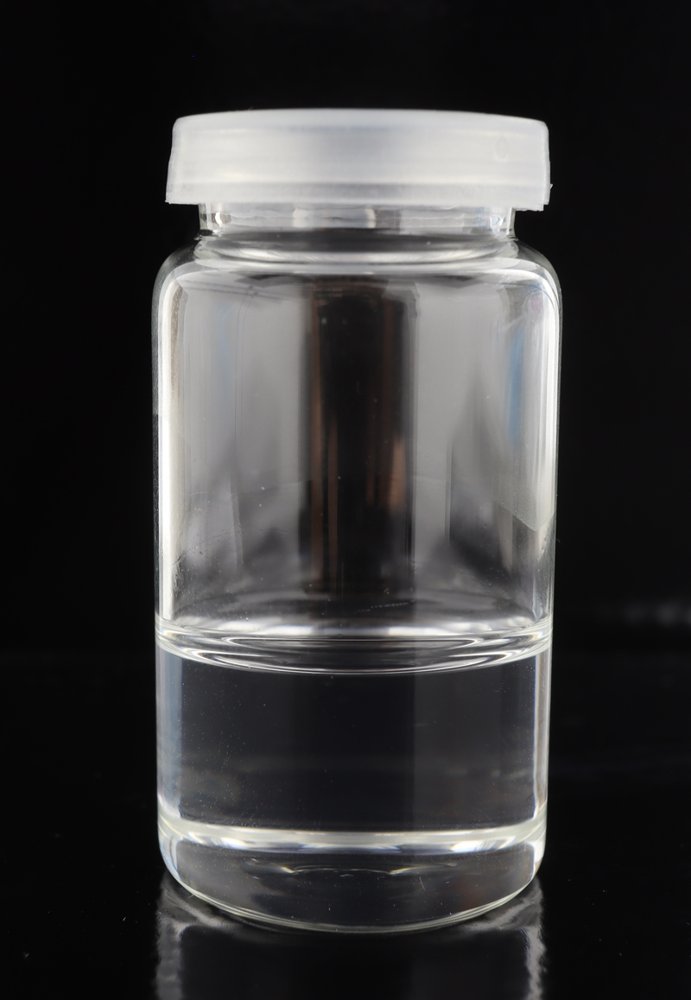
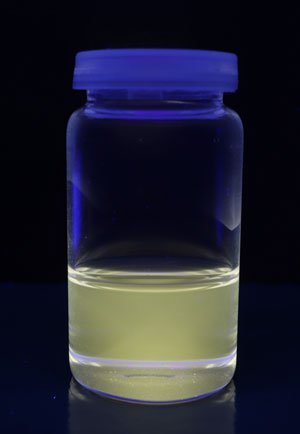
Zinc Oxide Quantum Dots-based ink (ZnO-DMSO ink) Patented nanocolloidal dispersion of ZnO QDs in easily removable solvent molecules. Free from any organic stabilizing molecules and salt impurities allowing to cast pure ZnO thin films featuring no agglomeration, high crystallinity, stability, excellent electrical contact, and a low-density defects of ZnO. Recommended for fabrication of low-temperature processed non-passivated ETL layers in state-of-the-art devices with improved performance and enhanced operational stability. Monodispersed, narrow size distribution, solution-stable, bright yellow luminescence upon excitation with UV. - Superior nanocrystal quality in comparison to sol-gel derived ZnO QDs - Superior nanocolloidal solution – no agglomeration in time - Lack of bulky organic coating and organic stabilizing molecules – excellent electrical contact - No surface defects – improved charge separation and stability - High-purity ZnO Nanoparticles without any added process metal impurities General properties Appearance Transparent nanocolloid Excitation 330 nm ± 5 nm Emission (max.) 530 nm ± 5 nm FWHM 135 nm ± 5 nm Core size 2 – 10 nm Solubility Colloidal solution in DMSO Concentration 5 mg/ml CAS 1314-13-2 Storage conditions Room temperature, to be used in 3 months after opening Additional information Applications Photovoltaics (perovskites and organics), OLED, QLED Sensors Printed electronics Catalyst Functions Electron transfer Electron injection Hole blocking Sensing material Typical mean size ~5 nm Methods of deposition Spin coating Dip coating Spray Coating Ink jet Post-deposition treatment Thermal heating at 150°C to remove DMSO Purity Standard purity Electronic purity upon request Chemical compatibility All the absorbers and emitters including perovskites. References: - Chavan, R. D., Wolska‐Pietkiewicz, M., Prochowicz, D., Jędrzejewska, M., Tavakoli, M. M., Yadav, P., Hong, C., Lewiński, J. (2022). Organic Ligand‐Free ZnO Quantum Dots for Efficient and Stable Perovskite Solar Cells. Advanced Functional Materials, 2205909. https://doi.org/10.1002/adfm.202205909 - Prochowicz, D., Tavakoli, M. M., Wolska-Pietkiewicz, M., Jędrzejewska, M., Trivedi, S., Kumar, M., Zakeeruddin, M., Lewiński, J., Graetzel, M., Yadav, P. (2020). Suppressing recombination in perovskite solar cells via surface engineering of TiO2 ETL. Solar Energy, 197(December 2019), 50–57. https://doi.org/10.1016/j.solener.2019.12.070 - Lee, D., Wolska-Pietkiewicz, M., Badoni, S., Grala, A., Lewiński, J., & De Paëpe, G. (2019). Disclosing Interfaces of ZnO Nanocrystals Using Dynamic Nuclear Polarization: Sol-Gel versus Organometallic Approach. Angewandte Chemie – International Edition, 58(48), 17163–17168. https://doi.org/10.1002/anie.201906726 - Grala, A., Wolska-Pietkiewicz, M., Danowski, W., Wróbel, Z., Grzonka, J., & Lewiński, J. (2016). ‘Clickable’ ZnO nanocrystals: the superiority of a novel organometallic approach over the inorganic sol–gel procedure. Chem. Commun., 52(46), 7340–7343. https://doi.org/10.1039/C6CC01430E PRODUCT INTENDED FOR RESEARCH AND DEVELOPMENT PURPOSES ONLY. NOT INTENDED FOR ANY ANIMAL OR HUMAN THERAPEUTIC OR DIAGNOSTIC USE. € 250.00
CATEGORY

High-quality Uncoated Zinc Oxide Quantum Dots for Electronics - Superior nanocrystal quality in comparison to sol-gel derived ZnO QDs - Well – soluble in DMSO – no agglomeration in time - Lack of bulky organic coating – excellent electrical contact - No surface defects – improved charge separation and stability - High purity ZnO nanoparticles without any added process metal impurities General properties Appearance White, air-stable powder Excitation 330 nm ± 5 nm Emission (max.) 530 nm ± 5 nm FWHM 135 nm ± 5 nm Core size 2 – 10 nm Solubility Colloidal solution in DMSO Additional information Applications Photovoltaics (perovskites and organics), OLED, QLED Sensors Printed electronics Catalyst Functions Electron transfer Electron injection Hole blocking Sensing material Typical mean size ~5 nm Methods of deposition Spin coating Dip coating Spray Coating Ink jet Post-deposition treatment Thermal heating at 70°C to remove DMSO Purity Standard purity Electronic purity upon request Chemical compatibility All the absorbers and emitters including perovskites. CAS 1314-13-2 References: - Prochowicz, D., Tavakoli, M. M., Wolska-Pietkiewicz, M., Jędrzejewska, M., Trivedi, S., Kumar, M., Zakeeruddin, M., Lewiński, J., Graetzel, M., Yadav, P. (2020). Suppressing recombination in perovskite solar cells via surface engineering of TiO2 ETL. Solar Energy, 197(December 2019), 50–57. https://doi.org/10.1016/j.solener.2019.12.070 - Lee, D., Wolska-Pietkiewicz, M., Badoni, S., Grala, A., Lewiński, J., & De Paëpe, G. (2019). Disclosing Interfaces of ZnO Nanocrystals Using Dynamic Nuclear Polarization: Sol-Gel versus Organometallic Approach. Angewandte Chemie – International Edition, 58(48), 17163–17168. https://doi.org/10.1002/anie.201906726 - Grala, A., Wolska-Pietkiewicz, M., Danowski, W., Wróbel, Z., Grzonka, J., & Lewiński, J. (2016). ‘Clickable’ ZnO nanocrystals: the superiority of a novel organometallic approach over the inorganic sol–gel procedure. Chem. Commun., 52(46), 7340–7343. https://doi.org/10.1039/C6CC01430E PRODUCT INTENDED FOR RESEARCH AND DEVELOPMENT PURPOSES ONLY. NOT INTENDED FOR ANY ANIMAL OR HUMAN THERAPEUTIC OR DIAGNOSTIC USE.
CATEGORY
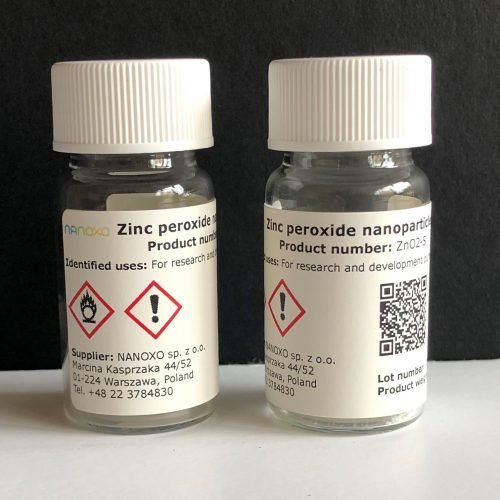
Zinc Dioxide Zinc Peroxide (ZnO2) is a compound possessing very strong oxidizing properties and the ability to generate free radicals and other reactive oxygen species. Nowadays, the material is mainly used in bulk in many areas like rubber and polymer industry, cosmetics, pyrotechnics, or organic synthesis. Nanoxo new patent-pending technology offers a broad range of products based on high-quality zinc peroxide nanoparticles with an average diameter below 5 nm and rationally designed and well-specified characteristics. Nanoxo zinc peroxide (ZnO2) nanostructures are superior to other products available on the market. The small size and well-defined structure of nanoparticles offers considerably better performance and high stability in many potential applications like: - Plastics processing - Material engineering (e.g. antibacterial additives) - Pyrotechnics mixtures - Photocatalyst - Cosmetics - Medicine (e.g. anticancer, wound healing, antibacterial agent) - Electronics - Zinc oxide precursor - Basic scientific research of new nanomaterials The novel organometallic approach developed by Nanoxo enables the manufacturing of tailored products that possess unique properties: - Heavy-metal free composition - Very high purity (electronic purity on request) - Monodispersed nanoparticles with typical average size between 1-5 nm - Possibility of custom functionalization - Hydrophilic or hydrophobic - Long term stability (100% ZnO2 content) - High specific surface area - Scalability High flexibility of the technology allows to improve end-user processes and products by rational design of new materials adapted to specific requirements. Nanoxo novel zinc peroxide (ZnO2) nanostructures are available at https://nanoxo.eu/shop/
CATEGORY
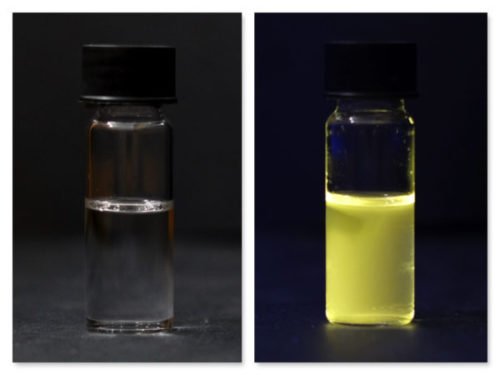
NANOXO Zinc Oxide quantum dots (ZnO QDs) are of unprecedented quality. They have significantly better chemical and physical properties than their counterparts currently being produced by the most popular sol-gel method. Organometallic approach The organometallic approach developed by Nanoxo allows for manufacturing defect-free ZnO QDs with novel physicochemical properties such as long-term stability, monodispersity, a relatively high quantum efficiency, record-long luminescence lifetimes and EPR silence under standard conditions. The unique features of the tightly coordinated and impermeable organic shells stabilizing the surface make the new ZnO quantum dots resistant to both chemical and biological environments - True, non-toxic, bio-safe - UV absorption up to 400 nm (depending on product version) - Luminescence lifetime up to µseconds - Tunable color emission (480 – 570 nm) - High quantum yield and brightness - Size tunable (2 – 10 nm) - Possibility of attaching custom chemical groups for further coupling (click chemistry) - Hydrophilic or hydrophobic (dependent on product version) - Long term stability - Do not aggregate into clusters - Different shapes - Scalability Nanoxo novel Zinc Oxide Quantum Dots are available at https://nanoxo.eu/shop/ For customized solutions - ZnO Qdots in various solvents, polymers, paints or varnishes, or for special applications please inquire at: company@nanoxo.eu
CATEGORY
