
HRL Laboratories’ 7A77 aluminum alloy and feedstock powder for additive manufacturing has been officially authorized for use in Formula One race cars. HRL’s 7A77 High-Strength Aluminum Alloy Added to List of Allowable Materials for Construction of Formula One Cars. HRL Laboratories, LLC, achieved another milestone for its 7A77 aluminum alloy and feedstock powder designed specifically for additive manufacturing when the material has been officially authorized for parts on Formula One race cars. “Our printable aluminum powder has been added to the list of acceptable materials for any component on a Formula One car,” said Darby LaPlant, HRL materials scientist. “This step is further validation of our 3D-printed high-strength alloy. We’re excited to be working with Formula One to bring 7A77 to an incredibly demanding application.” Formula One racing is known for always pushing the limits of what is possible and additive manufacturing gives them a mechanism to do that by designing fully optimized structures. Now they can use our 7A77 alloy with a yield strength of 530 MPa, the highest strength of any additive aluminum alloy. HRL’s new class of 3D-printable high-strength aluminum alloys was based on historically high-strength and low-cost wrought alloy systems such as Al-7075. HRL is working on designing additional alloys for 3D printing.
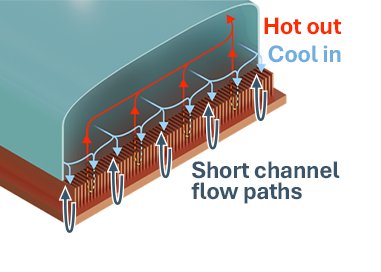
A revolutionary microprocessor cooling technology for data centers, Low-Chill™, is available from HRL Laboratories immediately for demonstrations and commercialization opportunities. Developed under co-investment with the ARPA-E COOLERCHIPS program, our groundbreaking direct liquid cooling approach enables future high power GPUs and megawatt rack densities in modern data centers without the cost and complexity of two-phase cooling systems while supporting low-water usage cooling architectures. The Low-Chill™ architecture has undergone long-duration testing, demonstrating durable, stable thermal performance with minimal degradation over time. An innovative approach A novel cooling block architecture that uses a 3D-printed manifold to distribute coolant through hundreds of short flow paths directly over the processor. By delivering cold coolant uniformly across the die, the design avoids the long flow channels and friction losses that constrain conventional cooling blocks. With this approach, HRL reduced the state-of-the-art thermal interface resistance to 8.2°C/kW. - Extends single-phase liquid cooling well into the next decade - Data centers can avoid higher-cost, more complex two-phase cooling which requires vaporizing and re-condensing the cooling fluid HRL's highly effective Low-Chill™ technology serves as a drop-in replacement for existing data center cooling systems. All parts are commercially available or can be produced at scale with current 3D printing technology. The Low-Chill™ cooling block architecture can be produced in a range of materials, including polymers and metals, while delivering consistent thermal performance across material choices. Low-Chill™ direct liquid cooling - Ultra-low < 8.2°C/kW thermal resistance - Ultra-low < 1% IT power for pumping - Ultra-low < 1 psi pressure drop This Low-Chill™ approach extends single-phase cooling to MW racks using a 3D-printed manifold to enable low thermal resistance and low-pressure drop. Technology - Optimizes readily for any chip size or power - MW racks ready now with single-phase direct liquid cooling - Cost equivalent to existing liquid cooling - Enables elevated temperature cooling architectures compatible with dry air cooling and reduced water consumption Implementation - High-volume supply chain ready to support components - Validated 3D printing suppliers for the manifold; all other components are standard - Existing and forward-looking comprehensive IP protections Designed for data centers HRL's single-phase water-cooling solution can cool 3000W per die vs 2100W per die today at <1% IT power. This applies broadly to future generations of NVIDIA and AMD GPUs. The novel cooling block enables 40% higher power densities or 10X lower pumping power compared to current state-of-the-art. This enables more AI Tokens per Watt (TPW). Also, the solution is compatible with current commercial-off-the-shelf (COTS) direct liquid cooling components. Conserving water Data center water consumption is driven primarily by heat rejection rather than on-chip cooling. When paired with hot-water coolant loops and dry air coolers, HRL's Low-Chill™ approach can reduce water use by eliminating evaporative cooling. Results depend on the facility's heat rejection architecture. Compare against current cooling blocks Current cooling technology relies on long intra-channel flow paths along hot fins. - Large friction-induced pressure loss = limits efficiency - Long sections of "fully developed" flow = diminishes thermal performance - Difference in coolant temperature (center to periphery) = less cooling over the chip HRL leverages hundreds of short flow loops, well beyond even the most advanced and intricate conventionally machined manifolds, resulting in low-pressure drop and uniform cold coolant. Performance data Comparison notes: - Increases feasible rack power density versus commercial technologies - Cools 1KW with <5W of pump power Comparison notes: - Short flow paths result in much lower pressure drop - Lower pressure drop yields significantly reduced pumping power HRL is seeking partners to incorporate this technology into next generation data center cooling. Please reach out to understand more about the technology and explore partnering opportunities.
CATEGORY
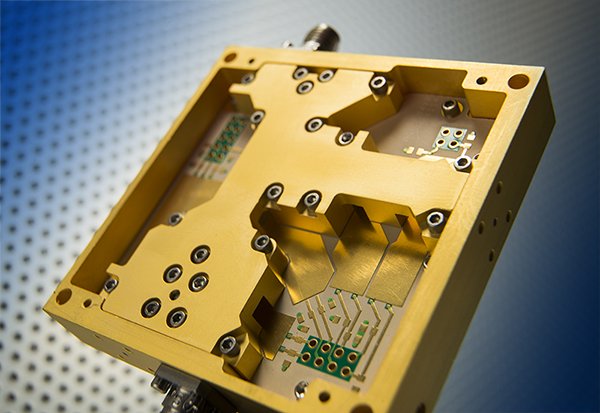
HRL’s commercial GaN MMIC offerings include a 94 GHz narrow-band PA and a broadband 70–105 GHz PA designed for demanding E-band and W-band applications. Both products are fabricated in HRL’s T3L GaN technology, a state-of-the-art mm-wave GaN process delivering exceptional power density, efficiency, and reliability at frequencies at W-band. We are actively expanding our T3L-based product family with upcoming high-power amplifiers, LNAs, and advanced mmW components. GaN Power Amplifiers Part | Datasheet | Function | Frequency (GHz) | Psat (dBm) | Lin Gain (dB) | DATA | CAD FILES - BAL-WPA-T3L (New) | PDF | Broadband Power Amplifier | 80-100 | 23 | 20 | E-mail for specs | E-mail for specs - G94-PA-T3L (New) | PDF | Power Amplifier | 90-96 | 27 | 14 | E-mail for specs | E-mail for specs - HPA94-T3L | Coming soon | High Power Amplifier | 90-96 | 30 | Coming soon… | E-mail for specs | E-mail for specs Items are subject to U.S. Government export control laws and regulations including 15 CFR Parts 730–774 (Export Administration Regulations) and may require a license for export, re-export or retransfer.
CATEGORY
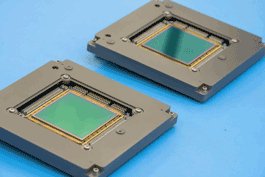
A variety of Focal plane array (FPA) sizes to meet customer needs. 4Kx4K "Global Eye" IR Focal Plane Module is a hybrid IR detector and ROIC in small format module product. Key applications include - Large-format space instruments, including detection, track and custody - Airborne IDCA systems - Ground/ocean-based threat assessment - Open or sealed system compatible Large-format space instruments, including detection, track and custody ROIC Specifications: 4K Parameter | Value Optical Format | 4K x 4K Pixel Size | 10μm Detector Specifications: 4K GaAs Substrate III-V pBn Detector | MWIR | SW-MWIR | SWIR Wavelength (μm) | 3.0 - 5.2 | 2.5 – 5.2 | 2.0 – 3.4 12-month lead-time and priced under $1.0M.
CATEGORY
